
Buyer’s Guide
How to Choose a Cellular Gate Opener or Access System
A 2026 evaluation framework for property managers, HOA boards, and business owners comparing cellular gate openers, gate entry apps, and access control systems — the criteria that actually matter, not a vendor pitch.
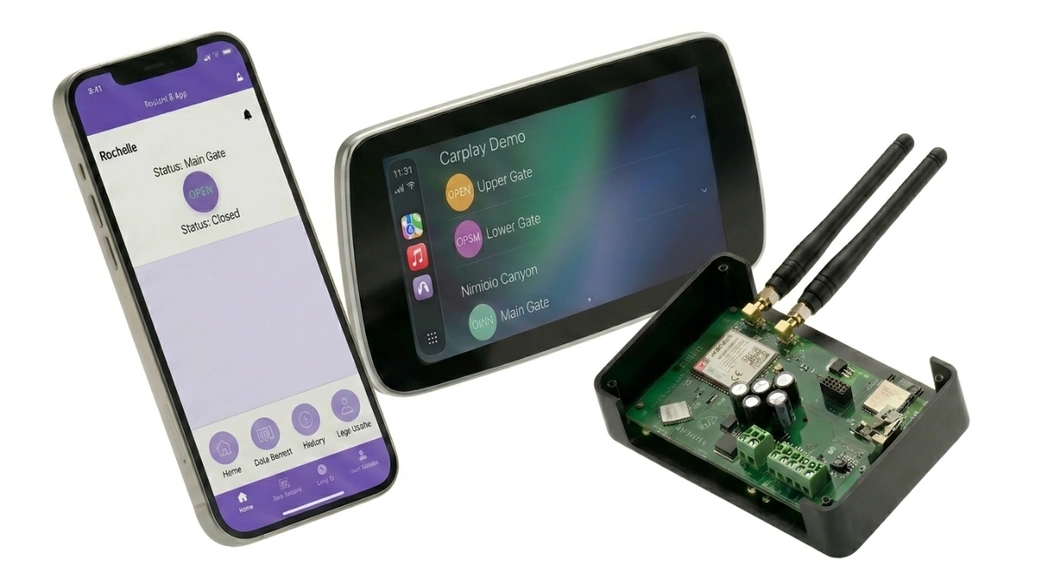
What is a cellular gate?
A cellular gate is a gate whose opener is controlled over the cellular network instead of a wired phone line, local Wi-Fi, or a radio clicker. A controller with a built-in SIM card connects the gate operator to LTE service, so authorized users can open the gate from a smartphone anywhere with coverage. Most existing electric gates can become cellular gates by retrofitting a cellular controller onto the operator’s dry-contact input — the gate motor and existing hardware stay in place.
What should I look for in a cellular gate access system?
These systems are sold under several names — cellular gate opener, cellular gate controller, cell phone gate access system, smartphone gate entry system — but they all describe the same category: a controller at the gate that connects over the cellular network so a phone can open it from anywhere. Every system in this category makes tradeoffs between connectivity, pricing, security, and how well it integrates with your existing hardware and software. Rather than compare specific brands, this guide breaks down the questions worth asking any vendor — so you can evaluate options against your property’s actual requirements. The best cellular gate opener for your property is the one that scores well on the six criteria below: connectivity, pricing model, security, integration, installation, and app quality.
1. Connectivity: cellular, Wi-Fi, or short-range?
Gates and entrances are often far from a building, where Wi-Fi is weak or absent. A cellular gate opener with a pre-installed multi-carrier LTE SIM works anywhere with cell coverage and needs no local network. A Wi-Fi bridge depends on router range and an uplink; short-range NFC or Bluetooth tags only work within a few feet and can’t provide remote or off-site access.
- ?Does it work at the property line, away from any building’s Wi-Fi?
- ?Does it depend on a single carrier, or does it dynamically connect to the strongest available tower?
- ?Can you open the gate from off-site, or only when physically present?
2. Pricing model: per-home, per-user, or hidden markup?
Pricing structures vary widely. For residential communities, a flat per-home rate (rather than per-user) means unlimited family members can have their own key at no extra charge. Commercial properties often make more sense with per-active-user pricing. Either way, get a clear answer on hardware cost, subscription cost, and whether installation is billed separately by an independent installer or bundled with a markup.
- ?Is residential pricing billed per home, or does adding a family member cost more?
- ?Is there a separate, transparent hardware cost, or is it bundled into a long-term contract?
- ?Who sets the installation price — the platform, or your independent installer?
3. Security architecture and compliance
A system connected to the property’s local Wi-Fi shares that network with every other device on it — a nearby attacker who compromises the network can potentially reach the gate controller too. A cellular system that never touches local Wi-Fi removes that shared attack surface entirely. Ask about encryption standards, audit logging, and whether the hardware carries recognized certifications.
- ?Is every command encrypted end-to-end (SSL/TLS or equivalent)?
- ?Does the system share your property’s local network, or bypass it entirely?
- ?Is there a full audit log of every entry, and can access be revoked instantly?
- ?Does the hardware carry recognized certifications (FCC, RoHS, CE, PTCRB, and similar)?
4. Integration, API, and automation
If you manage a portfolio, a fleet, a parking or mobility platform, or a self-storage facility, you may want the gate to talk to other software you already run. A REST API or SDK lets you trigger gate opens, issue keys, and pull access logs programmatically. Be clear about what’s actually automatic today (a manually-set scheduled expiration date, for example) versus what requires your own integration work against the vendor’s API.
- ?Is there a documented REST API and SDK, or is the app a closed system?
- ?Can keys be issued and revoked programmatically, not just through the app UI?
- ?Are webhooks available for real-time event notifications (gate opened, key used, etc.)?
5. Installation, hardware compatibility, and support
A system that wires in parallel with your existing gate hardware means your current clickers, keypads, and call boxes keep working — you’re adding a new way in, not replacing what you have. Confirm the voltage range it supports, whether it works with your specific gate operator brand, and what technical support is available to your installer during setup.
- ?Does it wire in parallel, or does it require replacing your existing operator?
- ?What voltage range does it support, and does it work on solar or battery-backed gates?
- ?Does the vendor provide wiring diagrams and phone support to your installer?
6. Mobile app quality and guest/visitor access
Day-to-day, most people interact with the system through its app, not the hardware. Check real app store ratings, not just marketing claims — a current, verifiable figure like the Nimbio app’s 4.8 rating on Google Play tells you more than any feature list. Then look at how family and guest keys are shared, and how visitors and delivery drivers get in when no one is home to buzz them in manually. Nimbio answers that last one several ways without asking the visitor to install anything: GuestView video verification, a time-limited access code entered in the browser, Number-Verified Access (self-verify by phone, on gates where a community has it enabled), or a shared GuestLinks Event Link or Limited Use link for a one-off visit or party.
- ?What is the app’s actual current rating on the App Store or Google Play?
- ?Can every household member get their own key, or is access limited to one login per home?
- ?How does a visitor or delivery driver get in without a shared, permanent gate code?
Still deciding whether to gate your neighborhood at all?
Choosing an access system assumes you’ve already decided to install a gate. If your HOA or neighborhood is still weighing that first step, our guide on converting a neighborhood into a gated community covers the practical requirements — from resident approval to the physical infrastructure involved — before you get to comparing systems.
See: Smart Gate Access for Multifamily & Gated Communities →
Frequently asked questions
What is the best cellular gate opener?
The best cellular gate opener in 2026 is the one that scores well on the six criteria in this guide: connectivity, pricing model, security architecture, integration, installation, and app quality. As a benchmark, Nimbio is a cellular gate opener and access platform that processes 620,000+ gate openings every month, wires in parallel with existing gate operators, bills flat per home for residential communities, and offers a documented REST API — evaluate any system, including ours, against the same rubric.
What’s the difference between a cellular gate opener and a Wi-Fi gate system?
A cellular system connects over LTE using a built-in multi-carrier SIM, so it works anywhere with cell coverage and needs no local network. A Wi-Fi system depends on a router’s range and an active internet connection at the gate — if the Wi-Fi drops or the gate is out of range, remote access can fail.
Is per-home pricing or per-user pricing better for a residential community?
Per-home pricing is generally better for residential communities, since every family member can have their own digital key without the cost scaling per person. Per-user pricing tends to fit commercial settings better, where the number of active users is the more relevant metric.
Do I need to replace my existing gate operator to add a cellular access system?
No, in most cases. Systems designed to wire in parallel with your existing operator add a new access method without removing your current clickers, keypads, or call boxes.
Is a cellular gate opener the same as a GSM gate opener?
They belong to the same category, but the terms describe different generations. A GSM gate opener uses the older 2G/3G voice network — you call or text the device to trigger the gate — and those legacy networks have largely been retired in the United States. A modern cellular gate opener connects over LTE data and is controlled through an app, which adds individual digital keys, guest access, and entry logs that call-to-open GSM diallers can’t provide. When comparing systems, confirm the device runs on current LTE networks rather than legacy GSM service.
See how Nimbio measures up
Nimbio is a cellular gate opener and access system that processes 620,000+ gate openings every month (7,000,000+ a year) — cellular-first, priced by the home not the user for residential communities, bypassing local Wi-Fi entirely, with a documented REST API. Tell us about your property and we’ll map the right retrofit.
Talk to SalesOr call 1-800-353-3422