A tenant says a package vanished, a carrier says the box was secured, and a board member asks who still has the mailbox master key. That's the moment many communities realize mail access was never treated like a real access-control system, it was treated like a housekeeping detail.
For property managers, HOA boards, and security installers, the phrase master key mailbox sounds simple until a missing key exposes an entire mail bank. The problem isn't just lost mail, it's the lack of audit trails, unclear ownership, and access rules that many people only learn after an incident.
Table of Contents
- What Is a Master Key Mailbox System
- Who Controls Master Keys and Why It Matters
- The Security Risks of Shared Master Keys
- How Modern Mailbox Lock Engineering Works
- Best Practices for Securing Mail Access
- Digital Alternatives to Traditional Master Keys
What Is a Master Key Mailbox System
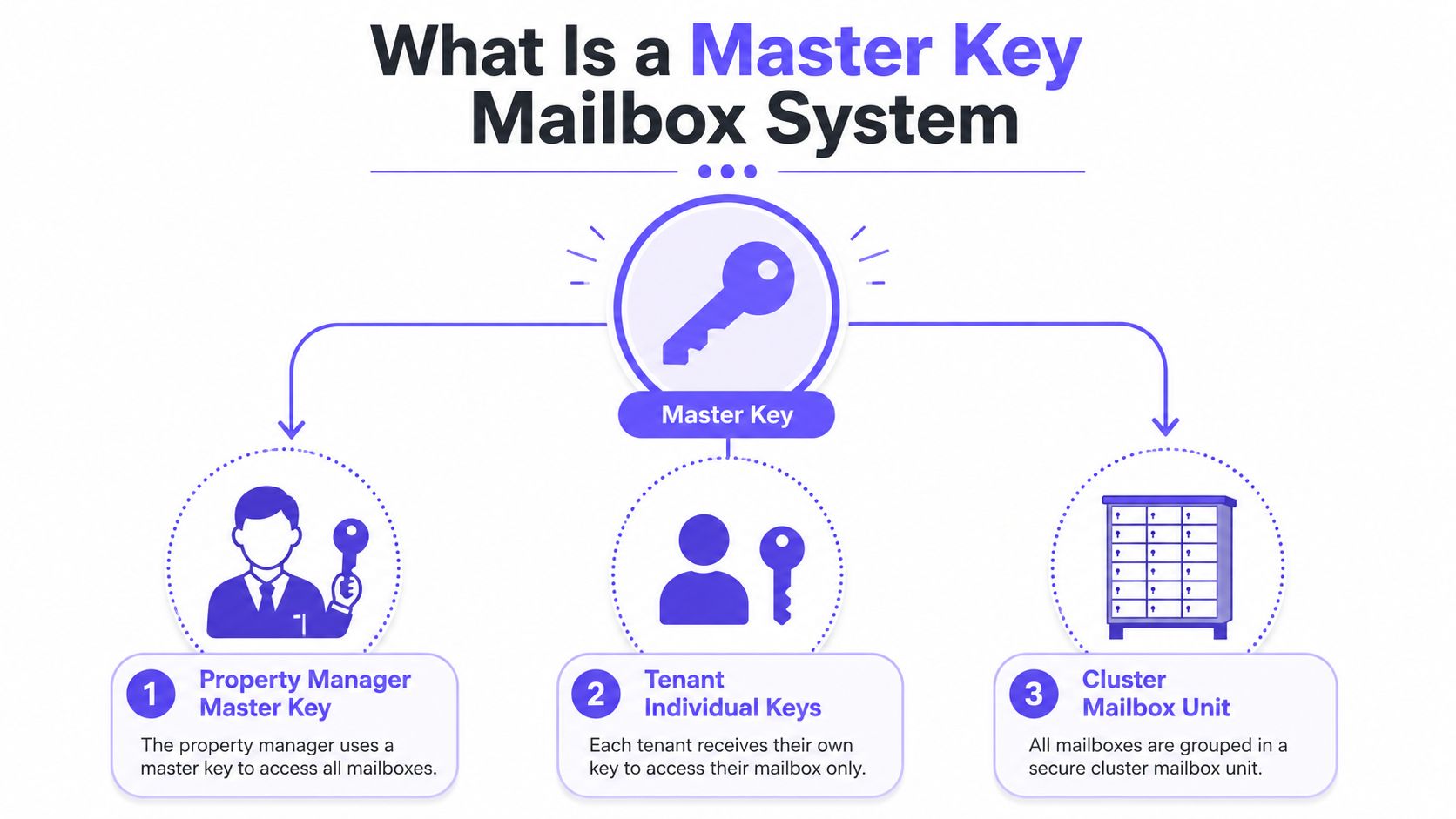
A master key mailbox system is a mail access setup where a single carrier key can open secured mailbox hardware used across a property or route. In the U.S., that key is commonly called an arrow key, and it's part of a national mailing standard that grew out of early mailbox standardization in the late 19th and early 20th centuries, including the 1915 adoption of two standard tunnel-shaped mailbox designs and the 1923 requirement that each household have a mailbox or letter slot. USPS history of mailbox standardization
A property manager usually sees the system from the outside. A tenant gets a delivery notice, a carrier opens the cluster unit from the service side, and the mail gets placed into individual compartments. The key point is that the carrier's access is not the same as resident access, and it's not a universal key to every compartment.
The part most communities miss
The word master key creates confusion because people assume it opens every mailbox door in the bank. In practice, USPS access keys are generally tied to the rear or service side of cluster mailbox units, while residents still use their own compartment keys for individual boxes.
That distinction matters operationally. If a property manager thinks of the mailbox bank as a single object, key control gets sloppy fast.
A mail access system is only as strong as its key accountability.
A useful outside reference on broader MDU security systems is MDU security systems from Amax Fire & Security Ltd, especially for teams trying to connect mail access to building-wide security planning.
Why this system became national infrastructure
The U.S. mailbox ecosystem didn't appear by accident. Postal collection mailboxes first showed up on city streets in the 1850s, Albert Potts patented an early street mailbox on March 9, 1858, and modern mailbox standardization kept expanding as delivery scaled nationwide. USPS mailbox history timeline
That long history explains why the master key mailbox model feels so embedded in apartment communities, HOAs, and mixed-use properties. It isn't a local workaround. It's part of a delivery architecture built for scale.
Who Controls Master Keys and Why It Matters
The first question property teams should ask is simple. Who owns the lock, who holds the key, and who replaces it when something goes wrong? The answer depends on the mailbox type, and getting it wrong can create a real liability gap.
USPS guidance says its master access locks are furnished by the Postal Service and are not available for builders to pre-install, with limited exceptions in special access setups. USPS also says carriers generally may not accept keys for locks on private mail receptacles, buildings, or offices, which means mailbox access has to follow a separate carrier-approved path. USPS Handbook PO-632
Ownership changes the response
A USPS-owned cluster mailbox unit is handled differently from an apartment or HOA mailbox. For USPS-owned CBUs and PO boxes, the local post office is the right contact point. For apartment or HOA mailboxes, property management or the leasing office usually handles the lock and key process. USPS locked mailbox guidance
That split sounds minor until a tenant loses a key or a box is damaged. Then the question becomes whether the community can legally change hardware, duplicate a key, or has to coordinate through postal channels.
| Master Key Ownership by Mailbox Type | Key Owner | Replacement Contact |
|---|---|---|
| USPS-owned cluster mailbox unit | USPS | Local post office |
| Apartment mailbox | Property owner or manager | Leasing office or management |
| HOA mailbox | HOA or managing association | HOA management |
| Private receptacle | Private owner | Private property contact |
Why managers get stuck
Many communities don't keep a clean record of who has access. That's a problem because key control isn't just a maintenance issue, it's a responsibility issue.
When a mailbox bank sits inside a multifamily site, several people may touch the access chain. Carriers, maintenance staff, leasing teams, board members, and vendors can all create uncertainty if the property never wrote down who was authorized.
Practical rule: if the property can't identify who had access last, it can't prove where accountability breaks down.
For teams that also manage gate and building access, the contrast is obvious. A digital platform can show who was granted access and when, while a physical key chain often leaves only assumptions.
The Security Risks of Shared Master Keys
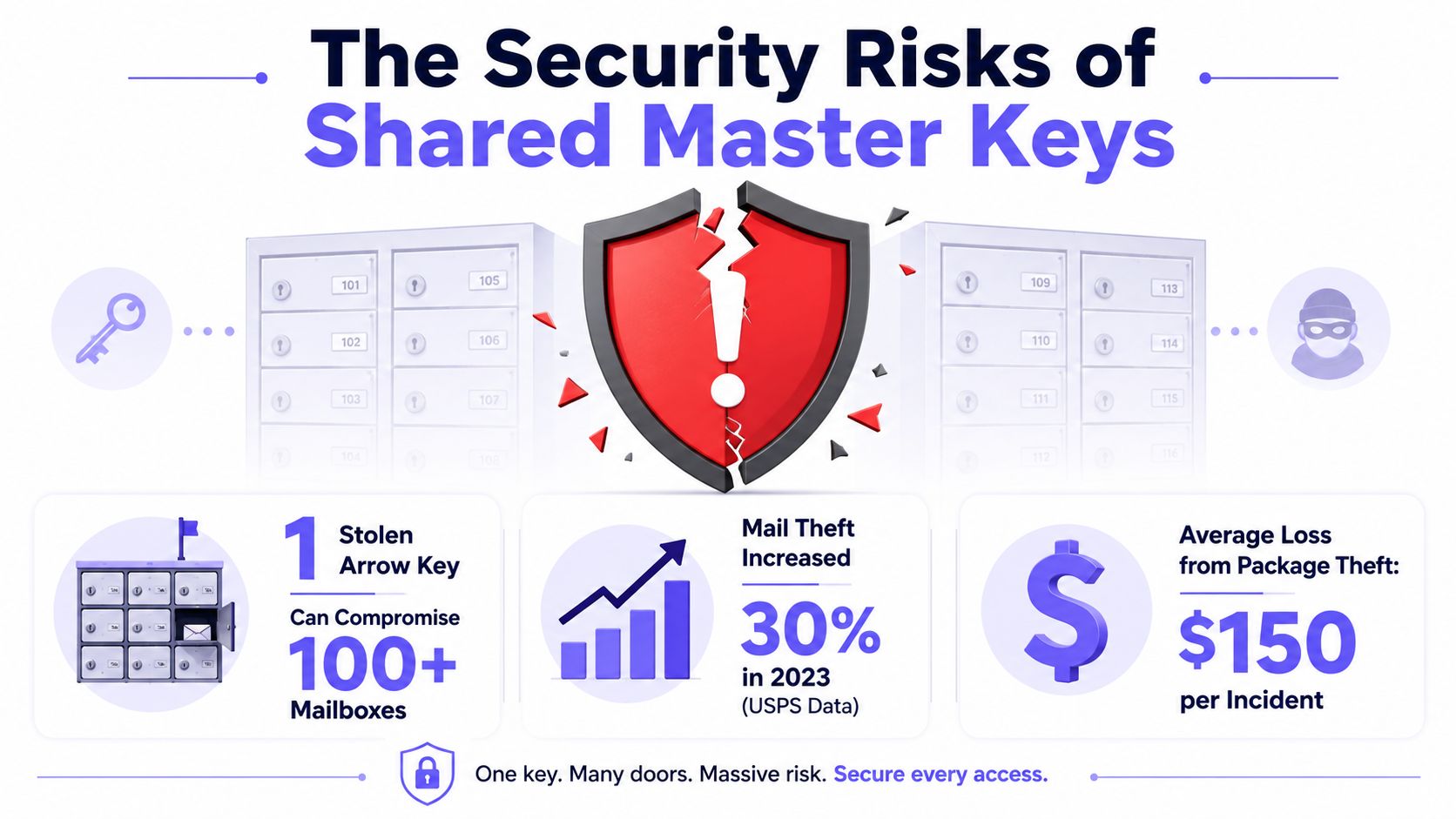
A shared mail key creates a blast radius problem. One compromised USPS access key can expose an entire mailbox bank, not just one resident's compartment, and that changes the risk from an inconvenience into a security event.
Independent security commentary has repeatedly pointed out that the design choice matters because the carrier key is often for the service side of cluster units, not just a single compartment. Recent reporting and community accounts have described thefts using stolen USPS access keys in Chicago, Los Angeles, Las Vegas, and Seattle area communities, which shows the issue is operational, not theoretical. Security analysis on mailbox insecurity
What the failure mode looks like
Once one key is stolen, the attacker doesn't need to defeat each lock individually. The lock bank becomes the target.
That's why communities often discover the problem only after a string of complaints, missing checks, or stolen identity documents. The mailbox hardware itself may still be intact, but the access model has already failed.
Why accountability is the real weak point
CBS News reported that thieves have repeatedly used stolen master keys to steal mail from secured boxes, and the repeated pattern shows how much the system depends on human control. CBS News report on stolen USPS master keys
For property managers, the liability question is straightforward. If a community can't document who held an access key, when it was issued, or whether it was returned, the property has little evidence that it exercised reasonable control.
That's why mail theft complaints often spread beyond one address. A missing USPS access key can affect residents, nonprofits, neighboring buildings, and the property team itself.
A mailbox bank with weak key control behaves like a shared vulnerability, not a set of private boxes.
For teams already trying to reduce shared credentials in the rest of the property, the logic is familiar. A shared physical master key is harder to audit than a managed digital credential, and that gap becomes more obvious when theft starts.
How Modern Mailbox Lock Engineering Works
Modern mailbox locks aren't built around convenience, they're built around certification, strength, and controlled key coding. That matters because the lock is part of the compliance chain, not a casual add-on.
CompX's USPS-L-1172C mailbox-lock implementation requires a stainless steel plug that can withstand 1,000 pounds of force applied to the cam, up from 100 pounds in the earlier USPS-L-1172 spec, and it uses a 3/16-inch heavy-duty stainless steel cam for added resistance to attack. CompX mailbox lock specification overview
Why the spec matters in the field
Those details tell property managers something important. Mailbox locks are selected as certified units, not improvised parts.
The same specification family uses 4,000 key codes split across two keyways, with visual identification marked into the housing for field verification. That is a hardware system built for standardization and traceability, not for layering on extra master-key complexity. CompX mailbox lock specification overview
Field takeaway: if the lock is certified for a specific access path, changing the keying structure can create compatibility and compliance problems.
Why master-key layering can backfire
Adding a property-level master key may sound efficient, but it can undermine carrier access and weaken the lock's anti-torque performance. That's why mailbox products specify USPS access hardware rather than generic master-keyed cylinders.
A certified mailbox lock is not the same thing as a general-purpose door lock. For multifamily communities, that distinction should drive purchasing decisions, especially when a replacement is being considered after a theft or lock failure.
The practical lesson is direct. Security upgrades should preserve the carrier-approved access method while tightening control around the rest of the property's entry points.
Best Practices for Securing Mail Access
A property that wants better mail security needs a documented process, not just a better-looking mailbox bank. The starting point is always a full key inventory, because no lock upgrade can fix unknown access.
The most effective communities treat mail access like any other controlled system. They know who has keys, who can approve replacements, and who reviews the records. The moment those questions get fuzzy, theft risk and dispute risk both rise.
Start with the audit, then fix the hardware
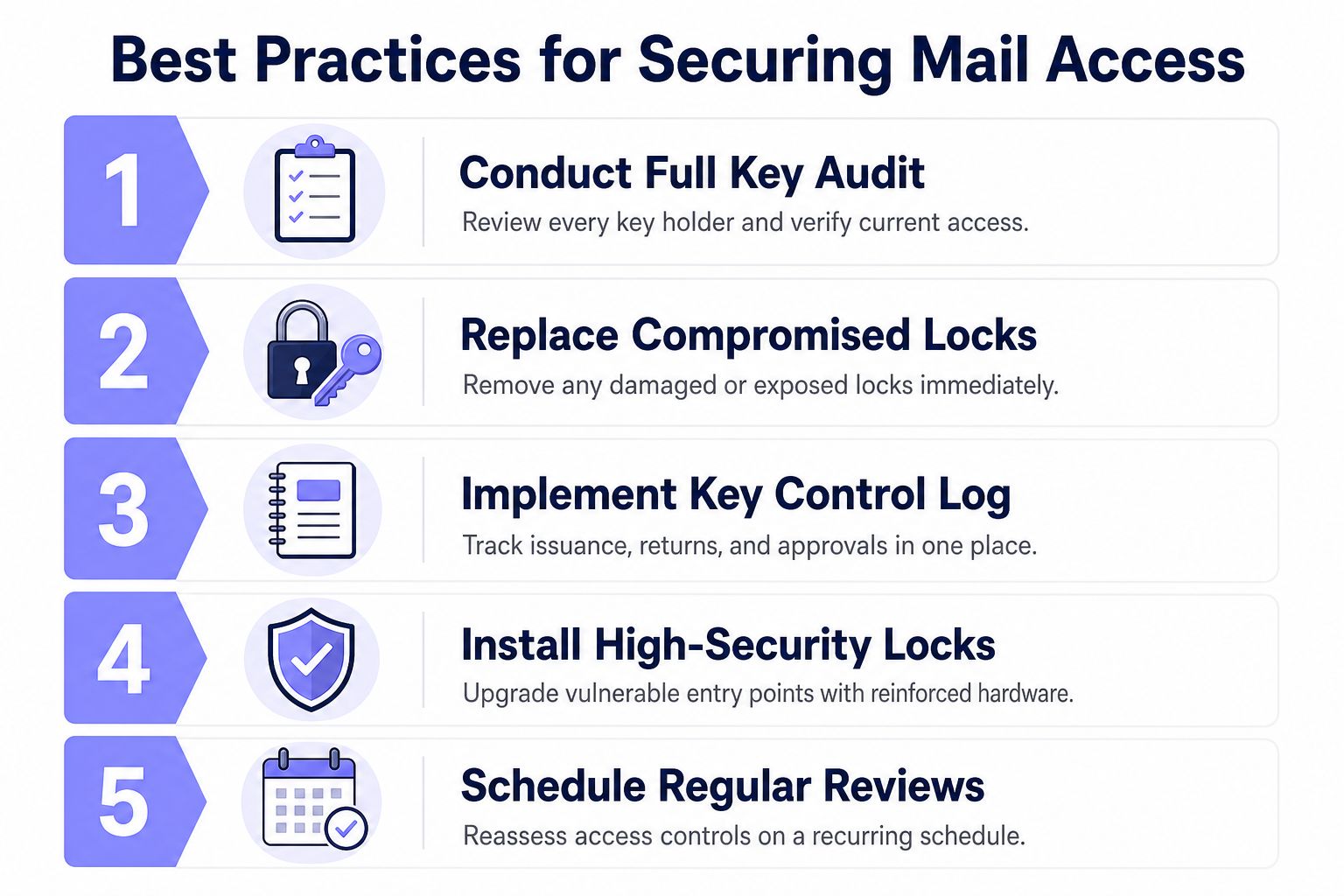
Conduct a full key audit. Build a list of every carrier key, manager key, contractor key, and resident key in circulation. If the property can't account for a key, treat it as compromised.
Replace compromised locks. A missing or duplicated mailbox lock shouldn't stay in service just because the box still opens. USPS-compliant hardware matters here, because the system has to preserve approved carrier access.
Write a key-handling log. Every handoff needs a record. That includes who received the key, when it was returned, and who authorized the issue.
Use stronger approved hardware. Better lock construction helps, but only when it matches the mailbox system's certification path.
Review access regularly. A one-time cleanup isn't enough. Access changes over time as staff turn over and vendors rotate.
For communities trying to align mailbox security with the rest of the property, complete apartment security overview can be useful context for building-wide planning.
Keep postal coordination explicit
USPS-owned systems still need coordination with the local post office, while apartment and HOA systems usually sit with the property team. That split should be written down before there's an incident.
A clear policy should answer three questions:
- Who can request a lock change
- Who approves duplicate keys
- Who documents return or destruction of old keys
Operational rule: if the property can't explain its mail-access chain to a new manager in five minutes, the policy isn't mature enough.
Communities that already use cloud-based access control for gates and entries can apply the same thinking to mail security. The difference is that mailbox systems often lag behind the rest of the property, even when the rest of the site already has better logging and authorization.
Digital Alternatives to Traditional Master Keys
A mailbox bank can look secure from the curb while hiding a weak point inside the access process. A single USPS master key, often called an arrow key, can open an entire cluster of mailboxes, and many communities still have no clear audit trail for who handled that key or when. That gap matters because the hardware may be sound while the access record is missing.
Property teams that manage multifamily or gated communities often face the same pattern. Shared physical keys are easy to hand off and hard to track, while residents and vendors depend on a chain of duplicates that becomes harder to control over time. Digital credentials address that operational problem by giving managers a way to approve, revoke, and review access without chasing down every copy.
A helpful outside example of broader connected-home planning is from Edinhart Realty, which shows how property teams are increasingly thinking about access as part of a larger smart-home stack.
Traditional keys versus cellular digital access
| Category | Traditional Master Key System | Cellular Digital Access |
|---|---|---|
| Access method | Physical key | Smartphone credential |
| Audit trail | Limited or manual | Real-time logs |
| Credential recovery | Lock change or rekey | Revoke instantly |
| Connectivity | Not applicable | Cellular, no Wi-Fi dependency |
| Hardware changes | Often key-dependent and rigid | Often hardware-agnostic retrofit |
| Visitor handling | Manual or separate process | Remote visitor management |
A cellular platform is useful because it avoids dependence on local Wi-Fi. Equipment rooms, gates, and older buildings do not always have reliable network coverage, so a credential system that uses cellular connectivity can keep working where Wi-Fi-based tools may struggle.
The Nimbio key management system is one example of this approach. It uses cellular-based control for gates and building access, supports remote granting and revocation of credentials, and is designed to retrofit existing gate hardware instead of forcing full replacement. It can also support remote visitor management and access logs, which gives property teams something physical keys rarely provide, a clear record of who opened what and when.
Why this matters for mail security decisions
Digital access does not change USPS mail hardware itself. It changes the control layer around the property, which is where many communities lose visibility. If a community already struggles to track mailbox keys, the same weak process often shows up at gates, amenity doors, and service entries too.
That is the operational lesson. Mail theft exposes the weakness of physical key control, while digital systems show what accountability looks like when access is managed centrally and records are easy to review. A mailbox may still need a physical lock, but the surrounding access process can move into a system that logs approvals, revocations, and use.
For property managers, the practical goal is to stop relying on untracked shared credentials where a managed, auditable system will do the job better. A smarter rollout does not require replacing every piece of hardware at once, and it gives communities a path to better control without waiting for a full construction project.