A property manager watches the entry lane fill with cars while residents hold badges to a reader that accepts one credential and rejects the next. The gate operator works, the card appears intact, and yet the queue grows because the failure may sit in the chip interface, middleware, certificate validation, or the access policy rather than in the gate itself.
That's the practical problem behind choosing a PIV badge reader. PIV technology can be appropriate for federally managed facilities and high-assurance environments, but it often introduces more operational overhead than a gated community, HOA, or ordinary commercial property needs. The right decision starts with the credential, the compliance obligation, and the complete access-control system, not with the reader hardware alone.
Table of Contents
- What Property Managers Need to Know About PIV Badge Readers
- Understanding FIPS 201 Standards and PIV Credential Architecture
- Contact Versus Contactless PIV Reader Technologies
- Integration Challenges and Middleware Dependencies
- When PIV Badge Readers Make Sense for Your Property
- Procurement and Installation Considerations
- Making the Right Access Control Decision for Your Property
What Property Managers Need to Know About PIV Badge Readers
A PIV badge reader is a smart-card reader designed to authenticate a Personal Identity Verification credential. PIV cards are used primarily in federal environments, where identity proofing, credential issuance, authentication, and facility access must work within a common trust framework. The broader access-control market is substantial and globally relevant, with one estimate placing it at USD 4.09 billion in 2026 and USD 5.94 billion by 2031, while RFID and NFC represented 57.75% of connectivity share in 2025, according to Mordor Intelligence's global access control market analysis.
At a physical gate or door, the reader is only the visible component. A typical installation includes:
- Chip interface: Makes electrical contact with an inserted card in a contact reader.
- Contactless antenna: Exchanges data with a card held near a contactless reader.
- Reader firmware: Handles the card protocol and passes credential data onward.
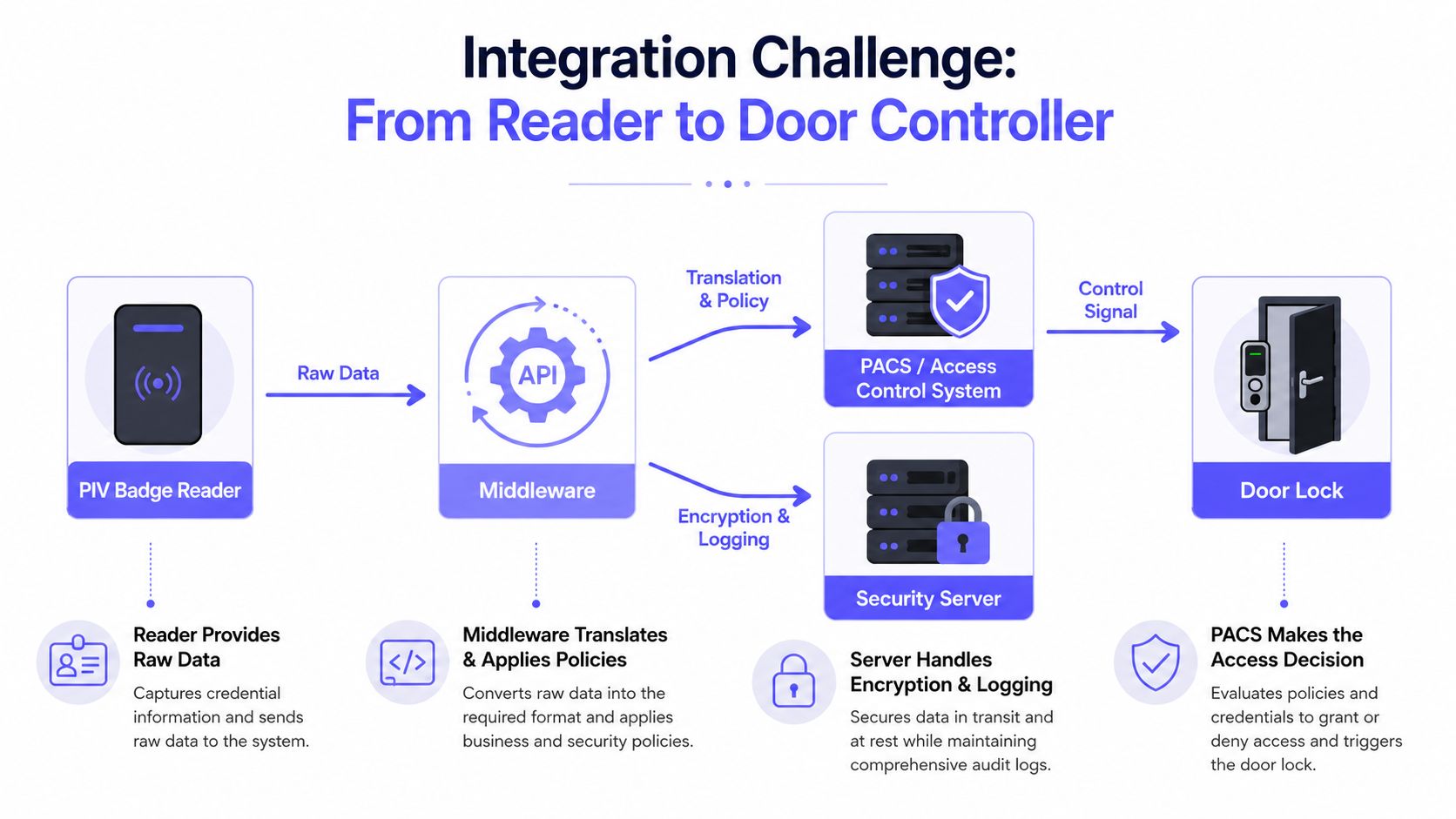
- Middleware: Interprets certificates and card applications, then communicates with the physical access control system.
- PACS policy engine: Decides whether the identified person is authorized for that door, gate, schedule, or zone.
A property may encounter PIV equipment because a government contractor needs access, a government-adjacent tenant requires it, or an older installation was built around smart cards. That doesn't automatically make PIV the correct choice for every resident, employee, or visitor.
The first diagnostic question
A legacy proximity badge system may use low-frequency 125 kHz credentials. Those cards became common in schools, hospitals, offices, and government buildings after their introduction in the late 1970s and early 1980s, according to O'Brien's history of proximity cards. A PIV reader belongs to a different technical category, particularly when it supports contactless smart-card communication at 13.56 MHz.
Practical rule: A badge that looks familiar isn't proof of compatibility. The credential technology, reader protocol, middleware, and access policy must all match.
If residents are struggling with a legacy badge reader at a residential gate, replacing it with a PIV badge reader may solve nothing. The property may need a better credential strategy, a cellular retrofit, or a review of how visitor and resident access are administered.
Understanding FIPS 201 Standards and PIV Credential Architecture
FIPS 201 defines the federal identity credential framework behind PIV cards. It's designed to support consistent authentication across approved federal systems, rather than provide a convenient way to open a door. That distinction matters because a PIV badge reader must process a credential with certificates, card applications, and trust relationships that ordinary proximity readers never handle.
A useful analogy is a passport and a border checkpoint. The card carries several layers of identity information, while the reader and supporting systems must verify the relevant layers before an access-control system can make a decision.
How the interfaces work
PIV cards can communicate through contact and contactless interfaces. Under NIST's FIPS 201 requirements:
- Contact readers must conform to ISO/IEC 7816 at the card-to-reader layer.
- Contactless readers must conform to ISO/IEC 14443.
- Contactless data exchange must still conform to ISO/IEC 7816 requirements.
- Desktop reader deployments generally require PC/SC compliance and conformance to NIST SP 800-96.
These standards create interoperability between approved credentials and reader vendors. They also explain why a generic NFC reader isn't automatically a PIV reader. A device may detect a contactless card without supporting the authentication process, certificate handling, or system integration required for a compliant deployment.
Why performance affects the door experience
NIST SP 800-96 also addresses reader performance. It recommends that retrieval of 12.5 KB of data through the contact interface should not exceed 2.0 seconds, as documented in NIST Special Publication 800-96.
The same guidance notes that readers need enough buffer capacity for the maximum frame size permitted by the smart-card protocol. In practice, slow exchanges, weak reader hardware, poor middleware, or delayed certificate checks can turn a technically valid credential into a frustrating gate backup.
Property managers should separate federal compliance from general security preference. A residential community or standard commercial property may gain little from adopting this architecture unless a tenant, contract, or facility rule specifically requires PIV support. For broader context on traditional credential systems, Nimbio's guide to key card entry systems provides a useful comparison of card-based access models.
Contact Versus Contactless PIV Reader Technologies
The central choice is straightforward. A contact PIV reader requires the user to insert the card, while a contactless PIV reader reads the credential when it's placed near the device. The operational consequences are less simple because the two designs balance assurance, throughput, maintenance, and user behavior differently.
Contact readers can support detailed chip communication and certificate-based exchanges through the physical interface. They suit controlled environments where users can follow a precise procedure, such as a desktop unit at a security desk or a low-volume interior checkpoint. The slot, however, introduces moving parts and creates more opportunities for contamination, insertion errors, and mechanical wear.
Contactless readers are more practical at busy doors and gates. Commercial FIPS 201 products commonly operate at 13.56 MHz and support credentials such as PIV, PIV-I, CIV, CAC, TWIC, and FRAC, as shown in this pcProx FIPS 201 reader data sheet. They're faster for users who need to present a card without aligning it to a slot, but the supported authentication behavior still depends on the reader, middleware, PACS, and configured policy.
| Feature | Contact Readers | Contactless Readers |
|---|---|---|
| User action | Insert the card into a slot | Hold the card near the reader |
| Typical placement | Desktop unit, guard station, controlled interior door | Wall-mounted entry, lobby, gate approach |
| Main strength | Detailed chip interaction and controlled presentation | Faster user flow and fewer mechanical components |
| Main weakness | Insertion errors and slot maintenance | Compatibility depends on supported contactless functions |
| Suitable environment | Lower-volume, high-control checkpoints | Higher-traffic entrances and outdoor approaches |
| Residential fit | Usually cumbersome for residents and visitors | Easier, but still requires physical credential management |
Where both approaches fall short
Neither format removes the burden of issuing, replacing, suspending, and recovering physical credentials. A lost card requires administrative action, and a departed resident or contractor must have access removed from the system. The reader also needs a compatible controller and software path into the property's PACS.
At a residential gate, a phone-based credential can reduce that friction because residents already carry their smartphones. A cellular access system can also avoid dependence on local Wi-Fi, which is useful where the gate is distant from the property's network equipment. Nimbio's practical NFC access guide helps installers compare reader-based retrofits with other ways to trigger an existing gate operator.
For a federal facility, a contactless PIV reader may be the correct requirement. For an HOA main gate, the better question is whether the property needs federal smart-card authentication at all, or whether it needs reliable resident entry, remote visitor management, and simple credential revocation.
Integration Challenges and Middleware Dependencies
A PIV badge reader doesn't make the access decision by itself. The deployment needs middleware that can interpret the card application, validate certificates, check revocation status where required, and communicate with the physical access control system. The PACS then applies authorization rules for the specific door, gate, time, role, and security zone.
This layered design creates several failure points:
- Card orientation: Some users must insert the card in a particular direction or place a contactless card vertically and centrally.
- Power and communication: The reader must power the chip and maintain a reliable exchange.
- Middleware compatibility: Software may not support the credential application or reader configuration in use.
- Certificate validation: Network delays or unavailable validation services can cause timeouts.
- PACS translation: The access system may receive identity data but lack the policy mapping needed to grant entry.
- Support ownership: The badge office, reader vendor, middleware provider, network team, and property manager may each control a different part of the failure.
Government troubleshooting guidance reflects this reality. The CMS PIV FAQ directs users toward practical checks such as reinserting the card, trying another reader, and confirming the required card position. Those steps are useful, but they also show why generic product pages understate the support burden.
A better troubleshooting sequence
A property team should isolate the fault before ordering replacement hardware.
- Test the credential elsewhere. If the card fails on multiple known-good readers, escalate the badge or issuing authority.
- Test another credential on the same reader. This helps separate a reader problem from a card problem.
- Check middleware logs. Look for certificate, driver, PC/SC, or revocation errors.
- Verify the PACS mapping. Authentication identifies a cardholder, but the policy engine still needs an authorization rule.
- Review network dependencies. Certificate and revocation checks can fail even when the gate controller is online.
Support reality: Replacing the reader won't fix middleware that can't interpret the credential, and middleware won't fix a PACS rule that denies an authenticated user.
For non-federal properties, this complexity can outweigh the benefit. A simpler cellular design may connect directly to an existing gate controller, provide cloud-based access administration, and avoid the card issuance and smart-card middleware stack. Integrators that need to connect gate hardware to software services can also review Nimbio's gate access API for developers.
When PIV Badge Readers Make Sense for Your Property
The strongest argument for a PIV badge reader is a real requirement to accept PIV credentials. That requirement commonly comes from federal ownership, a federal contract, or a facility policy tied to government access. It shouldn't come merely from the assumption that a more advanced credential automatically produces a better property security outcome.
For federally managed facilities, NIST SP 800-116 Rev. 1 says installed PACS readers must come from the General Services Administration's FIPS 201 Evaluation Program approved products list. A private gated community or ordinary commercial property generally doesn't face that federal procurement rule, although a contract or tenant requirement could create a specific obligation.
Authentication isn't authorization
A PIV card authenticating at a reader proves that the cardholder was identified. It doesn't, by itself, prove that the person is authorized to enter a particular space at a particular time.
NIST guidance on PIV physical access makes that distinction important. The PACS still needs an authorization decision, and credential lifecycle management still requires registration, re-validation, suspension, revocation, and replacement processes.
For an HOA board, that means the security outcome depends on more than reader certification. The board should ask:
- Can administrators revoke a former resident's access immediately?
- Can the system identify which person opened the gate?
- Can visitors receive temporary credentials without sharing a permanent PIN?
- Can staff manage access remotely during evenings and weekends?
- Can the property preserve existing gate hardware?
A smartphone-based cellular retrofit such as Nimbio can provide digital keys, remote visitor management, real-time entry logs, scheduled access, and remote credential revocation while connecting to existing electronic gates. It uses cellular connectivity rather than relying on Wi-Fi coverage at the gate, which addresses a common source of outages for distributed properties.
For non-federal sites, the practical choice is often between a physical credential ecosystem that requires specialized support and a cloud-based access-control model built around devices residents already use. PIV readers make sense when the mandate is real. They're usually excessive when the property only needs dependable, auditable entry management.
Procurement and Installation Considerations
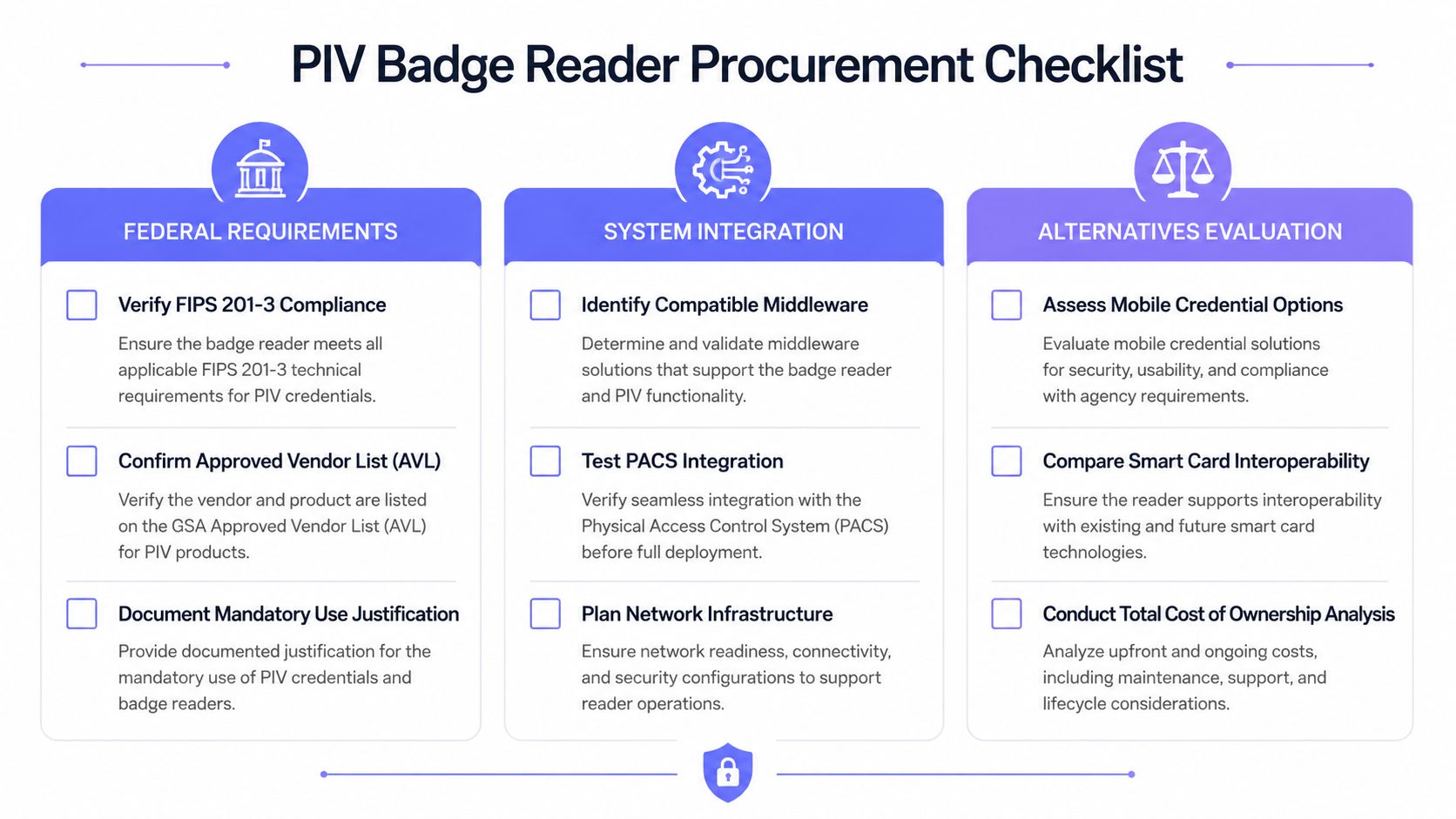
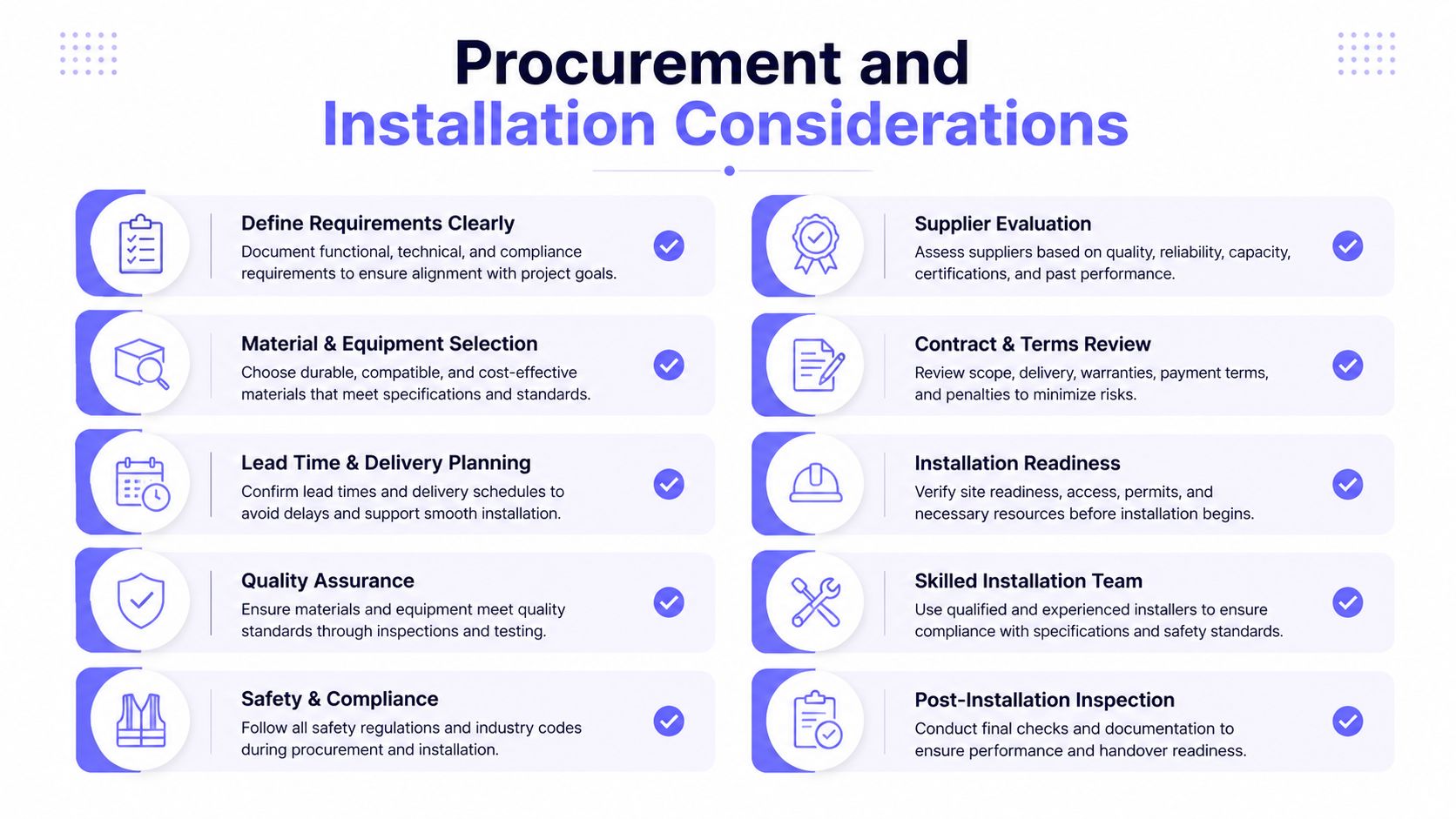
A federal or government-contracted property should treat PIV reader procurement as a compliance project, not a routine hardware purchase. The selected product needs to appear on the applicable approved list, support the required interfaces, and integrate with the existing PACS without weakening authentication or audit processes.
A procurement sequence that avoids rework
- Confirm the obligation first. Document whether the requirement comes from federal ownership, a contract, tenant security policy, or an internal preference.
- Verify the approved product. Check the GSA FIPS 201 Evaluation Program list before issuing a purchase order.
- Map the software path. Identify the middleware, PC/SC components, certificate validation services, PACS integration, and support owners.
- Run a controlled test. Test approved credentials, reader orientation, certificate handling, authorization rules, offline behavior, and event logging.
- Use a qualified integrator. The installer should understand both the physical gate or door hardware and the identity infrastructure.
Outdoor gate installations need additional attention. The reader location must allow safe presentation without exposing users to moving vehicles, while the enclosure, power supply, cabling, and controller must suit the site's environmental conditions. The network path should be documented, especially if validation or centralized policy services sit away from the gate.
The retrofit alternative for private properties
A gated community without a federal requirement can evaluate a cellular controller that triggers the existing gate operator instead of replacing the gate system. Nimbio supports common operators including LiftMaster, Viking, FAAC, Nice, DoorKing, and Mighty Mule, allowing an installer to preserve the mechanical equipment while adding smartphone-based access.
The business model also differs. PIV deployments can involve card issuance, replacement, middleware licensing, certificate infrastructure, specialized support, and reader maintenance. A cellular access model typically uses hardware plus subscription service, with over-the-air updates and a lifetime hardware warranty described in the product profile.
Property managers should still request a written scope. The proposal should identify installation labor, cellular service, administrator seats, visitor features, audit logs, credential revocation, warranty coverage, and what happens if the existing gate operator needs repair. A clear total-cost comparison is more useful than comparing reader prices alone.
Making the Right Access Control Decision for Your Property
The decision can be reduced to the property's actual obligation and operating model.
Use a PIV badge reader when
- A federal facility requirement applies.
- A government contract requires PIV credential acceptance.
- The PACS and identity infrastructure can support certificate validation and lifecycle controls.
- The organization can fund specialized procurement, middleware, testing, and support.
In that situation, the property should use a GSA-approved PIV reader and plan for the associated integration work. Compliance isn't optional because a smartphone system is easier to operate.
Consider cellular smartphone access when
- The site is an HOA, gated community, multifamily property, or standard commercial facility.
- Residents, tenants, and visitors need convenient entry.
- Managers need remote credential administration and audit logs.
- The existing gate operator works and should be retained.
- Local Wi-Fi is unreliable or unavailable at the entry point.
A cellular retrofit can provide app-based credentials, remote visitor management, scheduled access, and immediate revocation without distributing physical badges to every user. The access-control market's long-term growth and the continued use of badge systems show that credentialed entry remains important, but the right credential depends on the property's risk and staffing model, as reflected in the global market overview from Mordor Intelligence.
Property managers comparing connected entry products may also find this best Airbnb lock guide from ScanStay useful for understanding how mobile credentials and remote management apply to short-term rental operations.
The next step is practical: document compliance requirements, inventory the existing gate or door hardware, calculate card and middleware ownership costs, and pilot a cellular access option at one entrance. That process gives the HOA board or property owner evidence about reliability, visitor handling, reporting, and administrator workload before committing to a PIV infrastructure that the property may not need.
Nimbio connects existing electronic gates and building entry systems to a smartphone app through cellular connectivity, with remote visitor management, digital credentials, audit logs, and over-the-air updates. Property managers and HOA boards can visit Nimbio to review retrofit options for their current gate operator and request a practical access-control evaluation.