A lot of HOA boards are dealing with the same scene right now. A resident can't find guest parking, a delivery driver stops in a fire lane, a gate line starts backing into the street, and management gets blamed for all of it.
That's why traffic and parking control on private property can't be treated as a sign-and-tow problem anymore. In gated communities and multifamily sites, vehicle flow, access control, visitor verification, and enforcement all affect security, convenience, and operating cost.
Table of Contents
- Why Traffic and Parking Control Is a Priority
- Common Traffic and Parking Challenges in Communities
- Developing an Effective Policy and Enforcement Plan
- A Survey of Modern Traffic Control Technologies
- Implementing a Smartphone Controlled Access System
- Analyzing the ROI of Automated Access and Parking Control
- The Future of Smart Community Management
Why Traffic and Parking Control Is a Priority
When a community loses control of parking, it usually loses control of several other things at the same time. Resident satisfaction drops, security weakens, staff time gets swallowed by complaints, and simple entry tasks turn into daily friction.
Private-property traffic and parking control covers more than painted stalls and posted rules. It includes gate entry, visitor flow, resident credentials, delivery access, garage circulation, loading behavior, and how quickly management can respond when something goes wrong.
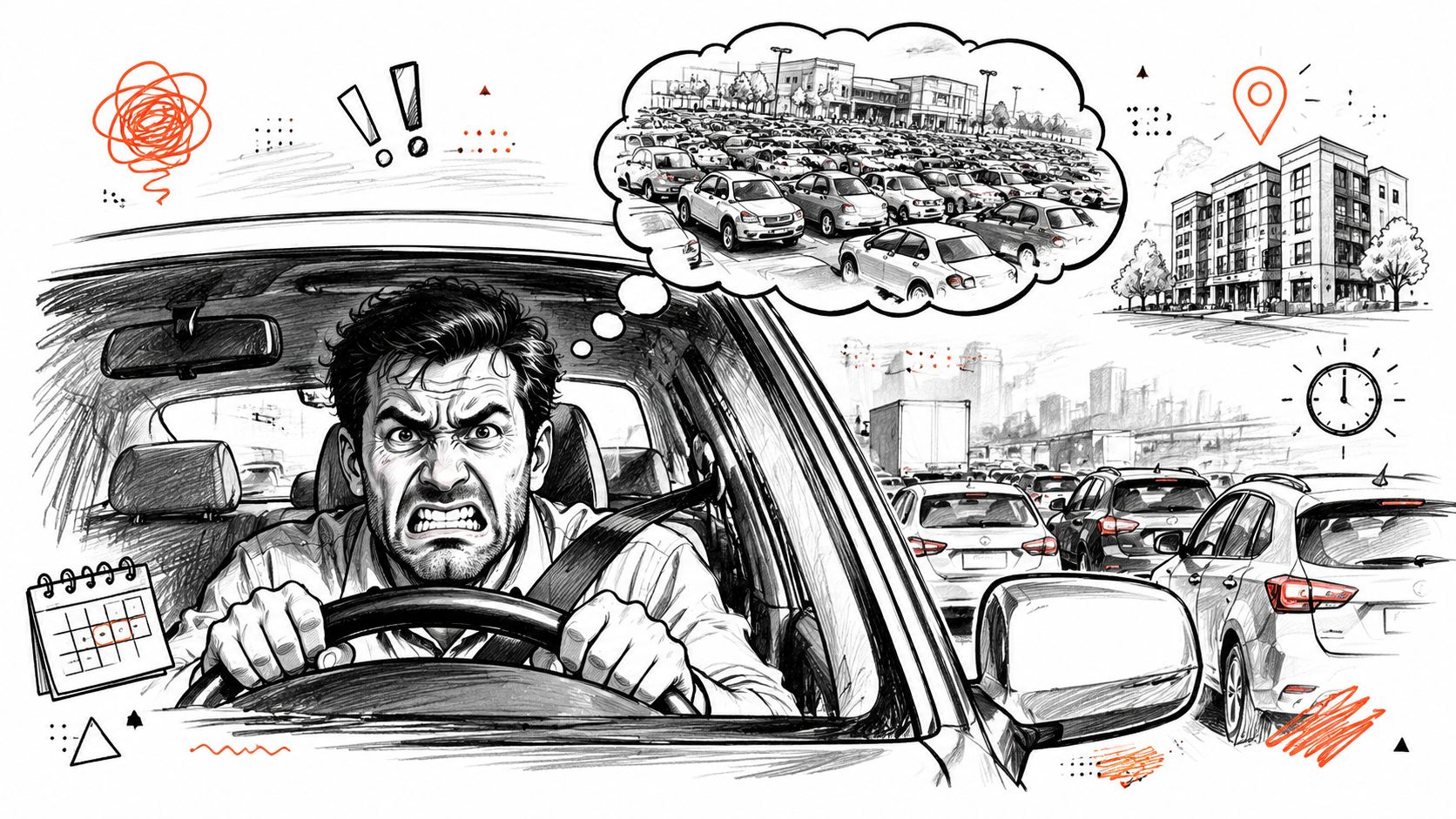
The urgency is easy to see in the broader market. The global parking management market is projected to expand from USD 7.22 billion in 2025 to USD 12.41 billion by 2030, driven by urbanization and the need to optimize parking utilization to reduce congestion and improve traffic flow, according to MarketsandMarkets on parking management.
That projection matters to HOA boards because it reflects a clear reality. Communities aren't dealing with a niche operational issue. They're dealing with a category of infrastructure that's becoming more connected, more data-driven, and more central to property operations.
What boards are really trying to protect
Most boards aren't looking for a fancy system. They want fewer resident complaints, cleaner rule enforcement, safer entry points, and a process that doesn't depend on someone answering a phone at exactly the right moment.
A workable strategy usually protects four things:
- Access integrity: Only approved residents, guests, vendors, and deliveries should enter.
- Vehicle flow: Cars shouldn't stack at gates or circulate endlessly inside the property.
- Rule clarity: Residents need to know where they can park, when they can park there, and what happens if they don't.
- Administrative time: Staff shouldn't spend the day chasing remotes, updating spreadsheets, and mediating parking disputes.
Practical rule: If a board can't explain its parking and entry rules in one page, enforcement will be inconsistent.
The strongest communities treat traffic control, parking policy, and gate access as one operating system. Signs matter. Striping matters. But without reliable entry control and auditable permissions, those pieces don't hold together for long.
Common Traffic and Parking Challenges in Communities
Most community traffic problems don't start with reckless driving. They start with uncertainty. A driver doesn't know where to park, whether a gate will open, whether a visitor space is available, or whether stopping “for just a minute” will cause a problem.
That uncertainty creates operational drag. It also creates security gaps.
Parking search behavior creates real risk
Research on driver behavior shows that drivers searching for parking increase their rate of off-road glances lasting over 2 seconds by 235%, which raises distraction and safety risk inside a community, according to the ROSAP driver behavior dataset.
For private properties, that means poor parking organization isn't just annoying. It changes how people drive once they're through the gate. Drivers slow down, look away longer, hesitate near intersections, and make unpredictable stops near curbs, garages, and pedestrian areas.
The problems boards see every week
A typical HOA or multifamily site runs into a familiar set of issues:
- Unauthorized resident overflow: Households use guest areas as permanent storage for extra vehicles.
- Visitor parking abuse: Friends, contractors, or short-term users occupy spaces longer than intended.
- Gate bottlenecks: Entry backups form when credentials fail, visitors don't know the process, or staff must intervene manually.
- Unsafe stopping behavior: Delivery vehicles and rideshare drivers stop in lanes that should stay clear.
- Shared access abuse: Old remotes, copied codes, and untracked credentials continue to circulate after they should've been removed.
These aren't separate headaches. They reinforce each other. Weak access control increases unauthorized parking. Poor parking availability increases circulation. More circulation increases distraction and conflict.
Communities usually don't have a parking problem or a gate problem. They have a coordination problem.
That's why boards should think beyond signs alone when managing parking lot access. The physical gate matters, but so does how credentials are issued, how visitors are approved, and whether management can see what happened after the fact.
Why private property needs a broader operating view
Public-road traffic guidance doesn't map perfectly to an HOA, but some adjacent compliance discussions are useful. For example, this compliance perspective on truck parking issues is a reminder that parking search time creates cost, delay, and operational stress well beyond the curb line.
Inside a community, the equivalent cost shows up differently. Staff fields complaints. Security responds to access confusion. Residents lose confidence in the rules because enforcement looks selective. Once that happens, even good policies start to fail in practice.
Developing an Effective Policy and Enforcement Plan
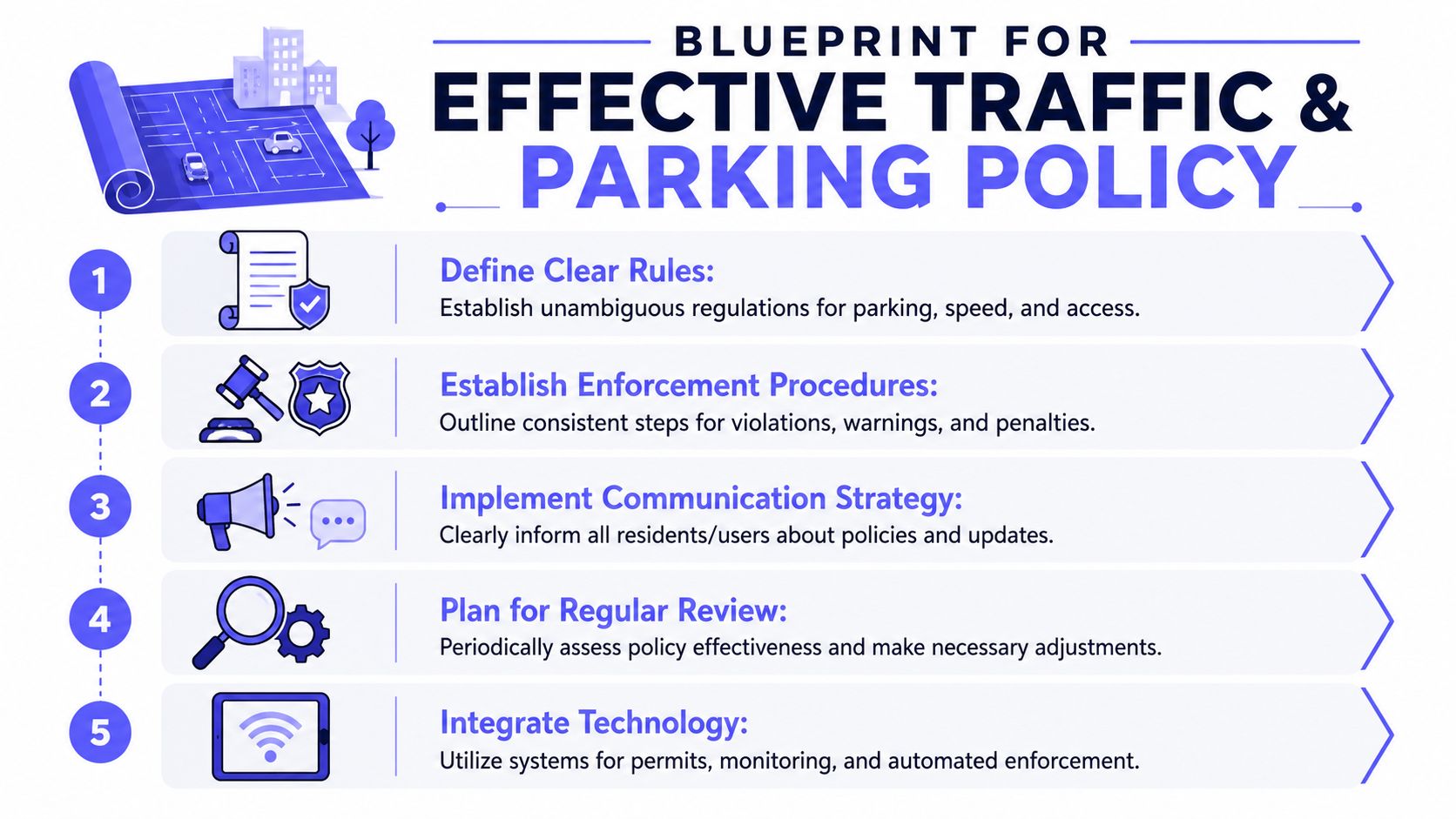
Technology can't rescue a weak policy. If resident parking, guest access, loading rules, and no-parking zones aren't clearly defined, the system just automates confusion.
The best traffic and parking control plans start on paper. They're specific, visible, and enforceable.
Start with rules people can actually follow
Boards often overcomplicate parking policy. A stronger approach is to define categories first, then attach enforcement to each category.
A practical policy usually includes:
Resident vehicle rules
Tie parking rights to units, leases, or approved registrations. Clarify whether garages, assigned spaces, and common spaces have priority.Guest parking standards
Set the approval process, permitted duration, and any restricted hours. Make it clear who is responsible for a guest vehicle.Restricted-area controls
Fire lanes, dumpsters, service roads, loading areas, and gate approaches should have no ambiguity at all.Commercial and delivery access
Spell out where vendors may stop, how long they may remain, and whether advance authorization is required.Enforcement steps
Warnings, citations, towing authorization, and appeal procedures should follow a predictable sequence.
Boards also need an operational owner. Someone has to update resident credentials, approve exceptions, review recurring violations, and keep vendor instructions current.
Make signage enforceable and visible
Policy only works when drivers can see it in time to act on it. According to the Federal Highway Administration guidance summarized here, a traffic control device includes signs and markings used to regulate traffic, and the MUTCD requires signage used at night to be retroreflective or illuminated.
That matters at private gates. If a visitor can't read directions until reaching the call box, the community has already created friction at the most sensitive control point.
A practical signage review should check:
- Entry instructions: Can first-time visitors understand the process before reaching the gate operator?
- Parking designation: Are guest, resident, reserved, and service areas clearly differentiated?
- Night visibility: Are rules readable after dark without relying on ambient lighting alone?
- Decision timing: Does the driver get enough distance to choose the right lane or stop point?
Board guidance: Don't approve enforcement language until signage and striping match it on the ground.
Communication is the other half of enforcement. Residents should receive plain-language rules, examples of common violations, and a simple process for registering vehicles and guests. When communities skip that step, management ends up debating expectations that were never clearly delivered.
A Survey of Modern Traffic Control Technologies
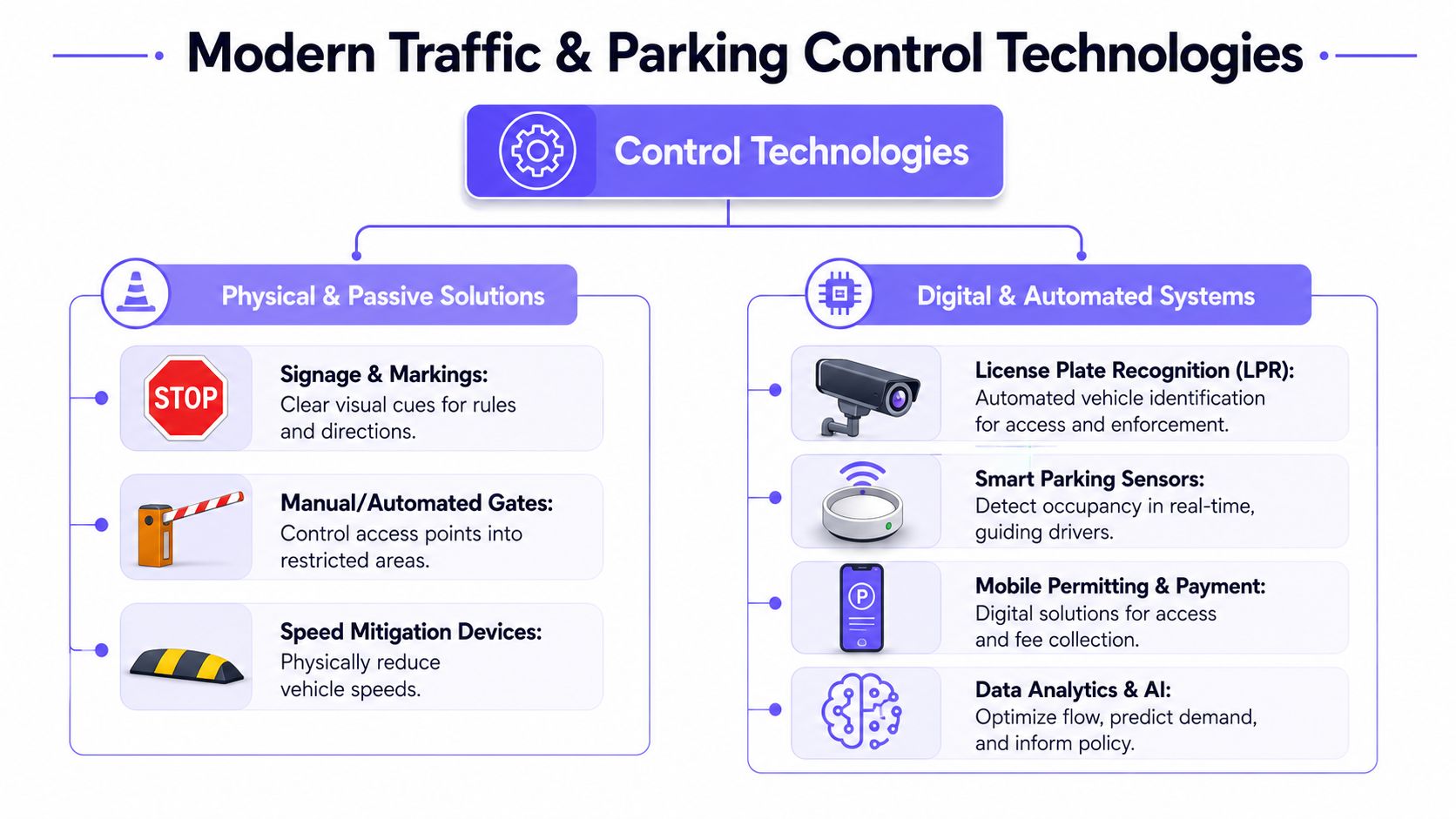
Most properties already have pieces of a traffic solution. They have signs, striping, a gate operator, maybe a keypad, maybe a clicker system, and sometimes a camera. The problem is that these tools often function as separate parts rather than a coordinated system.
A modern stack for private-property traffic and parking control should be judged on reliability, auditability, and ease of administration. If a tool creates extra handoffs or leaves management guessing who entered and why, it's not helping enough.
What still works
Basic physical controls still matter. Most communities need a mix of visible, passive, and active measures.
Common examples include:
- Signage and pavement markings: These define circulation, reserved areas, speed expectations, and stopping restrictions.
- Barrier gates and gate arms: These create the actual control point for vehicle entry.
- Speed mitigation devices: Humps, tables, and channelization can slow traffic where visibility is limited.
- Cameras: Video records activity and helps resolve disputes after incidents.
- Parking sensors or occupancy tools: These are more useful in larger sites where availability changes throughout the day.
For properties planning future charging areas or service-vehicle coordination, adjacent operational planning also matters. Teams thinking about vendor circulation or amenity parking may find this guide to managing electric vehicle fleets useful as they consider how vehicle operations are changing on private property.
What usually creates friction
Legacy tools often fail because they're hard to govern. Shared PIN codes spread. Clickers get lost. Old credentials remain active too long. Wi-Fi dependent devices become unreliable in exterior conditions where coverage isn't consistent.
Cellular systems address a major part of that problem. Cellular gate access control systems offer reliable entry management regardless of local Wi-Fi or internet availability and require only a standard power outlet and a low-voltage wire to the gate operator.
That combination matters in retrofits. Boards usually don't want to replace a functioning LiftMaster, Viking, FAAC, Nice, DoorKing, or Mighty Mule setup just to modernize access. They want to preserve the gate operator and improve the control layer around it.
For communities that want vehicle-based automation, LPR is one of the strongest add-ons because it reduces friction for approved vehicles while preserving logs for management. That's where Nimbio's LPR access control fits naturally into a broader smart-community approach.
Implementing a Smartphone Controlled Access System
The easiest upgrade path is usually not a full rip-and-replace. It's a retrofit that keeps the existing gate equipment and updates the way permissions, visitor entry, and logs are managed.
That's especially important for HOA boards. Most communities can approve an access modernization project faster when the gate operator, wiring path, and resident habits don't need to be rebuilt from scratch.
How rollout works on an existing gate
A smartphone-controlled system works best when implementation follows the property's actual traffic pattern, not a generic template.
A practical rollout usually looks like this:
- Review the entry points: Main gate, resident-only gates, garage doors, amenity entrances, and service entrances may need different permission rules.
- Confirm gate compatibility: The control layer should work with the existing operator rather than forcing replacement.
- Map user groups: Residents, staff, vendors, delivery users, and temporary guests need separate credential logic.
- Move access into a dashboard: Management should be able to grant, revoke, and schedule digital credentials without chasing remotes.
- Set visitor workflows: Residents should be able to approve guests remotely instead of relying on shared codes or gate calls that no one answers.
Smartphone access outperforms fobs and keypads, giving administrators a live record of access privileges and letting residents manage expected visitors from wherever they are.
A good access platform should reduce calls to management, not create a new reason to contact management.
Visual verification also matters at the gate. If a resident can confirm who's requesting entry before opening, the community closes one of the most common gaps in visitor handling. That's much stronger than a four-digit code that gets forwarded from phone to phone.
Communities that want a smoother driver experience can also look at an Automated gate entry system that extends control into in-car interfaces for approved users.
Old access habits versus modern operations
The difference is easiest to see side by side.
| Feature | Traditional Methods (Fobs, Clickers, Codes) | Modern Cellular Access (e.g., Nimbio) |
|---|---|---|
| Credential control | Often manual, fragmented, and hard to audit | Managed centrally through a cloud-based dashboard |
| Visitor entry | Shared codes or staff intervention | Remote visitor management and digital credentials |
| Gate reliability | Can depend on local networking or aging devices | Cellular connectivity avoids local Wi-Fi dependency |
| Lost access tools | Physical replacement process | Digital access can be revoked and reissued quickly |
| Existing gate equipment | May require workarounds | Hardware-agnostic retrofit can preserve existing operators |
| Oversight | Limited or inconsistent records | Real-time logs support accountability and review |
Old methods can still open a gate. They just don't manage a community very well.
Analyzing the ROI of Automated Access and Parking Control
Boards usually approve traffic projects for one of two reasons. Either operations have become painful enough that change is unavoidable, or someone presents a clear cost case that's hard to ignore.
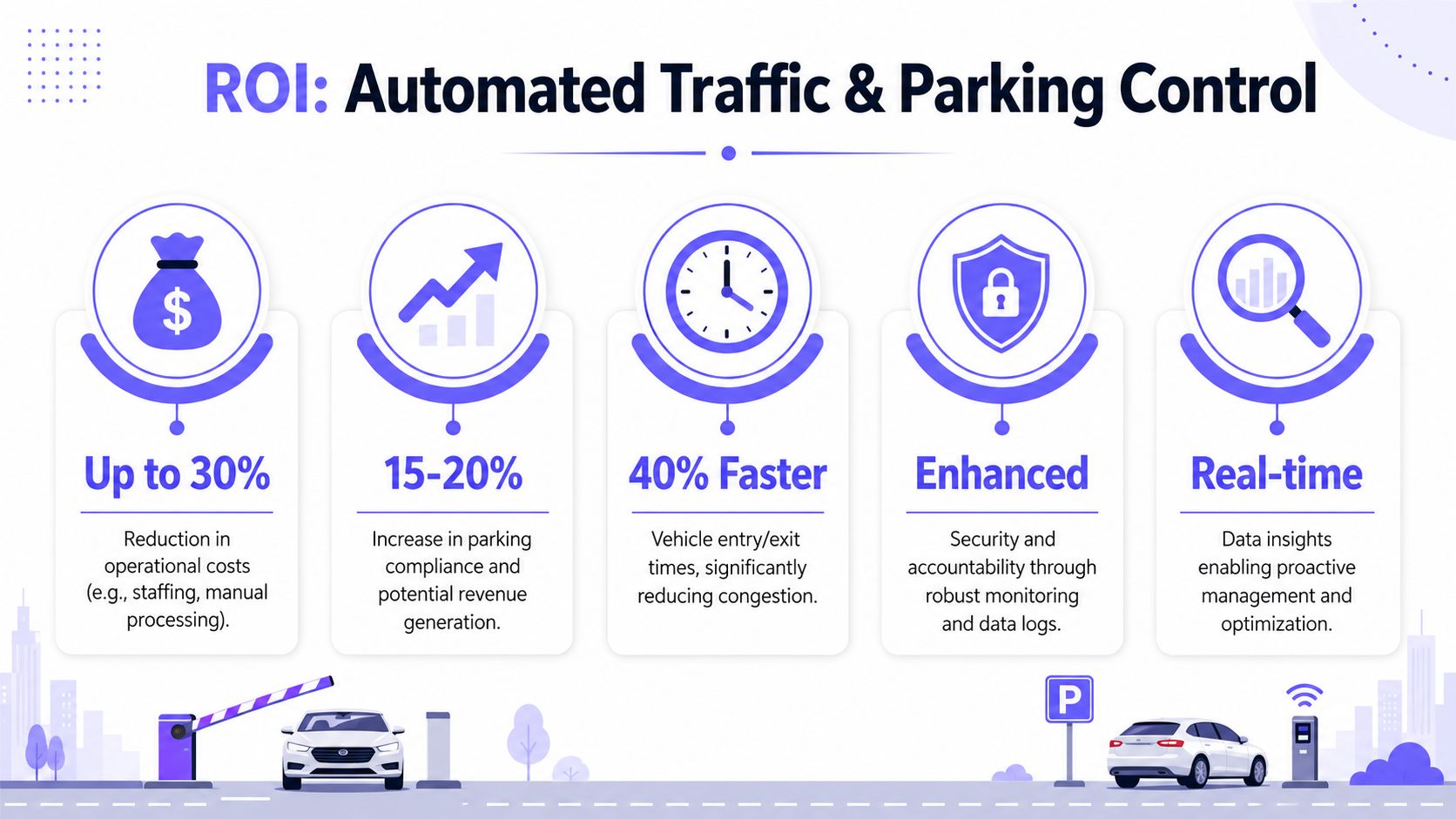
For automated access and parking control, the ROI case is stronger than many boards expect because savings don't come from one line item alone. They come from staffing, error reduction, fewer manual tasks, cleaner enforcement, and better resident experience.
Where the savings actually come from
The biggest comparison is often human guard coverage versus automated entry control. According to the cited analysis in the MUTCD-linked source provided, manual guard services cost 3.2x more annually than automated cellular-based alternatives, generate 64% more entry errors, and automated gate systems saved $12,400/year per 100-unit property versus guards.
That doesn't mean every community should eliminate every staffed role. It means boards should stop assuming that a person at the gate is automatically the most efficient or most accurate option.
A realistic ROI review should include:
- Direct operating cost: Ongoing staffing, replacement remotes, code resets, and manual visitor handling.
- Administrative workload: Time spent issuing credentials, resolving access disputes, and tracking who should still have entry.
- Error recovery: The cost of bad entries, resident lockouts, and unmanaged visitor approvals.
- Audit value: Entry logs reduce guesswork when a board needs to investigate an incident or policy violation.
Why boards approve these projects
The strongest proposals tie operational pain to board priorities. That usually means security, resident satisfaction, and budget discipline.
A board is more likely to move when it can see that automation will:
- Reduce recurring labor pressure
- Improve accountability through entry logs
- Support cleaner enforcement of parking and guest rules
- Modernize the property without replacing major hardware
- Lower friction for residents who are tired of clickers, fobs, and gate code sharing
Decision filter: If the system lowers manual work and improves visibility at the same time, the board should evaluate it seriously.
The financial return is important, but so is the operational upgrade. A community that can issue remote credentials, control visitor access, and review entry history from one cloud-based access control environment runs more predictably. Predictability is what boards are really buying.
The Future of Smart Community Management
Strong traffic and parking control on private property isn't a collection of disconnected tools. It's a coordinated operating model that links policy, signage, access permissions, visitor verification, and enforcement.
That's why the old formula no longer holds up. A few signs, a gate keypad, and a drawer full of remotes won't give a board the visibility or control it needs in a modern smart community.
The properties performing best are moving toward connected systems that do three things well. They keep entry reliable, they make rules easier to enforce, and they reduce the amount of staff time required to manage daily exceptions.
Boards should also expect access control to become more integrated with the rest of property operations. Video verification, mobile credentials, LPR, scheduling, audit trails, and cloud-based management fit naturally together because they solve the same underlying problem. They replace fragmented, manual decision-making with a clear, traceable workflow.
That shift matters for more than convenience. It supports HOA security, resident trust, and long-term property appeal.
A community doesn't become smarter because it installs more hardware. It becomes smarter when the gate, the rules, and the management process all work together.
If a property is still relying on clickers, shared codes, or manual gate workflows, it may be time to look at a modern retrofit. Nimbio helps communities modernize existing gates and entry systems with cellular, smartphone-controlled access, remote visitor management, and hardware-agnostic deployment that preserves current equipment while improving control, auditability, and day-to-day convenience.