A property manager usually notices the pricing problem during uneven months. One property has steady resident traffic and few guest requests. Another has move-ins, vendors, package deliveries, and after-hours access requests that pile up fast, yet both may still be paying under a pricing model that treats every site as if usage were the same.
That mismatch is why usage based pricing in access control is getting attention. In physical access systems, key activities often happen at the gate, door, directory, credential workflow, and remote approval layer. When those activities vary sharply by property type, occupancy pattern, or operating schedule, a rigid flat fee can feel blunt.
For HOA boards, multifamily operators, and installers, the question isn't whether flexible pricing sounds modern. The question is whether it improves budgeting, preserves security, and fits the way the property runs.
Table of Contents
- The Shift from Fixed Costs to Flexible Access Control
- What Is Usage-Based Pricing in Access Control
- Benefits and Drawbacks for Property Managers
- How Usage-Based Pricing Works in Practice Examples
- Implementing and Managing a Usage-Based System
- Frequently Asked Questions
The Shift from Fixed Costs to Flexible Access Control
Access control was traditionally budgeted like a utility that never changed. A board approved a monthly amount per gate, per site, or per user group, and the vendor billed the same way whether the property had a quiet month or a chaotic one.
That approach worked when systems were simpler and less observable. A keypad, a clicker, and a gate operator didn't generate much actionable data for billing. Most managers accepted fixed pricing because it was easy to understand and easy to forecast.
The problem is that modern properties don't behave in fixed patterns.
A gated HOA may have long stretches of predictable resident traffic, then sudden spikes during holidays or contractor projects. A multifamily building can stay stable for weeks, then swing hard during lease turnovers, delivery surges, or maintenance campaigns. A commercial yard may look calm on one shift and busy on the next.
Why fixed pricing often misses the real workload
Flat pricing hides who is subsidizing whom.
- Low-traffic sites often overpay: A quiet entrance with limited visitor activity may get billed as if it were a much busier property.
- Heavy-use sites can be underpriced: Frequent remote opens, temporary credentials, and visitor approvals create more system activity than a simple monthly fee reflects.
- Operational planning gets blurry: Managers can't easily see which behaviors are driving cost because the bill isn't tied to actual system events.
Practical rule: If the property's access activity changes by season, occupancy, or operating hours, the pricing model should at least acknowledge that variability.
Usage based pricing in access control transitions from theoretical to practical application. Instead of charging only for the right to have the system installed, it charges around measurable activity. In physical security, that might mean access transactions, issued credentials, visitor interactions, or other logged events that reflect real service intensity.
Why this shift matters for smart communities
A smart community already depends on more dynamic access workflows than older gate systems did. Residents expect app-based entry, managers expect remote control, and vendors expect temporary permissions that can be granted or revoked without a truck roll.
Those expectations push access control closer to a metered service model.
For property operators, the key advantage isn't novelty. It's alignment. When pricing follows actual use, the budget conversation becomes more concrete. Managers can compare quiet periods to busy periods, review entry patterns, and decide whether a fixed plan, a variable plan, or a hybrid arrangement fits the property better.
What Is Usage-Based Pricing in Access Control
A simple definition
Usage-based pricing in access control means the property pays according to what the system does, not just according to how many gates, users, or doors exist on paper.
The easiest analogy is a utility bill. Electricity isn't priced the same way whether a building uses very little power or runs heavy loads every day. Access control can work similarly when the platform can measure real activity, such as gate openings, digital credential actions, or remote access events.
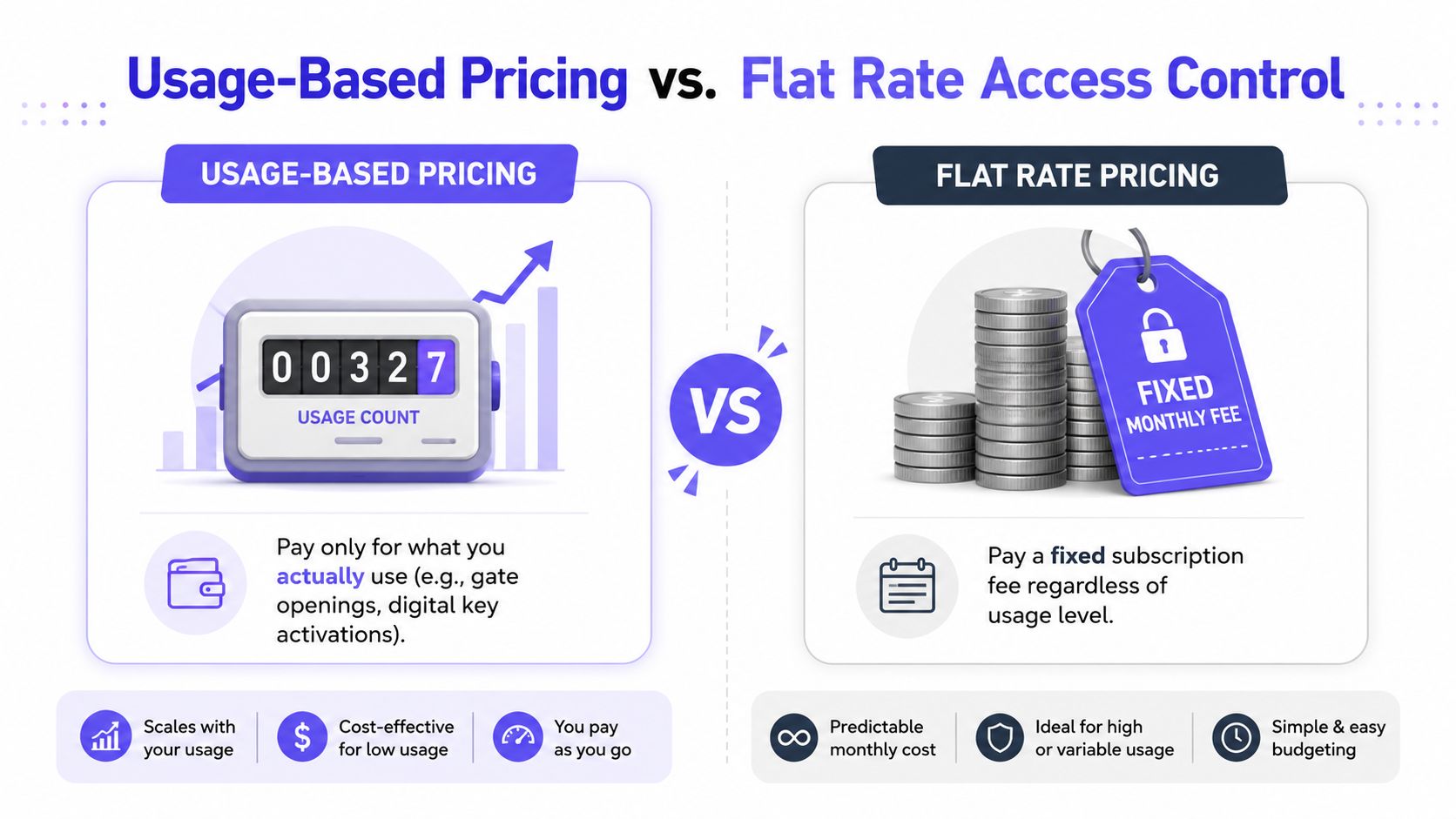
In access control, the "usage" side only works if the provider can count events cleanly and tie them to a billable unit that makes operational sense. That matters more in cloud-managed systems, especially in cloud-based access control for properties, where permissions, logs, and remote actions already flow through software.
How it differs from older pricing models
The contrast becomes clearer when put side by side.
| Model | How it usually bills | Common issue |
|---|---|---|
| Flat-rate subscription | Same monthly fee regardless of activity | Light-use properties may feel overcharged |
| Per-user or per-door | Charges based on people, units, or hardware count | Doesn't always match actual access activity |
| Tiered pricing | Different pricing bands based on account size | Can still be disconnected from real event volume |
| Usage-based pricing | Charges tied to measured activity | Requires strong metering and visibility |
A flat monthly rate is simple. It also ignores whether one property handled a handful of visitor approvals and another handled constant entry activity.
Per-user pricing can be just as awkward in real estate. A community with many residents may not generate as much operational load as a smaller property with high guest turnover, active vendor traffic, and frequent remote access requests.
Tiered pricing improves packaging, but it still groups customers into broad buckets. That helps sales and procurement, but it doesn't always create fairness at the property level.
Why this model is gaining traction
Usage-based pricing is no longer niche in software. More than 46% of SaaS companies now use usage-based pricing, and Gartner has been quoted as predicting that 70% of businesses will prefer usage-based pricing over per-seat models by 2026, according to M3ter's guide to usage-based pricing.
That shift matters in access control because usage is rarely uniform. A residential side gate, a clubhouse door, and a warehouse vehicle gate may all sit under the same ownership umbrella while producing very different patterns of activity.
The stronger the variation between sites, the weaker a one-size-fits-all access pricing model tends to look.
For property managers, this doesn't mean every property should move to pure pay-per-use billing. It means the old assumption, that fixed pricing is automatically the cleanest option, is no longer safe. Modern access systems can measure what happens. Once that visibility exists, pricing can follow it.
The most practical version often isn't purely variable. Many operators prefer a structure with a stable baseline and a metered component for heavier activity. That preserves some monthly predictability while still aligning cost with the way the site is used.
Benefits and Drawbacks for Property Managers
Where usage pricing helps
The biggest benefit is cost fairness. If one property generates modest access activity and another has constant remote opens, visitor approvals, and temporary credentials, a usage model can separate those realities instead of averaging them together.
That can help in several common situations:
- Smaller sites with lighter traffic: They don't have to carry the same pricing logic as busier communities.
- Growing portfolios: Costs can rise with operational demand instead of forcing an early jump to a larger fixed plan.
- Properties with seasonal swings: The bill can track what happened rather than what might happen.
A second benefit is operational visibility. A metered pricing model usually forces better reporting. Managers see more clearly which doors, gates, or workflows are driving activity, and that often improves staffing, scheduling, and policy decisions.
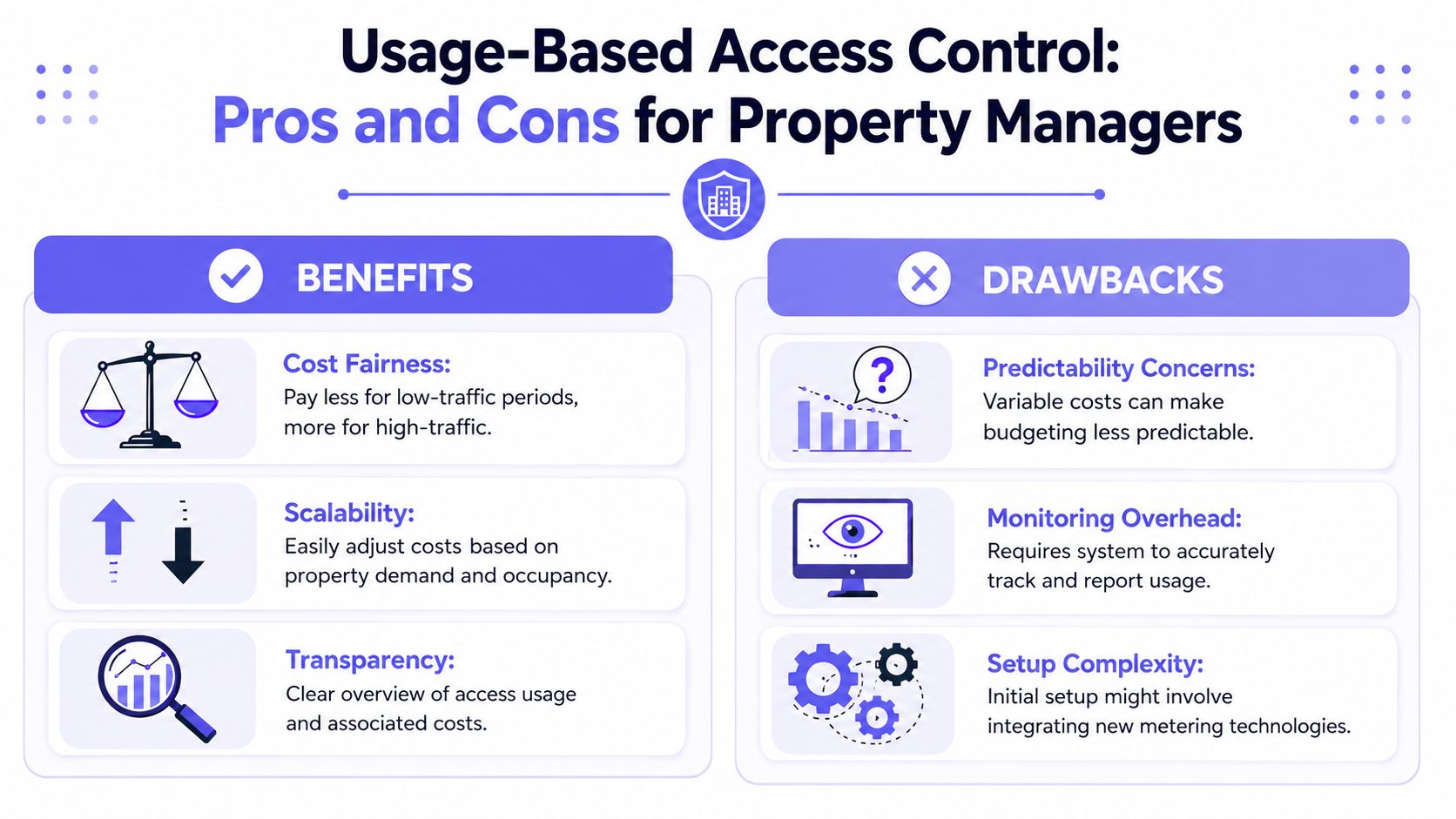
For some communities, that visibility is as useful as the billing change itself. It turns access control from a fixed line item into an operational dataset.
A property team comparing vendors can also use a broader gated community access control comparison to judge whether labor-heavy or hardware-heavy alternatives are masking the true cost of gate operations.
Where it creates friction
The main drawback is obvious. Budget uncertainty.
When usage rises, cost can rise with it. That makes some boards nervous, especially when they manage properties with uneven visitor traffic, delivery spikes, seasonal residents, or frequent contractor access.
There's also a practical concern around trust. If the system can't show exactly what was counted, managers will question the invoice. In access control, disputes usually don't start because a board hates flexible pricing. They start because the site team can't verify which events were billable and which were not.
A variable bill is tolerable. A variable bill that can't be audited isn't.
A second friction point is implementation discipline. Usage pricing sounds elegant in procurement meetings, but it can become messy if the provider hasn't built reliable event logging, clean entitlements, and understandable dashboards.
What makes the trade-off manageable
The answer isn't to avoid variable pricing altogether. It's to insist on controls.
According to OpenMeter's overview of usage-based pricing challenges, the main challenge with usage-based models is budget uncertainty, which has led to procurement controls such as spending caps, real-time usage alerts, and annual commitments with flexible drawdowns becoming mainstream.
For property managers, those controls translate well into access operations:
- Set monthly caps or allowances for each property or entry point.
- Require live usage visibility before invoices close.
- Use alerts at defined thresholds so teams can react before costs surprise anyone.
- Review historical patterns before choosing pure usage pricing over a hybrid plan.
The balanced conclusion is straightforward. Usage pricing works best when the property's access intensity varies and when the provider gives the manager tools to monitor, cap, and explain that usage. Without those safeguards, the flexibility isn't worth much.
How Usage-Based Pricing Works in Practice Examples
The unit of value comes first
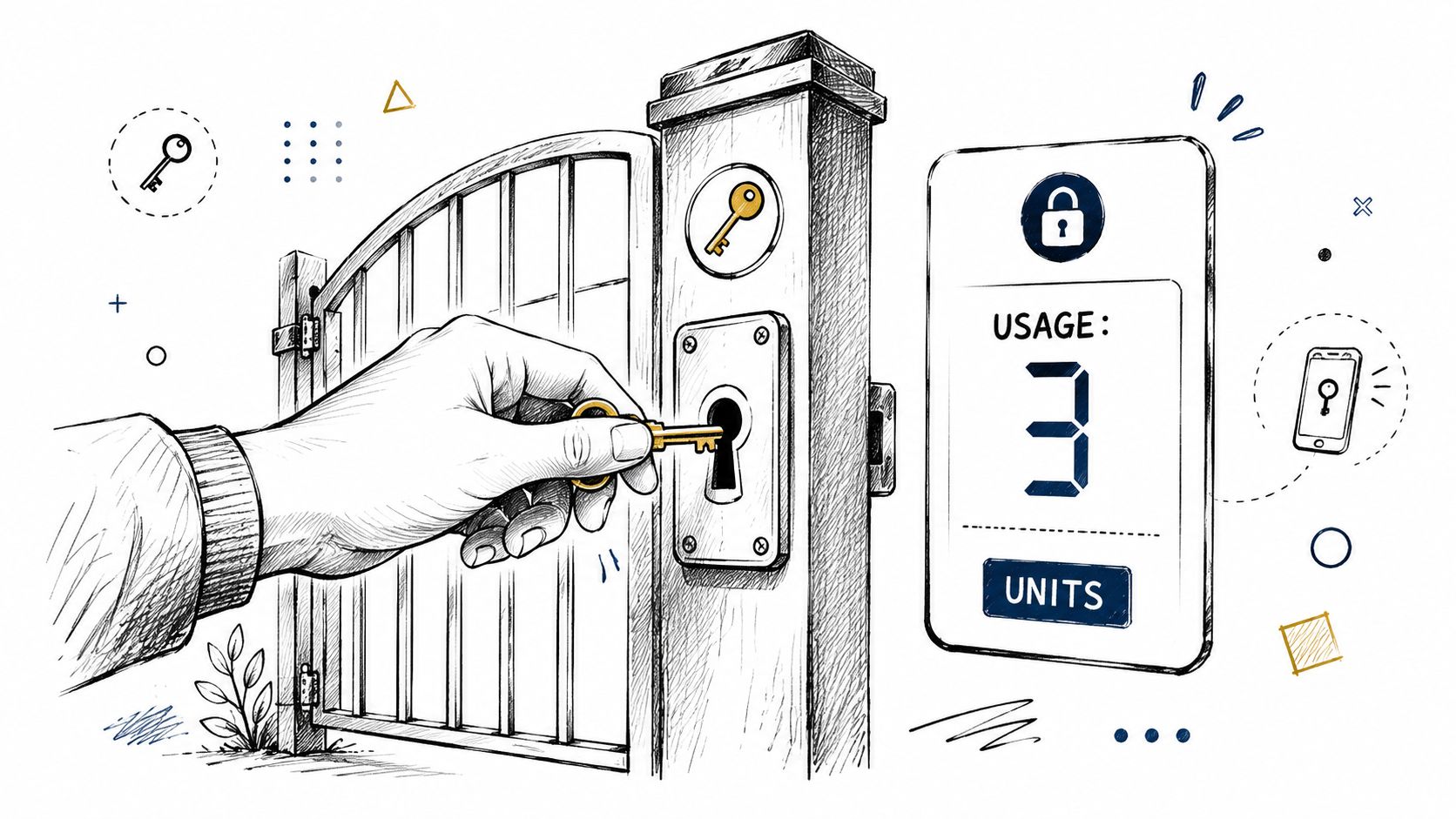
A usage model only works when everyone agrees on what is being counted. In access control, the cleanest billing units are observable actions that map to real system workload, not vague ideas about convenience or premium service.
According to XYTE's guidance on implementing usage-based pricing, effective usage-based models should be built around a single, observable unit of value that reflects service intensity, such as transaction volume.
In plain terms, that usually means choosing one primary meter, then building the billing logic around it.
Common examples include:
- Access transactions: Gate openings, remote activations, or approved entry events
- Credential activity: Temporary key issuance, scheduled permissions, or visitor passes
- Interaction-based events: Directory calls, remote approvals, or monitored visitor workflows
For teams that want to understand how metered systems typically count billable activity, Capgo billing metrics is a useful background read because it explains the discipline behind usage counting without limiting the discussion to access control.
Scenario one small HOA
A small HOA usually wants two things from gate access. Reliability and simplicity.
If resident traffic is consistent and visitor volume stays light, usage-based billing can make sense when the property would otherwise be stuck in a flat plan designed for busier communities. Instead of paying for capacity it rarely uses, the board can align cost more closely to actual gate activity.
This works best when the billable event is easy to explain. A remote gate open, a visitor credential, or an approved guest entry makes intuitive sense to board members reviewing invoices.
A practical fit looks like this:
- Stable resident routines keep baseline activity understandable.
- Occasional guest surges are visible rather than buried inside a generic subscription.
- Simple audit trails let the board confirm what happened without technical guesswork.
The risk appears when the HOA wants perfect invoice predictability above all else. In that case, a hybrid arrangement often feels safer than pure event billing.
Scenario two busy multifamily property
A multifamily building creates a different access pattern. There are residents, staff, vendors, deliveries, amenity access changes, move-ins, move-outs, and after-hours requests. The system is doing more operational work, even if the hardware footprint doesn't look dramatically different from another property.
In that environment, usage pricing can be useful because activity scales with occupancy behavior. During high-turnover periods, the property may issue more temporary credentials and process more access actions. During calmer months, activity can normalize.
The most defensible pricing model is usually the one that matches the manager's actual workload, not the one that looks simplest on a rate card.
For multifamily operators, remote visitor management takes on importance. If the platform supports app-based entry, temporary digital credentials, and centralized administration, the team can connect billing to workflows they already understand. They aren't paying for abstract software value. They're paying for logged access operations.
Still, many residential operators prefer a fixed monthly rate because boards and owners like consistency. That preference is reasonable. Usage billing isn't automatically superior just because it is more dynamic.
Scenario three commercial yards and warehouses
Commercial sites are where usage-based access pricing often becomes easiest to justify. A logistics yard, warehouse, or transportation facility may have unpredictable peaks tied to shift changes, deliveries, contractor arrivals, and operational surges.
Those properties consume access control differently from a gated neighborhood.
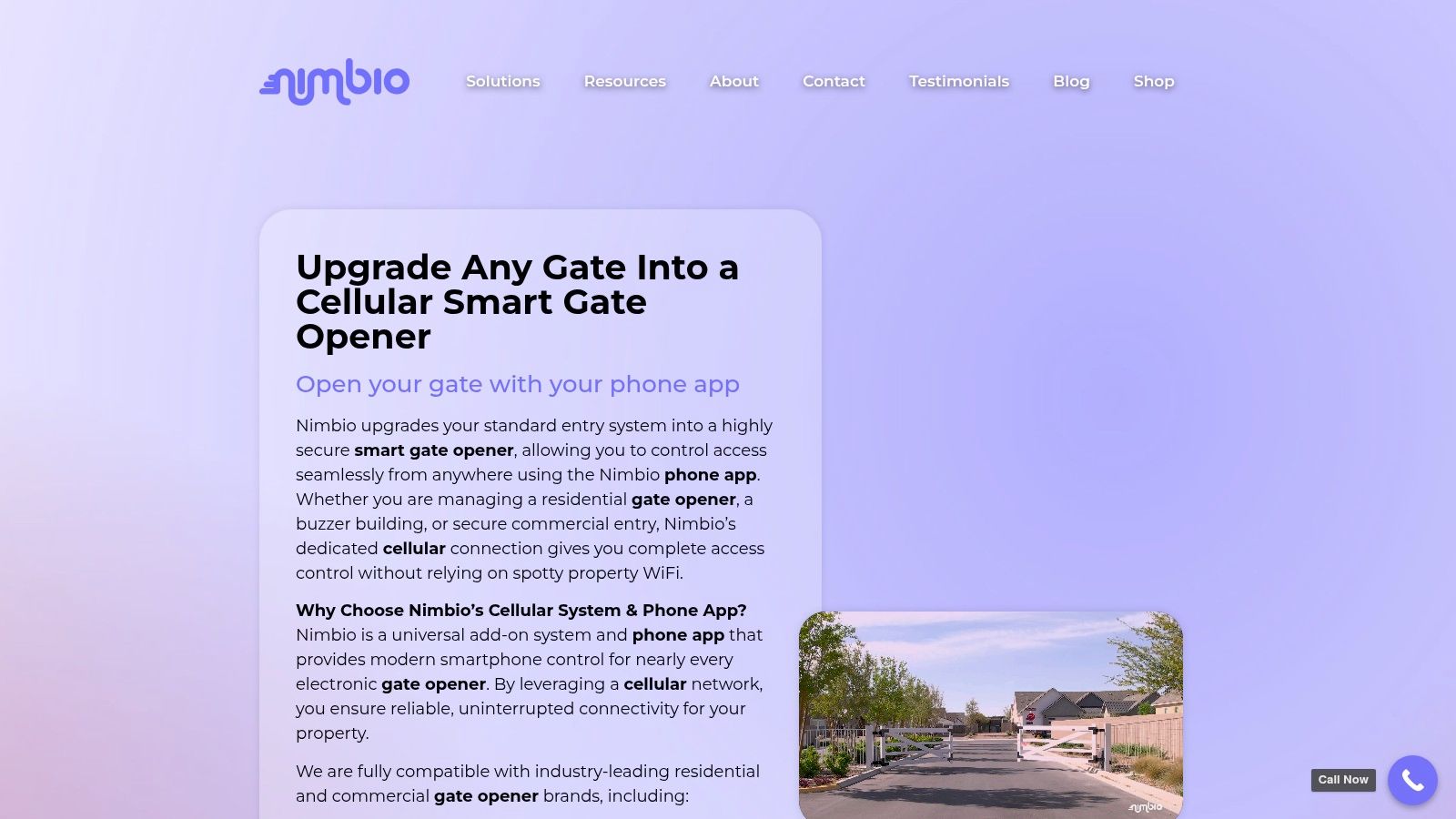
A cellular, hardware-agnostic retrofit can be especially relevant here because commercial operators often want to modernize existing gates and doors without replacing the underlying gate operator or rebuilding the site network. In that context, Nimbio can be used as one option for smartphone-controlled access on existing electronic gates and entry points, with cellular connectivity, remote credential management, and a commercial pricing structure that can accommodate variable usage.
Commercial teams usually care about three operational outcomes:
| Concern | Why it matters in commercial access |
|---|---|
| Traffic volatility | Entry demand can spike by shift or delivery window |
| Remote control | Managers need to grant or revoke access without being on site |
| Infrastructure reliability | Cellular connectivity helps avoid dependence on local Wi-Fi conditions |
In commercial settings, variable pricing tends to feel more natural because the site's activity already fluctuates. A fixed residential-style plan can understate heavy operational use or force the operator into a package that doesn't match real traffic patterns.
Implementing and Managing a Usage-Based System
What to track before rollout
Most access control billing problems start before the contract is signed. A property agrees to a usage model without deciding which events matter, who reviews them, and what thresholds should trigger an alert.
A practical rollout starts with operational metrics, not price sheets.
Track these first:
- Daily entry counts: Separate routine resident traffic from guest, vendor, or staff activity.
- Peak access windows: Note shift changes, school pickup periods, move-ins, and recurring delivery blocks.
- Credential issuance activity: Watch temporary passes, scheduled access windows, and revocations.
- Remote approvals: Count how often staff or residents open gates from an app or admin dashboard.
That baseline tells the manager whether variability is occasional or constant. It also shows whether the likely billable unit reflects how the property uses the system.
What to demand from a provider
A usage model should never rely on estimates. It needs metering, entitlement checks, and billing automation that can stand up to audit.
According to Stigg's usage-based pricing implementation guide, a successful model requires event metering, entitlement checks, and billing automation, and the platform must bill from a durable log of every actionable event because billing accuracy depends on the integrity of the underlying meter data.
That requirement changes the buying checklist. Property teams should ask for:
- A live dashboard that shows current usage before invoicing.
- Threshold alerts that warn when a site is nearing a cap or allowance.
- Historical reporting that supports audit, budgeting, and vendor review.
- Clear entitlement logic so admins know what happens when limits are reached.
- Role-based controls and identity discipline for administrators, especially on larger portfolios. For teams reviewing sign-in and identity handoff basics, Intelligent Contacts' SSO guide is a useful reference point for understanding the broader authentication side of secure software access.
If the provider can't show how an event is counted, the manager shouldn't agree to be billed for it.
A detailed secure smart access point guide can also help teams connect pricing discussions to the daily realities of managing credentials, entry points, and audit trails across a property.
Why the connectivity layer matters
The billing model is only as trustworthy as the event log behind it. If access events drop, duplicate, or arrive late because the underlying connection is inconsistent, the invoice becomes harder to defend.
That is one reason cellular-connected access control deserves attention. For many properties, avoiding dependence on local Wi-Fi reduces one common failure point in event capture and remote command delivery. In a metered model, cleaner connectivity supports cleaner billing.
The same is true for retrofit strategy. If the platform can modernize an existing gate or door instead of forcing a full hardware replacement, the property can adopt better logging, remote management, and measurable access workflows without turning the project into a complete infrastructure overhaul.
Frequently Asked Questions
Is usage-based pricing better than a flat monthly fee
Not always. It tends to fit properties where access activity varies meaningfully across sites, seasons, or operating schedules.
A flat fee is often easier for strict budgeting. A usage model is often fairer when the property's workload changes a lot from month to month.
What should count as usage in an access control system
Only events that are observable, auditable, and clearly tied to system activity should count. Good examples include access transactions, remote releases, or credential actions.
Bad billing units are vague ones. If a manager can't explain the charge to a board or owner, the unit probably isn't strong enough.
How can a property avoid surprise bills
The contract should include controls before the system goes live.
The most useful protections are:
- Spending caps: These stop usage from running beyond an agreed comfort zone.
- Threshold alerts: These give the property team time to react during spikes.
- Usage dashboards: These make billing visible before month-end.
- Historical reviews: These help boards choose a pricing model based on actual patterns rather than assumptions.
Does this model work for residential communities
Yes, but not every residential property needs it.
Many HOAs and multifamily buildings still prefer fixed monthly pricing because it simplifies communication with residents and board members. Usage pricing tends to fit better when visitor traffic, vendor access, or remote approvals swing enough to make flat pricing feel disconnected from reality.
Why are more technology companies using this model
The broader software market has already moved in this direction. According to BillingPlatform's discussion of usage-based pricing, 45% of SaaS companies were using usage-based pricing in 2021, up 11 percentage points from 2020, and companies using the model showed about 10 percentage points higher net dollar retention than subscription-only companies.
That doesn't prove every property should adopt it. It does show the model has become credible, sustainable, and familiar to buyers evaluating modern service platforms.
For access control, the takeaway is simple. The right pricing model should match the actual behavior of the property, preserve security during busy periods, and give managers enough visibility to defend both the invoice and the operating plan.
Properties that want smartphone-based gate and entry control without replacing existing equipment can explore Nimbio for cellular-connected access management, remote visitor workflows, and retrofit-friendly modernization across residential and commercial sites.
For current plans and costs, see the Nimbio pricing page.