The commercial segment accounts for over 48% of the USD 2.49 billion gate openers market in 2023, and the category is projected to reach USD 4.31 billion by 2032. That tells property managers, HOA boards, and facility teams they're making an infrastructure decision, not buying a niche accessory.
For a commercial gate opener, the question isn't just which motor looks strongest. It's whether the site needs continuous duty, compliant safety hardware, and a retrofit path that won't force a full access-control rebuild.
Table of Contents
- Why Commercial Gate Openers Are a Different Category
- Commercial Gate Opener Types and When to Use Each
- Key Features and Specifications to Evaluate
- Installation and Maintenance Realities
- Costs, ROI, and Budget Planning for Commercial Gates
- Security and Compliance Requirements
- Retrofit vs Full Replacement Decisions
Why Commercial Gate Openers Are a Different Category
Commercial gate openers belong to a different class of equipment because they are tied to daily site operations, not occasional home use. Property managers should evaluate them based on duty cycle, compliant safety hardware, gate mass, gate length, and the retrofit path, since a strong motor alone does not tell you whether the system will hold up under real traffic.
A commercial site puts different stress on a gate operator than a driveway at a single home. Traffic is heavier, users are less predictable, and the opening cycle becomes part of routine access control rather than a convenience feature.
What changes in practice
A commercial gate opener is judged by more than motor size. The key variables are duty cycle, gate mass, gate length, safety integration, and whether the access system can keep working when the site is busy.
Practical rule: if a gate is part of daily operations, it should be specified like any other critical facility asset, with load, traffic, and safety engineered together.
That is where the retrofit question starts to matter. Many properties already have a gate that is structurally usable, so the decision is often how to modernize the access layer without tearing out the entire installation. In that setting, programmatic gate control for fleets can be a practical fit for sites that need centralized access changes, visitor handling, or multiple gate locations managed from one system.
Property managers need a broader buying lens than the product sheet alone provides. A unit that looks adequate on paper can become the wrong choice if the site needs repeated cycles, remote visitor handling, or a future access upgrade.
For that reason, the guide focuses on four things that usually decide the outcome in the field:
- Which operator type fits the site
- Which specifications matter
- What installation and maintenance involve
- Whether the existing gate can be retrofitted instead of replaced
The retrofit question matters more than most vendor brochures admit. Many sites already have a usable gate, which means the operator decision is really part of a larger modernization plan, not a simple swap.
Commercial Gate Opener Types and When to Use Each
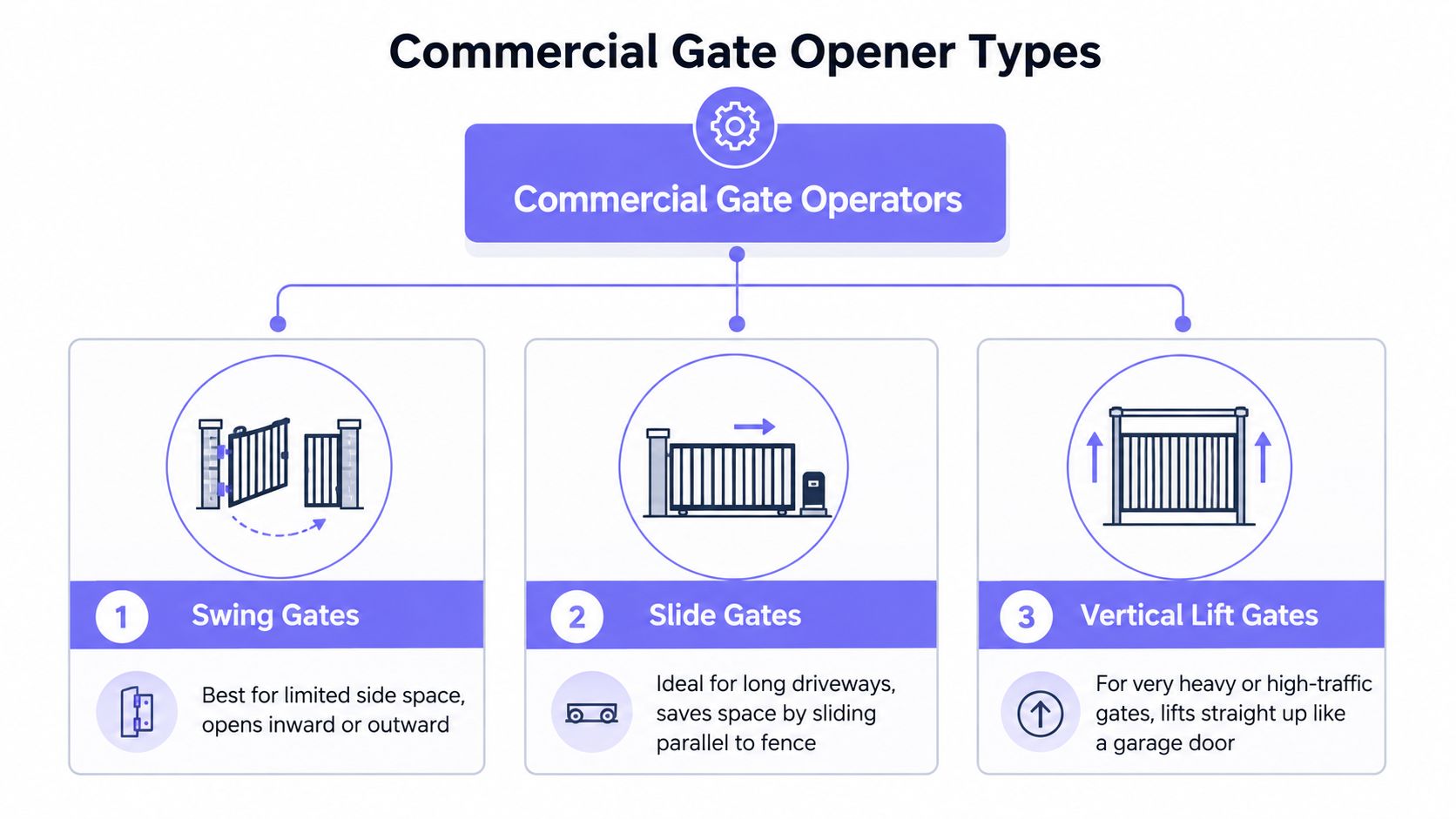
Commercial gate operators usually fall into three working categories, swing, slide, and vertical lift. Site geometry should drive the operator type selection, because each style fits a different physical layout and traffic pattern.
Swing gates work when clearance exists
Swing operators fit entrances with enough room for the gate to open inward or outward without hitting parked vehicles, landscaping, walls, or pedestrian paths. They are common at smaller commercial entrances, HOA driveways, and office properties where the approach is wide enough to keep the gate path clear.
The hardware specs show why gate size has to be matched carefully. A 1/2 HP linear commercial swing operator is rated for gates up to 18 ft and 700 lb, while the 1 HP version is rated for 26 ft and 1,000 lb. In that same series, the swing models open in about 15 seconds (linear swing specs PDF).
For retrofit projects, swing gates can be practical when the existing gate structure is still sound and the site has enough clearance to keep the old layout. That is often the case in HOA and low-rise commercial work, where the opener changes more than the gate itself. If you are tying the gate into broader access logic, a platform for programmatic gate control for fleets can simplify centralized changes without replacing the whole entrance.
Slide gates dominate tighter, busier sites
Slide operators fit better when side clearance is limited or the gate has to manage a heavier traffic pattern. Because the gate moves parallel to the fence line, the footprint stays compact, which is why slide systems show up so often in commercial settings.
The market data reflects that demand. Sliding gate openers were estimated at USD 496.48 million in 2026 and projected to reach USD 792.95 million by 2035 at a 5.4% CAGR. In 2023, more than 1.8 million sliding gate opener units were installed worldwide, with North America at 620,000 units (34%), Europe at 540,000 (30%), Asia-Pacific at 500,000 (28%), and the rest of the world at 140,000 (8%) (market growth reports sliding gate opener market).
Slide systems are usually the first option for busy commercial drive points, especially where the property line, landscaping, or traffic flow leaves no room for a swinging leaf.
Vertical lift fills a narrower niche
Vertical lift operators make sense where overhead clearance is usable and ground space is tight. They are usually the specialty option for industrial facilities that need direct up-and-down movement rather than a swing arc or a track-based slide layout.
They are also the hardest to retrofit casually. A vertical lift setup often depends on the gate opening geometry, overhead structure, and hardware alignment, so it tends to work best where the site was planned for that motion from the start. For owners evaluating whether to modernize an existing entrance or rebuild it, the guide to fence hardware is a useful reminder that opener choice depends on the whole gate assembly, not only the motor.
Commercial Gate Opener Types at a Glance
| Operator Type | Best For | Max Gate Length | Key Limitation |
|---|---|---|---|
| Swing | Clear side space, moderate traffic | Varies by model, up to 26 ft in one commercial series | Needs swing clearance |
| Slide | High-traffic commercial sites, narrow driveways | Up to 78 ft in one commercial segment (LiftMaster commercial gate operators) | Needs a track or clear slide path |
| Vertical lift | Industrial sites with limited footprint | Site-specific | Needs overhead clearance and specialty hardware |
A separate commercial reference from LiftMaster also points to wide differences in duty, length, and weight handling across operator families, which is why the retrofit decision usually starts with the physical site, not the catalog page.
Key Features and Specifications to Evaluate
Two operators with the same horsepower rating can perform very differently once gate length and weight enter the equation. That is the part many buyers miss. A spec sheet only helps if it is read in the right order, because horsepower is only one piece of the job. The gate operator still has to match gate length, gate weight, duty cycle, and the site's control ecosystem.
Start with load, then traffic, then speed
The cleanest buying mistake is choosing by horsepower alone. One commercial slide operator is rated at 1/2 HP, 45 ft max gate length, 1,100 lbs max weight, and continuous duty. Another commercial operator is listed at 1/2 HP to 1.5 HP and rated for gates up to 45 ft and 1,000 lbs (commercial slide operator listing).
That spread shows why matching the operator to the actual gate matters more than chasing a bigger motor. Two systems with similar horsepower can behave very differently once gate length and weight enter the equation.
Field takeaway: if the gate is long, heavy, or cycled often, the spec should leave thermal margin, not just minimum acceptable power.
Continuous duty is the commercial dividing line
A commercial guide from LiftMaster notes that some operators have no limitation on daily or hourly cycles and can move slide gates up to 75 ft long at up to 3,000 lbs, while swing models can handle up to 22 ft and 2,500 lbs. That is the kind of detail that matters on sites where the gate is part of the workflow.
Continuous-duty operation is not a nice extra. It is the difference between a system that keeps up with traffic and one that overheats under pressure. For properties weighing a retrofit, that also affects whether an existing gate can be modernized with a new operator, or whether the whole assembly needs to change to stay reliable.
Control inputs should match the site, not the brochure
Commercial operators are also expected to accept multiple control devices. One spec lists inputs for phone entry systems, push-button stations, radio receivers, fire boxes, digital keypads, loop detectors, and photocells (commercial operator input spec).
That matters because the opener is only one node in a larger access-control stack. On retrofit projects, the control side often decides how much of the old system can stay in place and where a cellular keyless entry upgrade makes more sense than a full replacement. Before a property commits to new hardware, the guide to fence hardware is a useful reminder that opener choice depends on the whole gate assembly, not only the motor.
Commercial Gate Opener Specification Comparison
| Operator Model | Horsepower | Max Gate Length | Max Gate Weight | Duty Cycle |
|---|---|---|---|---|
| Linear commercial swing operator | 1/2 HP | 18 ft | 700 lb | About 15 seconds to open, cycle rating not specified in the cited data |
| Linear commercial swing operator | 1 HP | 26 ft | 1,000 lb | About 15 seconds to open, cycle rating not specified in the cited data |
| Linear commercial slide operator | 1 HP | 78 ft | 2,200 lb | Continuous duty |
| Commercial slide operator listing | 1/2 HP | 45 ft | 1,100 lb | Continuous duty |
The right reading habit is simple, match weight, length, and cycle demand before comparing motor labels.
Installation and Maintenance Realities
A commercial gate opener install starts with the gate, not the operator. If the structure is weak, misaligned, or poorly balanced, even a strong opener becomes a maintenance problem.
What gets checked before anything is mounted
The gate's condition has to be evaluated for construction, swing direction, load-bearing capacity, and power availability. If the site doesn't have usable electrical service, the project can turn into an infrastructure job before the operator even goes in.
A practical sequence usually looks like this:
- Site assessment
- Structural evaluation
- Operator mounting
- Safety device installation
- Control wiring
- Final testing
That workflow keeps the installer from hiding a bad gate behind a new motor. It also reduces the chance that a mismatch will show up after the site is already live.
Maintenance is about preventing small failures
Commercial systems don't usually fail all at once. They drift out of alignment, lose sensor reliability, or start showing up as intermittent trouble at the worst time.
Routine care should include:
- Lubrication of moving parts
- Inspection of safety sensors
- Testing of entrapment protection
- Seasonal limit adjustments
- Fast checks after storms or power events
A commercial gate should be treated like access infrastructure, not like a one-time install. If the gate stops operating cleanly, traffic backs up and users notice immediately.
There's another planning detail that gets missed often. Teams should leave room for later additions such as cellular access, camera triggers, loop changes, or tighter security settings, because retrofit demands rarely stop at day one.
That upgrade margin saves a site from doing the same work twice.
Costs, ROI, and Budget Planning for Commercial Gates
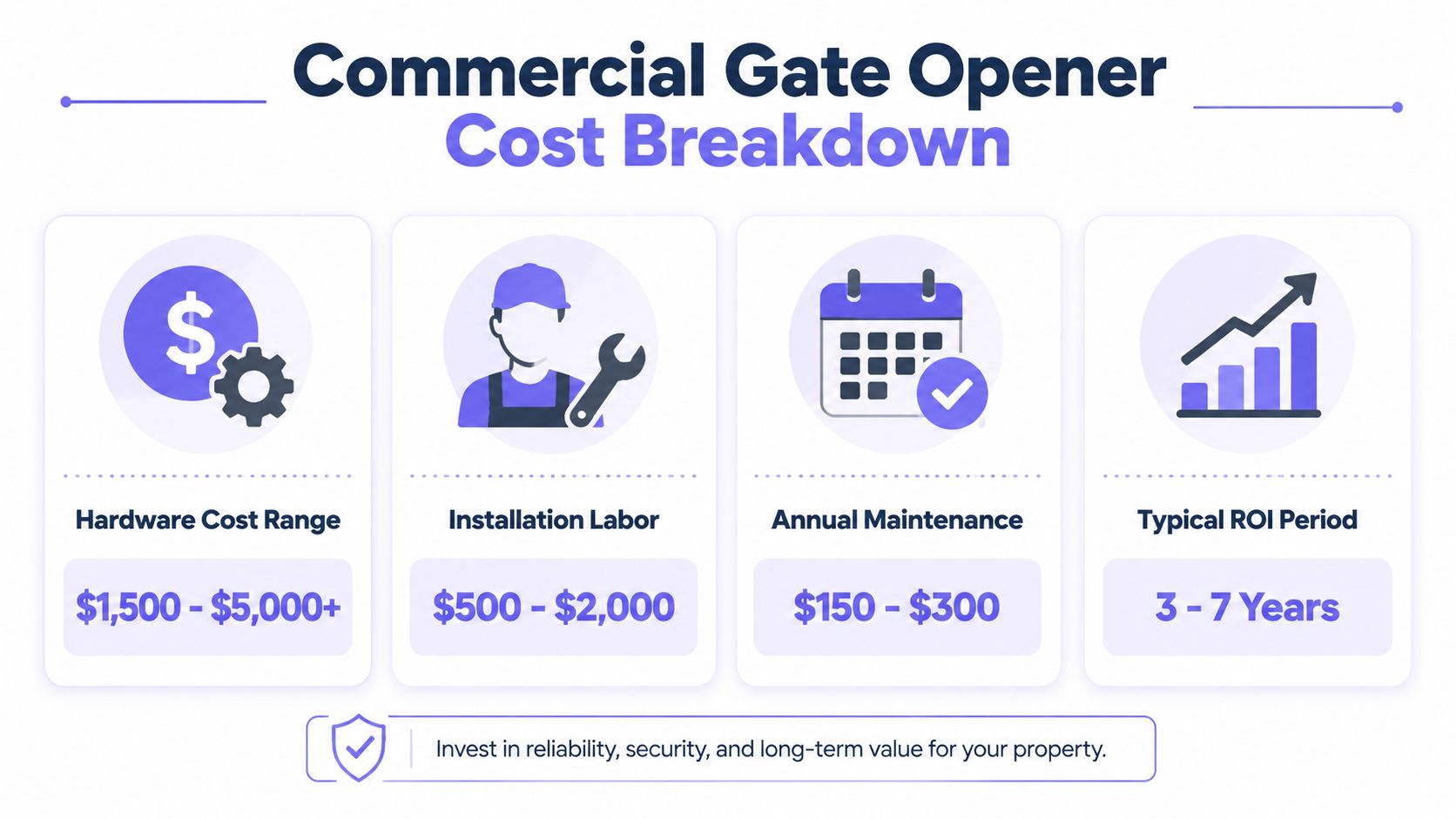
Commercial gate opener budgets usually fail when teams only price the operator itself. Hardware is visible, but labor, controls, and ongoing service are what shape total cost.
Build the budget around the full system
The hard cost question is not just what the gate operator costs. It's what it costs to install, wire, test, maintain, and eventually adapt the system when access rules change.
A practical budget should account for:
- Operator hardware
- Installation labor
- Safety devices
- Control integration
- Replacement parts
- Scheduled maintenance
- Ongoing access software or service fees
The U.S. gate opener market was USD 0.33 billion in 2023 and is expected to reach USD 0.60 billion by 2032 (SNS Insider gate openers market report). That growth points to a mature vendor environment, which usually helps buyers compare options without being locked into a single path.
The hidden cost is often access management
A lot of sites still spend money keeping legacy entry methods alive, physical fobs, replacement keypads, and shared codes that are hard to audit. Those costs don't always show up in the capital budget, but they show up in staff time and security cleanup.
For teams comparing access models, a usage based pricing guide for HOAs is useful because it frames recurring access costs alongside the operating burden of older credential systems.
What ROI usually comes from
The return on a modern access setup usually comes from three places:
- Fewer access headaches
- Less labor spent on remote entry handling
- Longer hardware life when the operator is correctly rated
A smart access platform can also support better auditability, which matters when managers need to know who entered and when. That is especially relevant on mixed-use and multifamily sites where access mistakes create more downstream work than the original fix.
Security and Compliance Requirements
Commercial gate safety is not optional, and it is not just a submittal item. The operator, the gate, and the safety devices have to work together, or the installation carries avoidable risk.
Dual monitored entrapment protection is the baseline
Commercial systems should use dual monitored entrapment protection. In practice, that means the operator's reversing logic has to work with secondary devices such as photo eyes or sensing edges, so the system fails safe if one device stops doing its job (commercial gate opener safety and compliance guidance).
A gate motor alone cannot protect people. Safety comes from the full circuit of detection, reversal, and physical gate design working together.
ASTM F2200 shapes the gate itself
The same guidance ties commercial gate construction to ASTM F2200. That includes smooth surfaces, picket spacing under four inches, and travel stops that help prevent crushing hazards and over-travel.
The practical point is straightforward. A gate can look heavy-duty and still miss the mark if the structure, spacing, or stopping points are wrong.
Compliance note: installers should verify the whole assembly, not just the opener label, because the gate frame, sensor layout, and class rating all affect the safety outcome.
A practical site checklist
Before approving a commercial installation, the site team should confirm:
- Secondary entrapment devices are present
- Sensors are monitored, not just installed
- Gate construction aligns with ASTM F2200 expectations
- Travel stops are in place
- The operator rating matches gate size and duty
- The access system can document and support the chosen setup
For teams comparing regional installer practices, access control systems in Perth is a useful reference point for how commercial access projects are scoped in the field.
Retrofit decisions also matter here. A site with sound gate construction may only need a control upgrade, which is where retrofitting legacy gate operators becomes the practical path instead of a full replacement. That approach can preserve the existing gate while modernizing entry control, provided the safety devices and operator class still line up with the site requirements.
Retrofit vs Full Replacement Decisions
Most commercial gate guides stop at the operator purchase. That misses the question property managers ask: can the existing gate be modernized without tearing everything out?
Start with what the site already has
Retrofit planning begins with the physical gate and the existing electrical setup. The core checks are straightforward, gate construction, swing direction, power availability, and current safety features.
Those constraints matter because most sites aren't clean new installs. They inherit mixed-vintage hardware, partial upgrades, and access rules that changed after the original gate went in.
Practical rule: if the gate is structurally sound, the lowest-risk upgrade is often to modernize access control first, not replace the gate assembly first.
Full replacement isn't the only upgrade path
A cellular retrofit can sit between “do nothing” and “replace everything.” In that model, a controller attaches to the existing operator and adds smartphone-based access control, remote visitor management, and entry logging without requiring Wi-Fi at the gate.
One option in that category is Nimbio, which retrofits existing gate operators with a cellular controller, supports remote opening through a mobile app, and works with major operator brands including LiftMaster, Viking, FAAC, Nice, DoorKing, and Mighty Mule. It also supports GuestView, which lets visitors request entry through a video call — one-way by default, two-way optional, and it offers a partner program for installers plus a lifetime hardware warranty.
Why retrofit often wins on operational fit
Retrofit is attractive when downtime matters. It preserves working hardware, avoids a full rewrite of the access system, and gives managers a better path for adding or removing credentials remotely.
For teams comparing upgrade options, retrofitting legacy gate operators is the right starting point because it shows how an add-on controller can modernize the site without requiring a new gate operator.
The main trade-off is clear. Full replacement gives a fresh mechanical system, while retrofit keeps usable hardware in place and focuses the spend on access control. On many commercial properties, that's the more realistic way to improve security without disrupting daily traffic.
If a commercial gate is already in place, the next move should be a retrofit review, not a blind replacement order. Visit Nimbio to see how cellular keyless access can modernize an existing gate operator, preserve working hardware, and give managers a cleaner way to manage credentials, visitors, and audit logs.
Securing gates or doors at a commercial property?
See how cellular access control works for commercial sites. Explore Commercial Gate & Door Access Control →