Commercial real estate development shapes far more than skylines. In 2020, the sector contributed over $1 trillion to U.S. GDP and supported 8 million jobs, while the total value of U.S. commercial real estate was estimated at $14.4 trillion to $17 trillion, according to commercial real estate market figures compiled here.
For property managers, HOA leaders, and building operators, that scale matters for a practical reason. Every decision made during commercial real estate development, from site access to utility coordination to entry systems, becomes an operating reality after the ribbon cutting.
A property that looks efficient on paper can still become hard to secure, expensive to manage, and frustrating for residents or tenants if development teams ignore operations too early. The strongest projects treat management, access control, and long-term resilience as part of development itself.
Table of Contents
- Understanding the Scope of Commercial Real Estate Development
- The Seven Stages of the CRE Development Lifecycle
- Key Stakeholders and Their Roles in a Development Project
- Navigating Project Financing and Financial Risks
- Regulatory Hurdles ESG and Community Impact
- Future-Proofing Properties with Smart Technology
- Conclusion Key Trends Shaping CRE Development in 2026
Understanding the Scope of Commercial Real Estate Development
Commercial real estate development is the process of creating value by improving land, repositioning an existing property, or building a new one for income-producing use. That can mean a multifamily community, an office asset, a retail center, a warehouse, or a mixed-use site.
From an operator's perspective, development isn't finished when construction ends. It isn't even close. The true test begins when residents start opening gates, delivery drivers need access, vendors arrive after hours, and maintenance teams inherit every shortcut made during planning.
Why operations should shape development decisions
Property managers often inherit problems they didn't create:
- Poor site circulation: Vehicles back up at gates because visitor access wasn't thought through.
- Fragmented building systems: Entry hardware, cameras, and gate operators don't communicate well.
- Maintenance-heavy choices: Cheap hardware lowers upfront cost but raises service calls later.
- Weak credential control: Shared fobs, clickers, and keypad codes make turnover harder to manage.
Those issues rarely start in operations. They start in design briefs, vendor selections, and budget trade-offs.
Practical rule: If a development choice affects daily access, staffing, compliance, or resident experience, it belongs in the planning conversation, not just the turnover checklist.
Commercial real estate development also sits at the intersection of finance, entitlement, design, and management. Developers focus on returns. Lenders focus on risk. Architects focus on plans. Contractors focus on execution. Property managers focus on whether the place functions every day.
That last viewpoint is often underused.
What strong projects get right
The most durable properties usually share a few traits:
- They solve for operations early. Teams think about access, deliveries, security, maintenance, and staffing before procurement is locked.
- They choose flexible systems. Retrofittable, interoperable tools age better than closed systems.
- They reduce avoidable friction. That includes entry bottlenecks, unclear visitor workflows, and manual credential handling.
For anyone managing a smart community, HOA security program, apartment complex, or commercial site, understanding commercial real estate development isn't academic. It's one of the clearest ways to protect asset value after occupancy.
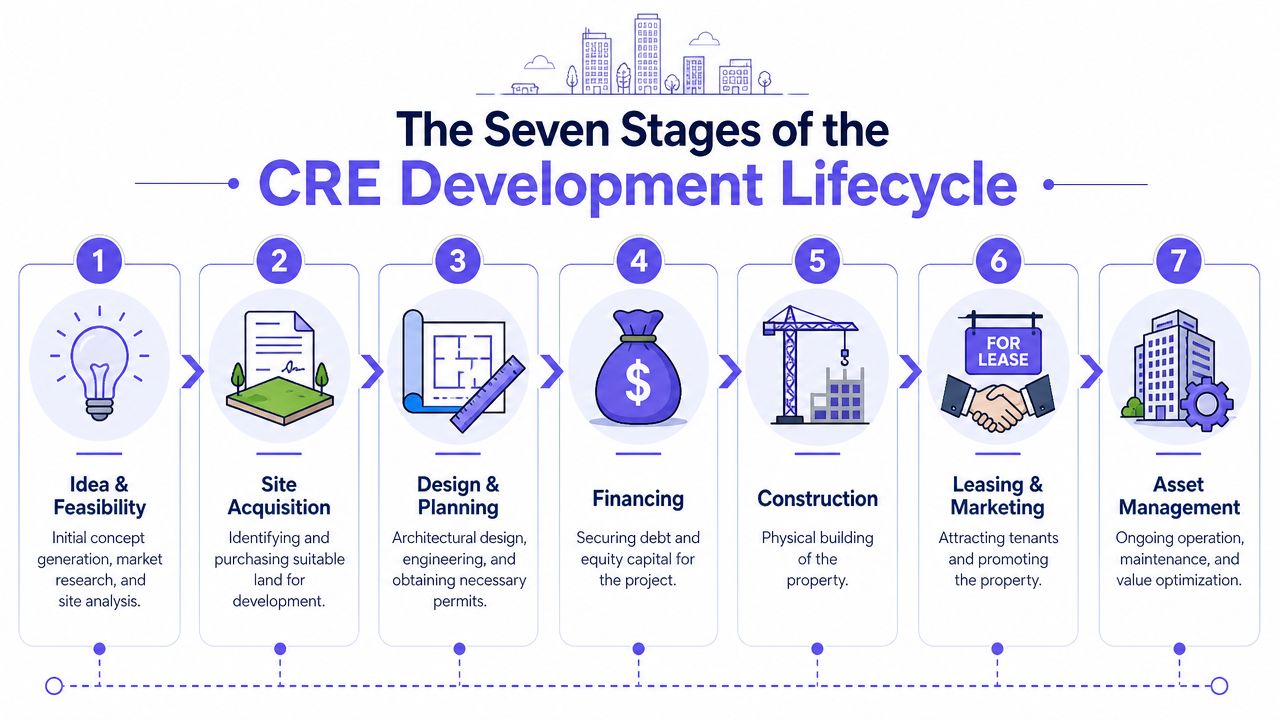
The Seven Stages of the CRE Development Lifecycle
Most commercial real estate development problems can be traced to an earlier stage than people think. A security headache at move-in often starts with site planning. A budget problem during lease-up often starts with underwriting assumptions. A gate access mess usually starts when entry systems are treated as an afterthought.
Why managers should care before construction starts
The highest-risk stages are often site selection and entitlement, because developers must work through zoning, utility availability, and municipal approvals before they can build. Early due diligence helps teams avoid delays, redesigns, and financing issues, as outlined in this overview of the commercial development process.
For property managers, that matters because these early constraints determine things like driveway placement, gate locations, utility routing, pedestrian flow, emergency access, and service access.
The seven stages in practice
- Idea and feasibility
The business case begins. Teams test whether a use fits the location, what demand looks like, and whether the concept can support the required rents or occupancy.
Bad feasibility work creates downstream stress. Managers usually feel it later through awkward layouts, weak amenity placement, or unrealistic operating assumptions.
Site acquisition
The developer secures control of the land or property. The right parcel isn't just one that can be bought. It's one that can be used as intended without hidden legal, infrastructure, or circulation problems.
Access matters here. A site with weak entry visibility or poor vehicle stacking can create permanent congestion issues.
Design and planning
Architects, engineers, consultants, and ownership shape the physical asset. This stage covers floor plans, utilities, life-safety coordination, elevations, and early system selections.
Access control should transition from vague intent to defined scope. Teams should identify gate operator compatibility, resident entry methods, delivery workflows, and visitor management expectations before procurement.
Financing
Debt and equity are assembled around a projected outcome. Lenders and investors want confidence that costs, timing, lease-up, and operations are realistic.
If the budget is too thin, operationally important systems are often downgraded first.
Construction
The plans become physical reality. Coordination quality matters more than glossy renderings at this point.
Field changes can introduce long-term headaches if nobody protects the original operating logic. A relocated pedestal, poor conduit path, or undersized equipment room can limit future upgrades.
Leasing and marketing
The asset moves from project to business. Tenants, residents, brokers, and on-site teams start interacting with the building as a live environment.
Smooth access becomes part of leasing performance. People notice whether entry feels modern, controlled, and convenient.
Asset management
This is the long tail. Ownership and management focus on occupancy, retention, maintenance, expense control, and capital planning.
At this stage, every earlier shortcut shows up in labor hours, complaints, and replacement costs.
A well-developed property doesn't just open on schedule. It operates cleanly, securely, and predictably after turnover.
Key Stakeholders and Their Roles in a Development Project
A development project works a lot like a film crew. One group may get top billing, but the final result depends on timing, coordination, and whether each specialist solves the right problem at the right moment.
Who drives value and who creates friction
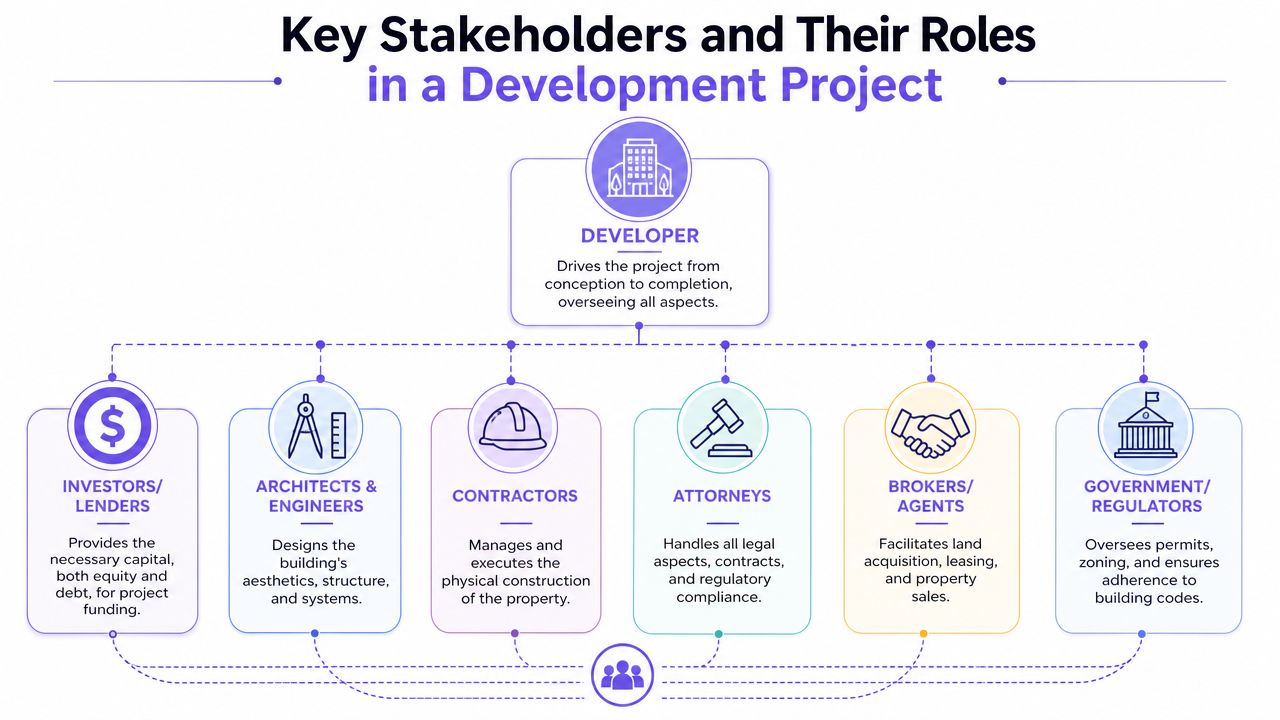
The developer is the quarterback. This role aligns land, design, approvals, financing, construction, and leasing into one executable plan.
Investors and lenders fund the project, but they also influence risk tolerance. Their requirements affect contingency levels, reporting discipline, and how much flexibility the team has when costs change.
Architects and engineers translate concept into buildable systems. They don't just decide how a project looks. They influence circulation, hardware locations, power paths, loading areas, security layers, and how expensive the asset will be to maintain.
Contractors turn drawings into field conditions. They also expose whether the design was realistic. The cleanest set of plans can still fail if coordination breaks down between trades.
Where property managers add the most value
Property and facility managers should be involved earlier than many teams assume. Their strongest contribution isn't abstract. It's operational pattern recognition.
They usually know where projects fail in real life:
- Entry management: Which access methods create fewer lockouts, tailgating issues, and credential headaches.
- Vendor access: How groundskeepers, package carriers, and emergency service providers move through a site.
- After-hours control: Which spaces need scheduled access and which need tighter restrictions.
- Maintenance burden: Which products are easy to support and which create recurring service calls.
A manager who reviews plans during design can prevent years of avoidable friction. That includes advising on gate placement, camera sightlines, call-box visibility, package room access, and whether a cloud-based access control workflow will be practical for staff.
Strong development teams don't ask property managers to "take over" at the end. They use operating input while the building is still on paper.
Attorneys, brokers, regulators, consultants, and specialty vendors all matter too. But from an owner's standpoint, the most expensive mistake is often simple. The people who know how the property will run weren't asked soon enough.
Navigating Project Financing and Financial Risks
Finance determines what gets built, what gets cut, and what operators inherit. In commercial real estate development, design intent only survives if the capital stack supports it.
The numbers that shape real decisions
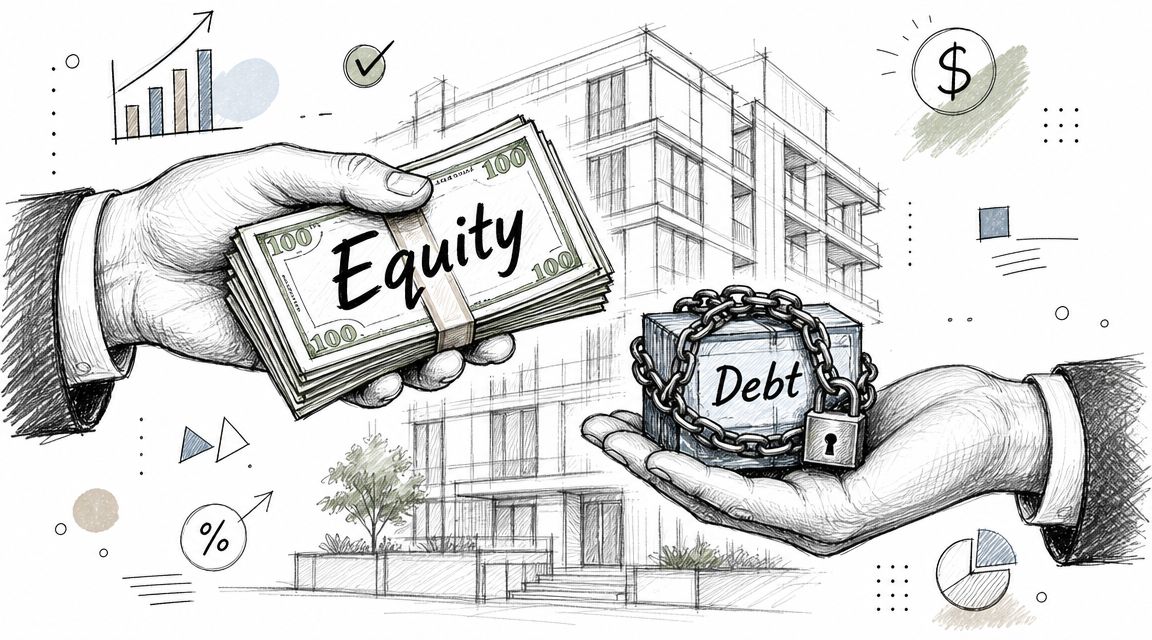
Most projects rely on some mix of equity and debt.
- Equity is ownership capital. It expects upside and usually absorbs more risk.
- Debt is borrowed capital. It expects repayment discipline and tighter covenants.
Teams use data analytics to evaluate whether a deal works. Core metrics include NOI, IRR, cash-on-cash return, and cap rate, and those metrics help developers stress-test underwriting and allocate capital more precisely, as described in this guide to commercial real estate data analytics.
A few more terms matter for operators:
| Metric | What it means in plain language | Why managers should care |
|---|---|---|
| LTV | How much debt is tied to asset value | Higher leverage can mean tighter budgets |
| DSCR | How comfortably property income covers debt payments | Weak coverage can limit operating flexibility |
| Cap rate | A yield shorthand used to compare income-producing assets | It affects pricing expectations and hold strategy |
| NOI | Revenue minus operating expenses, before debt and taxes | Daily operations directly influence it |
How financing choices show up in operations
Owners don't experience financing risk only in spreadsheets. They experience it in operating decisions after delivery.
Examples are easy to spot:
- Underfunded reserves: Deferred maintenance starts early.
- Aggressive underwriting: Management faces pressure to cut staffing or service levels.
- Cheap system selection: Hardware fails sooner and creates more manual work.
- Rigid lender expectations: Capital improvements become harder to approve.
This is why access control deserves a financial lens, not just a security lens. If a property depends on physical fobs, unmanaged clickers, or shared gate codes, staff spend more time on credential turnover, residents face more friction, and auditability stays weak. A more modern setup can support labor efficiency and resident satisfaction at the same time. For multifamily projects, this is a practical place to improve apartment complex ROI.
A financially sound project isn't the one with the lowest opening-day cost. It's the one whose systems keep supporting leasing, retention, and controllable operating expenses after occupancy.
Regulatory Hurdles ESG and Community Impact
Many projects satisfy code and still struggle in practice. Compliance keeps a project legal. It doesn't automatically make it durable, accepted, or well-positioned in the market.
Compliance is the floor not the strategy
Regulatory risk starts early and tends to compound. Zoning conflicts, utility gaps, encroachments, municipal review comments, and permit sequencing can all slow progress or force redesign.
For teams organizing permit workflows, a practical reference is this commercial building permit guide, especially when multiple approvals have to line up across trades and jurisdictions.
Property managers should also pay attention to governance obligations once a community or commercial asset begins operating. In HOA and gated environments, rules around access, common areas, resident rights, and vendor entry affect both policy and system setup. That makes understanding HOA legal requirements part of development thinking, not just post-turnover administration.
Community impact changes project durability
The strongest development strategy now goes beyond permits and basic public messaging. Brookings argues that developers can create inclusive local wealth by structuring projects to include minority-owned firms, shared procurement, workforce-related space, and tiered leases that help local businesses remain viable, as discussed in this analysis of inclusive catalytic development.
That approach matters for managers because community friction often shows up later as leasing resistance, political pressure, or reputational drag. A project that fits its neighborhood usually operates more smoothly than one that treats community concerns as a checkbox.
Useful questions during planning include:
- Who benefits locally: Are local firms included in procurement and tenant strategy?
- Who gets priced out: Does the deal structure leave room for smaller businesses?
- How will access work: Can residents, customers, and service providers move through the site without confusion?
- What will management inherit: Are policies and systems set up for fair, enforceable day-to-day operations?
Community impact isn't separate from asset performance. It affects leasing stability, local support, and how much conflict management must handle later.
Future-Proofing Properties with Smart Technology
A property can be beautifully designed and still be operationally brittle. The overlooked question is whether the building keeps functioning well when traffic patterns change, staffing is thin, vendors rotate, and residents expect mobile convenience.
Top development challenges still include financing, regulation, and supply-chain disruption. But operational resilience remains a major issue, and modern properties need to be flexible and logistics-aware to stay competitive, according to this industry discussion of commercial development challenges.
Operational resilience starts in design
Future-proofing starts with infrastructure choices that don't trap the property in one workflow.
That usually means planning for:
- Reliable connectivity: Entry systems shouldn't fail because local Wi-Fi is unstable.
- Retrofit flexibility: Owners should be able to modernize gates and doors without replacing functioning operators.
- Remote administration: Staff should be able to issue, revoke, and schedule credentials without visiting every entry point.
- Visitor control: Deliveries, guests, vendors, and contractors need a defined process that doesn't depend on shared codes.
Lighting is part of that resilience too. Entry points, pedestrian paths, garages, and service areas work better when visibility supports both security and ease of use. For teams evaluating those upgrades, this overview of business lighting installation is a useful companion to access planning.
Access control is now a development decision
Traditional access setups create familiar pain points. Keypads spread static codes. Fobs get lost. Clickers stay in circulation after tenants move out. On-site staff become the bottleneck for simple access changes.
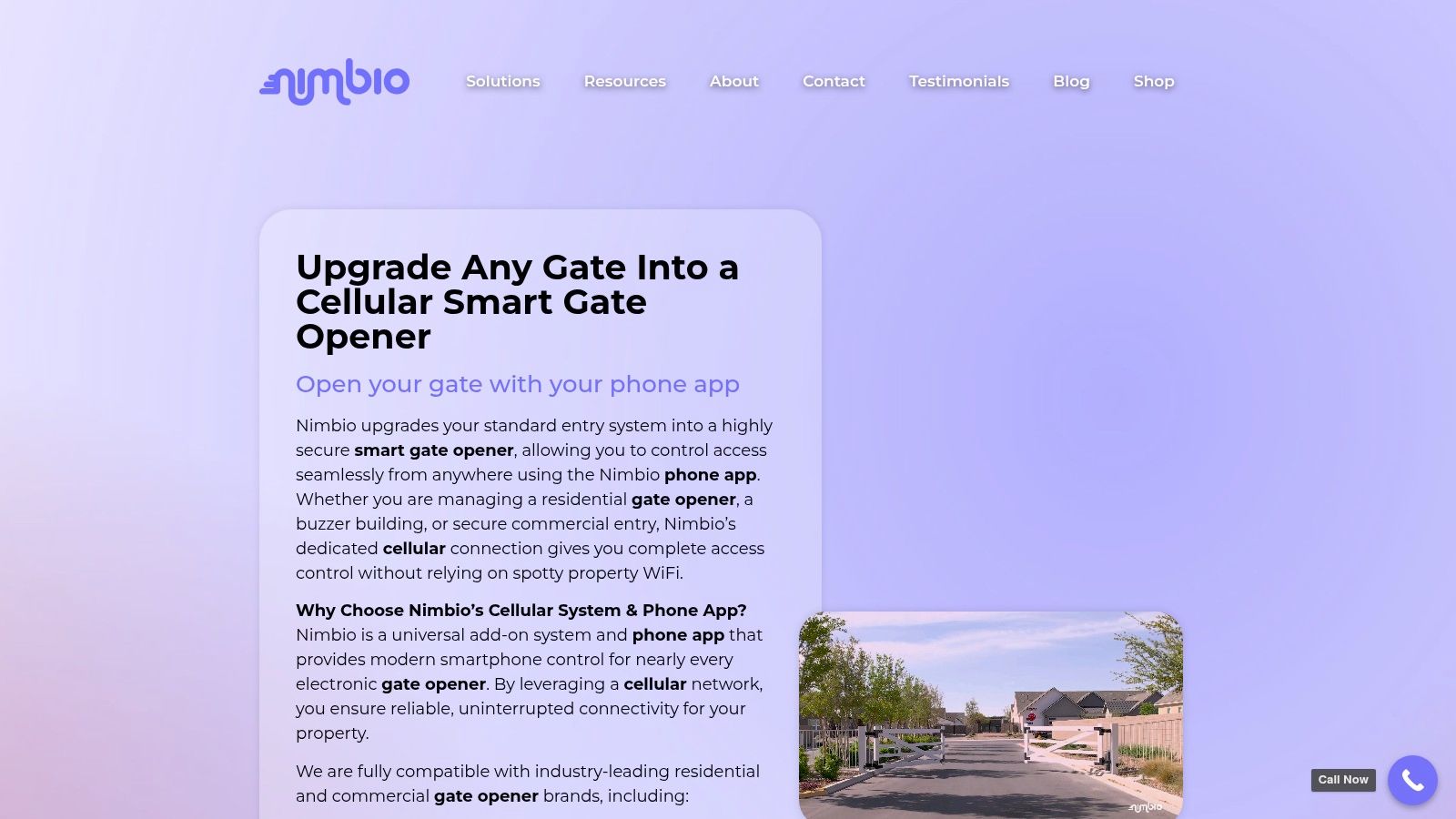
A modern cloud-based access control approach can reduce that friction, especially in gated communities, multifamily sites, and mixed-use properties where turnover and visitor traffic are constant. One example is Discover Nimbio's building solutions, which uses cellular connectivity rather than property Wi-Fi, works as a hardware-agnostic retrofit for existing electronic gates and building entry systems, and supports remote visitor management and digital credential control.
That combination is practical for development and renovation alike.
- For new projects: It can be scoped during design so entry workflows are cleaner from opening day.
- For existing properties: It can modernize access without forcing a full gate replacement.
- For management teams: It supports auditability, faster credential changes, and less dependence on untrackable shared PINs.
The smartest proptech choices aren't the flashiest ones. They're the systems that remove daily friction for residents and staff without creating a new maintenance burden.
Conclusion Key Trends Shaping CRE Development in 2026
Commercial real estate development still follows the same broad logic. Find the right site, secure approvals, assemble capital, build well, lease effectively, and operate with discipline.
What has changed is the margin for operational mistakes. Properties now need to perform as businesses from day one. That means development teams can't treat access, logistics, adaptability, and management workflows as late-stage details.
The near-term outlook still supports that discipline. Looking ahead to 2026, multifamily debt markets were described as strong, with government-sponsored enterprises receiving a 20.5% increase in lending caps, and a Deloitte global survey found 75% of European and Asia-Pacific respondents expected to increase real estate investment in the next 18 months, according to this market outlook summary. That's a projection-oriented signal, not a guarantee, but it points to continued capital interest in the asset class.
For property managers, several themes deserve close attention:
What to watch next
- Mixed-use complexity: More user types mean more complicated access and circulation patterns.
- Adaptive reuse: Older buildings often need infrastructure upgrades to support modern operating expectations.
- Proptech integration: Systems that were once optional are becoming baseline operating tools.
- Operational accountability: Owners increasingly want auditable, remotely managed building systems.
The practical takeaway is simple. A strong commercial property isn't just well financed or well located. It's easy to run, secure, maintain, and adapt.
Managers who contribute during planning, design, and system selection help create better assets. They reduce handoff problems, improve resident and tenant experience, and protect long-term property value in ways that spreadsheets alone don't capture.
If a property is being developed, renovated, or repositioned, access control should be evaluated as part of the asset strategy, not as a last-minute add-on. Nimbio helps property teams modernize electronic gates and building entry with cellular-based, smartphone-managed access that supports remote credentialing, visitor management, and retrofit-friendly deployment.
Portfolio owners and commercial real estate teams can find more detail in the Nimbio guide for commercial real estate & retail centers.