A property manager often notices the same pattern. A resident loses a fob, a vendor keeps using an old PIN, the gate phone stops answering after a network issue, and everyone calls it an “access control problem.”
It usually isn't just one problem. It's a stack of problems. Old credentials stay active too long, entry events aren't traceable, and the physical door or gate hardware doesn't always respond the way the software promised.
That's why a door entry system with lock release matters more than a basic call box or keypad. It combines communication, credential control, and an actual electronic release mechanism so staff, residents, or managers can verify a visitor and grant access to an entry point without handing out unmanaged codes or physical devices.
The category is no longer niche. The global door entry systems market was valued at USD 10.28 billion in 2024 and is expected to reach USD 22.0 billion by 2033, driven by security concerns and demand for remote monitoring and real-time entry logs, according to Coherent Market Insights.
Table of Contents
- What Is a Door Entry System with Lock Release
- The Core Components of Modern Access Control
- Understanding Your Lock Release Hardware
- Remote and Mobile Release Your Access Options
- Selecting the Right System for Your Property
- Enhancing Security with Audits and Management
- Installation Retrofit and Cost Factors
What Is a Door Entry System with Lock Release
A door entry system with lock release is an access system that does two jobs at once. It lets someone at the entrance request access, and it lets an authorized person trigger the lock or gate to open remotely.
That distinction matters. A voice-only intercom can let a resident talk to a visitor, but it doesn't solve entry unless the system can also release an electronic lock, electric strike, maglock, or gate operator.
For HOA boards and property teams, the primary value is operational. Instead of juggling physical keys, remotes, clickers, and shared codes, staff can manage access digitally and revoke credentials without collecting hardware back from former residents or vendors.
Why old systems keep creating work
Traditional entry setups usually break down in familiar ways:
- Keys get copied: Staff can't easily tell how many copies exist or who still has one.
- Fobs go missing: Replacement takes time, and old fobs may stay active longer than they should.
- PIN pads get shared: A code meant for one resident often ends up circulating among guests, delivery drivers, and contractors.
- Manual logs fall behind: Front office teams rarely have a clean record of who entered and when.
A modern system changes the job from handing out access tools to managing permissions.
Practical rule: If a property can't revoke access instantly and verify entry events afterward, it doesn't have real control. It only has a barrier.
Why this has become standard
Access control has shifted from a specialty upgrade to a baseline expectation in residential and commercial properties. Remote door release, audit trails, and digital key management are now part of everyday property operations, not luxury add-ons.
For readers who want a plain-language primer on the broader category, Overton Security explains access control in a way that helps non-technical decision-makers separate authentication, authorization, and physical entry hardware.
The important takeaway is simple. A door entry system with lock release isn't just about convenience. It's about replacing unmanaged access with a system that can verify, release, record, and adapt to the way people move through a property.
The Core Components of Modern Access Control
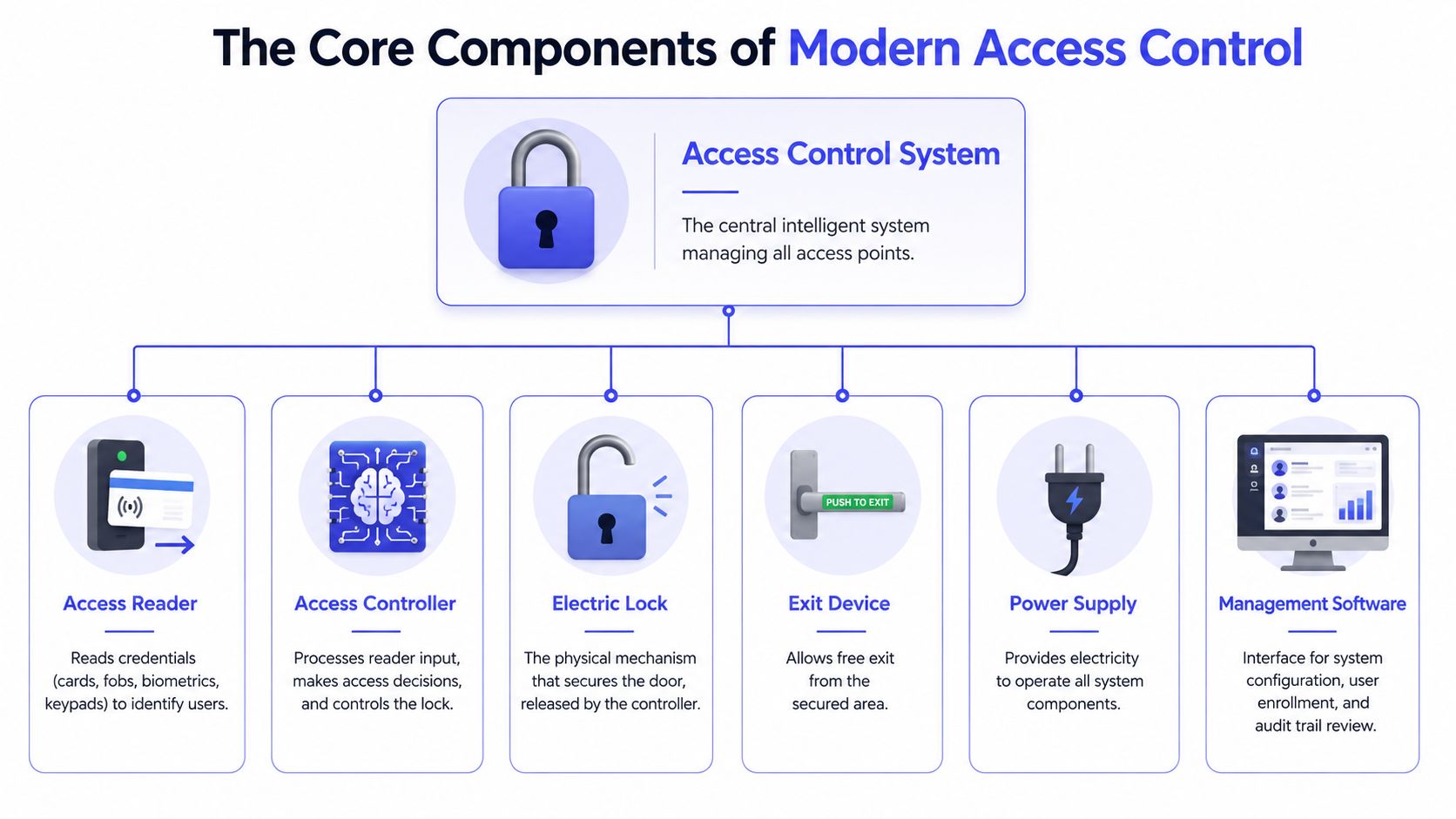
Every access system looks more complicated than it is. At a practical level, most setups are built from a few connected parts that pass a request from the front entry to the lock.
The easiest way to think about it is as a chain. One device collects the request, another decides whether access should be granted, and the lock hardware carries out that decision.
The reader at the entry point
At the front of the system is the access reader or entrance station. That may be a keypad, card reader, intercom panel, video entry station, vehicle gate call box, or biometric reader.
The process begins with a visitor or resident. The device doesn't make the final decision on its own. It captures a credential or a request and sends it to the system's decision-maker.
Other support hardware sits close to this first layer:
- Exit devices: Push bars, request-to-exit buttons, and interior release devices allow people to leave safely.
- Power supplies: Locks and controllers need stable power to work consistently.
- Management software: Staff use this layer to add users, schedule access, and review events.
The controller and the release path
The controller is the system's brain. It receives a signal from the entry device, checks the credential or release command, and then tells the lock what to do.
When access is granted through a phone or intercom, the system sends a low-voltage signal, typically 12VDC or 24VDC, to the control panel. That panel then tells the electronic lock to disengage for a few seconds. This operating principle applies to electric strikes, maglocks, and gate operators, as explained by Almas Industries.
That simple sequence clears up a common point of confusion. The intercom or app doesn't physically open the door. It sends an authorized signal to hardware that can release the secured opening.
The app is the command layer. The controller is the decision layer. The lock is the physical action layer.
A property manager doesn't need to wire these systems personally, but understanding this chain makes vendor conversations much easier. If the discussion skips over the controller output, lock type, and power requirements, the proposal is incomplete.
Understanding Your Lock Release Hardware
The lock hardware decides whether a door entry system with lock release works smoothly in daily use. Consequently, many buying conversations get too vague.
Two properties can buy similar software and have completely different results because one uses the right lock type for the opening and the other doesn't. A glass lobby door, an aluminum storefront door, and a perimeter pedestrian gate don't all behave the same way.
Electric strikes and maglocks
An electric strike replaces or works with the strike area in the frame. When the system sends a release signal, the strike allows the latch to move so the door can open.
A maglock works differently. It uses electromagnetic force to keep the door secured until power is interrupted and the door is released.
In practical terms:
- Electric strikes often make sense where the door already has a latch-based setup and the frame can support the hardware.
- Maglocks are common where surface-mounted hardware is more practical or where code-compliant egress design has already been addressed.
- Gate operators use the same release logic, but the “lock release” may be a trigger input on the operator rather than a door-mounted lock body.
For readers comparing mechanical security components at the door itself, this overview of commercial lock cylinder solutions from Elliott Diagnostics & Programming helps clarify where traditional cylinder security ends and electronic release begins.
Property teams also benefit from reviewing a more applied guide to smartphone controlled entry when evaluating how lock hardware connects to mobile credentials rather than fobs or keypads.
What happens when power fails
This is the point many non-specialists miss. A lock isn't just selected for convenience. It must behave correctly during a power outage.
Here is the core distinction.
| Attribute | Fail-Secure | Fail-Safe |
|---|---|---|
| Default state during power loss | Stays locked | Unlocks |
| Primary purpose | Protects assets and restricted areas | Protects safe egress and life safety |
| Common hardware behavior | Often associated with electric strike setups | Common with maglock setups |
| Typical use case | Private offices, storage rooms, controlled entry points | Egress paths, safety-sensitive exits, some common-area doors |
| Main planning concern | Preventing unauthorized entry during outage | Preventing occupants from being trapped |
A property manager doesn't choose between these based on preference alone. The opening's purpose matters.
A front entry that controls who gets in may need different lock behavior than a door people rely on to get out.
The strongest specification conversations ask three direct questions:
- What should the door do when power is lost?
- Is this opening primarily about entry control, safe egress, or both?
- What local life-safety and fire code requirements apply to this door or gate?
When those answers are clear, hardware selection gets much easier.
Remote and Mobile Release Your Access Options
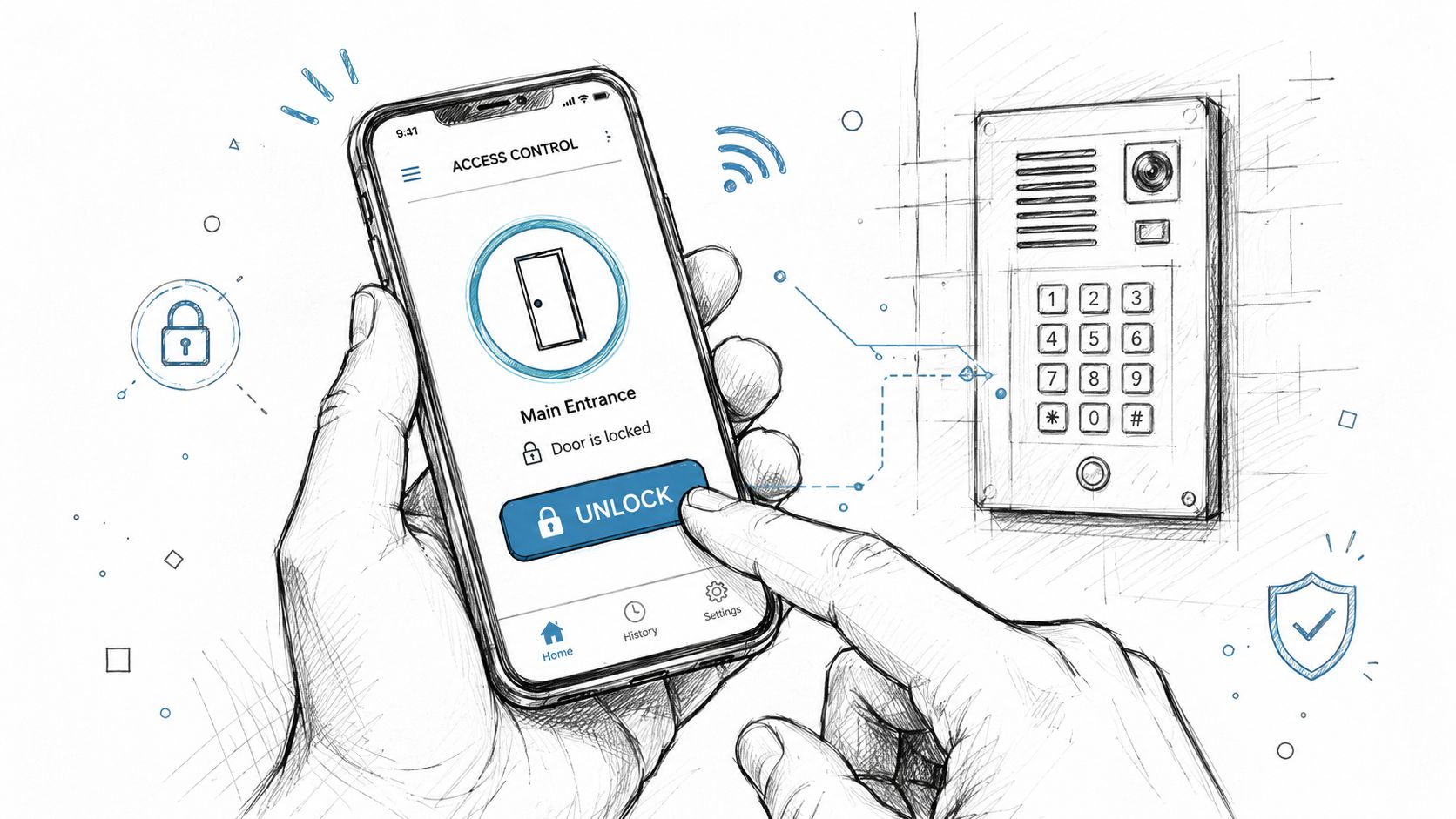
Remote release used to mean a resident answered a wall-mounted intercom, pressed a button, and hoped the door buzzed open. That model still exists, but it no longer matches how most residents and managers operate.
People expect to manage entry from a phone. They also expect it to work whether they're in the unit, in the leasing office, or off-site.
Why mobile release changed expectations
A mobile-first setup solves several everyday problems at once:
- Residents aren't tied to an in-unit station: They can respond from wherever they are.
- Managers can handle exceptions remotely: Deliveries, vendors, cleaners, and emergency access no longer require someone to be physically near the entry device.
- Credentials can be scheduled: Temporary access can be granted for specific people and specific windows of time.
Cloud-based access control made this practical. Instead of one fixed panel tied to one fixed location, permissions can be managed centrally and updated without visiting every door or gate.
Some properties also want access built into the daily driving experience. For vehicle-heavy communities, Nimbio in-car access shows how mobile entry control can extend into Apple CarPlay and Android Auto workflows for gate opening.
Why cellular is different
Many entry systems advertise remote access, but the transport layer matters. If a gate depends on unstable local Wi-Fi, reliability becomes a property-wide operations issue.
Cellular-based gate access systems that run on 4G LTE networks provide consistent reliability in areas with unstable Wi-Fi or no existing network infrastructure, which helps keep property access from failing during local internet issues, according to this overview on cellular access reliability.
That's especially important at perimeter gates, detached pedestrian entries, and outbuildings where Wi-Fi coverage is inconsistent. A property may have strong office internet and still have poor signal where the gate controller is mounted.
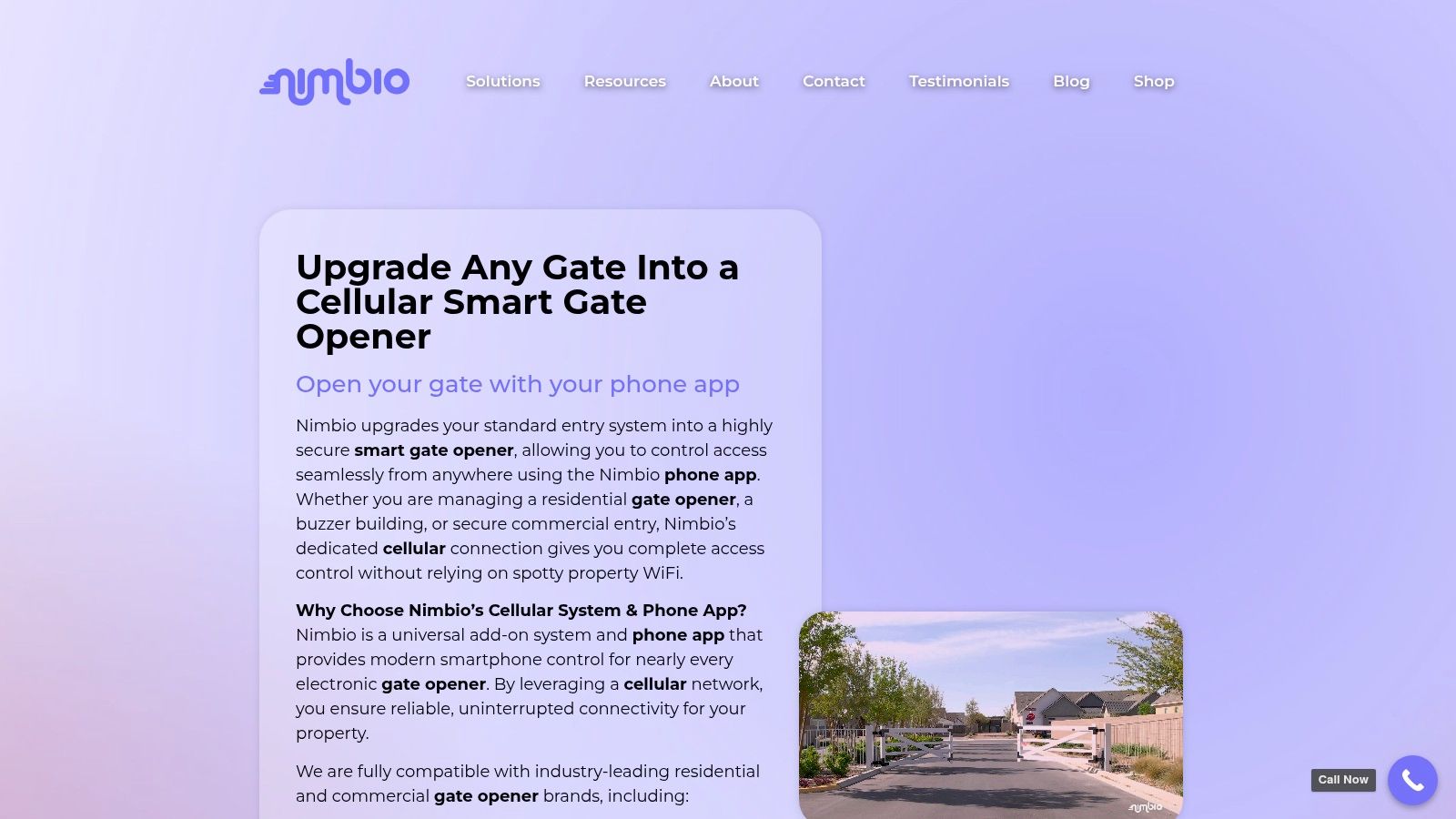
A cellular retrofit offers practical appeal. Instead of replacing a functioning gate operator, a property can often add a controller to existing hardware and shift the access method from remotes, clickers, and keypad dependence to managed mobile credentials. Nimbio is one example of that approach. It retrofits existing electronic gates and entry systems with smartphone control using cellular connectivity rather than site Wi-Fi.
A reliable remote release system depends on two things. The command has to reach the controller, and the controller has to work with the hardware already on site.
That's why installers should ask less about app appearance and more about connectivity path, operator compatibility, and credential management.
Selecting the Right System for Your Property
The right system for a downtown multifamily tower usually won't be the right system for a gated HOA, a small office building, or a mixed-use site with separate vehicle and pedestrian entries.
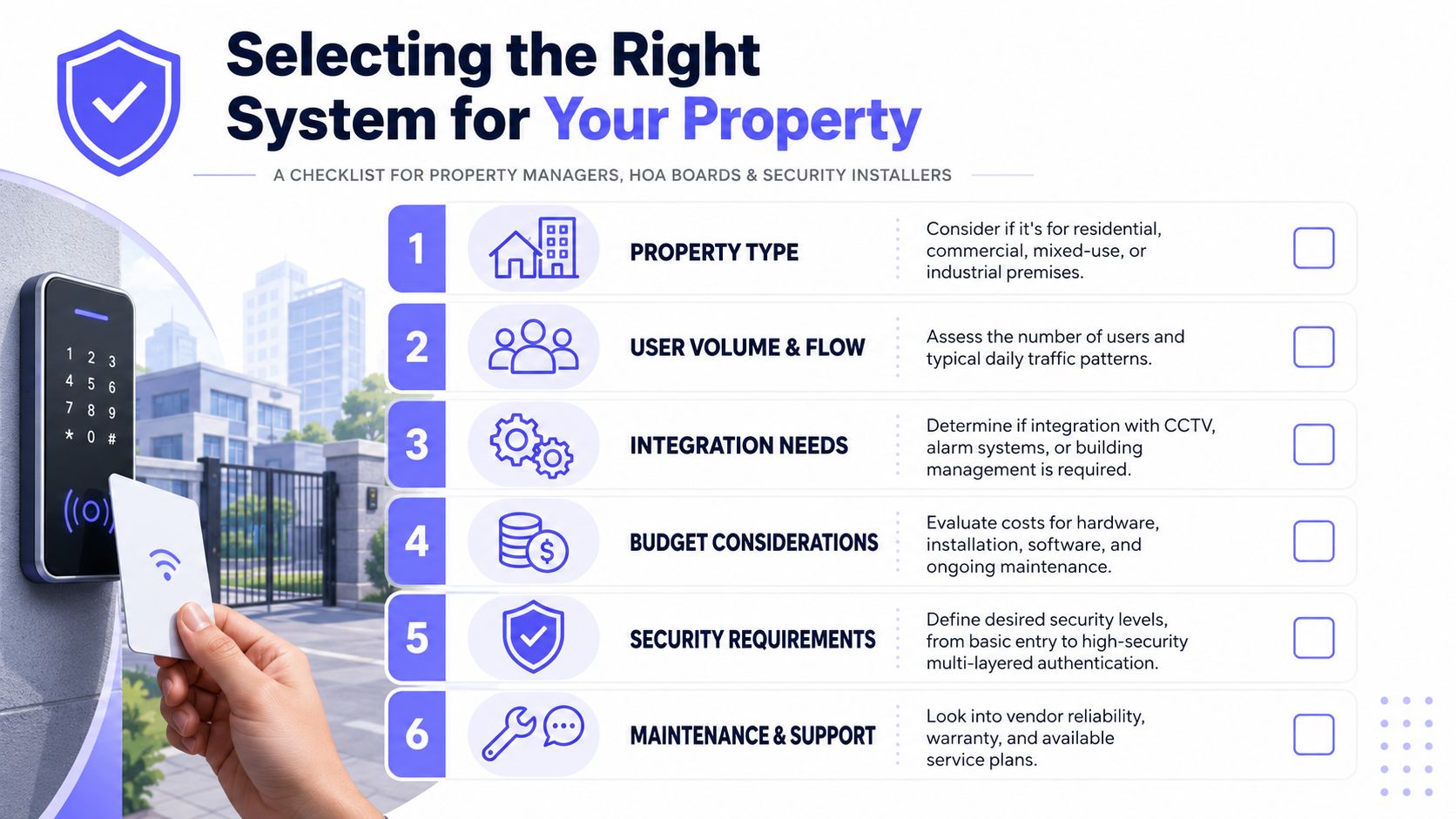
A good buying process starts with the property's traffic pattern, not the brochure. The opening itself matters. So does who needs access, when they need it, and whether existing hardware should stay in place.
Properties that modernize access often do it for security as much as convenience. Gated communities that implement modern access control systems can see burglaries reduced by up to 33% compared with non-gated counterparts, based on ProdataKey's review of gated entry security outcomes.
A practical evaluation checklist
When reviewing proposals, property teams should work through a checklist like this:
- Property type: A multifamily building needs different workflows than a private HOA entrance or a commercial loading gate.
- User mix: Residents, staff, vendors, guests, delivery drivers, and board members rarely need the same credential rules.
- Entry point type: A swinging pedestrian door, a magnetic-lock lobby entry, and a LiftMaster or DoorKing vehicle gate require different release logic.
- Existing hardware: Ask whether the system can retrofit the current gate operator or electronic lock instead of forcing full replacement.
- Management model: Some sites need on-site staff control. Others need regional managers to grant and revoke access from anywhere.
- Audit needs: Insurance, incident review, and board oversight often require entry logs, not just successful opening.
A hardware-agnostic approach usually gives a property more flexibility because it avoids tying the access strategy to one brand of gate or one replacement cycle. For teams comparing building-wide solutions, this look at smartphone-controlled entry for properties is useful for evaluating mobile credentials against more traditional fob and keypad models.
The strongest proposal is rarely the one with the longest feature list. It's the one that matches the property's real openings, traffic patterns, and management workload.
Security installers should also confirm operator compatibility early. A system that works beautifully on one gate brand may require additional relay or interface planning on another.
Enhancing Security with Audits and Management
Many properties still treat the keypad code as a harmless convenience. It isn't. Shared PINs create a management blind spot because they can be reused, forwarded, and remembered long after they should be retired.
That weakness becomes serious in multifamily and mixed-use settings where many people need short-term or recurring access. Delivery staff, dog walkers, cleaners, contractors, and former residents can all end up using the same unmanaged credential.
Why PIN codes create blind spots
Shared 4-digit PIN codes are responsible for 45% of unauthorized access incidents in multifamily properties because they leave no audit trail, according to Easter's Lock on door buzzer and PIN-based entry risks.
That single issue changes the conversation. A keypad code doesn't just create security risk. It creates operational opacity.
When a board asks who entered after hours, staff often can't answer if the property relies on shared codes. The system may show that the door opened, but not which person used the code.
What an audit-ready system should show
A modern cloud-based access control dashboard should make accountability routine. At minimum, administrators should be able to:
- Grant and revoke digital keys: Access should change instantly when residency, staffing, or vendor status changes.
- Apply schedules: A pool vendor may need Tuesday morning access, not all-day access every day.
- Review entry logs: Staff should be able to see who opened which entry point and when.
- Support incident review: Managers should be able to pair access events with surveillance footage and service records.
For teams aligning access logs with surveillance workflows, Premier Broadband's IP and NVR camera guide is a practical companion resource because it explains how camera systems fit into broader site security review.
Access control becomes far more useful when it answers two questions after every incident. Who had permission, and what actually happened?
That's the difference between an entry system that opens doors and one that supports professional property management.
Installation Retrofit and Cost Factors
Many buyers assume a failed release means the app, intercom, or controller is at fault. In practice, the physical opening often causes the trouble.
A door can receive the release command correctly and still fail to open if pressure is binding the latch or strike. That's why installation quality matters as much as software features.
The failure point most buyers miss
Industry analysis shows that 70% of electric strike failures come from mechanical issues such as door misalignment or hinge pressure, not electronic faults, according to this field-focused review of strike failure causes.
That has immediate consequences for property teams:
- Check alignment before blaming electronics: Sagging doors, tight weather stripping, and frame shift can stop a release from working.
- Inspect hinges and closers: Small mechanical adjustments often restore reliable operation.
- Match hardware to the opening: A strike, maglock, or gate relay has to suit the door type and how the opening is used.
- Require a site audit: Installers should evaluate the physical condition of the opening, not just the wiring path.
A property can spend heavily on a new intercom and still keep the same failure pattern if the door doesn't swing and latch properly.
Retrofit versus replacement
Therefore, retrofit strategy matters. The average cost of installing a gated entry system ranges from $3,000 to $10,000 per gate, plus connectivity fees, according to Gate Sentry's overview of gate access control system costs.
That cost range is why many managers look first at whether the existing gate operator, electronic lock, or call box can be preserved. If the current hardware is structurally sound, an add-on controller and updated credential method may solve the operational problem without a full rip-and-replace project.
The budget discussion should include four items:
- Hardware at the opening
- Installation labor
- Connectivity and software fees
- Ongoing service and maintenance
Properties usually get the best value when they modernize the control layer, verify mechanical integrity, and avoid replacing equipment that still works.
For teams evaluating a more reliable door entry system with lock release, Nimbio is worth reviewing as a cellular retrofit option for gates and building entries that already have electronic locking hardware. It supports smartphone-based access, remote credential management, and auditable entry control without requiring a full replacement of the existing operator or lock infrastructure.