An automated boom gate is a powered arm that rises to clear a vehicle lane and lowers to close it. Authorization alone doesn't make that lane safe, even when a keypad, clicker or phone correctly admits the driver.
Advice that starts with opening speed or smartphone entry starts too late. The first question is whether vehicles and pedestrians can move through the property without anyone entering the arm's path. Hardware selection, detection and access control should follow that assessment.
Table of Contents
- What an Automated Boom Gate Does
- Match the Arm and Operator to the Lane
- Parking, Yards and Community Lanes
- How Detectors Tell the Arm to Move
- Safety Devices and the Rules Behind Them
- Plan the Lane Before Installation
- Schedule Upkeep and Phone Access
What an Automated Boom Gate Does
An automated boom gate manages passage through a vehicle lane. Its arm provides a visible stopping point, but the complete installation includes the operator that moves it, detectors that report lane occupancy, and access controls that decide whether an opening request is allowed.
Those parts have different jobs. Authorization answers whether someone may enter. Safety detection answers whether the arm may move. A valid credential must never override a protective device reporting an obstruction.
A vehicle passing through
In a hypothetical office entrance, a driver stops at the marked line and presents an approved credential. The controller requests opening, the operator raises the arm, and the driver proceeds once the passage is clear.
The arm remains raised while the presence detector reports an occupied lane. Closing becomes permissible only after the configured clearance conditions are satisfied. A free-exit request can start a similar sequence on departure, without requiring an entry credential.
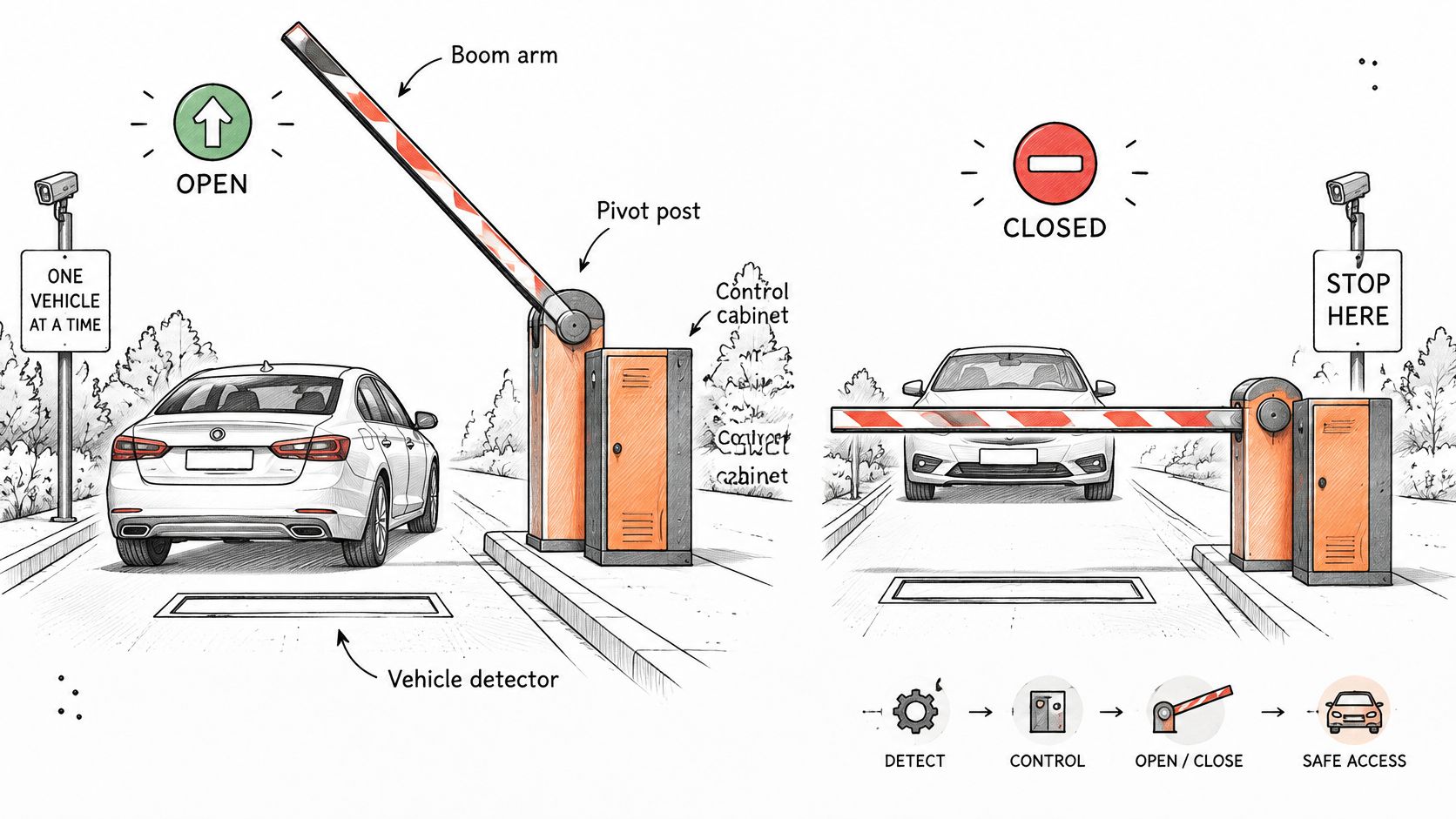
A swing gate needs an unobstructed arc. A slide gate needs a straight storage pocket beside the opening. A boom can suit a narrow vehicle entrance with limited side room, provided there's adequate space above the lane and around the operator housing.
That compact arrangement has limits. A raised arm doesn't create a pedestrian entrance, and a lowered arm doesn't create a continuous security fence. Properties requiring a solid perimeter closure need to evaluate a different gate arrangement.
People need a different route
The Door & Access Systems Manufacturers Association's gate-safety guidance describes independent entrapment protection and separate pedestrian access where pedestrian use is likely. It identifies UL 325 with operator safety and ASTM F2200 with gate construction; local requirements vary, and building departments may require additional measures.
A phone-enabled entrance can therefore become easier for drivers while remaining unsuitable for people on foot. A resident carrying groceries, a delivery worker approaching the wrong entrance, or a child following a car shouldn't have to negotiate the moving arm.
Practical rule: A vehicle credential grants permission to enter. It doesn't establish that the space beneath the arm is safe.
The installer's assessment should cover the full movement area, nearby fixed objects and foreseeable pedestrian shortcuts. The specification sheet should then describe the arm, operator, detection, release arrangements and pedestrian route together, rather than treating access control as an isolated purchase.
Match the Arm and Operator to the Lane
Boom type and spec choices by lane
| Choice | Fits this lane | Ask before buying | If ignored |
|---|---|---|---|
| Straight arm | Open single lane with overhead clearance | Will the raised arm clear the tallest vehicle and nearby signs? | Arm strikes a truck, fence or sign |
| Folding or articulated arm | Garage or canopy with low headroom | Where does the joint fold, and who maintains it? | Arm hits the structure or the joint wears out |
| Fence or skirted arm | Lane where people or motorcycles could pass under a plain arm | Can the operator support the extra weight, wind load and striking surface? | A plain arm leaves a gap, or a skirted arm strikes harder |
| Duty cycle | Any entrance with a real peak hour | What opening demand occurs at shift change, events or closing? | Motor overheats and the lane sticks |
| Opening speed | Queued parking, toll-style or yard lanes | How does clearance time compare with closing impact and protective coverage? | Traffic stacks, or the arm moves faster than the safety devices can manage |
| Manual release | Every unattended or after-hours lane | Who can release the arm during a power or control failure, and how? | Lane stays blocked during an outage |
The lane should determine the table row, not a catalog photograph. A straight arm may look simpler, but it's unsuitable where its raised position conflicts with a canopy, overhead sign or vehicle envelope.
A folding arm changes that envelope by bending at a joint. The installer needs to establish where that joint travels throughout the opening cycle, including its clearance from beams, pipes and lighting. The maintenance plan must account for the joint rather than treating it like a solid arm.
Match the mechanism to actual demand
Electromechanical operators are a common starting point for parking entrances and HOA vehicle lanes. Hydraulic equipment often enters the discussion for demanding yard applications. Neither drive type, by itself, proves that the selected model can handle the property's busiest period.
Duty rating must match concentrated demand. A quiet daily average can conceal continuous cycling during a shift change or an event departure. The installer should compare the expected operating pattern with the specific operator's published rating.
Opening speed also needs context. Faster movement may reduce part of a queue delay, but it won't fix drivers struggling to reach a reader or waiting for visitor approval. Closing speed must remain compatible with the installed protective system and its measured response.
Check the entire moving envelope
Boom length follows the usable lane opening and mounting arrangement. The assessment should include mirrors, truck bodies, trailer overhangs and turning paths, not merely the width between painted lines.
A skirted arm introduces additional surfaces, weight and wind exposure. It shouldn't be selected as a substitute for directing pedestrians to a separate entrance. The installer must confirm that the arm assembly is approved for the chosen operator.
Manual release belongs on the purchasing specification. The property manager needs a documented release arrangement that authorized staff can use during a failure, with model-specific instructions and controlled access to any release key.
Wind exposure, slope and ceiling height can rule out an otherwise attractive selection. Before purchasing connected controls, managers can also review what to look for in a gate access system, while keeping operator suitability and physical safety as separate acceptance decisions.
Parking, Yards and Community Lanes
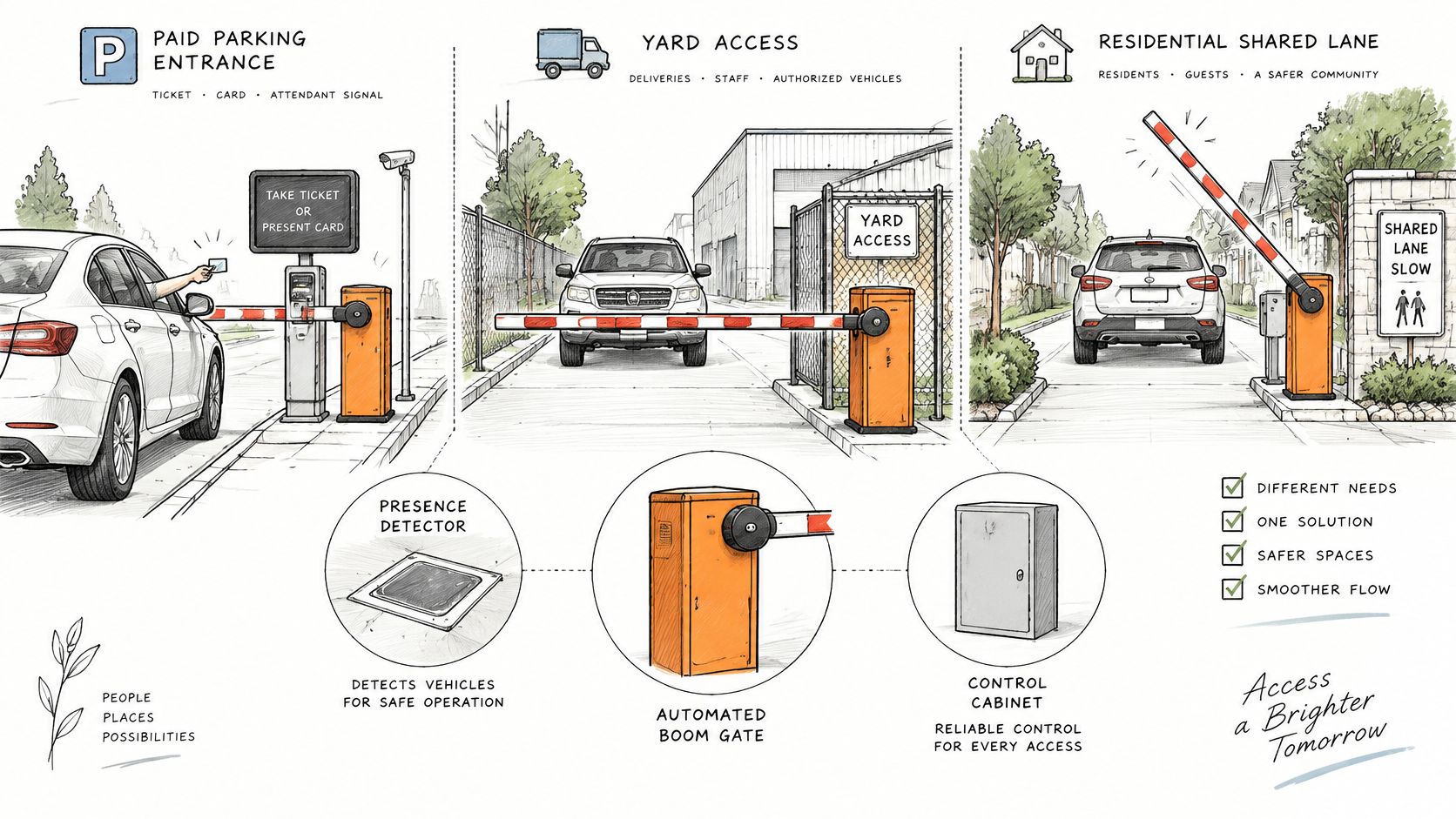
The same barrier shape can serve very different operating rules. Dataintelo's car boom barrier gate market analysis identifies commercial, residential, industrial and public applications, a useful reminder that a parking entrance and a distribution yard shouldn't share a specification merely because both use rising arms.
Parking and commercial entrances
In paid or permit parking, a ticket device, reader or attendant may request opening. Presence detection must protect an occupied passage, including a following vehicle that enters before the arm can safely close. Preventing unauthorized following must never mean deliberately lowering onto that vehicle.
Parking geometry can rule a boom out before access technology matters. An entrance beneath a structure with no suitable moving clearance needs another arrangement.
Office and commercial properties add visitors, vendors and staff with different permissions. Reception staff need a defined way to admit a guest without distributing a permanent shared credential. A property requiring continuous fence-like closure should reject a plain boom as its perimeter solution.
Yards and residential vehicle lanes
A logistics yard places more emphasis on trailer movement, high vehicles and concentrated arrivals. The specification should include the full vehicle combination, stopping positions, operating demand and arrangements after an arm strike. A trailer can occupy the hazard area differently from a passenger car.
Yard managers also need to distinguish access permission from processing. A driver may be authorized to enter but still need instructions about loading areas or paperwork. A boom isn't suitable where the approach cannot accommodate those stops without obstructing the public road.
For an HOA or multifamily property, a community gate access system should fit the way residents and guests arrive. School drop-off, dog walking and stroller traffic need a pedestrian route that people will realistically use, rather than a distant entrance they're likely to bypass.
A short driveway where children routinely cross the intended arm path is a reason to redesign the entrance before selecting a barrier. Access convenience doesn't resolve that conflict.
The useful comparison is between operating conditions, not between properties that happen to use the same style of arm.
In a hypothetical small parking lot and distribution yard, both properties could select an automated boom gate. The parking lot might prioritize straightforward visitor approval, while the yard needs a specification built around trailer clearance, concentrated cycling and recovery after vehicle impact. Their detection layouts and operating procedures would differ even if the cabinets looked alike.
How Detectors Tell the Arm to Move
An inductive loop is a coil of wire embedded in pavement, connected through a lead-in cable to detector electronics. The Federal Highway Administration's explanation of inductive-loop detection describes a tuned circuit whose inductance changes when a vehicle's conductive metal mass passes over or stops within the loop.
The detector doesn't recognize permission. It reports a condition that the controller interprets according to its assigned input and programming. That distinction explains why an exit loop may request opening while an entry presence loop only prevents closing.
Assign a defined control job
The installer should document what each detector is intended to do. A useful control schedule distinguishes these functions:
- Approach detection: Requests opening where free passage is permitted, or signals that a vehicle is waiting.
- Presence detection: Inhibits closing while a vehicle occupies the protected area.
- Clearance confirmation: Reports that the vehicle has passed the relevant downstream position.
- Non-contact protection: Detects occupancy in a protected space before the moving arm makes contact.
Those functions shouldn't be collapsed into a vague promise that the gate has a sensor. Placement and controller logic determine whether a detected vehicle causes an opening, holds the arm raised or prevents a new movement.
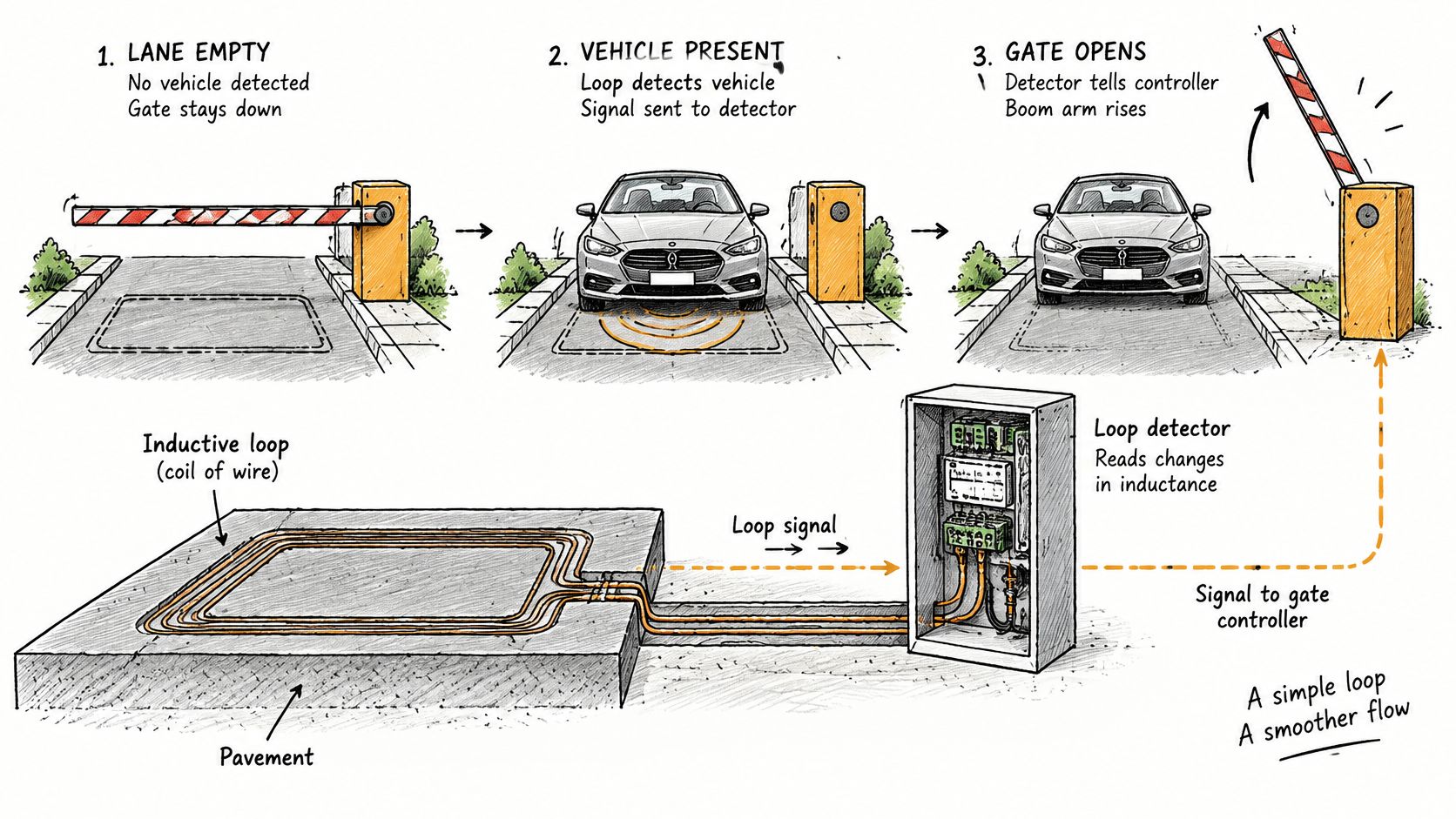
Detection has a coverage boundary
Loop geometry, saw-cut condition, cable routing and sensitivity affect performance. Cracked pavement can damage the installation, while electrical interference or unsuitable settings can contribute to unwanted openings or missed vehicles. Repeatedly changing sensitivity without diagnosing the cause can create a different problem elsewhere in the lane.
A loop detects conductive metal, not every object occupying the space above it. It mustn't be relied on for pedestrian protection, and bicycle or motorcycle detection needs specific validation rather than assumption.
Photoelectric devices and appropriately selected presence detectors can address spaces a pavement loop doesn't cover. Radar suitability depends on the device and its approved application; a traffic detector isn't automatically a safety-rated protective device. The installer must select coverage for the actual arm sweep and surrounding hazards.
Validate difficult vehicle positions
Commissioning should include representative vehicles and foreseeable stopping behavior. A low motorcycle, high-clearance truck, trailer stopping short and vehicle rolling backward can expose gaps that a simple passenger-car pass misses.
The commissioning record should identify each input, its protected area and the control response it produces. That gives a later technician a basis for diagnosing unexpected movement instead of guessing why the controller acted.
Wiring, input types and fault behavior differ among operators. A qualified technician should use the exact operator and detector manuals; a generic wiring diagram isn't a safe substitute for model-specific documentation.
Safety Devices and the Rules Behind Them
Force limits are ceilings, not desirable operating settings. The UK Health and Safety Executive's guidance on revised powered-door, gate and barrier standards explains that forces associated with BS EN 12453 should be kept as low as possible and verified after installation; local requirements vary.
Contact response matters too. The HSE's electric-gate safety bulletin warns that stopping movement can leave someone trapped and describes the need to back away from an obstruction. A controller that stops the motor has not necessarily removed the hazard.
Safeguards for a boom lane
| Safeguard | What it does | Limit |
|---|---|---|
| Force limitation | Keeps measured crushing and impact forces as low as possible, within applicable limits | A motor that cycles reliably can still close too hard |
| Photoelectric beams | Detect a person or object before contact within their coverage | A single beam rarely covers every pinch point |
| Inductive loop | Detects vehicle metal for an open, hold or clear function | Pedestrian detection isn't its job, and bicycles need specific validation |
| Safety edge | Signals contact so the controller can stop and back away | Damage, deterioration or a control fault can compromise protection |
| Hold-to-run | Allows movement only while an operator maintains the control | Poor fit for an unattended public lane |
| Separate walkway | Gives people a route outside the arm's movement | A vehicle operator mustn't serve as the pedestrian-gate operator |
Assess hazards outside the lane center
The arm tip, pivot area, drive housing and nearby posts deserve attention alongside the space beneath the arm. An installer should identify where someone could be struck, pinned against a fixed object or caught near a moving component.
The Door & Hardware Federation's powered-gate guidance describes combining contact-sensitive protection with light-beam detection and safeguarding crushing or shearing locations. A beam across the center of an entrance doesn't establish coverage of every dangerous area.
Warning labels can communicate a hazard, but they don't stop movement or create physical separation. Their position and condition belong in the maintenance plan, not in place of protective equipment.
Confirm the applicable safety framework
For U.S. projects, the operator and construction assessment should be coordinated. The ASTM F2200 construction standard complements operator-safety requirements rather than replacing them. Local adoption and project requirements vary, so the authority having jurisdiction should confirm the applicable rules.
An existing installation shouldn't be accepted because the arm still moves. Replacement controllers, altered geometry or added accessories can change the behavior of the assembled system.
Require an installer's acceptance record
The property manager should receive evidence of performance, not merely a demonstration that an approved credential opens the gate. The installer's model-specific commissioning process should address:
- Measured interaction forces: Recorded results using suitable test equipment.
- Protective coverage: Tests of the relevant approach directions and hazard areas.
- Fault response: Confirmation of the controller's behavior when a monitored protective device fails.
- Occupied-area behavior: Proof that the arm won't close into a detected person or vehicle.
- Handover information: Manuals, test records and the maintenance requirements for the installed equipment.
These are acceptance requirements for qualified personnel, not instructions for a resident to test a moving arm by standing underneath it. Where behavior is uncertain, the property should restrict use and arrange professional assessment.
Plan the Lane Before Installation
A useful site walk starts at the public road, not inside the operator cabinet. The installer needs to see how vehicles approach, where drivers wait and whether a queue could obstruct a sidewalk or spill into traffic.
Lane width alone isn't enough. Turning movements, mirrors, trailer tracking and the tallest expected vehicle establish the working envelope. Overhead signs, canopies and light poles can eliminate a straight-arm arrangement before equipment selection begins.
Follow the route toward the stopping point
The reader or call point should be reachable without requiring a driver to leave the vehicle beneath the arm. Its position must also allow a comfortable stopping location for the vehicles that use the entrance.
Wind exposure should be assessed for the proposed arm assembly, especially where a skirt or advertising panel would increase exposed area. A sloping approach affects vehicle positioning and clearance, while low points can collect water around equipment or pavement cuts.
For an associated fence or pedestrian entrance, Home Pro's Remodeling & Repairs offers context to choose hardware for your fence gate. Fence-gate hardware selection remains separate from powered-barrier design and its safety assessment.
A pedestrian route is only useful if its location makes it the obvious route to take.
The site layout should make the intended walking entrance visible and convenient. Signs, fencing and path placement should discourage shortcuts without creating a new obstruction or hiding approaching traffic.
Inspect the operator location
The operator needs a suitable foundation, drainage and access for servicing. Pavement condition matters where embedded detection is proposed, since a damaged surface can undermine an otherwise appropriate detector layout.
Power and backup arrangements should be documented before installation. The property needs a defined response to a supply failure, including who has authority to release the barrier and how emergency access will be maintained. Release access should be available to authorized personnel without making tampering easy.
For a retrofit, the operator's manufacturer, model and condition should be identified before any add-on is promised. Older equipment may require safety work or replacement rather than a new access device alone. Installation and wiring should follow the manufacturer's current model-specific documentation.
Produce a site note that supports a decision
The property manager's handover to the installer should capture the practical constraints:
- Vehicle envelope: Lane width, overhead clearance, vehicle height and turning needs.
- Traffic pattern: Arrival peaks, waiting position and available queue storage.
- Walking route: Pedestrian entrance, approach path and likely shortcuts.
- Infrastructure: Power source, backup arrangements, drainage and pavement condition.
- Existing equipment: Operator model, arm assembly and known faults.
- Emergency arrangements: Release location, authorized users and access procedures.
A qualified gate technician should confirm the design and installation against local requirements. For HOA, multifamily and commercial properties, the site note also gives boards and managers a record of the conditions the installation was intended to handle.
Schedule Upkeep and Phone Access
Mechanical upkeep and credential management need different owners. A property can hold a carefully maintained access list and still run an arm with impact damage, worn joints or unreliable protective detection. The cleanest digital key system in the world does nothing for a folding joint that has started to bind.
Maintenance should address arm strikes, folding-joint wear, cabinet seals, photocell alignment and damaged loop cuts. A release mechanism that has not been checked under the manufacturer's maintenance procedure also deserves attention. Property staff should not improvise repairs or adjust safety settings to keep a troublesome lane moving.
Maintain the equipment and its records
There is no honest universal maintenance price. Cost follows the operator model, operating demand, impact history, pavement repairs and whether major components are approaching replacement. A written technician's quote should distinguish routine service from corrective work, so a worn gearbox is not billed as a routine visit.
Commissioning records should remain available alongside subsequent force tests, protective-device checks and fault reports. The manufacturer's service requirements should set the maintenance tasks and intervals rather than an arbitrary property-wide schedule.
When power or controls fail, the response depends on which system failed. A dead network link on a connected controller calls for a different reaction than a stalled operator: the arm may still be mechanically sound and operable by its existing remotes while the app is unreachable. Staff need to know how to tell the two apart before assuming the physical mechanism is at fault.
Treat connected access as another operating system
DataHorizzon Research's automatic vehicle barrier market analysis identifies cybersecurity exposure in connected barriers and potential security work when upgrading legacy equipment. Cellular connectivity avoids dependence on local Wi-Fi, but it introduces its own dependencies on the carrier and the remote service.
The access-control review should cover more than whether a phone can open the arm:
- Administrator permissions: Limit who can issue credentials or change settings.
- Account protection: Check available authentication controls and account-recovery procedures.
- Credential removal: Define responsibility for lost phones, resident departures and staff turnover.
- Records: Establish what events are recorded, who can review them and how long records remain available.
- Service failures: Document the response to carrier, account, remote-service and power outages.
- Updates: Assign responsibility for supported firmware and security notices.
Those are evaluation questions, not assumptions about every connected product. Each proposed system needs an explicit answer, especially where remote administrators can admit vehicles without seeing the lane directly.
Add phone entry without changing the safety job
Nimbio is an example of a cellular add-on controller and smartphone app that works with an existing electric gate operator. It connects over a cellular connection, so no Wi-Fi is needed at the gate, while existing clickers, fobs and keypads keep working. The controller wires in parallel to the operator's dry-contact input, so the legacy credentials stay live rather than being replaced.
Managers can issue and revoke digital keys remotely, set a key's expiration date and admit visitors remotely with video verification. Those functions change authorization, not the arm's protective coverage or the installer's safety responsibilities. A phone request and a keypad request put the same demand on the same detectors.
Property managers can review how cellular gate access works and use the contact page to discuss the existing operator before arranging professional installation. The automated boom gate should retain its independently assessed detection and entrapment protection regardless of the credential used to request entry.
Nimbio offers cellular smartphone access for an existing electric gate while preserving clickers, fobs and keypads. Property managers considering phone entry for an automated boom gate can visit Nimbio with the operator model and site requirements ready, then coordinate the access upgrade with a qualified gate technician's safety assessment.