Automatic driveway gate installation gets sold as a choice between gate styles and remote brands. The order that actually decides whether the job works is different. Classify the site first, settle fire access and permits, match the gate build to an operator, then prove the entrapment protection during commissioning. Price and app features come after those decisions, not before them.
The order isn't paperwork for its own sake. A Consumer Product Safety Commission study cited by ASTM reported that more than 25,000 Americans were injured by automatic gates between 1990 and 2000, an average above 2,500 reported injuries a year. The response was UL 325, revised in the late 1990s, with changes effective in March 2000 that required two levels of entrapment protection, both operating in the opening and closing directions. A motor on its own stopped counting as an installation plan.
What follows is the working order a gate technician uses on a residential driveway, a multifamily entrance, or a loading dock gate, with the question to settle at each stage before money is committed. Local requirements vary, so treat the codes named here as a floor and confirm the rest with the authority having jurisdiction.
Table of Contents
- Usage Class Before Any Hardware Order
- Permits and Fire Access Before Purchase
- Reported Costs for a Powered Driveway Gate
- Gate Build and Operator Match
- Install Sequence and Entrapment Tests
- When to Hire a Licensed Installer
Usage Class Before Any Hardware Order
The first decision in automatic driveway gate installation is a classification, not a product. Before an operator is priced or a remote is compared, write down what the site is and how the gate leaf moves.
The framework is ASTM F2200, first published in 2002 after industry work that began in 1998, as the Door and Access Systems Manufacturers Association sets out in its technical summary. The standard covers six automated gate configurations: horizontal slide, horizontal swing, vertical lift, vertical pivot, overhead pivot, and horizontal bifold. It also sorts installations into four usage classes based on the property and its level of public exposure.
| Class | Property it covers | What changes the install |
|---|---|---|
| Class I | One- to four-family dwelling, garage or parking area | Residential exposure, still subject to operator and gate rules where codes apply |
| Class II | Multifamily with five or more units, hotel, retail, other public buildings | Higher public exposure and a different risk review than a single driveway |
| Class III | Industrial sites such as factories and loading docks | Industrial traffic and operating assumptions |
| Class IV | Guarded industrial or highly restricted facilities | Unauthorized access is prevented with security personnel |
Read it from the top. Class I is the single-family driveway serving a garage or parking area at a one- to four-family dwelling. Class II starts where strangers arrive all day: multifamily housing with five or more units, hotels, retail sites, other buildings serving the public. Class III is industrial traffic such as factories and loading docks. Class IV is a guarded or highly restricted facility, where the thing stopping an unauthorized visitor is a person, not the gate.
The class changes the review more often than it changes the hardware. A single-family driveway and a logistics facility may use similar mechanical concepts and still need different risk assessments, construction details, controls and operating assumptions.
Write it down first: class, gate form, and whether the leaf crosses a fire lane. Three lines settle most of the design conversation.
The regulatory frame reaches past the equipment. Beginning with the 2009 editions of the International Fire Code and International Building Code, automated vehicular gates within their scope have been required to comply with UL 325 and ASTM F2200, including gates across fire-apparatus access roads, per the same summary. So a gate on private ground can still sit inside a code written for fire trucks.
Settle the class and the gate form, then check local code. Access control is the last layer on the list, and a cellular gate access system buyer's guide is the right reading once the operator and protection devices are already chosen.
Permits and Fire Access Before Purchase
A driveway gate can be a permit item, and the permit can change the design before any hardware is ordered. The city of Celina, Texas requires permits for access-controlled gates, a fire-department Knox key switch, compliance with UL 325 and ASTM F2200, preserved fire-lane width and height, and a design that opens freely during a power failure, according to the city's access-controlled gate requirements.
That document also summarizes requirements from Northwest Fire District: separate gate and building permits, minimum clear widths of 20 feet for bidirectional roads and 14 feet for unidirectional roads, and emergency opening within 15 seconds when adjacent gates operate together.
These are examples, and the local rule is the one that binds. A private driveway isn't automatically covered. A gate across a fire lane or a shared private road may be, and then commercial-style access and inspection rules apply.
Ask before signing: call the fire marshal with the address, the gate location and the drive width. Get the answer in writing while the job is still a sketch.
Three things need confirming on site, not on a spec sheet. First, where the emergency override sits and who can reach it at 2 a.m. Second, whether the manual release works with a person standing at the gate rather than with a technician reading a drawing. Third, what happens on power loss. Don't assume the operator fails open, because plenty don't. Cycle it with the breaker off and watch the leaf.
If a retrofit controller is part of the plan, it must not interfere with approved emergency-access hardware. The safest route is to connect the new device only to the operator's approved activation input and leave the certified safety circuit alone. Nimbio recommends a licensed professional gate or low-voltage technician for installation and can put a customer in touch with an installer who has worked with Nimbio before on request.
Reported Costs for a Powered Driveway Gate
Published numbers differ enough that a single average would mislead. Here is what three publishers reported, as they reported it.
| Source | Year | Figure as reported |
|---|---|---|
| Fixr | 2025 | Automatic driveway gate installation typically $2,500 to $5,000; overall driveway-gate installation $1,000 to $6,000 |
| Viking Fence | 2024 | Automatic gate installation generally $3,000 to $12,000 or more |
| Security Garage and Gate | 2025 | Average professional price about $3,140; typical projects $1,525 to $5,135 |
Fixr's driveway gate cost guide puts automatic driveway gate installation typically at $2,500 to $5,000, inside a wider driveway-gate installation range of $1,000 to $6,000. Viking Fence reports automatic gate installation generally at $3,000 to $12,000 or more. Security Garage and Gate reports an average professional automatic-gate installation price of approximately $3,140, with typical projects from $1,525 to $5,135.
The spread isn't noise. Leaf weight and material drive the operator class. A swing leaf needs hinge strength and a clear arc, while a slide gate needs a straight or cantilevered runway. New posts and a concrete pad are separate work from hanging a leaf on an existing frame. Trenching power to the gate is its own line item. Permit work, fire-department hardware, and inspection time sit on top.
Take a hypothetical pair of bids. A short residential swing leaf hung on existing posts, on a driveway with a panel nearby, is not the same job as a wide slide gate that needs a new slab, a conduit run across a paved drive, and a Knox switch at the entrance. Same category on the invoice, different projects underneath.
Budget rule: a national range tells you whether a quote is in the neighborhood. It doesn't tell you whether the quote covers entrapment devices, permit work, or the trench.
Get a site bid after the usage class and the fire-lane status are known. Bring the operator make and model if one already exists, get the entrapment devices itemized, and ask what the price excludes. If app or keyless entry is added later, cellular gate opener pricing is quoted separately from the gate and operator work.
Gate Build and Operator Match
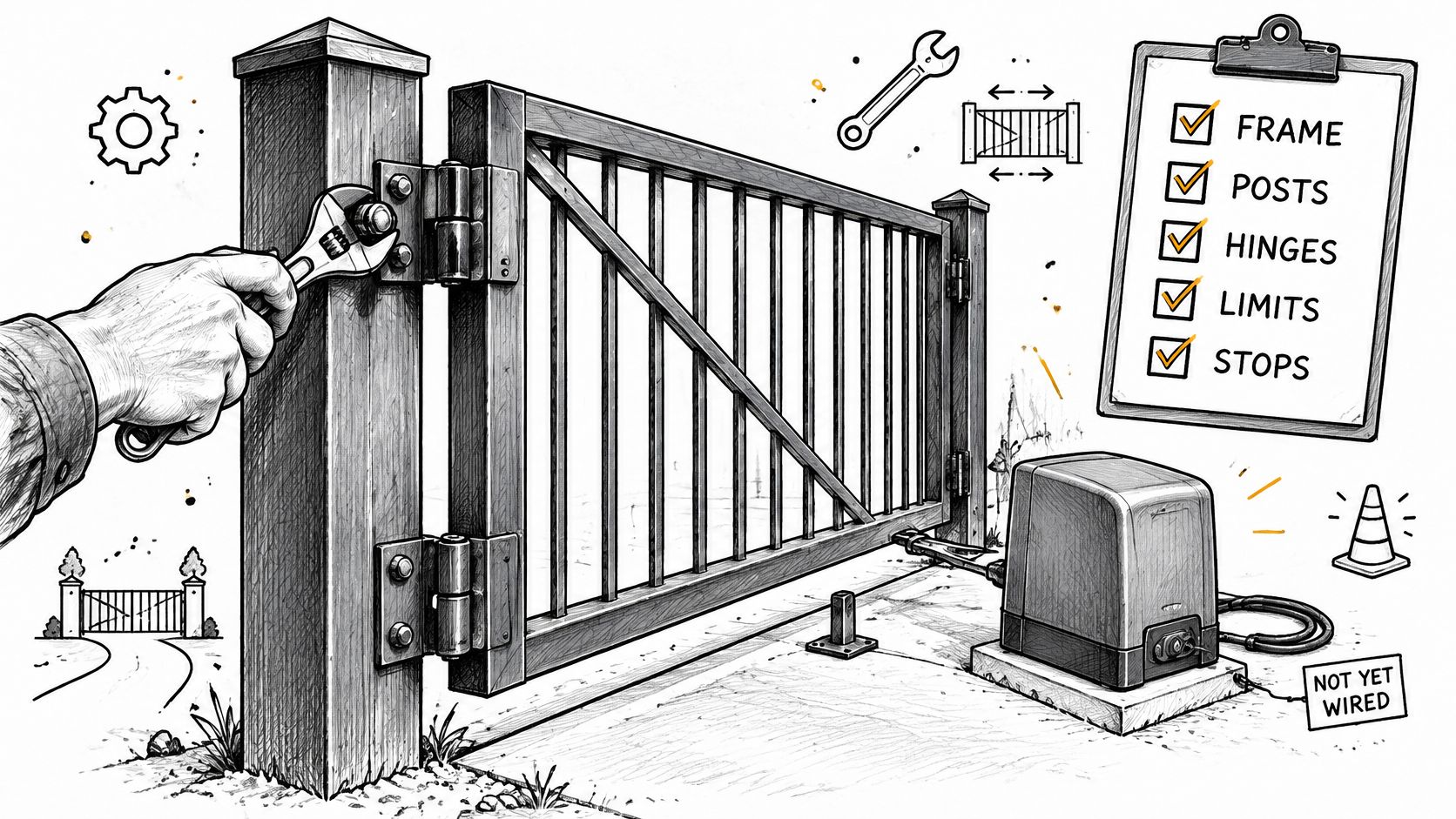
Start with the physical gate and work outward to the operator. A leaf that swings by hand with two fingers can still be the wrong match if the operator isn't rated for its size, mass, duty cycle and movement type.
ASTM F2200 covers both sides of that match. Its construction provisions address hazards such as gate sections falling over at a 45-degree angle, dangerous protrusions, and inadequate positive stops, and it requires automated vehicular gate systems to comply with ASTM F2200 and UL 325, as the ASTM F2200 scope summary states. On site, that means inspecting the frame, posts, hinges or rollers, travel limits and stopping hardware before a motor goes on.
Swing and slide compared on structural fit
A swing leaf needs a clear arc for its full travel and hinges strong enough to carry the leaf's weight and wind load. Check the stop posts, because a leaf that has been slamming into a bent stop will keep doing it once powered.
A slide leaf needs a straight path, or a cantilevered runway with overhead and underside wheels. Exposed rollers on a slide gate belong behind guards. Grade matters too: a driveway that falls away from the gate can drag a track gate out of alignment, while a cantilever design avoids a track in the drive entirely.
Neither configuration wins on its own. The site picks the form, and the operator follows the form.
Where people on foot enter the picture
Federal accessibility rules apply where pedestrians share the opening. For a forward approach, clearance is required when an obstruction within 18 inches of the latch side projects more than 8 inches beyond the face of the door or gate, per 36 CFR Part 1191. Controls for power-assisted doors and gates must be operable with one hand, without tight grasping, pinching or twisting.
The same rules address opening speed, safety sensors, activation devices and labeling when powered gates are provided, and they require accessible routes serving relevant spaces to work as emergency egress routes or connect to an accessible area of refuge, according to the U.S. Access Board guide to entrances, doors and gates.
In practice, mount the keypad, button or intercom where a person can reach it without standing in the vehicle path, and plan a walk-through gate or a separate pedestrian opening. A driver-only layout is a design decision, and it's one residents, delivery workers and responders will live with.
Buy list: compliant leaf hardware and stops, an operator matched to the leaf, and a control location checked against the pedestrian route. Three items, in that order.
Wiring and setup come next, and a clear picture of how cellular gate openers work helps when access control is added to an operator that's already installed.
Install Sequence and Entrapment Tests
Commissioning is where the plan turns into a working gate. Keep the operator manufacturer's manual on site for torque values, terminal assignments and limit setup, because models differ enough that a step from one brand can be wrong on another. If the manual and the site disagree, stop and call a qualified technician. Guessing at a flashing indicator light isn't troubleshooting.
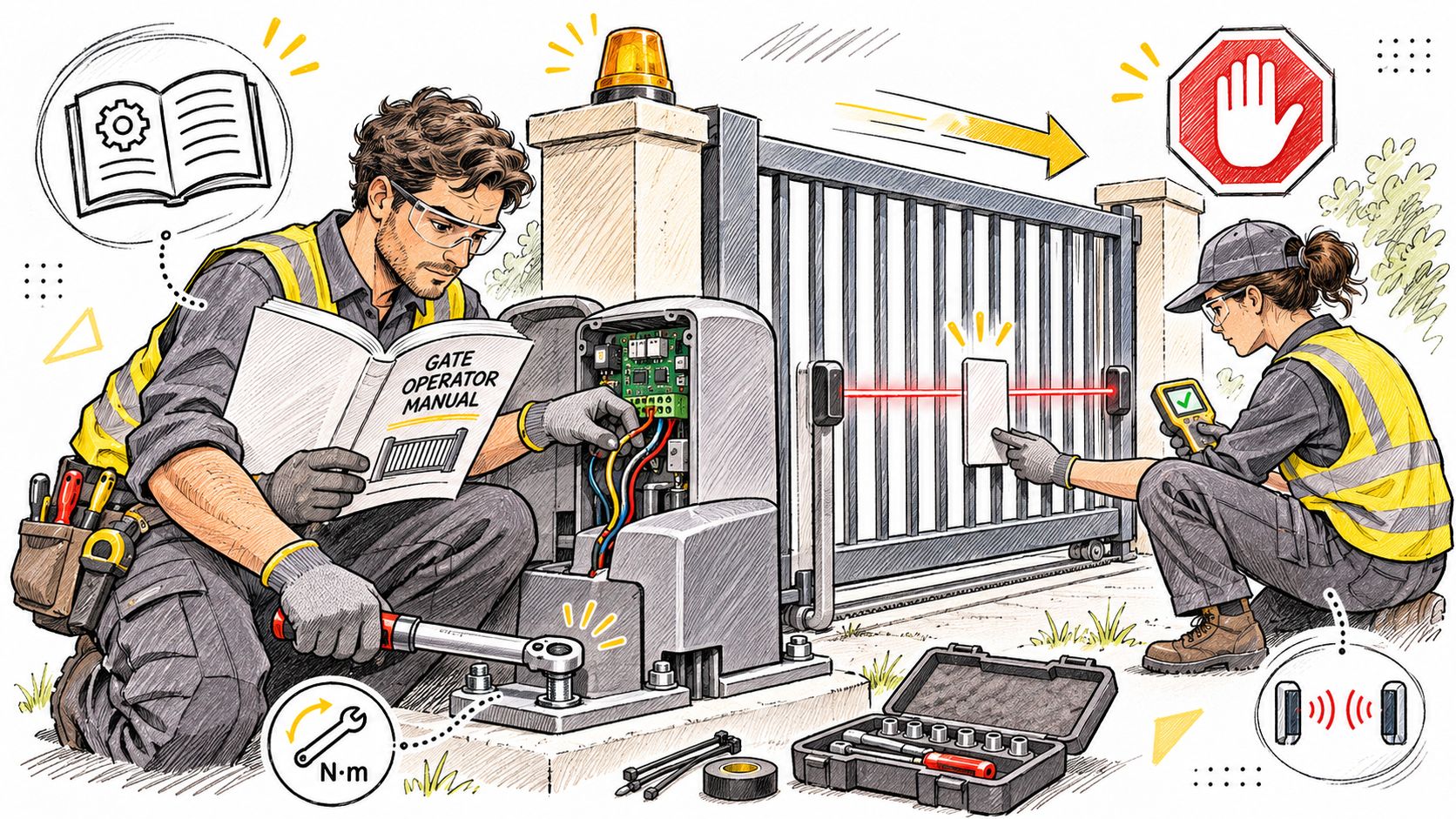
Work through the job in this order, and don't energize the operator until the devices that stop it are mounted and connected.
- Survey and classify. Classify the gate and operator, walk the full travel path, and write down every entrapment zone, meaning every place the moving leaf can pin a person against a post, wall, pilaster, fence, vehicle or adjacent moving part.
- Confirm the pedestrian route and the operator match. Pedestrians need a separate way through, and the operator has to suit the gate's size, mass, duty cycle and movement type.
- Provide two independent protection methods per zone. Typically a monitored photoelectric sensor plus a contact edge, or an approved inherent force-limiting system combined with an external device.
- Hold commissioning until both devices work. No handover while a device is disconnected, disabled or untested.
- Close the mechanical gaps. Eliminate gaps exceeding 2.25 inches where that limit applies, remove pinch points, guard exposed rollers, and verify structural stops and hinges.
- Position the control station. It needs a clear view of the gate, at least 6 feet from moving parts, and no way to operate the gate by reaching through, over or around the leaf.
- Test both directions and every access mode. Remote, keypad, vehicle sensor, manual release and any connected access controller, interrupting each beam and pressing each edge during opening and closing.
- Record and retest. Put stop and reverse response, travel limits, force settings, sensor alignment and fail-safe behavior in a handover report, then retest after any change to geometry, settings, wiring or access hardware.
Why two protection devices are the minimum
Since 2016, UL 325 has required slide and swing gate operators to use a minimum of two entrapment-protection means in both the opening and closing directions, as the DASMA summary of UL 325 requirements explains. The recognized categories are inherent protection, non-contact photoelectric sensors, contact edge sensors, constant-pressure controls, and for swing gates, inherent force limiting. Both devices must be connected and functioning for the operator to run.
There is one limited exception. For swing gates, when no entrapment zone exists in one direction of travel, only one protection device is required for that direction. That's a mechanical finding, not an electrical one, and it should be documented rather than assumed.
The injury record behind the rule is concrete. The U.S. Consumer Product Safety Commission reported 32 automatic-gate-related deaths identified from 1985 through 2000, including 20 children, and estimated nearly 25,000 injury-involved people from 1990 through 2000.
What the two second and 40 lbf numbers change
UL guidance specifies stopping or reversing within 2 seconds for applicable protective methods, and force-limiting systems must not exceed 40 lbf under the cited criteria, per UL's gate operator guidance. Those two numbers are the reason a sensor's position matters more than its spec sheet.
A single beam across the driveway is the most common installation failure. It covers the car lane and misses a person trapped against a post, a wall or a fence, which is exactly where a gate can do harm. Sensors have to cover the actual hazard geometry, including the corners and the closing edge.
Test like a skeptic: walk the travel path and stop at each pinch point. If a beam doesn't see you there, the layout is wrong, not the beam.
The handover record and the retrofit question
Commissioning means repeated cycles from every access mode, with deliberate interruptions. Record what happened, and retest after changing gate geometry, operator settings, wiring or access-control hardware.
On a retrofit, preserve the operator's certified safety circuit and connect the new control interface only to the manufacturer-approved activation input. Never bypass monitored entrapment protection to make a remote or app work. A gate that opens from a phone and closes on a child isn't an upgrade.
When to Hire a Licensed Installer
Hire a licensed gate or low-voltage technician for any new operator, any community entrance, and any gate on a fire access route. Bring in a professional when the survey finds entrapment zones the required devices can't cover, when the leaf is heavy or needs new posts or a slab, or when the fire marshal attaches conditions to the permit.
Ask three questions before work starts. Which usage class and gate form will be used, how the entrapment devices will be tested, and which manual the technician will follow. Confirm that manual release and backup power get tested on site, and that the results are documented for the property rather than left in a truck.
An access add-on comes after the operator, entrapment devices and emergency release already work. Nimbio is one example: a cellular add-on controller that uses LTE so the gate needs no Wi-Fi, wires into the operator a property already has, and leaves existing clickers, fobs and keypads working. Managers can issue or revoke app keys, set an expiration date on a key, and let a visitor in remotely with video verification. Details sit in the Nimbio features overview.
A successful app open doesn't prove the gate is safe. Test the gate first, then add the layer that makes daily access easier to manage.
Nimbio builds a cellular add-on controller that turns an existing automatic driveway gate into a smartphone-controlled entrance, with no Wi-Fi at the gate and no need to replace the operator, the clickers or the keypads already in service. Property managers issue and revoke digital keys remotely, set expiration dates, and admit visitors with video verification when someone arrives unannounced. If the gate on your property is ready for a simpler access layer, visit Nimbio to see how the controller fits the operator you already own.