One national estimate puts installing an automatic gate opener on an existing U.S. gate at about $1,688 to $3,377, including professional labor and materials. Automating a brand-new entrance costs more, because the gate itself, its posts, its footings, and the power run all join the bill.
Those two projects differ by more than a motor. One keeps the steel, the hinges, and the driveway; the other builds an entrance from the ground up and then motorizes it. That's why two properties a mile apart can receive bids thousands of dollars apart for what sounds like the same job.
A national range helps you budget. A bid from a technician who has walked your driveway is the only number you can sign.
Table of Contents
- Gate Opener Installation Cost on an Existing Gate
- Hardware Labor Power and Permit Lines
- How Gate Type and Site Work Multiply Labor
- A New Automatic Entrance Versus an Opener Only
- Access Upgrades Maintenance and Quote Inclusions
- Approve the Line Items Before the Work Starts
Gate Opener Installation Cost on an Existing Gate
An opener mounted on a gate that already stands is a different purchase from a new automated entrance. The ContractorPlus national cost page puts professional installation on an existing U.S. gate at about $1,688 to $3,377, with labor and materials included.
The model behind that band has three visible parts. It prices the opener motor kit at about $1,248, allows about $608 for eight hours of installation labor, then applies a 30% markup to reach the published total.
Read the range as a planning number. Local wages, gate weight, available power, trenching, concrete work, and local code requirements can each push a real quotation outside it.
Why the existing gate is the cheaper starting point
A gate that already hangs and swings, or already rolls on its track, leaves the expensive civil work alone. The leaf, the posts, the hinges or track, and much of the surrounding infrastructure stay exactly where they are.
Configuration still moves the number. Swing gates commonly need actuator arms and brackets. Slide gates may need track alignment, chain hardware, end stops, and additional safety equipment. Neither list changes the fact that you're buying an installation, not a gate.
The biggest line isn't the controller
Owners tend to assume the electronics drive the price. Mechanical installation, electrical work, safety devices, and site conditions carry more weight, and a national average can't see any of them on your property.
That distinction matters when comparing a retrofit access controller against full automation. If the mechanical and electrical scope stays put, a controller added to an operator the property already owns sits outside the installation band rather than inside it. The same reasoning applies when retrofitting legacy gate operators with a cellular add-on: the site work doesn't change, so the site-work cost doesn't either.
Planning range for an opener on an existing U.S. gate
| Piece of the model | Figure | What it covers |
|---|---|---|
| Installed opener on an existing gate | $1,688 to $3,377 | Professional labor and materials |
| Opener motor kit | about $1,248 | Equipment inside the model |
| Installation labor | about $608 | Eight hours inside the model |
| Markup | 30% | Applied in the cited model |
Ask each bidder to split their number into hardware, labor, electrical work, and access gear. A bid that arrives as a single figure hides which of those lines is thin and which is carrying the profit.
Hardware Labor Power and Permit Lines
Automating a suitable existing gate can cost roughly $400 to $5,500, according to ThePricer's electric gate installation cost breakdown. The low end assumes a straightforward gate and an inexpensive operator.
Inside it, the source splits the money four ways. Operator hardware is commonly estimated at $300 to $1,500. Professional labor runs $800 to $3,000. Electrical connection or trenching adds $500 to $1,500, and permits or inspections land around $150 to $300 where the jurisdiction requires them.
Residential opener costs when the gate can stay
| Line | Planning range | What drives it |
|---|---|---|
| Operator hardware | $300 to $1,500 | Size, weight, and power source of the motor |
| Professional labor | $800 to $3,000 | Mounting, wiring, safety devices, commissioning |
| Electrical connection or trenching | $500 to $1,500 | Distance to a code-compliant power source |
| Permits or inspections | $150 to $300 | Only where the jurisdiction requires them |
| Automating a suitable existing gate | $400 to $5,500 | Low end assumes a straightforward gate and an inexpensive operator |
Power decides which lines grow. A nearby, code-compliant source cuts excavation and electrician time. A gate at the end of a long drive can need buried conduit, driveway restoration, concrete work, or an entirely new circuit, and those costs belong to the site rather than to the motor.
Labor is priced as time, not as a part
Installation labor is sometimes quoted by the hour and sometimes as a fixed price, and the two stop being comparable the moment the technician finds a problem.
Practical rule: before approving work, ask whether labor is hourly or fixed-price, whether a minimum charge applies, and whether correcting a dragging gate or worn hinge is inside the quote or a change order.
Those questions matter most when automating an existing gate. The operator exposes alignment, hinge, and wiring problems that nobody scoped on the phone, and the same electrician visit that runs a new circuit can also be quoted through a structured job plan such as this electrical estimate template, which keeps materials, labor, and contingency on separate lines instead of one lump sum.
One decision is worth making early. If the gate sits far from utility power, get a second quote for a solar-powered operator. Skipping a long cable trench can offset the higher equipment price, and the two bids side by side show which route your site favors.
How Gate Type and Site Work Multiply Labor
Two identical operators can leave the shop at the same price and land on very different invoices. A simple residential job can fit in about 4 to 8 labor hours, while conduit trenching, concrete foundations, gate-track repairs, or a security tie-in can push labor to about $2,000 to $3,500 in Los Angeles; the same benchmark puts a new circuit around $500 to $2,000 and underground conduit around $8 to $15 per linear foot, per Gates On Site's motorized gate cost guide.
The motor is the visible line. The trench is the quiet one.
Where the hours actually go
Mounting the operator is only the start. Technicians align it with the gate's load path, connect control wiring, install and test safety devices, establish grounding and circuit protection, then cycle the gate under its real mechanical weight until it opens and closes reliably.
Leaf type decides where that alignment effort lands. A swing gate carries load on hinges and posts, so actuator arms, brackets, and hinge condition set the work. A slide gate carries load through a track, chain, rollers, and end stops, so alignment and travel limits set it.
Site and duty adders beyond the opener price
| Situation | Planning signal | Why it appears |
|---|---|---|
| Straightforward residential labor | about 4 to 8 hours | Power already nearby |
| Trenching, concrete, track repair, or security tie-in | about $2,000 to $3,500 labor | Los Angeles benchmark |
| New circuit | about $500 to $2,000 | Panel and circuit work |
| Underground conduit | $8 to $15 per linear foot | Trench length times that rate |
| Swing vs slide hardware | same residential operator class, different labor path | Swing needs actuator arms, brackets, sound hinges; slide needs track alignment, chain, rollers, end stops |
| Commercial operator hardware | heavier-duty class | Higher duty and heavier gates |
| Commercial installation | larger professional scope | More devices, more testing, more coordination |
| Commercial electrical work | broader power scope | Power, conduit, and related electrical scope |
Community and facility entrances climb because the equipment changes, not because the hourly rate does. Higher-duty operators, vehicle loop detectors, monitored photo eyes, conduit runs, concrete pads, and more than one access point all enter the scope.
A site survey beats a brochure. Require one that documents gate type, opening frequency, distance to power, trench length, concrete condition, safety-device requirements, and whether current remotes or keypads must keep working.
That last item gets skipped and then causes trouble. On a property where residents already carry clickers, the survey should state in writing that those devices stay in service after the work, because replacing the receiver strands every remote in the community. If a cellular access upgrade such as Nimbio is in scope, it wires in parallel to the operator's dry-contact input, so existing clickers, fobs, and keypad codes keep working.
Sequencing also matters when an entrance project includes new structures or a guard booth. The same discipline used for installing relocatable classroom buildings applies at a gate: foundations, power, and access routes get planned before anything arrives on site, because a late utility run stalls everything behind it.
A New Automatic Entrance Versus an Opener Only
A complete automatic-gate project includes the physical gate, opener, access controls, electrical connection, safety equipment, site preparation, and labor.
That scope doesn't contradict the retrofit range. It describes a different purchase.
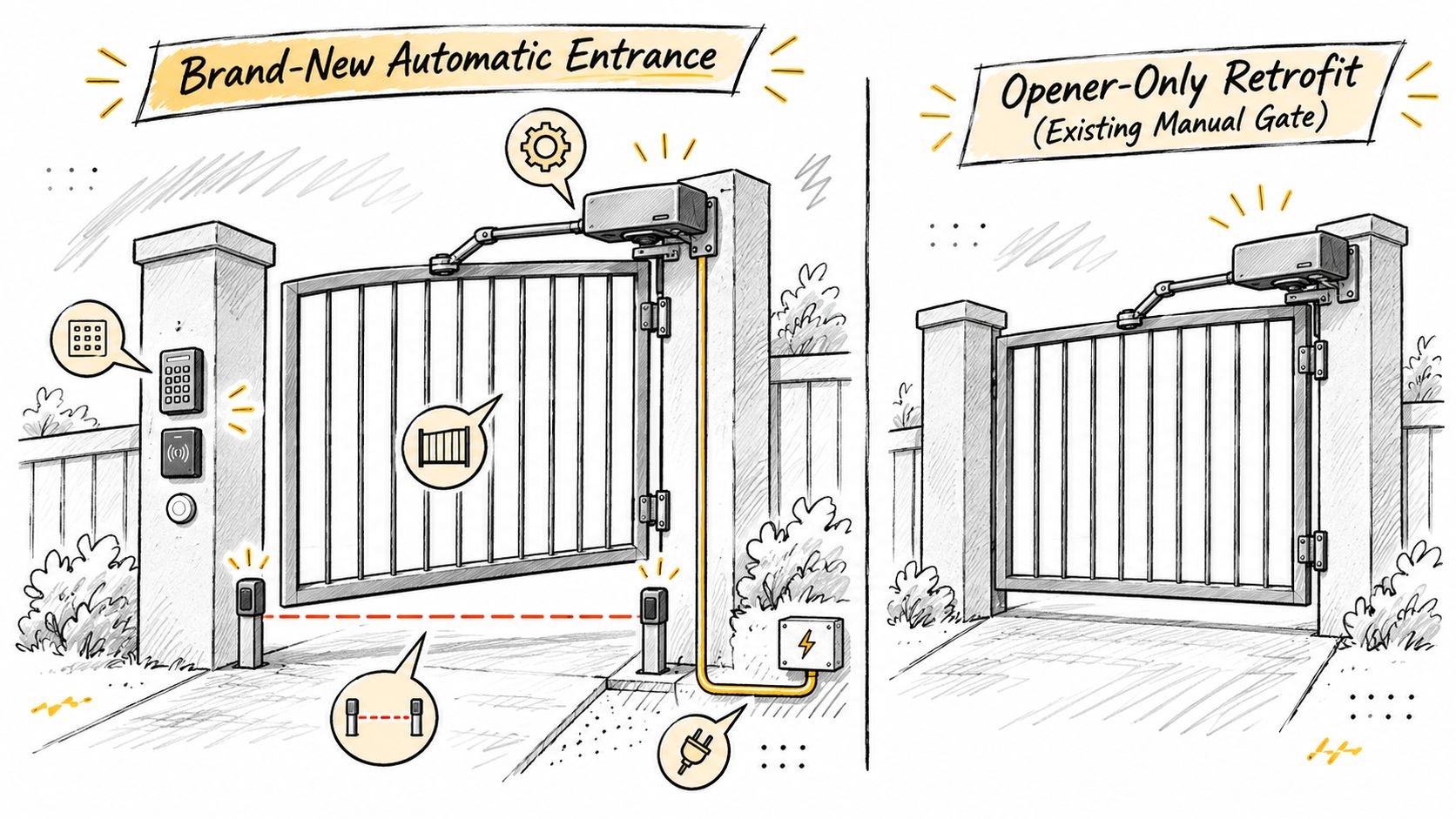
Labor, wiring, excavation, mounting, sensors, permits, and access hardware can equal or exceed the operator's price. That's the quiet fact behind most cost confusion: the motor is one line in a construction and electrical project.
Two hypothetical properties
Consider two hypothetical properties on the same street, both wanting automated entry.
Property A has a sound swing leaf, solid posts, and a power source at the post. The work is mostly operator, brackets, safety devices, and commissioning. This is an opener project.
Property B has a sagging leaf, posts that move when pushed, no pad, and no power within reach. It needs a new gate, new posts, a concrete pad, and a trench before anyone mounts an operator. This is a full-project build, whichever operator gets specified.
Same request from the board. Two entirely different scopes.
Where community entrances go higher
Larger residential entrances, HOA gates, and commercial or community facilities rise above both bands. High-duty operators, loop detectors, monitored photo eyes, conduit, concrete pads, and multiple access points all appear on those projects, and none of them is optional equipment you can defer.
The question to settle first: are you buying an operator for a gate that works, or an entrance that doesn't exist yet? Every later line item follows from that answer.
A board that answers it in writing before soliciting bids gets comparable quotes. A board that doesn't will spend a month comparing prices for different projects.
Access Upgrades Maintenance and Quote Inclusions
For the mechanism itself, see this breakdown of electric gate mechanism cost.
Access equipment is where the questions multiply. A keypad or intercom at the post, vehicle loops, monitored photo eyes, and a method for issuing and revoking entry credentials each add scope, and a low bid that omits them isn't cheaper. It's shorter.
What modern access control adds to the picture
A cellular add-on controller is one option at this layer. Nimbio's controller connects over cellular, so the gate needs no Wi-Fi, and it wires in parallel to the operator a property already owns rather than replacing the gate or the motor. Existing clickers, fobs, and keypad codes keep working alongside the app, and managers can grant, revoke, and schedule digital keys remotely, with remote visitor entry and a video check of who is at the gate.
Whether that path fits a given property comes down to the operator model, the wiring, and how the board wants to admit visitors. This guide to what to look for in a gate access system covers the compatibility questions worth answering before a site visit.
Ownership cost continues after commissioning
Routine maintenance commonly runs $150 to $400 annually, according to the same mechanism cost breakdown. A five-year comparison that ignores that cost is a one-year comparison wearing a longer label.
The cheapest installation isn't always the lowest five-year cost. Keeping a serviceable gate and adding modern access control can sometimes avoid replacement, trenching, and structural work, but existing-gate compatibility and safety certification have to be confirmed first. Assume nothing about a gate you haven't inspected.
The quote checklist
Every vendor should answer yes or no to each item below, in writing, on the quote itself.
- Gate condition assessment: is the existing leaf, track, and hardware inspected before pricing?
- Operator mounting: are brackets, arms, or track hardware included, or billed separately?
- Concrete and conduit: does the price cover pads, trenching, and conduit, or only the connection at each end?
- Electrical panel work: is a new circuit in scope, and who pulls the permit for it?
- Entrapment protection: which safety devices are supplied, installed, and tested?
- Access devices: keypads, intercoms, receivers, and controllers, named by model.
- Programming and commissioning: who sets travel, force, and safety thresholds, and who documents them?
- Permits, inspection, and haul-away: included, excluded, or billed at cost?
- Labor terms: fixed price or hourly, minimum call-out, and whether fixing a dragging gate or bad hinges is a change order.
Entrapment protection isn't a preference. UL 325 governs gate operator safety, ASTM F2200 governs gate construction, and local requirements vary by jurisdiction, so the authority having jurisdiction sets what your property must meet. Ask for the standard the installer is working to and get it in the file.
Questions that belong to the board
For an HOA or multifamily gate, three questions go beyond price. Who is allowed to service the operator after the installation, and will the next vendor honor that? Do existing clickers and the keypad stay in service, or does the upgrade strand them? And how are visitors admitted at 9 pm on a Sunday, when nobody is in the office? That last one deserves a real answer on the quote, not a shrug: a directory at the gate, a call to a resident's phone, or a scheduled hold-open window each changes what the board is buying.
Reject any single lump sum that won't map to the checklist. A quote you can't compare line by line isn't a quote, it's a starting position.
Approve the Line Items Before the Work Starts
Approval should follow scope, not the calendar. A board or owner should green-light work only once the quote matches their project: an opener on a sound gate, or a new entrance with leaf, posts, and power.
In nearly every version of this work, the large costs sit in mechanical installation, electrical work, safety devices, and site conditions. A controller added later is the small piece, and pricing it as though it were the whole project distorts the budget in both directions.
Use a licensed gate or low-voltage technician. Nimbio recommends a professional installer, and its technicians support anyone who takes on the installation, though HOA, multifamily, and commercial properties should confirm their work complies with local regulations governing gate access. Because every commercial gate, multifamily doorway, and residential lock is unique, installation pricing is determined directly by the selected technician rather than by a national kit price.
That's the honest reason to compare bids on the same line items. Nimbio's controller is one example of the add-on path: hardware wired to the existing operator, digital keys a manager can issue, revoke, and expire, and remote visitor entry with a video check. Current cellular gate opener pricing separates the hardware from the installation, and questions about a specific property can go through Nimbio's contact page as a retrofit plan rather than a generic order.
Bring the line-item list to the site visit. Get the solar alternative in writing when power sits far from the post. Then sign the bid that accounts for your gate, your power, and your rules.
A gate opener solves one problem: getting the gate to move. Nimbio handles the layer above it, wiring into the operator a property already owns so managers can issue, revoke, and expire digital keys, let visitors in remotely with a video check, and keep existing clickers and keypads working without Wi-Fi at the gate. When the bids come back, ask for a retrofit plan alongside them at Nimbio and compare the two paths on the same line items.