Complete professional installation of an automated residential gate costs about $3,000–$8,000, versus $1,500–$5,000 for a manual gate, according to the U.S. benchmark published in the Gates On Site driveway-gate cost guide. Electric gate mechanism cost therefore needs to cover the installed system, not merely the motor advertised in a hardware listing.
For a property manager or HOA board, the useful question is what the contractor must provide before the entrance can operate safely and reliably. Power, structural corrections, entrapment protection, and ongoing service can matter more to the budget than the operator's purchase price.
Table of Contents
- Residential Electric Gate Mechanism Cost Ranges
- Why the Operator Is Only Part of the Bill
- Gate Type and the Safety Rules That Set Cost
- Two Sites and Why Their Bids Diverge
- What Maintenance Adds Over Five Years
- Compare Quotes Before You Approve One
Residential Electric Gate Mechanism Cost Ranges
A residential gate quote should distinguish a complete installation from automation added to an existing gate. Those are different scopes, even when the proposed operator is identical.
A complete project may include fabrication, supports, foundations, automation, and commissioning. A retrofit may retain the gate and supports, but only if their condition and geometry suit powered operation. Keeping unsuitable hardware moves an unresolved problem into the new installation.
U.S. residential gate automation cost benchmarks
The Gates On Site guide cited in the opening provides these installation and add-on benchmarks. Its figures describe separate items, not a combined project estimate.
| Item | Range cited | What the line covers |
|---|---|---|
| Automated residential gate, professional install | $3,000–$8,000 | Complete professional installation |
| Manual gate | $1,500–$5,000 | Gate without automation |
| Underground wiring and conduit | $800–$2,500 | Power path to the gate |
| Electrical-panel upgrade | $1,200–$3,500 | Service capacity for the operator |
| Concrete pad for the operator | $400–$1,200 | Mounting base |
| Photo-eye sensors | $150–$400 per pair | Non-contact entrapment detection |
| Contact edge sensors | $200–$500 | Contact entrapment detection |
| Electrical permit | $150–$400 | Permit fee benchmark, jurisdiction varies |
| Building permit | $200–$800 | Permit fee benchmark, jurisdiction varies |
These are benchmarks for comparing quotes, not a bid. Local labor rates, electrical conditions, and permitting rules change the scope and price of each applicable line. A property outside the United States needs local pricing rather than a currency conversion of these estimates.
The table also explains why a low advertised gate opener cost can be misleading. A motor listing doesn't establish whether the property needs a new power path, a mounting foundation, or additional protection around moving parts.
Separate necessary work from optional work
Automating a suitable existing gate generally costs less than replacing the entire system because the owner avoids replacement-gate fabrication and some construction disruption. That advantage becomes less useful when the retained gate needs substantial support or alignment work.
The contractor should identify which existing components remain and which require replacement. Descriptions such as complete automation package aren't enough unless the proposal names the included electrical, mechanical, and safety work.
Budget rule: Don't add every row into a single total. The guide doesn't publish these items as a combined bid, and a complete-installation allowance may already include some of them.
Access-control upgrades belong on a separate line from the equipment that moves and protects the gate. Reviewing cellular gate opener pricing can help establish that distinction, but an access-control price shouldn't stand in for an installed automation quote.
The practical dividing line is necessity: power, mounting, and entrapment protection make the proposed installation workable. App access and other entry conveniences address how authorized people request entry.
Why the Operator Is Only Part of the Bill
The operator is the engine; the gate structure, power supply, and safety equipment are the rest of the vehicle. Buying an inexpensive engine doesn't correct a damaged chassis.
For a typical U.S. residential installation, ThePricer's electric-gate installation guide places operator equipment at roughly $300–$1,500, professional installation at approximately $800–$3,000, and electrical service or trenching at another $500–$1,500.
Three priced cost centers on a typical U.S. residential gate
| Cost center | Range cited | Budget note |
|---|---|---|
| Operator and controls | $300–$1,500 | Equipment only in a typical residential install |
| Professional installation | $800–$3,000 | Labor to fit and commission |
| Electrical service or trenching | $500–$1,500 | Getting power to the operator |
These bands aren't interchangeable with the complete-installation benchmark. Different guides package work differently, and a contractor may include mounting or commissioning under labor rather than equipment.
For budget review, the project needs separate allowances for operator and controls, electrical infrastructure, mechanical correction, and code-compliant safety devices. Professional labor crosses those categories, so the proposal should explain where it sits rather than leave it hidden in a package price.
What makes the supporting work grow
Electrical work expands when power isn't available near the entrance or when the route requires underground conduit and surface restoration. A short distance on a site plan doesn't establish whether the route crosses pavement, landscaping, or other services.
For estimating teams preparing a measured electrical scope, a resource such as Exayard electrical estimating software belongs alongside the plans and quantity takeoff. The estimate still needs a defined route, installation responsibilities, and exclusions; software can't substitute for those decisions.
Mechanical condition deserves equal attention. A heavy or misaligned leaf can impose excessive load, accelerate motor or gearbox wear, and cause nuisance reversals. Replacing the operator without addressing the resistance leaves the new equipment working against the same defect.
A bargain motor on a poorly supported gate isn't a completed repair. The proposal must address why the gate is difficult to move.
A qualified installer should verify duty cycle, gate mass, travel geometry, and available power before selecting an operator. Maximum gate size alone doesn't describe whether the mechanism suits the entrance's actual use.
Where a gate, keypad, and remotes already work, retrofitting legacy gate operators is a separate decision from replacing the mechanical system. A board should establish which problem needs solving before authorizing either approach.
These are U.S. budgeting bands. An HOA capital proposal needs local labor, permit, and trenching prices before the board votes, with unresolved site work identified rather than absorbed into a vague contingency.
Gate Type and the Safety Rules That Set Cost
A sliding gate moving past a fixed fence traps people differently than a swing leaf closing toward a wall. Travel direction sets where the entrapment zones sit, and the zones set how many protection devices the bid has to carry. That count is why two quotes built around the same operator can price out far apart.
Minimum entrapment protection by gate travel
The counts below summarize the AutoGate explanation of UL 325 gate-operator guidance, which lists horizontal slide and vertical pivot gates with two protection means in each direction, horizontal swing gates with two in each direction subject to the stated exception, and vertical lift gates with one in each direction.
| Gate type | While opening | While closing | Exception noted |
|---|---|---|---|
| Horizontal slide | Two independent means | Two independent means | None stated in this summary |
| Horizontal swing | Two independent means | Two independent means | Allowed when no entrapment zone exists in one direction |
| Vertical pivot | Two | Two | None stated in this summary |
| Vertical lift | One | One | None stated in this summary |
This is a planning summary, not a device-placement drawing. A protection means isn't necessarily a separately purchased sensor, and the table doesn't fix the final device count for a particular entrance.
The installer identifies the actual entrapment zones, the operator requirements that apply, and the compatible protection methods. Local adoption varies, and no generic table overrides the manufacturer's instructions or the authority having jurisdiction.
Protection has to be part of the operating system
Under ANSI/CAN/UL 325, the number of independent entrapment-protection means a vehicular gate operator must carry depends on the gate type and the direction of travel, which is why the counts in the table above differ by row. The operator cannot function until the required protection is installed and enabled. DASMA's gate-operator technical guidance also places activation controls generally at least six feet from moving gate parts.
Control placement has to prevent a person from reaching around, under, or through the gate to operate it. A keypad mounted wherever wiring happens to be convenient can create a design problem the bid then has to solve.
A written safety scope should go past "photo eyes included." It should name the protected zone, direction of travel, device type, mounting position, monitored connection where applicable, and who commissions the finished system.
- Photoelectric protection: The proposal should identify what the beam protects and how its location relates to moving parts.
- Contact edges: The installer should identify the surfaces that need contact-sensitive protection and the compatible connection method.
- Clearances and guarding: Fixed objects and reachable moving components need review alongside the operator.
- Controls and access: Authorized users and service personnel need appropriate positions from which to operate or maintain the installation.
Every line on that list is hardware, mounting, wiring, and test time. On a retrofit, the safety scope can rival the operator itself as a cost driver. Reusing an existing motor doesn't establish that its present sensors, wiring, clearances, or control locations remain acceptable.
Commissioning is skilled work
The UL gate-operator guidance specifies a stop-or-reverse response within two seconds for the described inherent or non-contact protection, a closing-force limit of 40 pounds-force for force-limiting protection, and force after obstruction sensing no more than 10% above the initial setting required to stop the gate.
Those limits explain why commissioning is more than attaching brackets and energizing a motor. A qualified installer configures and tests the system against the manufacturer's instructions. Owners shouldn't raise force settings to push past mechanical resistance; the limits exist to cap what the gate can do to a person in its path.
The cited guidance covers particular protection methods and operator requirements. It isn't a universal adjustment procedure for every gate model.
Approval test: A proposal that names the operator but leaves entrapment protection unspecified isn't ready for approval.
Applicable building and fire-code requirements depend on local adoption and the installation itself. The bidder should identify which requirements apply to the property rather than rely on an undated claim that the gate meets code.
Before comparing motor models, the owner should obtain a written list of protection means by direction of travel. Diagnostic lights, fault messages, and error codes belong to the specific operator manual or a qualified technician, because their meanings and corrective actions differ by model.
Two Sites and Why Their Bids Diverge
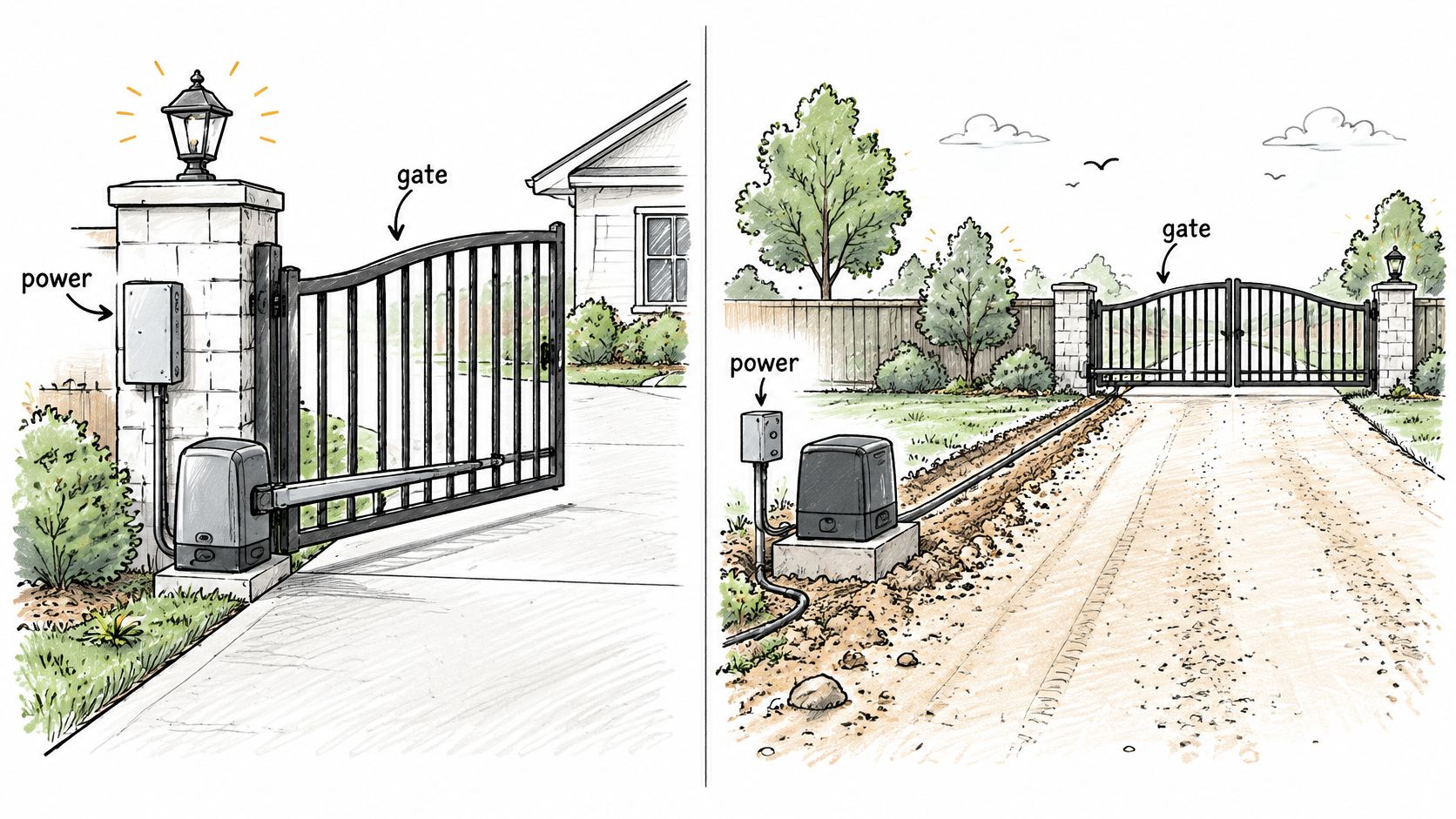
Both sites below are hypothetical, not completed projects or customer stories. They illustrate why the same operator category can produce very different installed quotes without assigning either site an invented total.
A sound driveway gate with nearby power
The hypothetical residential driveway has a sound swing leaf, stable supports, and power near the hinge post. The electrical contractor may find that a new underground route or panel upgrade isn't part of the work.
The bid still needs an appropriate operator, mounting arrangement, and entrapment protection suited to the swing geometry. Existing power is useful only after the installer verifies that it suits the selected equipment.
The owner should expect the proposal to state which components remain. If the contractor recommends replacement of an apparently serviceable post or hinge, the proposal should explain the reason rather than bury the change in miscellaneous materials.
A shared entrance with unresolved site work
The hypothetical community entrance has no nearby power, a heavy or misaligned leaf, and a sliding or wide-swing arrangement with entrapment zones in both directions. Its scope may include a new electrical route or panel work, a mounting pad or track repair, and additional sensor installation and testing.
That entrance also serves residents, visitors, deliveries, and service personnel. Compared with the hypothetical single driveway, its heavier use and broader range of users make operator selection and control arrangements more demanding.
The board should ask the bidder to mark the scope explicitly:
- Included work: Identify applicable electrical, foundation, mechanical, and protection items.
- Excluded work: Name restoration, repairs, or other tasks assigned to someone else.
- Open decisions: Identify conditions that require investigation before a firm price is possible.
Permit fees differ by jurisdiction. The local building department is the source for the actual fee and whether that entrance needs an electrical permit, a building permit, or both.
A phone estimate can't establish alignment, power-route conditions, or the relationship between the moving gate and nearby structures. A written site survey is the point where these hypothetical differences can become a defensible project price.
What Maintenance Adds Over Five Years
Installation day isn't the end of electric gate mechanism cost. Owners also need a service allowance that keeps the mechanism and its protective equipment in working condition.
The U.S. residential estimates in Rollin Gates' motorized-gate cost guide put a fully installed system at roughly $3,500–$10,000 or more, annual maintenance at $150–$400, and DIY automation kits at approximately $450–$4,500.
Install price versus routine upkeep
The midpoint illustration below is arithmetic using that guide's annual maintenance band, not a service contract or a promise of future costs.
| Item | Figure cited | What it excludes |
|---|---|---|
| Fully installed residential system | $3,500–$10,000 or more | Later repairs |
| Annual maintenance | $150–$400 | Major parts replacement |
| Five years at the $275 midpoint | About $1,375 | Major repairs and parts |
| DIY automation kits | $450–$4,500 | Labor, electrical work, permits, and site prep |
Using the stated midpoint over the ownership period gives a routine-maintenance allowance before major repairs or replacement parts. Expressed against the installation endpoints in the same guide, that arithmetic represents about 13.8% of the higher installation figure or 39.3% of the lower one.
The lesson isn't that a less expensive installation is a poor choice. The same recurring service bill represents a larger share of a smaller initial investment.
What the service allowance should cover
Typical upkeep includes lubrication, sensor inspection, hardware checks, safety testing, and operator or alignment adjustments. The manufacturer's maintenance instructions should determine the work and methods for the installed model.
A service proposal should distinguish routine attendance from replacement parts and corrective repairs. A board otherwise risks approving a maintenance allowance that doesn't cover the work it expects.
- Safety-critical service: Inspection of photo eyes and edges, plus applicable force and reversal testing by a qualified technician.
- Mechanical upkeep: Manufacturer-specified lubrication and checks of supports, hinges, rollers, track, and alignment.
- Convenience equipment: Keypads and phone access should be identified separately from protection required for safe gate movement.
Dust, corrosion, poor drainage, a damaged track, and frequent cycling can make an unsuitable light-duty mechanism expensive to own. A maintenance contract doesn't correct equipment that was selected for the wrong operating conditions.
Routine upkeep and major repair reserves serve different purposes. A service allowance shouldn't be presented as an all-inclusive ownership guarantee.
DIY kit pricing needs the same discipline. A box of equipment doesn't include the electrical route, site preparation, permits, or professional work needed to make the entrance operational.
Each bidder should provide an annual service price in writing, with included tasks, exclusions, and callout arrangements. That gives the property a meaningful ownership comparison instead of a comparison of installation totals alone.
Compare Quotes Before You Approve One
A bid that fits on one line, "automatic gate installation," gives a board nothing to compare. A proposal earns a place in the running only when another qualified contractor could read it and understand the intended work, the equipment specified, and the exclusions.
The operator model is usually the smallest decision on the page. The electrical route, entrapment protection devices, and service terms are what determine the actual cost of owning the mechanism, so those lines deserve the closest reading.
Mark these items on every proposal
- Operator selection: Record the model and duty rating, with confirmation that they suit the gate's weight, length, geometry, and expected use.
- Retained gate: State whether the existing leaf stays, is repaired, or is replaced.
- Electrical path: Identify trenching, conduit, panel work, connections, and responsibility for restoration.
- Mechanical scope: Name work to pads, posts, hinges, rollers, or track.
- Entrapment protection: List each protection device and the direction or zone it serves.
- Permits: Identify required approvals, fees, and the party responsible for obtaining them.
- Warranty and service: State coverage and what the initial service period includes.
- Exclusions: Identify landscaping, utility-location arrangements, additional leaves, and work assigned to other contractors.
A phone price obtained before a site visit can't account for hidden sag, slope, or the actual electrical route. Where a contractor provides a preliminary allowance, the board should keep it separate from a firm approval amount.
Keep access-control decisions separate
Where the gate and operator already work, the remaining problem may concern credentials or visitor entry rather than gate movement. The cellular gate access system buyer's guide can help frame that separate purchasing decision.
Nimbio is one example of a cellular add-on: it connects over cellular service with no Wi-Fi at the gate, wires in parallel to the existing operator's dry-contact input, and keeps existing clickers, fobs, and keypad codes working alongside its app. Managers can issue and revoke digital keys remotely, set schedules, and review entry logs, while visitors can request entry through a one-way video call so a resident can see who is at the gate before opening it.
That approach changes access management. It doesn't repair a worn mechanism or substitute for entrapment protection, so its scope should remain distinct from any mechanical or safety work identified during the survey.
Before approval of any electric gate mechanism cost, the proposal should show power and safety devices as their own written lines. The bidder should also confirm that the operator manual's model-specific entrapment requirements have been checked; otherwise, the proposal needs revision.
For a property with a working electric gate, Nimbio offers a cellular controller and smartphone app that add remote access while retaining existing entry devices. Property managers can visit nimbio.com to see the controller and app in action, or call 1-800-353-3422 to have the support team confirm wiring compatibility with a specific operator model before it goes into the gate budget.