A gate opener chain usually gets attention only after something goes wrong, a gate stops halfway, the operator hums, and someone has to move the gate by hand to get traffic through. That's the moment when the chain stops being a small part and starts acting like a clue, because it can point to wear, bad tension, misalignment, or a deeper operator problem. For a homeowner, HOA board member, or property manager, the question isn't whether the chain looks okay. It's whether the chain is telling the truth about the whole gate system.
Table of Contents
- Why the Chain on Your Gate Opener Matters More Than You Think
- How a Chain-Driven Gate Operator Actually Moves the Gate
- Chain vs Belt vs Rack Drive Systems
- Choosing the Right Chain Size for a Gate Operator
- What Chain Wear Is Telling You
- Inspection and Lubrication Routine for Gate Opener Chains
- Chain Condition Is Not the Same as a Safe Gate
- Replacement Triggers and a Final Inspection Checklist
Why the Chain on Your Gate Opener Matters More Than You Think
A quiet Monday call about a stuck gate can turn into a long afternoon fast. The clicker still works, the motor may still try to move, but the gate doesn't travel cleanly, or it lurches and stops before the cycle ends. In that moment, the gate opener chain is more than a wear item, it's a signal that something in the drive path, the alignment, or the safety setup needs attention.
The chain matters because it sits between the motor's output and the gate's movement. If it's wrong for the operator, too loose, too tight, corroded, or worn past its service limit, the gate won't behave predictably. A chain can also expose problems that aren't really “chain problems” at all, such as a bent track, hooked sprocket teeth, or a gate that's heavier than the operator was meant to handle.
A chain that looks fine can still be masking a drive problem or a safety problem.
That's why chain type, size, and upkeep matter for residential driveways, gated communities, and commercial entries alike. Standardized roller chain dimensions, developed from the late nineteenth-century design work around Hans Renold's 1880 bush roller chain patent, made parts more interchangeable across manufacturers, which is why the correct chain class and pitch still matter today. For background on the modern access side of the system, how cellular gate openers work helps explain why the mechanical operator and the access controller have to cooperate, not fight each other.
A good chain doesn't make a gate safe by itself, and a noisy chain doesn't always mean the chain is the root cause. It means the gate deserves a careful look before a small adjustment turns into a larger repair.
How a Chain-Driven Gate Operator Actually Moves the Gate
A chain-driven gate operator is simple in concept and picky in practice. The motor turns a gearbox, the gearbox drives a sprocket, the sprocket pulls the chain, and the chain moves the gate through a bracket attached to the gate frame. An idler or guide keeps the chain path aligned so the drive stays engaged instead of wandering.
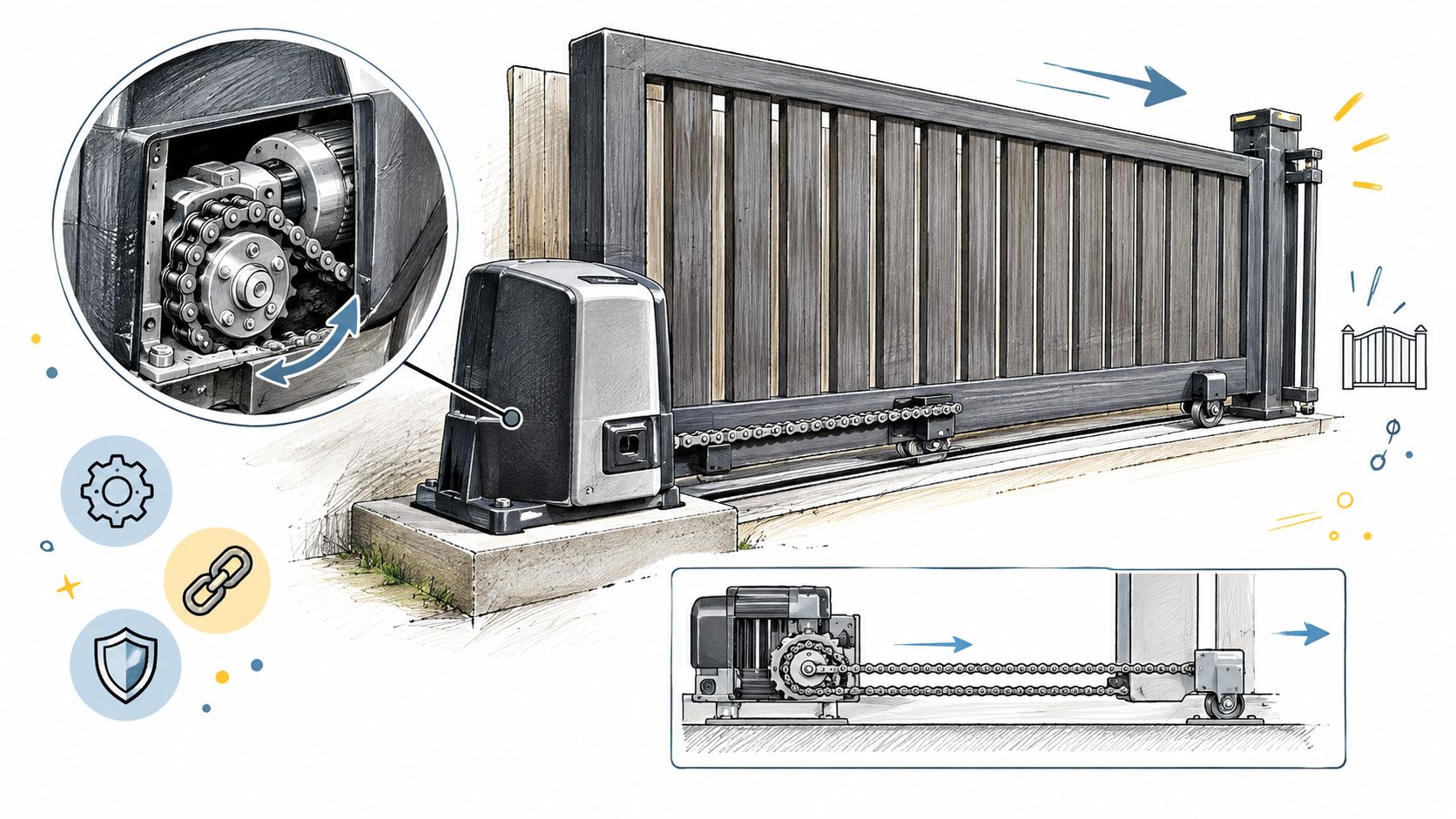
The easiest way to understand it is to think of a bicycle chain, because the same idea applies. The chain has to match the sprocket teeth, and the teeth have to match the chain pitch. If any one of those pieces is off, the chain doesn't seat correctly and the load gets transferred in the wrong places.
The parts that have to work together
The motor supplies power, but the gearbox is what gives the operator usable force. The drive sprocket pulls the chain, the idler keeps tension and direction under control, and the chain bracket on the gate turns that motion into actual gate travel. When one part wears faster than the others, the whole system starts to show it in noise, jerkiness, or poor positioning.
Practical rule: if the chain is doing anything dramatic, the operator is probably telling on something else too.
Manual disconnect matters because it lets the gate move when power is off or when servicing is needed. That disconnect should still leave the gate moving smoothly, without binding or surprise resistance. A properly set chain and a properly aligned gate should let the gate move without the operator having to fight every inch.
For managers comparing control options, secure entry system controllers are only useful when the underlying mechanics are sound. A controller can send the command, but it can't fix a bad chain path.
Chain vs Belt vs Rack Drive Systems
A property doesn't usually get to choose a drive system after the gate is built. It inherits the mechanical decision already made by the gate designer or installer, and the actual work becomes keeping that drive type in good shape. Chain, belt, and rack each solve the same problem in a different way, and each one brings different trade-offs.
Chain is common on heavier sliding gates because it handles load well and can be serviced without special parts in many standard layouts. Belt systems tend to be quieter and are often preferred where noise matters more than brute force. Rack drive setups use a toothed rack fixed to the gate, which can be neat and direct, but they still depend on correct alignment and solid installation.
For property owners comparing repair options, a local fencing contractor can be useful when the issue isn't the opener itself but the gate structure around it. One resource that homeowners sometimes use for broader fence and gate work is 1st Choice Home Repairs fencing, especially when the gate frame, track, or support posts also need attention.
| Drive Type | Typical Use | Strengths | Weaknesses |
|---|---|---|---|
| Chain | Heavier sliding gates | Strong, familiar, serviceable | Noisier, alignment sensitive |
| Belt | Quieter residential or noise-sensitive sites | Smooth operation, lower noise | Less suited to heavier exposed drives |
| Rack | Sliding gates with fixed gear engagement | Direct motion, clean layout | Alignment and rack condition matter |
A retrofit or controller upgrade sits on top of whichever drive already exists. That's why a cellular access change doesn't replace the need to inspect the operator, brackets, and gate travel. A modern controller can improve access control, but it can't change the fact that the gate still moves on the same mechanical path.
Choosing the Right Chain Size for a Gate Operator
A gate operator chain should be sized to the drive it was built for, not to what looks heavy enough in the box. ANSI chain sizing is straightforward once the markings are translated. #40 has a 0.500-inch pitch, #50 has a 0.625-inch pitch, and #60 has a 0.750-inch pitch. The last digit matters too, because 0 means standard roller chain, 1 means lightweight chain, and 5 means bushing chain without rollers.
Read the manual first
The operator manual sets the limit. Manufacturer guidance for sliding gate operators commonly specifies ANSI #41 chain for compatible light-duty systems and commonly limits chain length to 40 ft (12 m), with the chain adjusted to be approximately taut after installation (sliding gate operator manual guidance). That matters because the chain is part of the drive geometry, like a matched part in a machine, not a loose accessory.
If the wrong chain class goes in, the gate can wear early, jump the drive, or run unsafely. Too much slack lets the chain whip or skip. Too much tension shifts load into the sprocket, bearings, and gearbox, where the operator is least able to absorb it.
Match size to the gate, not the look
A chain that looks strong can still be the wrong pitch or construction. ANSI roller-chain standardization is what lets chains, sprockets, and drive components fit together across manufacturers (roller chain standardization). For a property manager or homeowner, the practical check is simple. Match the operator label, the manual, and the installed chain, then confirm they all agree.
An installation reference also gives about 1/4 to 3/8 in. of slack per foot of drive chain. That turns tension into something measurable instead of a guess based on touch.
If the manual names the chain class, use that class. A close substitute often becomes a repeat repair.
For heavier systems, the numbers climb fast. These are breaking-strength figures, not safe working loads. ANSI roller-chain data lists 455 pounds for #25 chain, 1,045 pounds for #35, 2,455 pounds for #40, 3,977 pounds for #50, 9,432 pounds for #60, 15,773 pounds for #80, and up to 98,090 pounds for much larger industrial sizes (ANSI roller-chain data). The key point is not the biggest number. It is that the operator manual and installation conditions still decide what is safe on the gate.
What Chain Wear Is Telling You
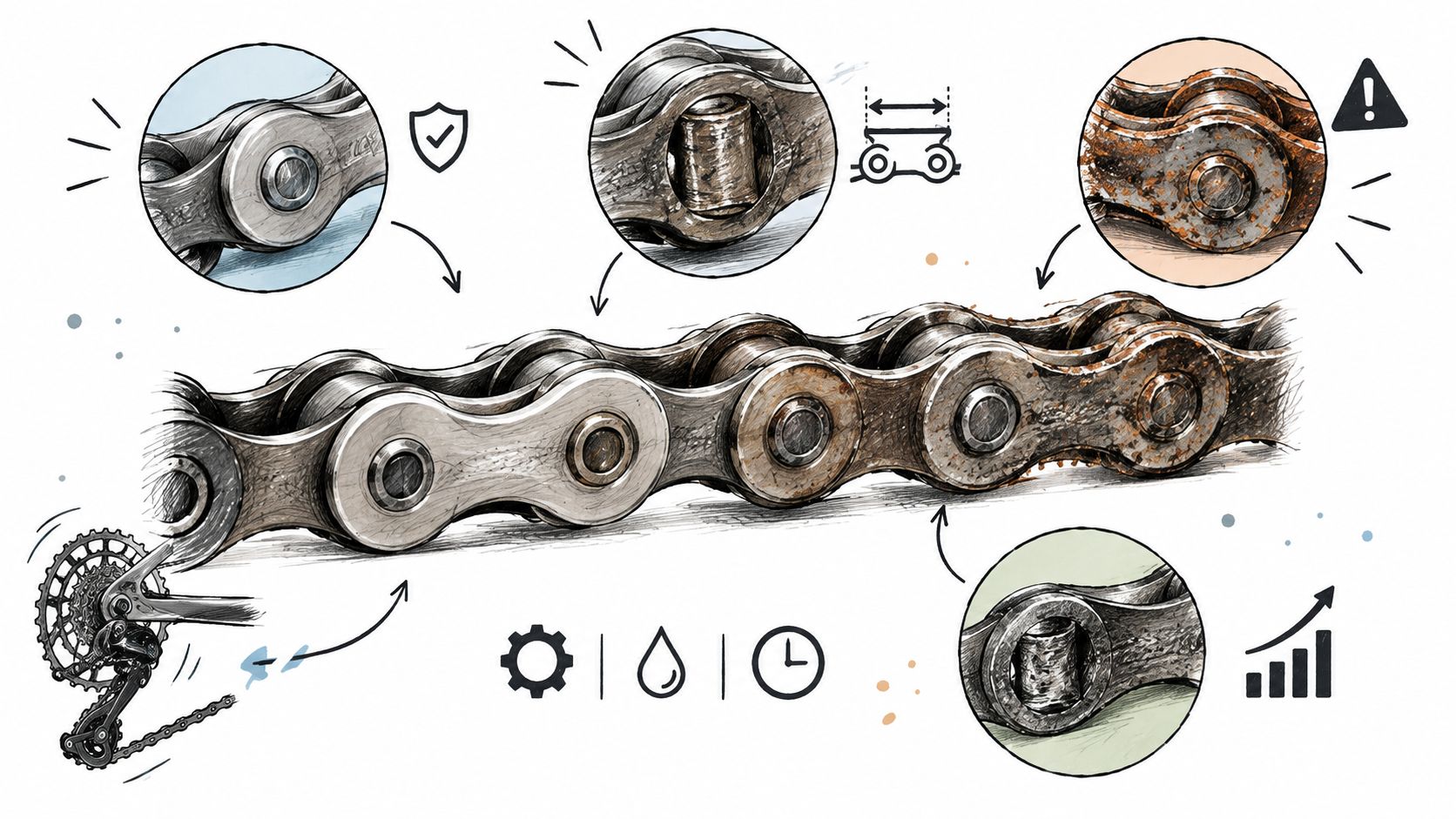
Wear rarely announces itself with a snapped chain. More often, it shows up as elongation, which comes from pin-and-bushing wear rather than the steel plates stretching. That matters because the chain is losing accuracy at the joints, not getting longer.
As elongation increases, the pitch relationship with the sprocket becomes less exact. The chain may ride higher on the teeth, load the sprocket unevenly, or skip under acceleration. Engineering guidance commonly treats about 2% elongation as the maximum limit for chain drives before replacement becomes the safer move (wear guidance).
The symptoms are often louder than the cause
A chain that keeps loosening, squealing, or making the operator hesitate is usually warning you about something else in the drive. The sprockets may be hooking, the gate may be carrying load through the drive in the wrong way, or the track may be misaligned. In dusty or coastal settings, corrosion and abrasive grit can make that wear show up faster.
Lubrication helps, but more lubricant is not always better. Grease and oil can attract dirt, and dirt becomes an abrasive. If the chain still loses tension after service, the issue may be the load path, sprocket wear, or misalignment rather than the chain alone.
What to look for during diagnosis
- Uneven travel: The gate accelerates or slows in a choppy way.
- Recurring slack: Tension comes back after adjustment, then disappears again.
- Visible corrosion: Rust that has etched the plates suggests more than surface grime.
- Stiff links: One or more links do not articulate freely.
A chain can act like a symptom detector. If it is wearing strangely, the rest of the system deserves the same level of scrutiny.
Inspection and Lubrication Routine for Gate Opener Chains
A quiet chain can still hide trouble, so the inspection should start with the whole drive path, not just the chain itself. Shut the operator down, then look for rust, grime, damaged links, missing fasteners, and anything that could force the chain to rub or climb the sprocket. After that, measure slack against the operator manual instead of estimating by feel.
A practical walk-the-gate check
Begin with a visual pass. Look for corrosion, debris buildup, missing hardware, and points where the chain runs off line. Then check the links by hand for stiffness or seized movement. One bad link can affect the full run, much like a kink in a bicycle chain slows the whole drive.
Measure elongation over a defined number of pitches. That gives a clearer picture than checking a single loose spot, because wear usually builds unevenly. Sprocket teeth also deserve attention. Hooked or asymmetrical teeth can damage a fresh chain quickly, even if the chain itself was recently serviced.
Lubrication has to reach the pin and bushing interfaces. Coating only the outside plates leaves the wear surface unprotected, where the damage starts.
Keep the chain and track free of corrosion, grime, and obstructions. Follow the manufacturer's sliding gate operator maintenance guidance from the manufacturer and test infrequently used gates at least monthly. If the gate starts to feel rough, verify that it moves smoothly by hand before you blame the chain alone. That matters on properties where the gate sits idle for stretches and then gets heavy use.
A manual-disconnect test belongs in the routine too. If the gate will not move cleanly when disconnected, the issue may be in the gate, rollers, track, or alignment rather than the chain drive. A chain can only do its job if the gate can move without binding.
How often to do it
Typical operator guidance calls for at least semiannual inspection and lubrication, with shorter intervals for high-cycle, dusty, or salt-exposed sites (wear guidance). That interval sets the minimum, not the finish line. The operator manual should always decide the final maintenance schedule.
Chain Condition Is Not the Same as a Safe Gate
A clean, adjusted chain is good maintenance, but it doesn't make the whole gate compliant or safe by itself. Automated vehicular gates are covered by ASTM F2200 and also have to comply with UL 325 requirements, which address how the gate is built, how it moves, and how it protects people around it (ASTM F2200 scope). The chain sits inside that system, not above it.
ASTM F2200 says an automated gate must be designed, constructed, and installed so that movement can't be initiated by gravity when the automatic operator is disconnected (ASTM F2200 gravity requirement). It also limits how far a detached gate may fall, to 45 degrees from the vertical plane (ASTM F2200 fall limit). Those are structural safety rules, not chain-maintenance tips.
UL 325 requires at least one independent primary and one independent secondary means of entrapment protection, with requirements varying by gate type and direction of travel (UL 325 guidance). Examples include photoelectric sensors, contact sensors, or monitored devices, and the operator's response to obstruction has to stay within the standard's limits. A lubricated chain doesn't replace photo eyes, sensing edges, or compliant controls.
Why this matters in real life
A gate can move smoothly and still be unsafe if the sensor system is missing or wrong. The reverse is also true, a gate can have working safety devices and still need chain service because the mechanical drive is worn out. The right response is to separate the problems instead of treating them as one.
The March 21, 2025 UL 325 update added or clarified requirements around monitored entrapment-protection circuits and gate movement limits, which is a reminder that standards change over time (UL 325 update notice). Local requirements vary too, so a property should verify both the standard and the installation practice before assuming a gate is compliant.
Replacement Triggers and a Final Inspection Checklist
Some chains are worth adjusting. Others are done. If elongation is nearing the engineering limit, if the gate keeps derailing after the track and brackets have been checked, if links are cracked or seized, or if rust has etched the plates instead of just sitting on the surface, replacement makes more sense than another round of oil and hope.
Wrong chain class is also a replacement trigger. A chain that was never the correct size for the operator can't be fixed by tensioning alone. The same is true when the drive keeps failing after sprocket wear and alignment have already been corrected.
For access-control retrofits, including a cellular add-on controller like Nimbio, the mechanical side still has to be right. That kind of upgrade wires into an existing operator, so it's smart to verify chain class, gate travel length, bracket alignment, and manual-disconnect movement before the new access layer goes live. For compatibility questions, the hardware and compatibility knowledge base is the place to check what the existing gate hardware can support.
If the gate has stopped responding and the issue may be electrical as well as mechanical, a local technician who handles control and power troubleshooting can save time. A useful reference for that broader diagnostic path is outlet not working electrician, especially when the operator needs both mechanical and electrical evaluation.
Keep this checklist by the motor
- Slack: Check that tension stays within the operator's manual guidance.
- Lubrication: Confirm lubricant reaches the pin and bushing interfaces.
- Elongation: Measure wear over several pitches, not just by eye.
- Sprockets: Look for hooked or uneven teeth.
- Brackets: Verify the gate connection hasn't loosened or shifted.
- Manual disconnect: Test that the gate moves without binding.
- Safety devices: Confirm the gate still has the required entrapment protection and control setup.
For a property manager, the best outcome is fewer surprises and a cleaner service record. For a homeowner, it's the difference between a gate that “mostly works” and one that moves the way it should.
Nimbio makes a cellular add-on controller and smartphone app for electric gates, so it can sit on an existing operator without replacing the gate or the remotes people already use. If a gate opener chain has started pointing to deeper mechanical issues, the right time to modernize access is after the drive path, chain class, and safety devices have been checked. Visit Nimbio to see how cellular gate control fits into an existing system.