A property manager often notices the same pattern first. The gate still opens, but the access process around it is messy. Residents share old clickers, vendors keep using a common PIN, after-hours deliveries stack up, and nobody can answer the basic question: who came through the gate, and when?
That's where an industrial gate opener stops being just a motor and becomes part of a broader security system. For HOAs, logistics yards, and commercial sites, the actual issue usually isn't only moving a gate leaf. It's controlling entry, proving what happened later, and managing access without driving to the property every time someone needs in.
That shift is happening across the market. The industrial gate and door opener market was valued at USD 3.5 billion in 2024 and is projected to reach USD 6.8 billion by 2034, with a 6.9% CAGR, reflecting stronger demand for perimeter security and automated access control. For property managers, that means one thing: gate decisions now belong in the same conversation as compliance, staffing, resident experience, and cloud-based access control.
Table of Contents
- Beyond the Physical Barrier
- Choosing Your Drive Mechanism
- Decoding Key Technical Specifications
- Modernizing Access Control Beyond the Clicker
- Installation and Retrofit Considerations
- Industrial Gate Openers in Action
- Your Actionable Selection Checklist
Beyond the Physical Barrier
The gate motor gets most of the attention because it's visible. The bigger operational problems usually sit behind it. Shared credentials, manual visitor handling, and missing entry records create more daily friction than the steel gate itself.
For an HOA board, that friction shows up as resident complaints and weak auditability. For an industrial site, it shows up as delayed vehicle flow, uncertain after-hours access, and more pressure on staff to manage exceptions manually.
Practical rule: A gate that opens reliably but can't produce trustworthy access records is only solving half the problem.
An industrial gate opener should be evaluated in two layers:
- Mechanical layer: Can it move the gate safely, consistently, and at the right speed?
- Operational layer: Can staff control access remotely, revoke credentials quickly, and review a usable audit trail?
That second layer gets overlooked far too often. Existing industry content tends to focus on hardware troubleshooting, such as limit switches, corrosion, and fuse issues, while missing the gap around auditability and digital access logging, as seen in common gate troubleshooting guidance. For property managers, that omission matters because access control policy is what determines whether the site is manageable at scale.
A strong system supports more than entry. It supports accountability. That's the difference between a gate that merely opens and a gate that fits a modern smart community.
Choosing Your Drive Mechanism
The first buying decision is simple in theory and expensive to get wrong in practice. The operator must match the gate's movement pattern, site layout, and traffic needs.
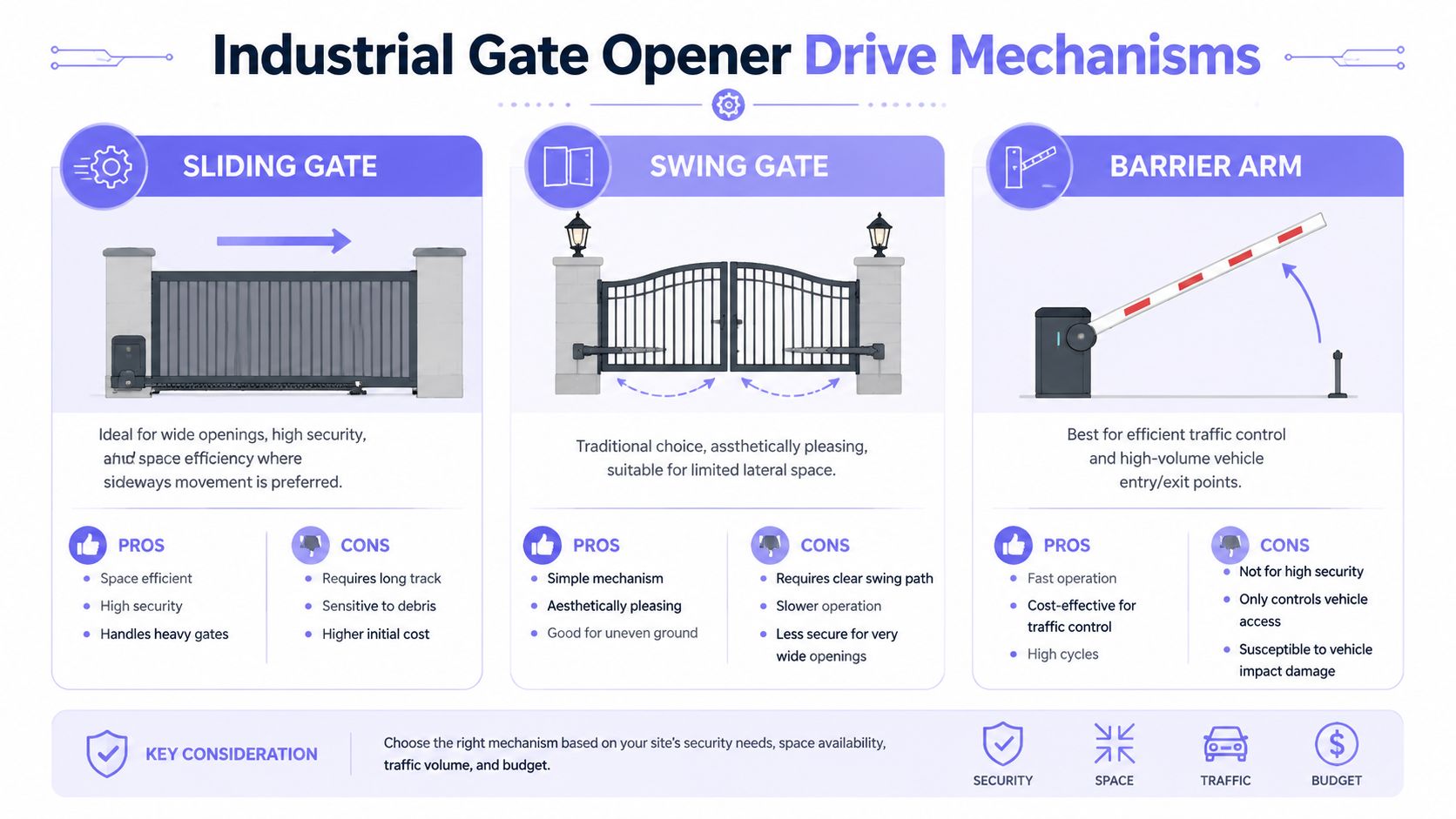
The three common categories are sliding, swing, and barrier arm operators. Each solves a different problem.
Sliding gate operators
A sliding operator moves the gate horizontally along a track or cantilever path. This is often the right choice for industrial properties, distribution yards, and sites that need stronger perimeter control.
Sliding systems work well when the property can't spare the inward or outward swing area. They're also easier to pair with heavy gates built for commercial security.
A useful performance example comes from high-speed industrial sliding gate opener specifications. A model rated for 1000 kg can open 4 meters in 10 seconds, while a 2000 kg model takes 14 seconds over the same distance. That's a clear reminder that weight, speed, and motor capacity are linked.
Where sliding gates fit best
- Tight frontage: They save space because the gate travels sideways.
- Heavier security gates: They're well suited to heavy-duty commercial gate leaves.
- Sites with frequent use: They tend to be a strong fit for repetitive daily operation.
Trade-offs to watch
- Track conditions: Debris can affect performance on track-based systems.
- Runback space: The site needs enough lateral room for the gate to travel.
- Operator sizing: Underpowered motors create reliability problems quickly.
For more complex hydraulic setups, installers may also review options for specifying UK hydraulic power packs when designing heavier-duty automation packages.
Swing gate operators
Swing operators push or pull the gate leaf on hinges. They're common in business parks, private roads, and community entrances where curb appeal matters alongside access control.
They can work well on certain uneven surfaces, and the mechanism is straightforward. The challenge is clearance. A swing gate needs a clean arc, and that space has to remain unobstructed.
Swing gates often look simpler on paper than they behave on busy sites. The swing path, vehicle stacking area, and slope all need careful review before approval.
Best use cases
- Professional entrances: They suit properties that want a traditional look.
- Moderate traffic: They're often acceptable where traffic surges are limited.
- Retrofit candidates: Some existing entrances already have hinge geometry that favors swing automation.
Property teams comparing power and resilience options may want to review reliable gate access systems when battery-supported operation is a priority.
Barrier arm operators
Barrier arms don't secure the perimeter the same way a sliding or swing gate does. They control vehicle flow. That makes them useful at parking entries, staffed checkpoints, and managed access lanes.
Their biggest advantage is throughput. They open quickly and support repetitive traffic management. Their limitation is just as obvious. They don't provide the same physical barrier as a full gate.
A short comparison helps:
| Mechanism | Strongest fit | Main limitation |
|---|---|---|
| Sliding | Security and heavy-duty access points | Needs lateral travel space |
| Swing | Formal entrances and moderate traffic | Needs clear swing path |
| Barrier arm | High-volume vehicle control | Lower physical security |
Decoding Key Technical Specifications
Brochures often make gate hardware look interchangeable. It isn't. A properly selected industrial gate opener is sized around workload, safety requirements, and control strategy.
The easiest way to evaluate specs is to translate them into site questions. How often will the gate move? How fast must it open? What happens during an obstruction or power loss? Can the system integrate with modern access control?
Performance that matches the site
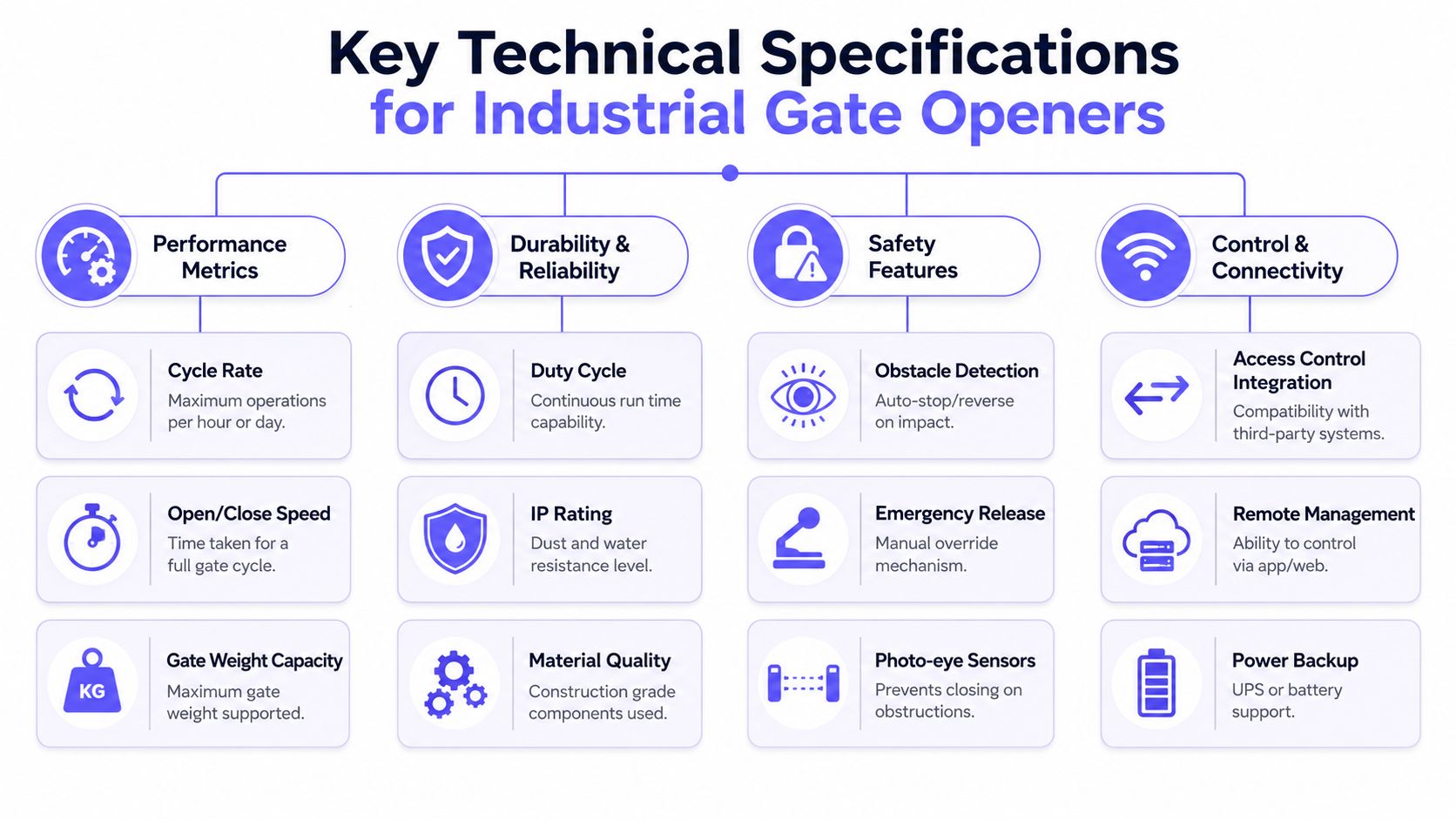
Two terms confuse non-technical buyers more than any others: duty cycle and cycle rate.
Duty cycle refers to how hard the operator can work over time without overheating or wearing out prematurely. Cycle rate refers to how many open-close movements the gate is expected to handle over a given operating period. A community gate with intermittent use has one profile. A warehouse receiving entrance has another.
Property managers should ask installers for a plain-language answer to these questions:
- What gate weight and length is the operator rated to handle?
- How frequently can it run without strain?
- How long does a full open or close cycle take under the actual gate load?
- What environmental conditions could affect reliability?
Other specifications matter too:
- IP rating: Important for dust, water, and exposed outdoor environments.
- Material quality: Better gearsets, housings, and corrosion resistance usually mean fewer service calls.
- Emergency release: Staff need a manual override procedure that's clear and accessible.
Safety isn't optional
Safety language can sound technical until liability enters the conversation. Then it becomes very simple.
For commercial and industrial gates, UL 325 compliance requirements mandate dual-monitored entrapment protection. The operator's internal reversing function isn't enough on its own. A secondary device, such as photo eyes or sensing edges, is required to help prevent injury and reduce liability exposure.
That matters because many buyers assume the motor's built-in reverse feature covers safety. It doesn't.
A compliant industrial gate opener isn't just a motor with a warning sticker. It's a system with redundant protection designed to fail safely.
A practical safety review should include:
- Photo-eye placement: Sensors must protect the actual hazard zone.
- Sensing edges: Important where pinch or crush points exist.
- Manual release procedure: Staff must know how to use it during emergencies.
- Installer documentation: The property should keep records for maintenance and compliance review.
Control and power decisions
The final technical layer is where many properties either future-proof the gate or lock themselves into outdated habits.
The operator should support access control integration, remote management, and power backup. Battery support matters because outages don't cancel deliveries or resident arrivals. Control integration matters because a gate shouldn't operate like a disconnected appliance.
For property managers, the best question isn't “Does the gate open?” It's “Can the site keep operating when conditions aren't ideal?”
Modernizing Access Control Beyond the Clicker
Mechanical automation solved one old problem. It removed the need for someone to get out of the vehicle and open the gate manually. It didn't solve the management problem.
That problem shows up when a resident loses a remote, a former vendor still knows the keypad code, or staff need to let in a guest after hours without being on site. Those are access control failures, not motor failures.
Why old credentials create blind spots
Traditional gate access tools are familiar, but they're weak from an operations standpoint.
- Physical remotes get shared: Once a clicker changes hands, oversight drops fast.
- Common PINs aren't accountable: If multiple people use the same code, there's no clean audit trail.
- On-site management slows response: Revoking access often requires staff to chase hardware, change codes, or schedule service.
The bigger gap is visibility. Industry guidance still focuses heavily on mechanical fixes while missing the need for real-time entry logs, revocable digital credentials, and auditability. For HOAs and commercial sites, that missing layer affects resident disputes, incident review, and policy enforcement.
Why cellular changes daily operations
Modern systems are moving toward connected control. According to global gate opener sales data, smart gate openers with IoT-enabled controllers accounted for 30% of all new installations globally in 2024. That's a meaningful signal that connected, remotely managed access is becoming standard.
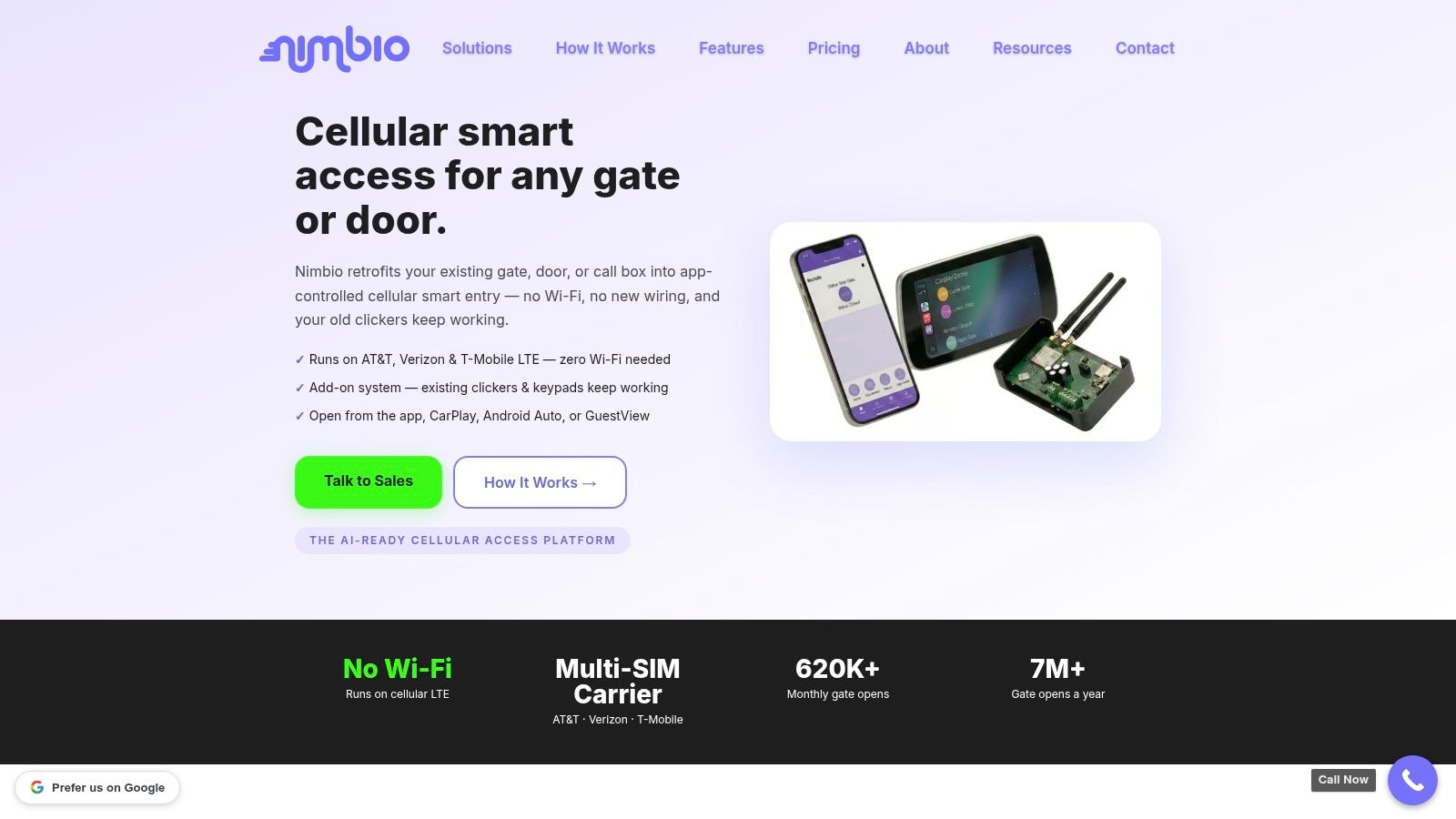
The connectivity choice matters. A cellular gate entry system uses mobile connectivity instead of relying on local Wi-Fi, which helps avoid the drops and outages that commonly disrupt gate access at the exact wrong moment. For gated communities and distributed commercial properties, that reliability changes the daily workload.
A modern cloud-based setup lets administrators do three important things from anywhere:
- Grant or revoke credentials remotely
- Manage visitors without driving to the gate
- Review time-stamped access activity when questions come up
Some properties also want the gate to connect to broader workflows. A gate access API can support custom integrations when teams need the gate tied into other software or operational tools.
One example in this category is Nimbio, a cellular retrofit system that adds smartphone control, remote credential management, and digital access logging to compatible electronic gates without depending on property Wi-Fi.
A further step is visual verification. Video-integrated gated entry systems can support visitor review before access is granted, which is especially useful for communities handling deliveries, guests, and service providers throughout the day.
Installation and Retrofit Considerations
Many property managers assume modernization requires a full gate replacement. In most cases, that's the wrong starting point.
The better starting point is to ask what already works. If the gate leaf is sound and the operator is still functional, the property may only need a control upgrade rather than a rip-and-replace project.
New installation versus retrofit
A new installation gives the team a clean slate. The gate type, operator, safety devices, and access control platform can be selected together. That's ideal when the site is under construction or the existing equipment has reached the end of its useful life.
A retrofit is different. The goal is to preserve viable infrastructure while fixing the parts of the system that create management headaches.
That's where cellular retrofits stand out. Hardware-agnostic cellular technology can retrofit existing operators from brands such as LiftMaster or Viking, preserving the original gate infrastructure while adding smartphone-based control.
The smartest upgrade often isn't a new gate. It's a better control layer on the gate that's already installed.
What a retrofit usually involves
A retrofit project should begin with a site review, not a product catalog.
The installer needs to confirm:
- Operator compatibility: The existing gate operator must support integration.
- Safety status: Current sensors and protection devices must meet requirements.
- Credential policy: The property should decide whether to keep remotes, phase out shared PINs, or move to digital keys.
- Connectivity plan: Cellular control avoids dependence on house Wi-Fi, clubhouse internet, or long wiring runs back to the building.
The practical appeal is straightforward. A cellular retrofit usually avoids trenching new network lines and avoids the instability that comes with consumer-grade Wi-Fi coverage across large properties.
Teams evaluating retrofitting legacy gate operators should focus on outcomes rather than hardware novelty. The key questions are whether the upgrade will reduce manual admin work, improve auditability, and give managers remote control when exceptions happen.
For many HOAs and commercial properties, that's the most cost-effective modernization path available.
Industrial Gate Openers in Action
Specifications matter, but the operational picture becomes clearer when the gate is viewed in context.
Logistics yard
A logistics manager needs to let in a delivery driver who arrives outside the expected window. With an old setup, staff may rely on a shared code, a phone call to the guard station, or a manual gate release.
With a modern access layer, the manager can issue a time-bound credential remotely, confirm entry activity later, and avoid leaving a standing code active for every future driver. That protects the site without slowing down freight movement.
Gated community HOA
An HOA board inherits a gate system where residents, former residents, dog walkers, and contractors all seem to know the same keypad code. Nobody wants to change it because the transition will be disruptive.
The better approach is to phase out shared credentials and issue individual, trackable digital access. When a resident moves out or a vendor relationship ends, access can be revoked without recollecting hardware from half the neighborhood.
For HOAs, the biggest gain often isn't convenience. It's the ability to stop guessing who still has access.
Self-storage and mixed-use sites
A self-storage property may want one access pattern during peak daytime use and a different one overnight. A mixed-use commercial site may need scheduled hold-open periods for regular traffic, then tighter access controls after business hours.
That kind of policy control turns the gate into an operational tool. Staff don't have to stand at the entrance managing routine patterns manually. They can set schedules, handle exceptions remotely, and review activity when a dispute or incident arises.
The common thread across all three environments is simple. The most useful industrial gate opener is the one that combines reliable movement with manageable, auditable access policy.
Your Actionable Selection Checklist
A good buying process should leave fewer surprises after installation. The easiest way to get there is to pressure-test the system before approving it.
Questions to take to vendors and installers
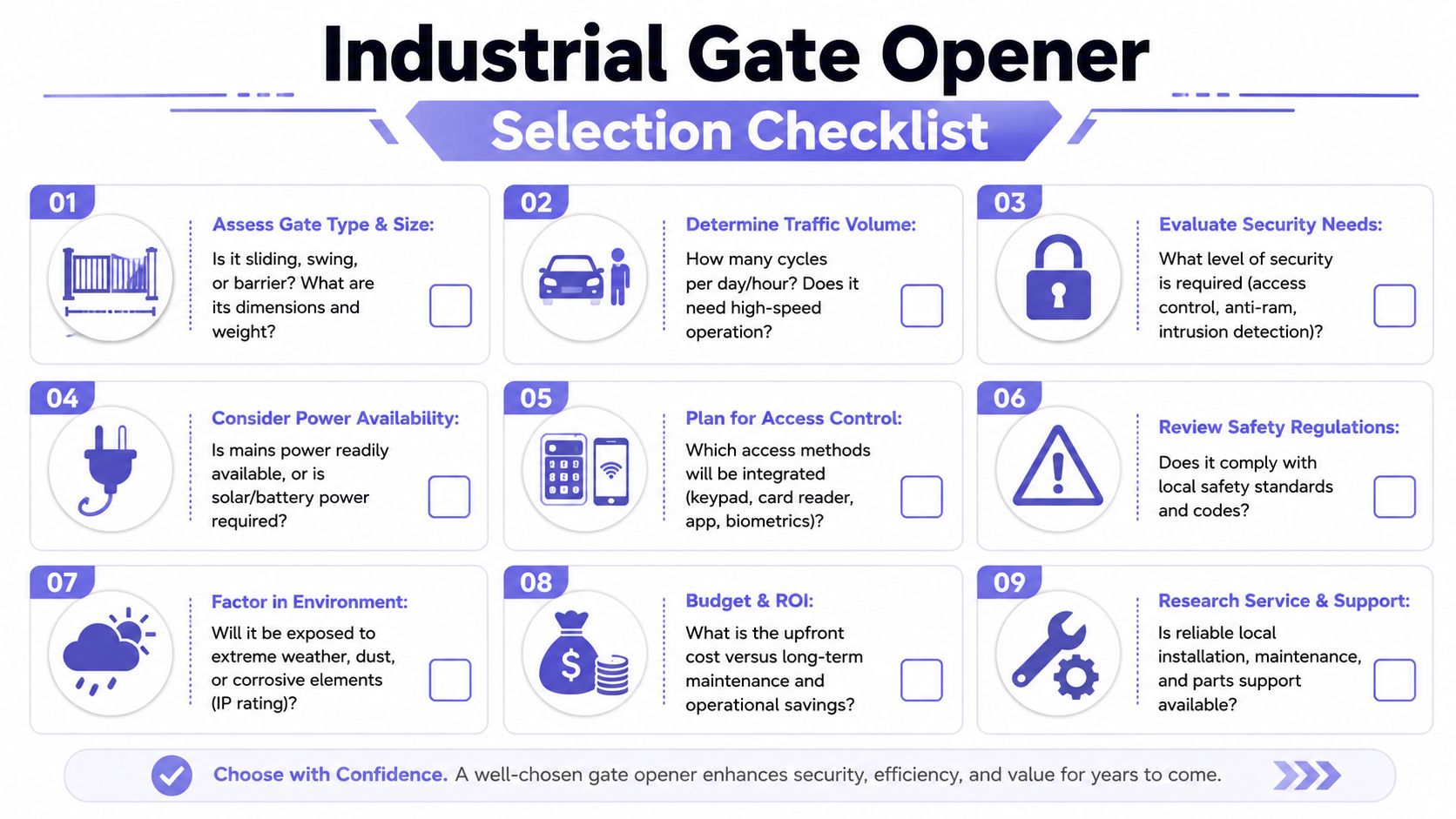
- Gate and site fit: Is the entrance better served by a sliding gate, swing gate, or barrier arm, and has the operator been matched to the actual gate size and weight?
- Traffic profile: Does the system suit the property's real cycle demands, including rush periods, deliveries, and after-hours use?
- Safety compliance: Has the installer specified dual-monitored entrapment protection and the correct sensor layout for the hazard zones?
- Environmental resilience: Will the equipment hold up under dust, rain, exposure, and the site's day-to-day operating conditions?
- Power continuity: What happens during a power outage, and what backup options keep the gate usable?
- Credential control: Can staff issue, schedule, and revoke access without collecting remotes or changing shared PINs?
- Audit trail: Will the property have a usable record of entry events for incident review, compliance, and resident questions?
- Remote management: Can managers handle visitors and exceptions without driving to the site?
- Retrofit practicality: If the current operator still works, can the property modernize control without replacing the whole gate?
The strongest long-term choice is usually the one that answers both the mechanical and administrative questions well. For many properties, that means pairing a properly sized gate operator with a cellular, remotely managed access layer that supports auditability instead of relying on untrackable clickers and keypad codes.
A property team that wants to modernize access without replacing the entire entrance can review Nimbio as one option for adding cellular smartphone control, remote credential management, and digital gate activity logging to compatible electronic gates.
Controlling gate access at an industrial facility?
See how cellular access control works for manufacturing and industrial sites. Explore Manufacturing & Heavy Industry →