A residential gate opener usually gets replaced for the wrong reason. The motor still works, but the access feels clumsy, the safety setup is dated, and nobody can tell who's coming and going without standing at the gate or juggling a pile of remotes.
That's the key decision now for homeowners, HOAs, and property managers. A residential gate opener is no longer just a box that moves a leaf, it's part of a stack that includes the operator, the safety layer, and the access-control layer. If the operator is still solid, a cellular retrofit can modernize the access layer without tearing out the gate hardware already in place.
Table of Contents
- What a Residential Gate Opener Does in 2026
- The Three Gate Types and How to Choose
- Power Options from AC to Solar
- Safety Sensors and Code Requirements That Matter
- Access Control from Clickers to Smartphone
- Installation, Permits, and HOA Coordination
- Maintenance and Troubleshooting That Prevents Service Calls
- Choosing the Right Setup for Your Role
What a Residential Gate Opener Does in 2026
At 10 p.m., a property manager is still on the phone, letting in a delivery driver who cannot get through the gate. The gate does not care whether the entry method is a handheld remote, a shared PIN, a keypad, or a phone app, but the property does.
That call shows how the system really works. The physical operator moves the gate, the safety layer keeps people from getting trapped, and the access-control layer decides who gets in, when, and how. A modern retrofit can update the access layer without replacing the opener itself, which is why a cellular controller matters so much on existing gates.
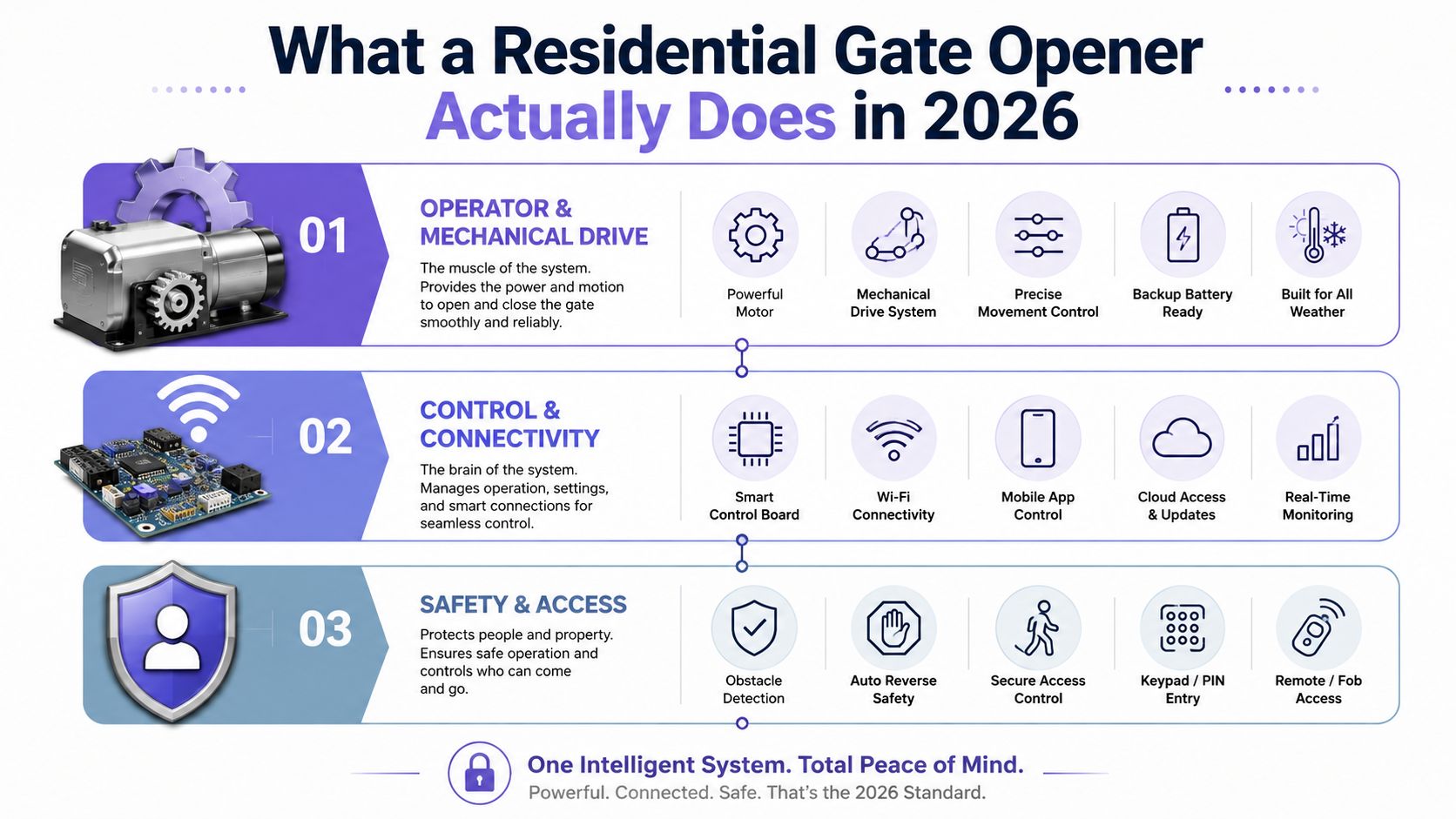
Three buyers, three priorities
A single-family homeowner usually wants quiet operation, dependable entry, and fewer remote-control hassles. An HOA board cares about resident access, guest control, and fewer after-hours calls. A property manager wants auditability and fewer labor-heavy gate interventions, while a security installer wants a retrofit that is clean, repeatable, and does not force a full replacement.
The market is large enough that this is no longer a niche gadget. Fortune Business Insights estimates the global market at USD 2.90 billion in 2025, rising to USD 3.04 billion in 2026 and reaching USD 4.60 billion by 2034, which implies a 5.30% CAGR over the forecast period, with the residential segment estimated at USD 548.4 million and 42% market share in 2025 (Fortune Business Insights).
Practical rule: If the gate opens reliably, upgrade the access layer first, not the motor.
For homeowners comparing driveway layouts, automatic gate options for Ottawa is a useful regional reference on how gate type affects the hardware decision.
The Three Gate Types and How to Choose
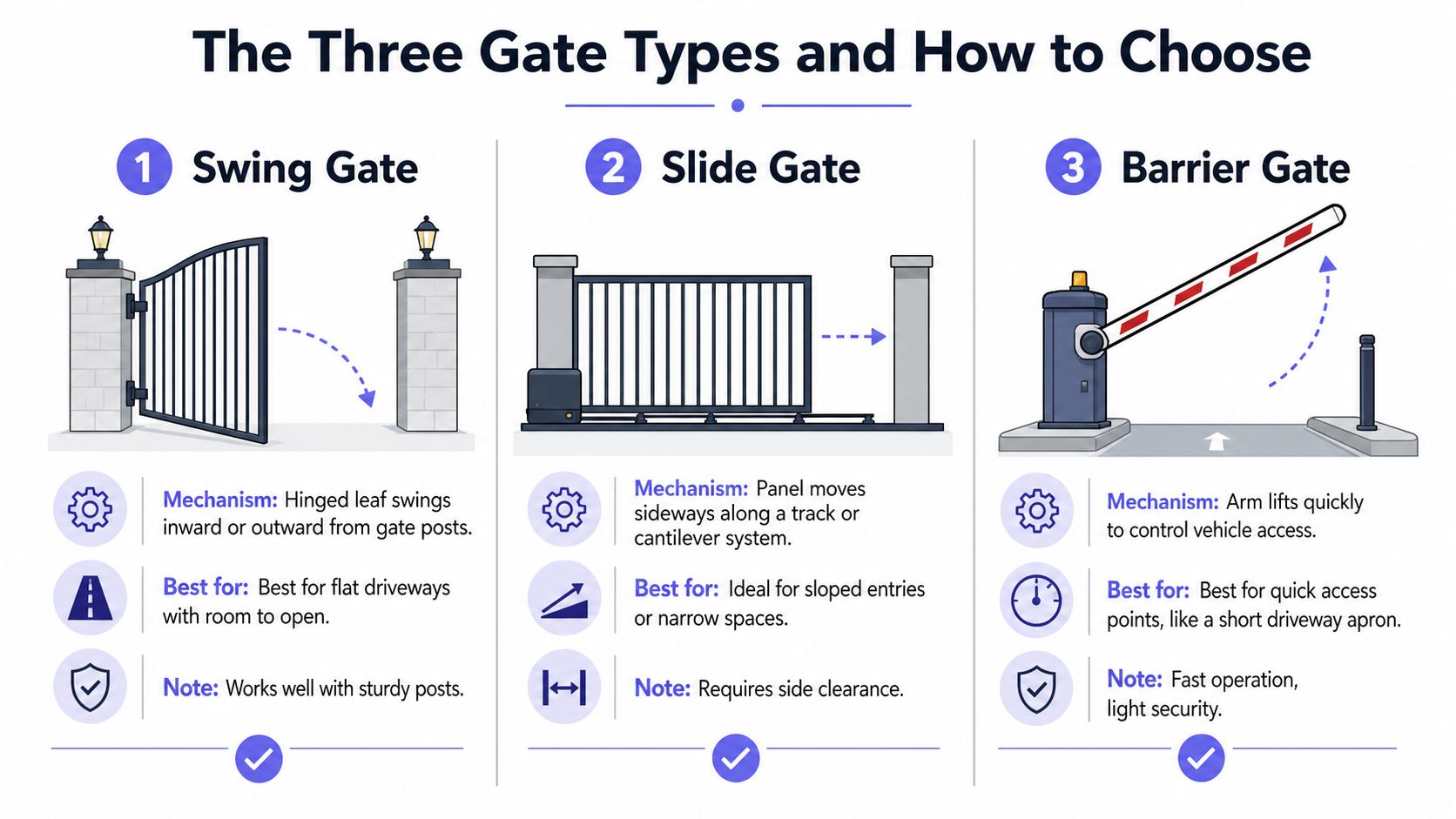
Gate type comes before brand, horsepower, or app features. A gate opener has to match the way the gate moves, the space it has, and the kind of traffic the property creates.
Swing gates belong on properties with real arc clearance
A swing gate opener fits a flat driveway with posts and room for the gate leaf to travel in an arc. That makes it the right pick for many single-family homes and decorative entries.
The catch is geometry. A lot of first-time buyers assume the gate can open as far as the driveway needs, but actuator design often limits the angle. One manufacturer's guidance shows a 106° maximum in a pull-to-open setup with specific arm dimensions, while another installation guide notes articulated-arm systems can reach 120° (TOPENS).
Slide gates win when clearance is tight
A sliding gate opener makes sense when the driveway is short, the entrance is sloped, or a swing arc would hit parked cars, snow piles, or landscaping. It moves the gate sideways, so it trades opening clearance for a track or cantilever path that must stay clean and aligned.
That makes it a better fit for many shared entrances. The gate mass matters more than marketing language here, because heavier leaves and poor balance create more load than casual buyers expect.
Barrier arms are for traffic control, not privacy drama
A barrier gate fits a site that needs fast, obvious vehicle control rather than a full physical enclosure. In residential settings, it shows up more in larger communities, parking control points, and shared access roads than in a private driveway.
Rule of thumb: If there isn't enough room for a swing arc, choose slide. If the site needs quick vehicle control more than perimeter closure, choose barrier.
For property managers, the right answer is usually obvious from the driveway itself.
- Flat drive with room to swing: choose a swing operator.
- Narrow side space or slope: choose a slide operator.
- Fast traffic control at an entrance: choose a barrier arm.
Power Options from AC to Solar
Power decisions should start with the site, not the brochure. Most homes have a straightforward option, a few sites need backup, and some properties need solar because trenching power is more trouble than it's worth.
AC is the default, backup is the insurance
Standard 110 to 120 VAC is the normal fit for many residential gate operators. Published sliding-gate specs show a typical operator drawing around 280 to 370 W, which is enough to remind installers that wire sizing and load planning matter even when the gate looks simple (Home Depot spec sheet).
Battery backup is what keeps the property moving during outages. That's the part many buyers skip until the first storm knocks the gate offline.
Solar works, but only on the right site
Solar is a smart choice when power trenching is impractical, but it's not magic. Residential units are typically sized for lighter duty, and industry guidance notes that limited-duty residential systems are commonly sized for around 100 cycles per day, while residential systems are also often described as light to moderate use up to 50 cycles per day (Automated Gate Company, Elite Gates).
That matters because solar sizing is about the whole use pattern, not just the panel. A winter site with shade, wind load, and frequent guest access can outgrow a small solar setup fast.
Guardrail: If the site already pushes the operator near its cycle limit, don't expect solar to cover for bad sizing.
The access layer also affects power planning. A cellular retrofit can modernize control without adding the local Wi-Fi fragility that consumer smart-home bridges tend to bring into gate-side deployments.
Safety Sensors and Code Requirements That Matter
A residential gate opener is only as safe as the devices around it. Automatic gates can injure or kill, and the U.S. Consumer Product Safety Commission reported 32 deaths related to automatic gates since 1985, including 20 child deaths.
UL 325 set the baseline
UL safety requirements adopted in March 2000 changed what a compliant gate system needs to include. The standard calls for at least two anti-entrapment mechanisms, usually a reversing sensor paired with a second device such as a photo eye or edge sensor.
That changes how you buy. Safety devices belong in the original spec, not on a later shopping list. Owners and property managers who treat them that way avoid the worst service calls, the ones that follow a complaint, a failed test, or an incident.
The devices that matter most
The safety stack should include monitored or properly placed photo eyes, an edge sensor on the leading edge where pinch risk exists, and a manual release for power loss. Audible alerts help on busy sites, but they do not replace the required protection devices.
The right setup also needs a maintenance routine that proves each part still works.
- Photo eye alignment: keep the beam clean and aligned.
- Monthly reverse test: confirm the gate reverses on obstruction.
- Manual release operation: verify staff can open it during a power outage.
A good test log matters more than a good intention. If a safety device cannot be checked and recorded, it is not being managed as part of the system.
Retrofits matter here too. Older gates often have a solid operator but weak detection, and that is where owners get burned. If you are comparing control layers, the same planning mindset applies to fob and keyless entry systems, because access and safety should be reviewed together, not as separate afterthoughts.
That is the budget trap. People spend on the opener, then treat the safety hardware like a nuisance line item. Buy the sensors, test them, and keep the record. how cellular gate openers work also matters on modern retrofits, because the access layer should not create new safety blind spots.
Access Control from Clickers to Smartphone
The most outdated part of a residential gate opener is usually not the motor. It's the way people get in.
Remotes, keypads, and telephone entry all solve different problems
Typical residential operators are often limited to around 40 remotes (Home Depot spec sheet). That works until residents lose them, share them, or ask for more than the receiver can comfortably manage.
A keypad is better than a shared remote pile, but it still depends on a code that spreads. A telephone entry system helps with visitor calling, but it still leaves managers doing manual work if access isn't integrated with a better controller. For a broader overview of legacy credential systems, fob and keyless entry systems are worth comparing against phone-based control.
| Access Method | Best For | Retrofit Friendly | Logging | Visitor Verification |
|---|---|---|---|---|
| Remotes | Small households | Yes | No | No |
| Keypads | Simple shared access | Yes | Limited | No |
| Telephone entry | Visitor call-in points | Sometimes | Limited | Some |
| Cellular smartphone control | Managed properties and busy driveways | Yes | Yes | Yes |
Cellular control is the modern shortcut
A cellular controller changes the access layer without forcing a hard cutover. Existing remotes and keypads can stay in service while residents, staff, and managers gain smartphone access, revocable digital keys, and activity logs.
That's the cleanest answer for mixed-user properties. It also avoids the Wi-Fi drop problem, because the system doesn't depend on a flaky consumer network at the gate.
Nimbio's how cellular gate openers work explains the add-on model in plain terms, and the hardware-agnostic approach is what matters for retrofits. It can sit on existing equipment from brands like LiftMaster, Viking, FAAC, Nice, DoorKing, and Mighty Mule without ripping out the operator.
What property managers should ask for
- Grant and revoke access instantly: no chasing down forgotten fobs.
- Schedule hold-open windows: useful for delivery blocks and staff shifts.
- See real-time entry logs: useful for disputes and audit trails.
- Verify visitors before entry: especially for gated communities.
The point is simple. The motor moves the gate, but the access layer decides whether the property is manageable.
Installation, Permits, and HOA Coordination
The hardest part of a gate project is often not the gate. It's the paperwork, site prep, and coordination around it.
Start with the site, not the order form
Before anyone buys hardware, the property needs a site survey, utility locate, gate-post check, power-run plan, and safety-device layout. A weak post, bad geometry, or poor clearance will wreck a good operator faster than a cheap motor ever could.
HOAs also care about appearance, hours of operation, and contractor selection. If the entrance changes the streetscape or creates nighttime noise, board approval becomes part of the job.
Licensing rules can change the install scope
Texas is a good example of how the rules shift once cloud monitoring enters the picture. Gate operator installation is generally not a DPS-licensed activity if it's just the operator and accessories, but the installation becomes license-relevant when the operator is tied to an alarm system or includes monitoring and logging of ingress and egress (Texas DPS).
That matters because modern access control often includes audit logs. It's not just a gate anymore.
Why retrofit keeps the install cleaner
A cellular retrofit usually sidesteps a lot of this friction. It doesn't require new wiring into the operator cabinet the way a full replacement often does, and it can preserve the existing gate hardware while changing how the community uses it.
For HOA boards evaluating a broader access plan, the option to replace key fobs for gated communities can be cleaner than replacing the entire operator stack.
Best practice: Get approval for the access model before the concrete or wiring starts, not after.
That sequence saves time, money, and argument.
Maintenance and Troubleshooting That Prevents Service Calls
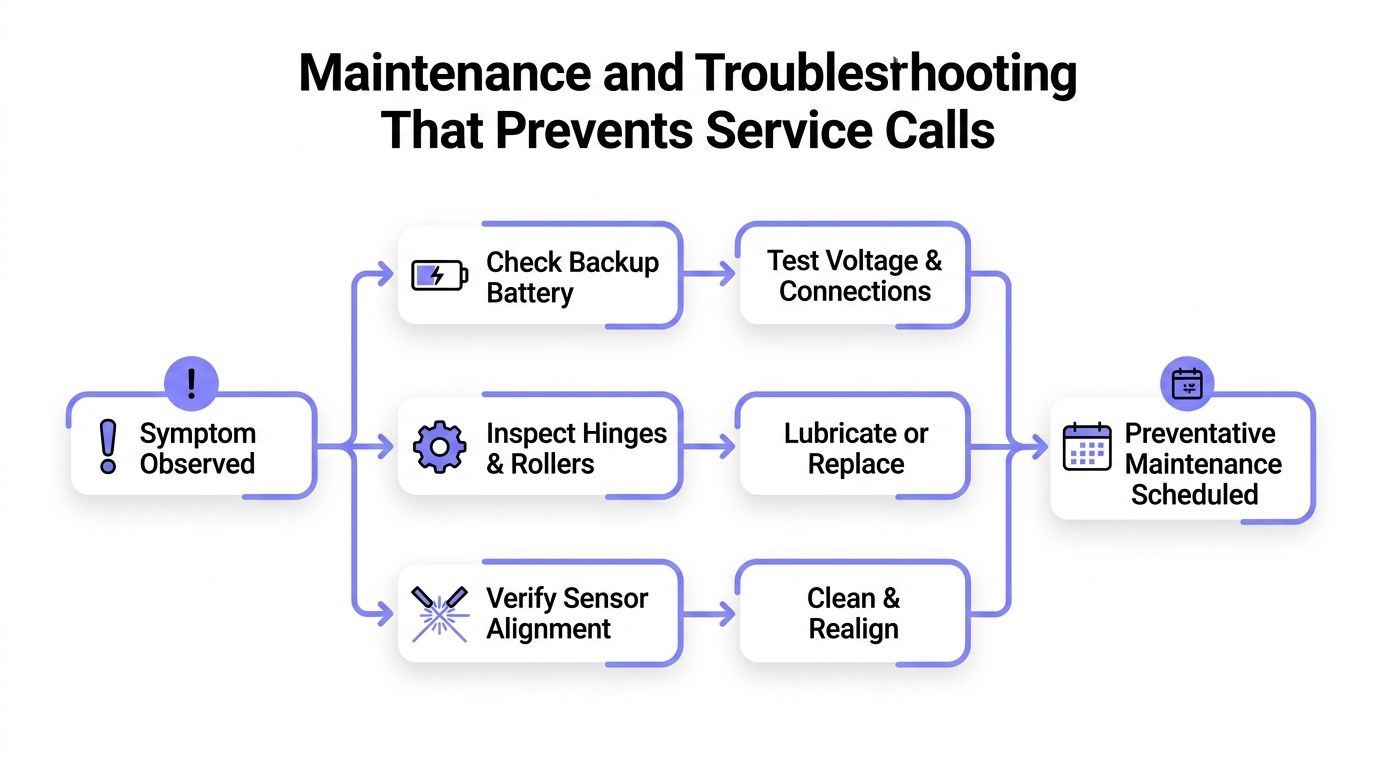
Most gate failures are not motor failures. They're hinge problems, sensor problems, battery problems, or hardware that's been ignored until it starts dragging the whole system down.
The usual suspects are boring, not mysterious
A residential troubleshooting guide points to dead batteries, corroded hinges, loose hardware, sensor misalignment, motor gearing issues, and control-board faults as common causes of failure (DuraServ). That's why a lot of “bad opener” complaints are really maintenance complaints.
A five-minute hinge lubrication can keep the gearbox from working harder than it should. A monthly reverse test catches safety failures before a resident does.
A simple preventive schedule works
- Monthly: test reversing behavior and manual release.
- Quarterly: clean sensors, inspect hinges, tighten loose hardware.
- Annually: inspect batteries, look for weather intrusion, and review control-board condition.
If the gate grinds, slows under load, reverses intermittently, or shows scorch marks on the board, stop guessing and call a technician.
For a practical service-side view of upkeep, Lighthouse Energy Services gate advice is a useful maintenance reference for owners who want fewer truck rolls.
A cellular controller adds another maintenance advantage. Over-the-air firmware updates can improve the access layer without a site visit, and that helps keep the control side current even when the operator itself is aging.
Choosing the Right Setup for Your Role
A homeowner should size the operator to gate weight and cycle use, then add a cellular controller if the current hardware still runs cleanly. An HOA board or property manager should treat the access layer as a separate budget line, because remote credentials, logs, and visitor handling matter just as much as the motor.
Security installers and low-voltage dealers should frame the retrofit as a fast deployment path, not a rip-and-replace sale. For anyone comparing the fit of a cellular overlay, these remote gate access selection tips are the right next step before specifying hardware.
Nimbio turns existing gate operators into smartphone-controlled access points with cellular connectivity, so properties don't have to depend on Wi-Fi or replace working hardware to modernize. For homeowners, HOAs, and installers who want cleaner access control without a full rebuild, Nimbio is the place to start.
Adding smart access to your own gate?
See how cellular gate control works for homes, ranches, and estates. Explore Single Family, Ranches & Estates →