A gate can have a modern operator, app-based credentials, remote visitor approval, and clean audit trails. If the swinging gate hinge is undersized, worn, or misaligned, the entire system still fails at the hinge line.
That failure shows up in familiar ways. The gate drags, the latch stops lining up, the operator strains, residents start forcing the leaf by hand, and property staff get the service calls.
For HOA boards, property managers, and installers, this is the mechanical reality behind a lot of “smart gate” complaints. The software may be working perfectly. The access rules may be correct. But if the gate can't swing cleanly, the expensive electronics are sitting on top of a bad foundation.
A swinging gate hinge is the dumbest part of the opening system. It's also the part that decides whether the rest of the system gets to work at all.
Table of Contents
- The Unsung Hero of Your Gated Community
- Understanding Swinging Gate Hinge Fundamentals
- Comparing Hinge Types Materials and Load Ratings
- How to Choose the Right Swinging Gate Hinge
- Installation and Safety Considerations
- Maintenance Troubleshooting and When to Upgrade
- Modernizing Your Gate with Smart Access Control
The Unsung Hero of Your Gated Community
A gated community usually notices the hinge only after something goes wrong. The operator still has power. The credentials still work. The call box still answers. Yet the gate leaf sags just enough that the latch misses, the strike point shifts, or the operator starts fighting resistance.
That's not a small hardware issue. It's a site operations issue.
For a property manager, the consequences stack up fast:
- Resident frustration: people blame the access system when the actual problem is mechanical drag.
- Security gaps: a gate that won't close flush can leave an opening even when the operator cycle completes.
- Repeat service calls: technicians end up adjusting limits, closers, latches, or operator settings when the hinge is the root cause.
- Budget waste: money goes into electronics troubleshooting while the gate frame keeps pulling out of alignment.
A smart gate is only as reliable as the hardware that carries its weight every day.
This matters even more in communities that rely on cloud-based access control, scheduled hold-open windows, and remote visitor management. Those features assume the gate opens, swings, and re-latches consistently. A bad hinge introduces friction into every one of those actions.
The mistake is treating hinge selection as a finish item. It isn't. Hinge geometry, mounting method, and corrosion resistance decide whether the gate moves predictably or starts drifting out of alignment.
Boards often focus on the visible technology. Installers often focus on the operator. Residents focus on convenience. The hinge sits in the background doing the heaviest mechanical work in the system.
That's why the swinging gate hinge deserves more attention than it gets. It carries the static load when the gate is parked, the dynamic load when the gate moves, and the cumulative wear from daily cycles, weather, and misuse.
When that hinge is wrong, the rest of the stack gets blamed. The keypad gets blamed. The app gets blamed. The gate operator gets blamed. In practice, a lot of unreliable gate behavior starts with very ordinary hardware that wasn't sized, installed, or maintained for the gate it's carrying.
Understanding Swinging Gate Hinge Fundamentals
A swinging gate hinge has one job on paper. It lets the gate rotate on a fixed axis.
In the field, its job is larger than that. It has to support weight, control movement, preserve alignment, and keep doing all of that through weather, vibration, and repeated opening cycles.
What a hinge actually does
The idea is ancient. The earliest known pivot hinges date to around 1600 B.C. on wooden doors at Hattusa, and later examples appear in descriptions of King Solomon's temple, roughly 970–931 B.C., showing how long hinges have been tied to secure entry points (history of hinges at Hinge Outlet).
That long history matters because the function hasn't changed. A secure entry point still depends on a movable barrier staying supported where it's supposed to be.
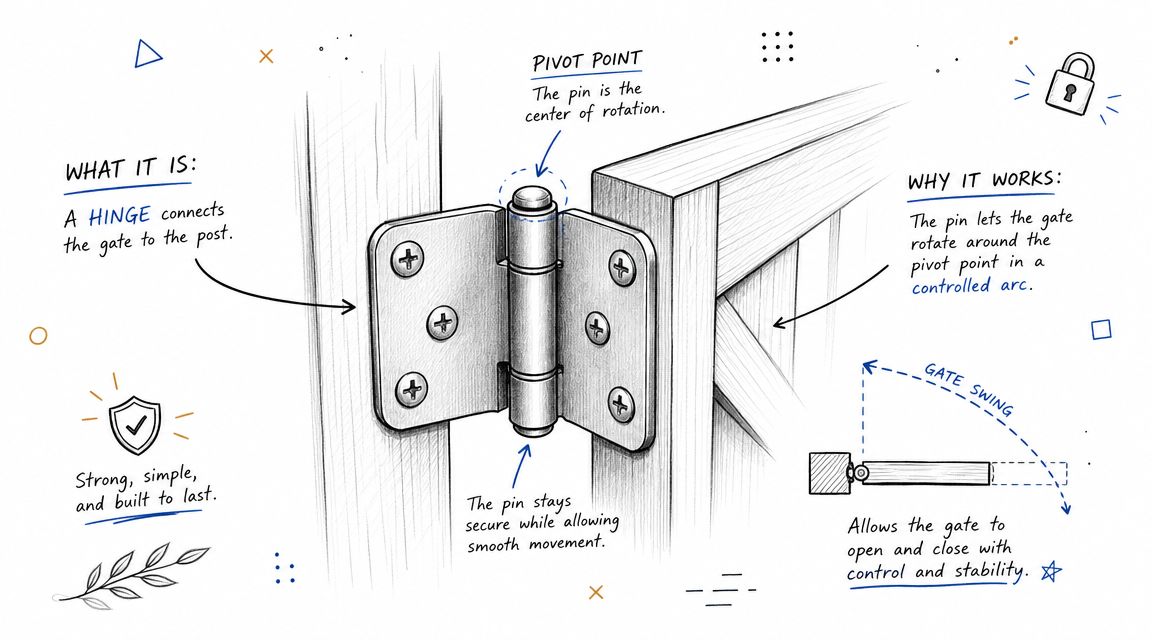
For gates, the hinge has to manage more than simple rotation:
- Static load: the gate's weight while it hangs at rest
- Dynamic load: the changing force as the gate starts, stops, and reverses
- Alignment control: keeping the gate leaf in the correct plane relative to the latch and post
- Clearance preservation: preventing the bottom edge from dropping into the driveway or grade
A door hinge and a gate hinge may look similar at a glance. They don't live the same life. Gates are larger, heavier, more exposed, and more likely to be pushed, slammed, climbed, or left open against wind.
The main parts installers talk about
Most gate hardware conversations come down to a few core terms:
- Leaf or strap: the flat mounting portion attached to the gate frame or post
- Barrel: the cylindrical section where the hinge rotates
- Pin or pintle: the vertical pivot element that carries motion and load
Knowing those words helps when reading hardware specs or installer notes. It also helps property teams ask better questions before a purchase order gets approved.
Practical rule: If the conversation is only about hinge appearance and finish, the project is missing the mechanical discussion that actually decides service life.
The hinge isn't just a connector. It is the load-bearing pivot that determines whether the rest of the gate system can operate smoothly. That becomes much clearer when the common hinge types are compared side by side.
Comparing Hinge Types Materials and Load Ratings
Not all hinges fail for the same reason, because not all hinges are built to carry load the same way. The right swinging gate hinge depends on geometry, mounting surface, gate weight, environment, and how forgiving the installation conditions are.
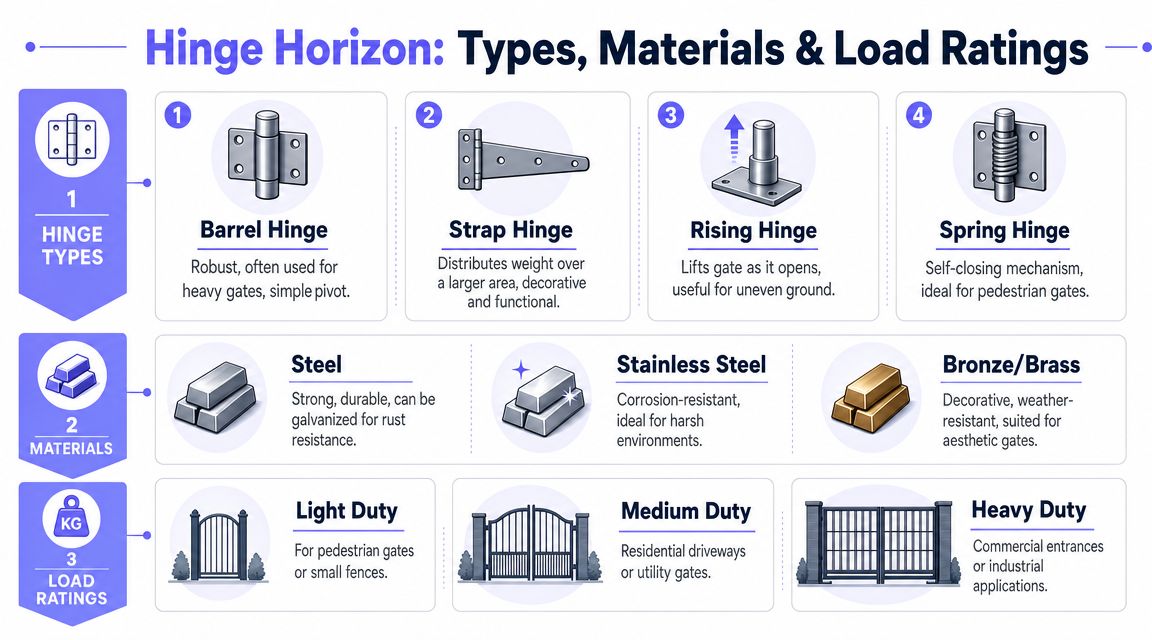
How the main hinge types differ
Barrel hinges are common on heavier gates because the design supports load through the hinge body. Industry guidance notes that barrel-style hinges distribute gate weight along the full hinge length, which is one reason they're often chosen for heavy-duty swing gates (gate hinge selection guidance from HardwareSource).
Pintle hinges use a vertical pin-and-eye arrangement. They allow free swing and can make gate removal easier after installation, which can be useful where service access matters.
Butt hinges are familiar and compact. For light applications they can be fine, but they're often the wrong answer for a heavy driveway or perimeter gate because they provide less margin for abuse, misalignment, and outdoor wear.
Strap hinges spread the mounting load across a larger section of the gate frame. That can help on wood gates or framed metal gates where a broader attachment footprint is useful.
Self-closing or gravity hinges can help pedestrian gates and some sloped installations, but they shouldn't be treated as a universal fix for bad geometry. They can add convenience, yet they don't replace correct alignment, proper latch setup, or good clearance planning.
Swinging Gate Hinge Comparison
| Hinge Type | Best For | Typical Load Capacity | Pros | Cons |
|---|---|---|---|---|
| Barrel hinge | Heavy metal swing gates | Varies by design and material | Strong load distribution, compact profile, common for weld-on installs | Usually needs accurate fabrication and alignment |
| Pintle hinge | Heavy gates needing easy removal | Varies by design and sizing | Free swing, removable gate option, practical for service | Poor sizing or placement creates alignment problems fast |
| Butt hinge | Light gates and smaller access points | Smaller applications | Simple, familiar, clean look | Limited for heavy-duty use outdoors |
| Strap hinge | Wood gates and framed utility gates | Design-dependent | Wide mounting area, practical load spread | Can be bulky, not ideal for every security gate |
| Gravity or self-closing hinge | Pedestrian or grade-sensitive gates | Application-dependent | Helps encourage closing | Closing behavior depends heavily on installation conditions |
Materials matter outdoors
Material choice changes how long a hinge stays serviceable outside. A heavy-duty steel swing gate hinge example from Hinge Outlet uses 10-inch leaves with 6-inch or 9-inch barrel options, plus a stainless-steel pin and grease fitting, features that matter because longer leaves increase mounting footprint and the lubricated stainless pin is intended to reduce wear and corrosion in outdoor use (heavy-duty steel swing gate hinge example).
For most exterior gates, the practical shortlist is:
- Galvanized steel: good where rust resistance is needed at a reasonable cost
- Stainless steel: useful in harsh exposure where corrosion is a constant risk
- Standard steel: workable if protected properly, but less forgiving outdoors if coatings fail
Load ratings also need a careful reading. A hinge isn't “heavy-duty” because a listing says so. The primary question is whether the hinge design, material, and mounting method match the actual gate.
A decorative hinge on a heavy leaf is a short-term solution. A light hinge on a windy opening is a service call waiting to happen. For commercial entries and HOA security gates, hinge choice is an engineering decision first and a finish decision second.
How to Choose the Right Swinging Gate Hinge
Most bad hinge choices start with shopping by category instead of by gate. The right process begins with the actual leaf, post, and operating conditions.
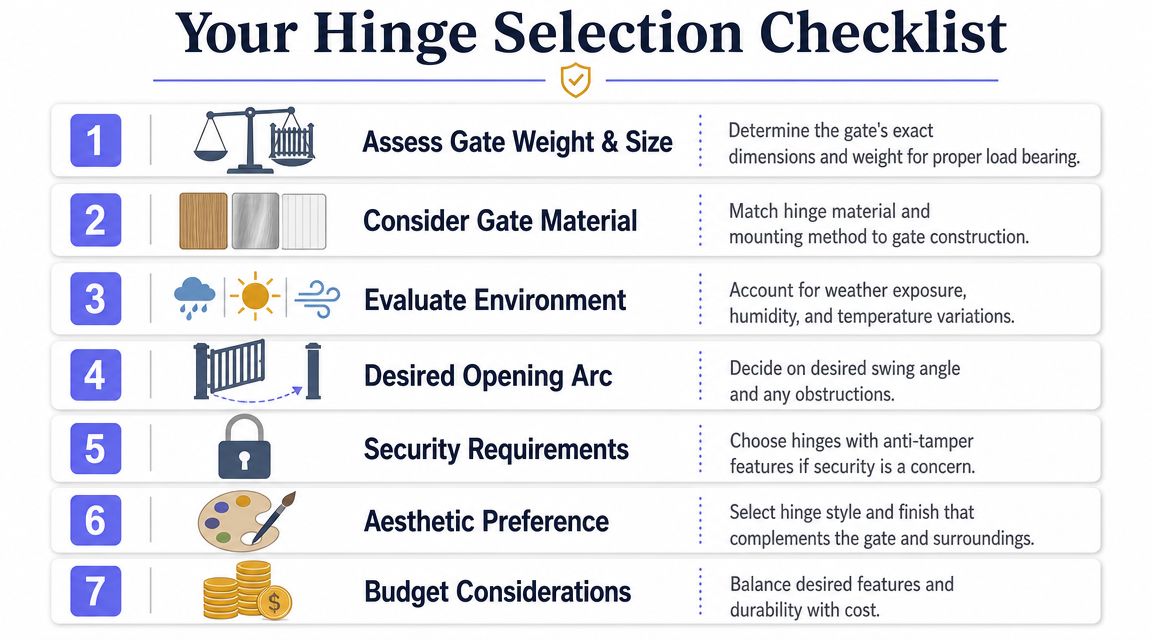
Start with the gate not the catalog
Industry guidance gives a practical rule of thumb: each hinge should support at least 1/5 of the gate's total weight, and hinge width should be at least one-third of the gate's width. The same guidance notes that a gate project typically uses at least two hinges, and cites common sizes such as 4.5 inches for butt hinges, 5 to 9 inches for barrel hinges, and 72 inches for piano hinges on tall gates. It also notes that two 18-inch strap hinges can hold up to 300 pounds in a heavier installation (Angi gate hinge sizing guidance).
That doesn't replace a manufacturer spec. It does give buyers a reality check.
A practical selection process looks like this:
- Confirm the gate's actual size and weight. Estimate isn't good enough for a heavy automated gate.
- Check the gate material. Tube steel, ornamental iron, wood, and composite frames spread load differently.
- Review the post condition. A strong hinge mounted to a weak or shifting post won't stay aligned.
- Decide how the gate needs to swing. The opening arc and stop points affect hinge geometry.
- Match usage to hardware. A lightly used side gate and a community vehicle gate don't belong on the same hardware assumptions.
A practical selection checklist
The fastest way to narrow options is to ask what would make this gate fail early.
- If the gate is heavy: move toward heavy-duty barrel, pintle, or weld-on solutions.
- If removal for service matters: pintle-style setups can make field work easier.
- If the gate frame needs broader support: strap designs may distribute load better.
- If the site is exposed: prioritize corrosion resistance and serviceable pins.
The hinge should be chosen to carry the gate you have on the worst day it will see, not the best day in the showroom.
A few judgment calls matter more than buyers expect:
- A wider gate amplifies the strain. Even when total weight seems manageable, width changes stress at the hinge line.
- A solid-panel gate behaves differently than an open frame. Wind and operator force become part of the equation.
- Frequent use changes the maintenance picture. A hinge that works on a seldom-used gate may drift fast on a shared entrance.
The hinge also has to work with the larger access setup. If the property plans to use app-based credentials, remote visitor entry, or managed schedules, the gate needs consistent swing behavior first. Electronics can't correct a gate that physically refuses to line up.
Installation and Safety Considerations
A well-chosen hinge still fails if the installation team chases speed instead of alignment. Most long-term gate problems start during mounting, not during daily use.
Alignment is the real installation job
The basic decision is usually weld-on versus bolt-on. Weld-on hinges often make sense for steel frames where a strong permanent connection is needed. Bolt-on hardware can be practical where future replacement, field adjustment, or mixed materials make welding less desirable.
What matters more than the method is whether the hinge axis is true from top to bottom. If the hinges aren't aligned on the same vertical plane, the gate won't swing cleanly no matter how expensive the hardware is.
Common installation mistakes include:
- Uneven hinge spacing: changes load distribution and encourages sag
- Weak attachment points: the hinge is sound, but the frame or post deforms
- Ignoring latch-side geometry: the gate swings, but it doesn't meet the receiver correctly
- Skipping service clearance: there's no room for adjustment once the site settles
For broader perimeter security planning, readers thinking about entries beyond gates may also want guidance on how to improve home security with new doors, especially when the goal is consistent access performance across a property.
Slope grade and clearance problems
Sloped terrain causes more hinge trouble than many specs acknowledge. Available guidance is often vague, and a recent demo of a gravity hinge suggests self-closing behavior can help on grade, but not as a guaranteed installation outcome. The key issue is that hinge selection and placement must preserve latch alignment and clearance without binding on uneven ground (discussion of self-closing hinges on grade).
That means teams need to check more than whether the gate opens.
They should verify:
- Bottom-edge clearance through the full swing
- Latch alignment when fully closed
- Operator arm geometry if automation is present
- Whether the gate still closes reliably after partial openings
On a sloped driveway, the wrong hinge can create a gate that technically moves but never closes the same way twice.
Safety also has to stay visible during installation. Gates are heavy, hinge-side pinch points are real, and temporary support is essential while hardware is being fitted. For teams planning automation at the same time, Nimbio's guide to property preparation for smart access is a useful companion because site readiness affects both hardware installation and access control reliability.
Maintenance Troubleshooting and When to Upgrade
Most hinge failures don't begin as a dramatic break. They begin as noise, drag, uneven gaps, or a latch that needs a shove.
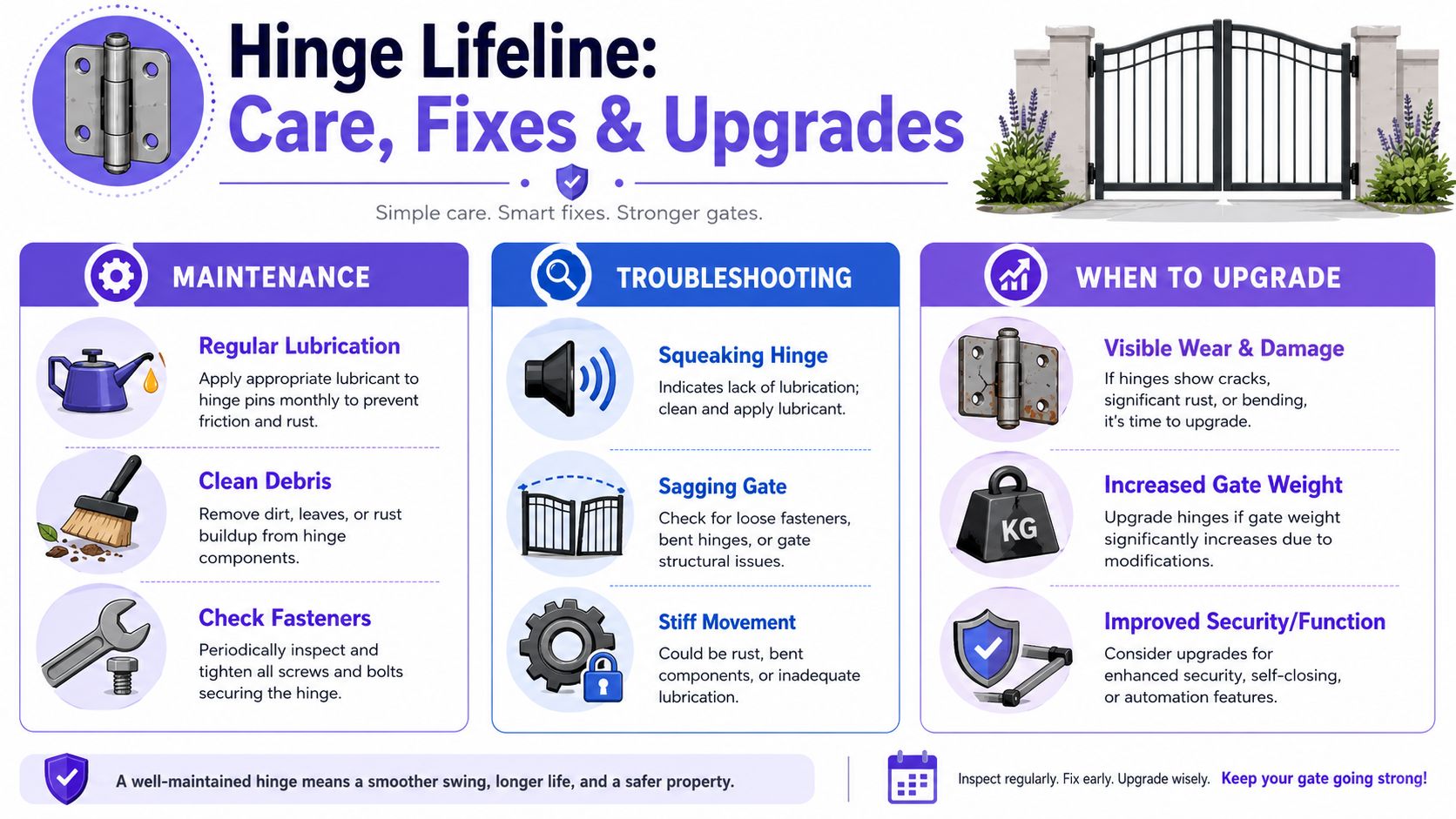
What to inspect before a failure becomes visible
Long-term failure modes in heavy-duty hinges include bearing wear, weld fatigue, and gradual misalignment due to high usage. That matters because a hinge can drift out of alignment and create security gaps or access control problems well before the operator itself fails (gate hinge lifecycle concerns at Hinge Outlet).
A maintenance routine should focus on the points where movement and attachment meet:
- Pins and barrels: look for dry rotation, grinding, or looseness
- Welds or fasteners: check for movement, cracking, or elongation around the mount
- Gate reveal and latch fit: watch for changing gaps over time
- Rust and contamination: dirt, corrosion, and debris accelerate wear
Property teams often save money by acting early. A hinge that's beginning to drift can be corrected before it turns into operator strain, latch failure, or a resident complaint that gets logged as an access issue.
Common symptoms and what they usually mean
Some field symptoms are straightforward if the hinge is inspected first.
| Symptom | Likely hinge-related cause | What to do next |
|---|---|---|
| Squeaking or rough swing | Dry pin, debris, early wear | Clean, lubricate, inspect rotation |
| Gate sag | Fastener movement, hinge wear, frame stress | Check hinge alignment and attachment points |
| Latch misses receiver | Gradual misalignment at hinge line | Measure reveal, inspect post and hinge mounts |
| Operator strains or reverses | Binding or drag through swing path | Verify free manual swing before changing operator settings |
A few signs usually point to replacement instead of adjustment:
- Visible bending or cracking
- Repeated alignment loss after minor fixes
- Corrosion that affects structural integrity
- A gate upgrade that added weight the old hinges weren't meant to carry
If the gate only works after repeated operator tuning, the team should stop blaming the operator and inspect the hinge path first.
For properties already running automated entry, maintenance should include the full mechanical and electronic stack. Nimbio's guide on how to make smart gates last is helpful here because smart access reliability depends on the hinge, latch, operator, and credentials all staying in sync.
Modernizing Your Gate with Smart Access Control
A mechanically sound gate is the prerequisite for every digital upgrade that comes after it. If the hinge is wrong, the access experience will still feel unreliable even when the software is doing exactly what it should.
That's why smart community projects should start with a blunt question. Does the gate swing freely, close consistently, and line up at the latch every time?
If the answer is no, the hinge problem has to be solved before adding more control layers. If the answer is yes, modern access control becomes much easier to justify and manage.
For many sites, the practical next step is a retrofit approach rather than a full gate replacement. A hardware-agnostic system like Nimbio can add smartphone-based entry, remote credential management, visitor access handling, and cellular connectivity to existing electronic gates without depending on on-site Wi-Fi. That makes it relevant for communities that want modern control while keeping a mechanically sound gate and operator in service through access control for gated communities.
The main point is simple. Smart access doesn't replace hinge discipline. It depends on it.
When the hinge is correctly selected, properly installed, and routinely maintained, the rest of the system has a stable foundation. The gate operator works with less strain. Latches line up. Residents get consistent entry behavior. Property managers get fewer avoidable calls. Remote access tools, scheduled credentials, and visitor approval finally perform the way they're supposed to perform.
Nimbio helps properties modernize gate and entry access with cellular, smartphone-based control that works with existing electronic gate systems. For HOA boards, property managers, installers, and gated communities evaluating a retrofit, Nimbio is a practical place to start.