Is a stronger motor the same thing as the right swinging gate operator? Boards often treat those as one purchase. They are not.
A swinging gate operator is the powered unit that swings a gate leaf on its hinges. Choosing the right one means matching the leaf, the entrance, and the safety devices together, instead of buying from a motor rating alone. A sliding gate is a different machine: its leaf travels on a track.
The operator is not the gate. Hinges carry the leaf. Stops set the end of travel. The control board decides when the motor may run. Protective devices decide when it must stop or reverse. Neighbors will ask about three decisions: which configuration fits the entrance, which ratings the site needs, and how phone access can be added without changing how the gate stops.
Table of Contents
- What a Swinging Gate Operator Actually Does
- How Swing Gate Operators Work
- Comparing Articulated Arm, Linear Arm and Underground Operators
- Selection Criteria for Load, Cycle Rate and Environment
- Safety Standards That Shape Every Swing Gate Installation
- Adding Smartphone Access Control to an Existing Operator
- Installation and Maintenance Basics for Property Managers
- A Practical Buying Checklist for HOAs and Homeowners
What a Swinging Gate Operator Actually Does
A swinging gate operator opens and closes a hinged leaf. The gate is the barrier. The operator is the drive that moves it. Mixing those up is how a quote for "a new gate" turns into a motor swap that leaves bad hinges and missing edges in place.
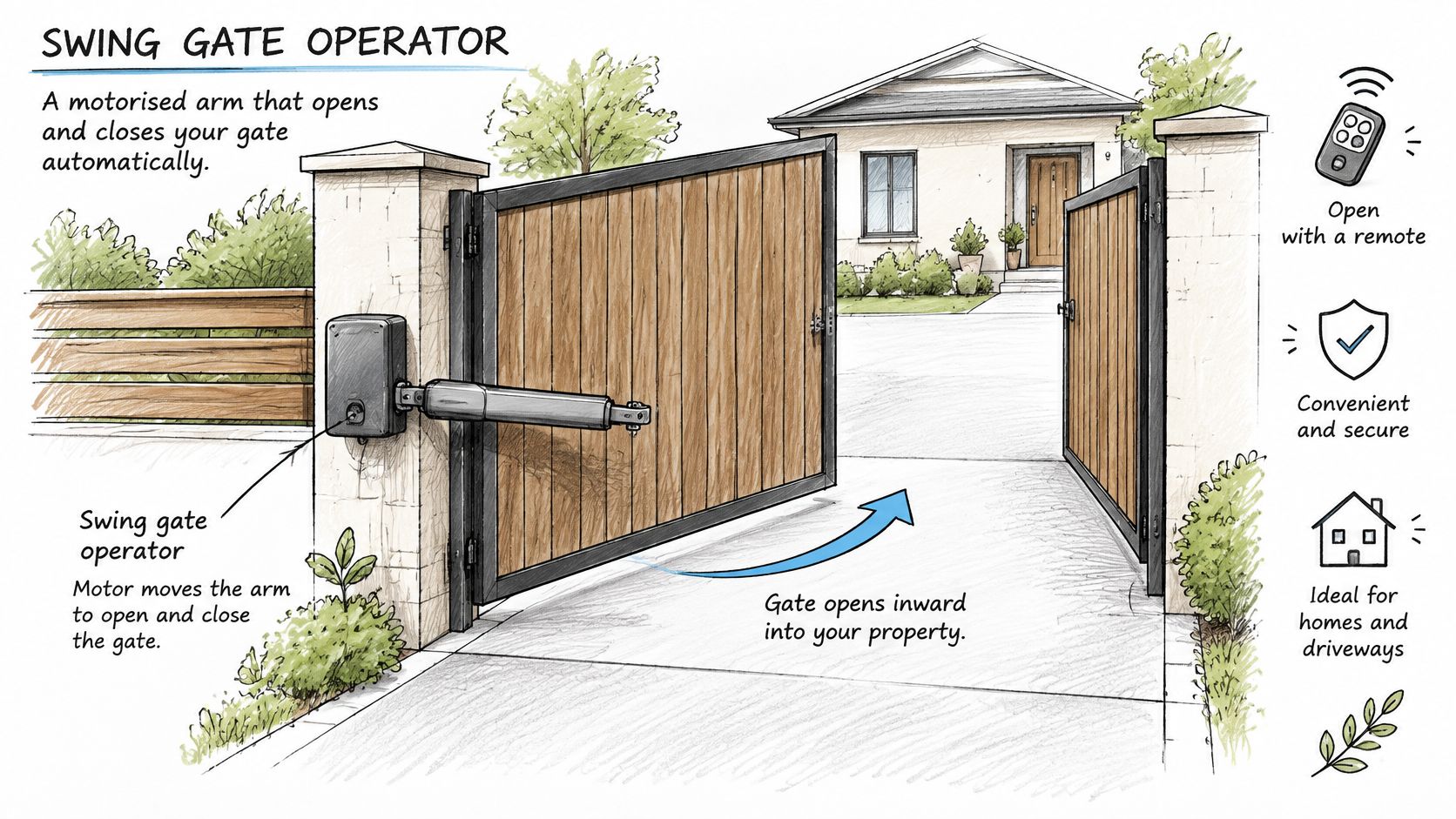
A normal open cycle is short. A command arrives from a clicker, a keypad, or another control input. The board allows the motor to run. The gearbox turns the arm, and the leaf swings through its arc. At the open limit, the board stops the drive so the leaf does not keep traveling past the stop.
Plain version for a board packet: the operator belongs to a regulated safety system. Sensors, monitoring, stopping, and reversal sit in the same decision as the motor.
Three decisions, then the facts to gather
Configuration. Articulated arm, linear arm, and underground operators fit different posts, different clearance, and different expectations about how visible the hardware should be.
Ratings. Leaf weight, leaf width, how often the entrance opens, weather, and power at the post narrow the list before brand names do.
Access control. A later phone or cellular command should use the operator's existing input and leave obstruction detection, emergency release, and reversing alone.
Before anyone compares models, write down leaf weight, leaf width, and the power already available at the gate. Those three facts keep a quote from being copied off a different property.
How Swing Gate Operators Work
What a technician sees first is an arm or an underground housing, a motor and gearbox, and a control board under a cover. Command inputs sit upstream of that board: a keypad, a radio receiver, or a dry-contact pair. Safety inputs sit beside them, usually photo eyes across the path and contact edges where someone could be struck or pinned.
Why the arm changes the pinch
An articulated arm folds as the leaf opens, like an elbow. A linear arm extends and retracts, pushing or pulling along a straighter line. Bracket position changes the mechanical advantage. The same motor can press harder at the leading edge if the geometry is poor near the closed post. That is a mounting problem, not a software preference.
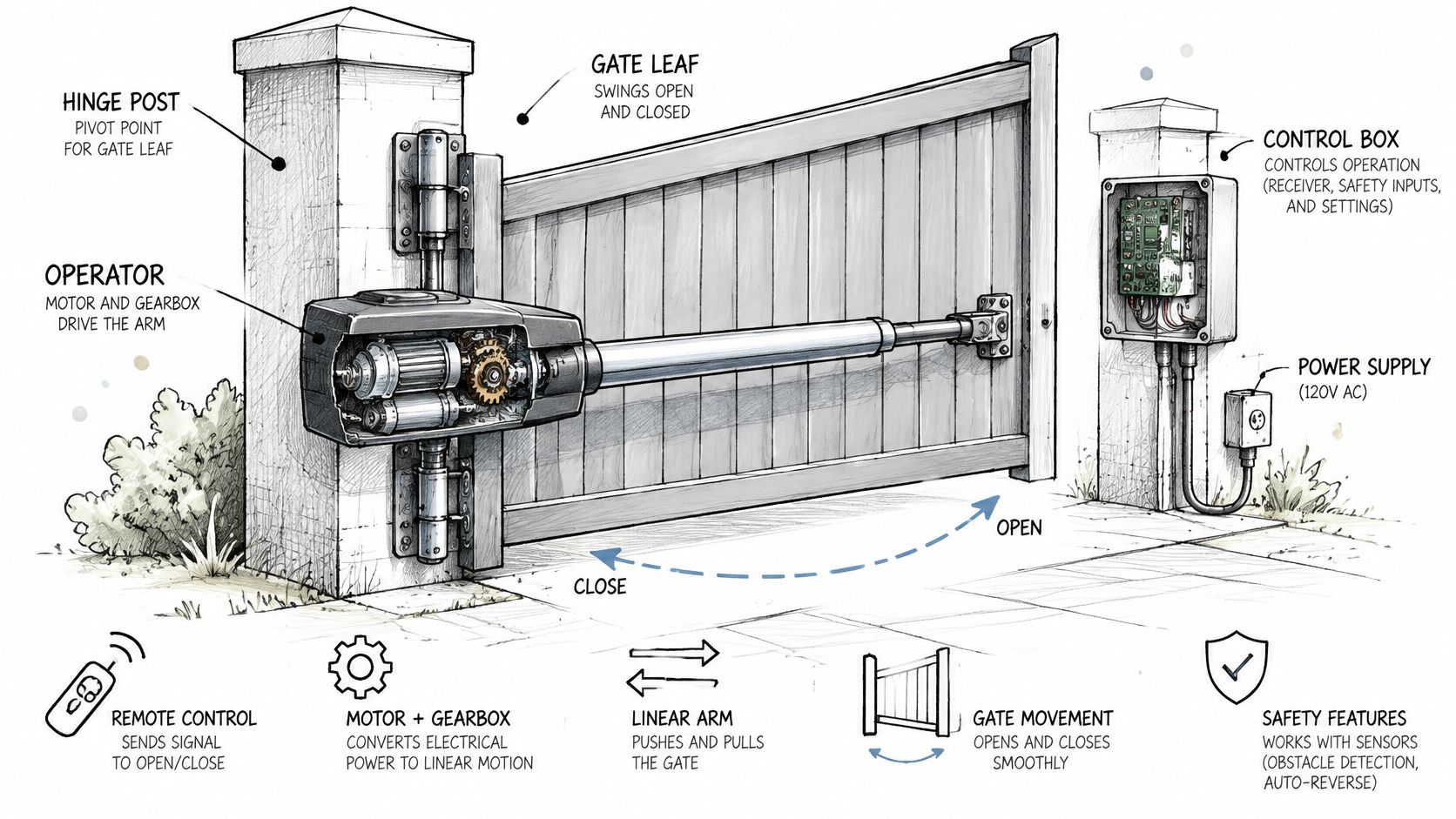
A command is only a request. The board checks safety inputs and travel limits, then runs, stops, or reverses. A phone opener, including how cellular gate openers work, is another way to send that request. It does not retune the arm.
What a service visit actually checks
Arm and brackets. Loose hardware changes the arc and can spike force near the end of travel.
Hinges and leaf alignment. Drag and sag make the motor work harder than the nameplate implies.
Stops and limits. The leaf should meet the stop without the motor grinding into the post. Where it stops is model-specific, so the manufacturer's manual governs the adjustment.
Eyes and edges. Lenses get dirty and edges get skipped. Both need a test, not an assumption.
Force at the leading edge is a measured result. Where Type C inherent force limiting is used on a horizontal swing gate, DASMA Technical Data Sheet 353 states the gate must not exert more than 40 lbf at the leading edge of the shortest recommended gate length two seconds after startup. After extended operation under rated load, stopping force must not rise by more than 10% above the initial setting, and the 40 lbf cap still applies. Hinge friction, sag, misaligned stops, snow, debris, and wind can all move that reading. Test after installation and after any mechanical work.
Comparing Articulated Arm, Linear Arm and Underground Operators
Width, weight, clearance, visibility, and how hard the unit is to service separate the three swing configurations. A rating that fits one entrance can miss the next if the post is thicker or the leaf is solid.
Swing Operator Configurations Compared
| Configuration | Typical Gate Width | Clearance Needed | Visibility | Service Access |
|---|---|---|---|---|
| Articulated arm | Moderate leaves; wide leaves need a unit rated for the torque | Room for the elbow to fold beside the leaf | Arm stays visible | Usually reached at the post, no excavation |
| Linear arm | Set by the actuator rating and the post geometry | A straight path for the actuator; a tight post can cut the open angle | Actuator shows along the leaf or post | Reachable unless the bracket is buried against a wall |
| Underground | Set by the operator rating, not by arm swing space | A below-grade housing plus real drainage | Most of the hardware is hidden | The pit has to be opened, and water is a repeat fault |
Which entrance suits which unit
A narrow residential drive with room beside the post usually takes an articulated or linear arm. The choice follows the brackets, not the brochure photo. Measure from the hinge to the post bracket before assuming a full open angle. If that distance is too large, or the mounting face is too narrow, the leaf can stop short of the opening the neighbors expect.
A wide or solid leaf needs more torque through the whole arc. Hinge drag and an uphill close raise the force measured at the leading edge even when the motor "seems fine" on an empty test. That is a commercial-duty arm problem. Hiding the operator underground does not shrink the leaf.
An appearance-first entrance can use an underground operator when the pit drains and someone can still service it. If the housing will sit in a low spot, the hidden look is an expensive leak.
Outswing leaves add another constraint. The hinge has to clear the post through the arc, which is why outswing hinge advice from Breaking Glass Co. is useful before anyone assumes a standard hinge will miss the jamb. Confirm the operator's listed limits against this leaf's weight and width. A unit that worked on the property next door is not evidence.
Selection Criteria for Load, Cycle Rate and Environment
Buyers meet the limits in a fixed order. Skip one and the shortlist looks fine until the first windy week or the first busy Saturday.
Leaf weight and width come first
Weight and width set the minimum class and the torque the unit must hold through the arc, not only at mid-travel. A light picket leaf and a solid panel of the same width are different loads. Ask the installer to use the actual leaf, including added cladding, not the original shop drawing if the gate was skinned later.
Cycle rate knocks out residential duty
Cycle rate is how often the leaf moves, per hour and per day. A house that opens a few times a day is not the same duty as a community entrance or a commercial yard that cycles through the workday. An operator can meet the weight number and still be the wrong machine if the duty cycle is too low. Heat in the motor and wear in the gearbox show up as stalled leaves, not as a polite warning in the quote.
Weather and power finish the cut
Wind on a solid leaf, snow at the bottom rail, debris in the swing path, salt air, and an operator sitting in the open all raise demand or attack the enclosure. A housing that is only "weather resistant" on a spec sheet still needs a technician to match it to this exposure.
Power is the last filter. If the supply at the post cannot feed the chosen unit, the rest of the shortlist does not matter. Note voltage and whether a dedicated circuit already exists. Do not guess from the house panel.
Questions to answer before calling
Weight and width. What does this leaf weigh, and how wide is it, including any recent cladding?
Openings. About how many times a day does it move on a busy day, and is that steady or in bursts?
Exposure. Is the operator in rain, salt air, or a spot that drifts with snow?
Supply. What power is at the gate today?
Keep what works. Which clickers, fobs, and keypads have to stay?
Start the installer call from those answers. A hypothetical entrance that "opens all the time" is not a duty cycle.
Safety Standards That Shape Every Swing Gate Installation
Compliance is a selection rule, not a punch-list item after the motor is hung. Gate Safe reports that the U.S. Consumer Product Safety Commission estimated nearly 25,000 people were injured in automated-gate incidents between 1990 and 2000, and that 32 deaths associated with automated gates were reported from 1985 through 2000, 20 of them children. The same 2024 review of more than 100 automated commercial gates, including 65 swing gates, found over 90% unsafe under that protocol, and more than 98% of the commercial swing gates unsafe, with missing hinge protection and absent safety edges among the common gaps. Those figures cover automated gates broadly, not swing gates alone, but they show why the installed system is the unit of compliance.
What UL 325 asks of a swing operator
ANSI/CAN/UL 325 governs electrically operated gates. The first edition, published in April 1973, covered doors, draperies, gates, louvers, and windows. From 1982 through 1992, 54 deaths and 37 serious injuries involving children under 15 were reported after automatic garage doors failed to stop or reverse, and that record pushed the standard outward. Vehicular-gate entrapment rules arrived in the 1998/2000 revisions. Since 2000 the standard has required two independent means of entrapment protection for each applicable zone, and the August 1, 2018 update reinforced monitored, independent devices for swing and slide gates, as summarized in LiftMaster's UL 325 overview.
For a horizontal swing operator, DASMA Technical Data Sheet 356 states that each direction of travel needs at least two independent means wherever an entrapment zone exists. Acceptable means include inherent force sensing, photoelectric sensors, contact edges, or constant-pressure controls. The operator must not run unless that protection is installed and enabled. If one direction has no entrapment zone, one means may cover that direction. The other direction still needs two.
Stops, protrusions, and local rules
ASTM F2200 covers the gate as built, not only the control board. ASTM's note on gate hazards points to 45-degree fall-over protection, hazardous protrusions, and positive stops. A positive stop, at the top or bottom of the leaf, ends travel where the design says it should. Over-travel moves the places a person can be pinned. The standard also separates horizontal swing gates from slide, vertical lift, vertical pivot, overhead pivot, and horizontal bifold gates, because each path creates different entrapment.
Local requirements vary. The manual for the specific model governs wiring and commissioning, and models differ. A qualified technician should confirm the installation. A phone command does not replace photo eyes, edges, or force limiting.
Adding Smartphone Access Control to an Existing Operator
Most boards arrive with a narrower question than "which motor." They want residents and visitors to use a phone without throwing out a working leaf and operator.
Replace the operator, or add a controller
Replacing the operator makes sense when the unit is undersized, obsolete, or cannot meet the entrapment rules already described. The new machine then has to be commissioned with its own monitored devices, limits, and stops. Connectivity that happens to be built in is not a reason to scrap a sound operator.
A retrofit leaves the operator in place and adds a controller on the existing command input. The controller requests an open. Photo eyes, edges, force limiting, and emergency release stay on the operator. Clickers, fobs, and keypads can stay too, if the add-on is wired so it does not take their input away.
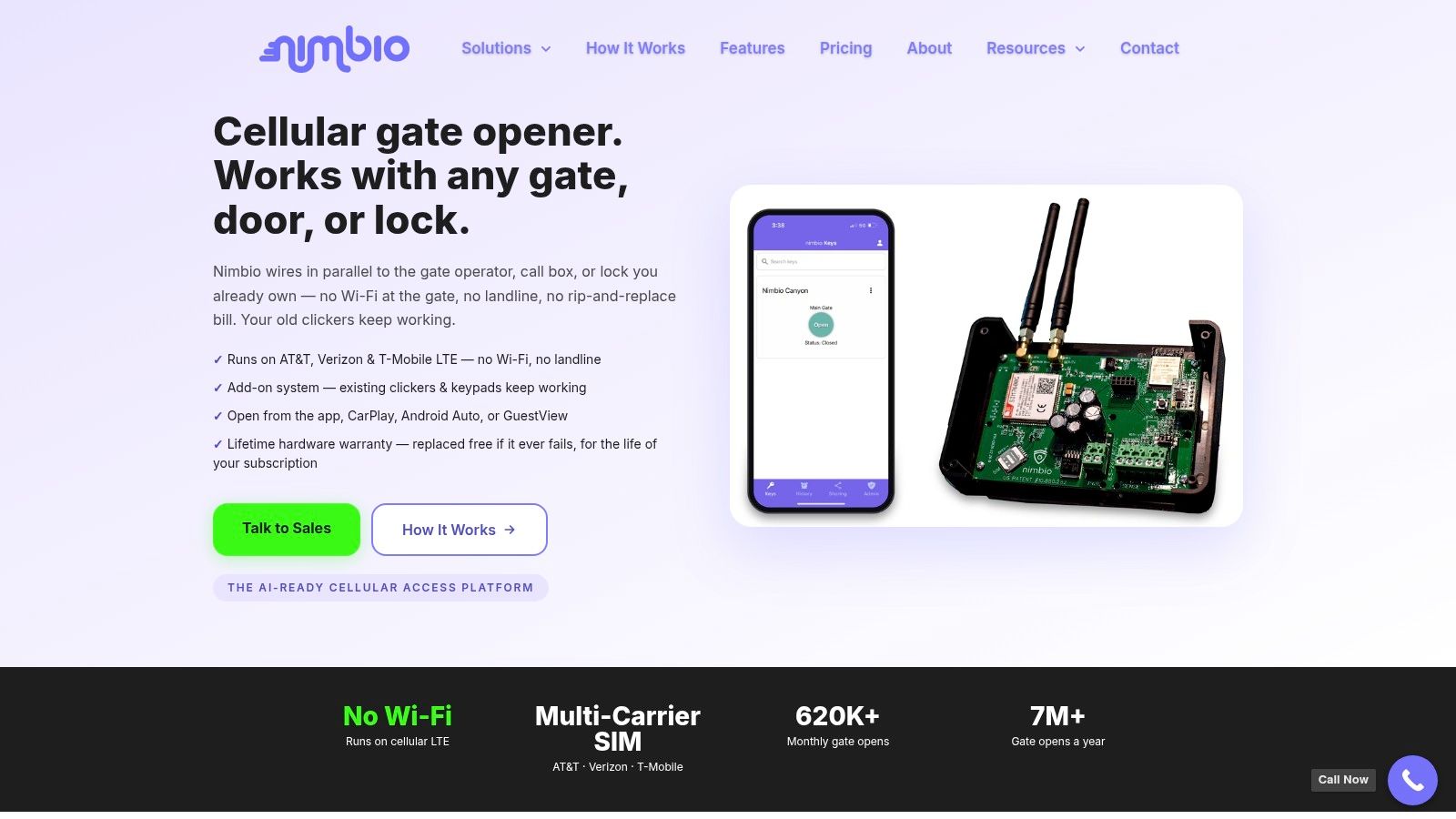
That second path is what a hardware-agnostic cellular controller is for. Nimbio is one example: it works with swing, slide, and overhead gates, and with mag locks and strikes. It wires in parallel to the dry-contact input on the operator, call box, or lock the property already owns, so legacy clickers and keypads keep working, with no Wi-Fi at the gate and no need to replace the gate. Managers issue and revoke digital keys remotely, set an expiration date, and can admit a visitor remotely with video verification at the gate. The smartphone gate access features are command tools. They are not a second safety system.
Boards comparing "smart" upgrades should separate a gadget swap from an access layer. Smart-home advice from Edinhart Realty is a useful check against replacing equipment that already does its job. Confirm terminal compatibility in the operator manual, or with the manufacturer, before buying. Indicator lights and error codes differ by model. Do not guess them.
Installation and Maintenance Basics for Property Managers
Installation belongs to a professional gate technician or a local low-voltage installer. The work is mounting, power and control wiring, and commissioning the safety devices. The steps differ by model. Follow that model's manual, and stop where the manual is unclear.
Nimbio hardware, where a property uses it, wires into the existing operator, but the physical work is still done by independent gate technicians or low-voltage installers. Nimbio recommends a professional installer, and its technicians can support the person doing the work. HOA, multifamily, and commercial properties should confirm the work meets local rules on gate access.
Checks worth putting on a calendar
Leading-edge force. Retest after install and after any hinge, stop, or leaf repair. A smooth unloaded swing can still be too hard at one crushing point.
Hinges, sag, and stops. Friction, a dropped leaf, and a misaligned stop change motor demand and can cause nuisance reversals or a weak response to a real obstruction.
Eyes, edges, and reverse. Clean the lenses, confirm the edges are present, and watch a test obstruction produce a reverse.
Emergency release. Someone who is trapped has to be able to disengage the leaf by hand. Prove that release, do not only locate the lever.
Snow, debris, and wind belong on the same list, because they change the load the last test did not see. Some properties fold those visits into outsourced technology upkeep so the gate is not waiting on a stuck morning to get attention. Nothing in a general checklist replaces the manual for the brand on the post.
A Practical Buying Checklist for HOAs and Homeowners
Have these facts before requesting quotes. Leaf weight and width. Openings on a busy day. Wind, snow, salt, or debris the operator will see. Power at the gate. Whether clickers and keypads must keep working.
The operator has to be installed with the entrapment protection its standard requires. Local rules vary, so ask the technician to say which devices cover opening and which cover closing.
Ask three questions in the quote meeting. Does this unit meet this leaf's weight and this entrance's cycle rate? How will safety devices be tested at commissioning? What does the maintenance schedule look like after the first month?
This week, write down weight, width, and daily cycles, then ask a qualified installer or the operator manufacturer to confirm compatibility before the board commits. If the operator stays and the open question is smartphone access, Nimbio's support team will confirm wiring compatibility for a specific model before installation. Call 1-800-353-3422. For community entrances, an HOA gate access system is a retrofit discussion, not a substitute for the safety devices on the leaf.
Nimbio offers a cellular add-on controller and a smartphone app for electric gates a property already operates, so a swing entrance can take phone access without a Wi-Fi network at the post. Managers can issue and revoke digital keys while existing clickers and keypads stay in service, and the operator's stopping and reversing behavior stays in place. See how that fits this entrance at Nimbio.