The popular advice is to warn once and fine fast. That shortcut is how a real violation turns into a weak case. To enforce HOA rules fairly, a board or manager runs one published sequence for every comparable case: confirm the rule, record the facts, send written notice, offer a hearing, and decide in writing. A text from a director, a fine settled in the hallway, and a penalty issued before notice are the moves that get challenged later.
Speed feels like control. It is not. A faster fine is often a weaker file, because the owner can attack the process even when the conduct was obvious. The stronger file is slower on purpose. It shows the citation, the evidence, the chance to cure, and a decision someone else can read months later.
Table of Contents
- Start With a Written Enforcement Process
- Six Stages From Violation to Decision
- What the Notice and Hearing Papers Include
- Apply the Same Standard to Every Owner
- Gate and Visitor Rules in the Same File
- Choose a Sanction Only After the Hearing
Start With a Written Enforcement Process
Say a director spots a trailer on a driveway and texts the manager, "Fine them today, the neighbors are angry." The manager who treats that text as a decision has already created the problem. The trailer may violate the declaration. The text does not. How to enforce HOA rules starts with one sequence the board can show an owner, a lawyer, or a later board, and that sequence does not begin with the penalty.
South Carolina's complaint record is a useful warning about what owners dispute. The 2026 HOA complaint report from the South Carolina Department of Consumer Affairs lists failure to adhere to or enforce covenants and bylaws as the largest category, at 16.8%, ahead of maintenance concerns at 11.7% and ignored document-access requests at 9.5%. Read that split as a consistency and process problem. It is not a reason to fine faster. Owners complain when the rules sit unused, and they also complain when the board cannot show how a decision was made.
Practical rule: If the only record is a director's text and a manager's memory, the association does not yet have a case. It has a rumor with a dollar amount attached.
A working case file is ordinary paperwork. Open it the same way for a trailer, a trash cart, a parked commercial van, or a gate that was propped open.
- The rule: The declaration section, bylaw, or adopted regulation that bars the conduct.
- The facts: Date, property, a photo or log line, and a neutral description.
- The notice: What must change, by when, and what penalty is under consideration.
- The hearing: The date offered, whether the owner appeared, and the written result.
That same file covers gate and visitor rules. A keypad entry or a visitor list is evidence inside the case, not a separate punishment system. The community access management guide is a useful companion when the alleged violation is about who used an entry point, because the access record still has to sit next to the citation and the notice.
Owners who believe the paperwork skipped a step often look for outside help on challenging an unfair HOA violation notice. Boards should assume that review will happen. Pull the declaration, the bylaws, and the current fine policy before anyone opens a case. If those documents do not authorize the penalty the director wants, the file closes there.
Six Stages From Violation to Decision
A board can run this process in the current week. Each stage produces a page, a photo, or a dated note. Skip a stage and the later penalty is the part an owner attacks first.
- Confirm the conduct is barred. Read the declaration, the bylaws, the statute that applies, and any properly adopted rule. If nothing prohibits the conduct, close the file. A neighbor's dislike of a boat, a paint color, or a work van is not a violation.
- Record objective evidence. Write the date, the property, and a neutral description. Attach photographs or a log line. "Trailer parked on the driveway, facing the street, photographed at 8:12 a.m." is usable. "Owner is disrespecting the neighborhood" is not.
- Send written notice. Name the rule, the facts, the cure, the deadline, and the penalty under consideration. A vague request to "clean up the property" does not tell the owner what compliance looks like.
- Offer a hearing and calendar it. Use the deadline in the statute and the governing documents. Put the hearing date on the case log the day the notice goes out, and note whether the owner must request the hearing or whether it is set automatically.
- Decide in writing. Separate two questions that boards often mash together. Did the owner cure the conduct? Was any penalty imposed, reduced, or waived? An owner can cure and still owe a fine the documents allow, or cure and owe nothing. The letter should say which.
- Escalate only after the cure window and the hearing are finished. Counsel, a suspension of use rights, or a collection letter comes after those stages, not instead of them.
One state's notice rules, not a national rule
Florida's homeowners' association statute is a concrete version of stages 3 and 4. It is not the rule for every state. Under the 2026 Florida homeowners' association statute, the notice goes out at least 14 days before the hearing, to the owner's designated mailing or email address in the association's official records and, when it applies, to the occupant, licensee, or invitee. The notice describes the alleged violation, the specific cure when a cure applies, and the hearing date, location, and access information for a telephone or electronic hearing. The hearing must occur within 90 days after the notice and before a qualifying committee of at least three members.
Beside those notice rules, the sanction has a ceiling in that same Florida homeowners' association setting. A fine is generally no more than $100 per violation. A continuing violation may be fined each day, but the total generally cannot exceed $1,000 unless the governing documents authorize another amount. A fine, or a suspension of use rights, waits for the 14-day notice and a hearing before a committee of at least three members who are not officers, directors, employees, or certain close relatives.
A fine issued on day one, or a notice that cites no section, is the usual failure. The conduct can be real and the penalty still fails.
Local law and the governing documents control the exact number of days, the delivery method, and the fine authority. A manager in another state should not copy Florida's 14 days or its dollar caps onto a letterhead. The six stages still travel. The deadlines and the hearing body do not. The comparison table later in this article puts those two state examples side by side so a board can see the shape of the file without treating either state as the national form.
What the Notice and Hearing Papers Include
California shows a different clock and a different hearing body. An HOA board must give the member individual written notice at least 10 days before the meeting at which discipline or a monetary charge will be considered, according to this summary of California fine procedure. That notice must identify the date, time, and place, describe the nature of the alleged violation, and state that the member may attend and address the board. If the member requests it, the board meets with the member in executive session. If the board imposes a fine, it must send written notice of the decision within 15 days after taking action.
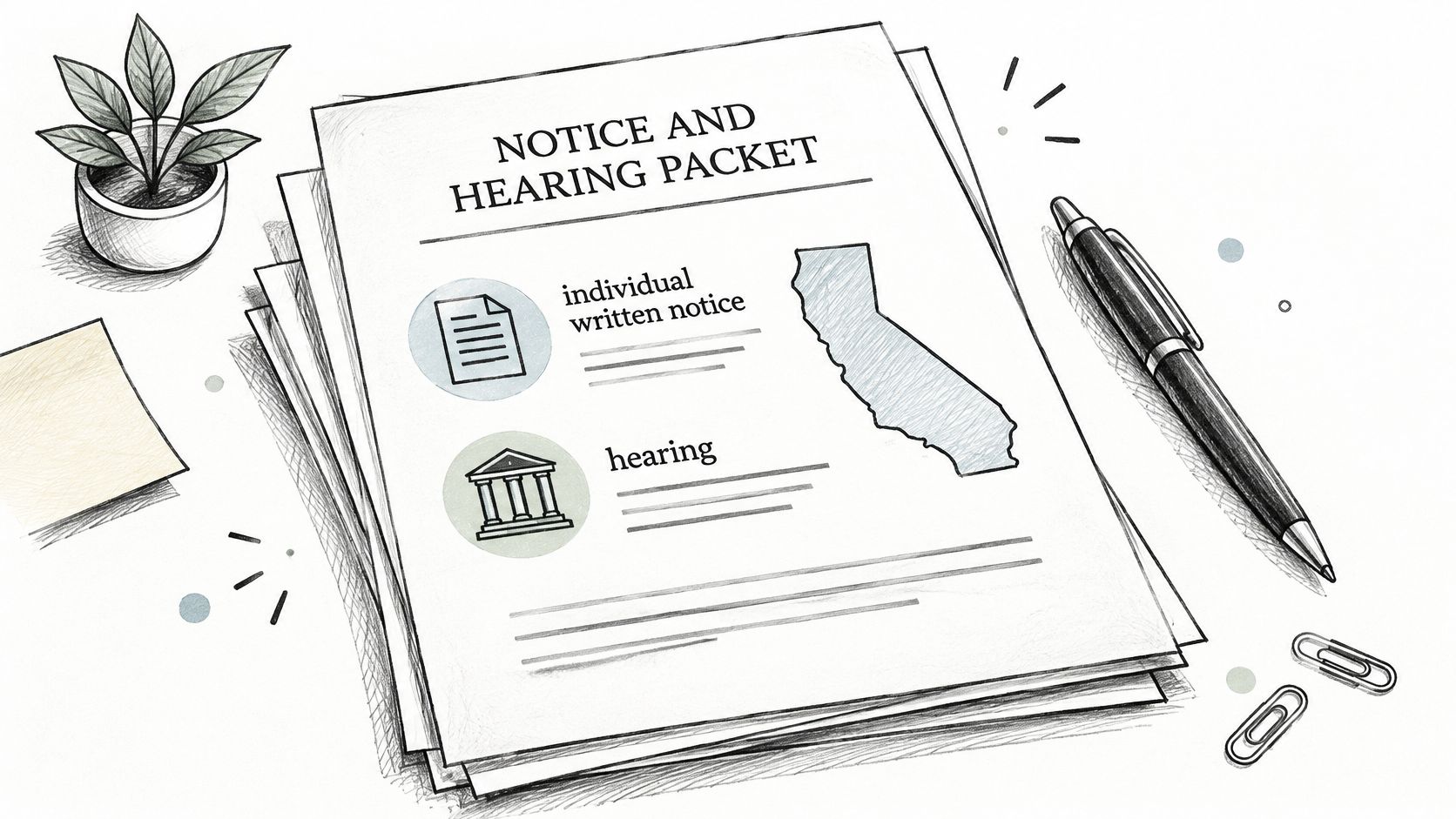
The structural contrast matters more than any single number of days. Some states hear discipline at the board. Some require an independent committee. Some states hold the hearing even if the owner stays home. Others set the meeting and let the owner decide whether to appear. Copying another community's form, including a Florida form, is how a California notice misses the executive-session request or the 15-day decision letter.
Fields a working notice should carry
A manager should not invent the contents of the letter for each house. The notice, and the hearing packet behind it, should carry the same fields every time.
- Owner and property: The name on the roster and the address or unit the rule applies to.
- Governing-document citation: The article, section, or adopted rule, not a paraphrase alone.
- Dated facts: What was observed, when, and where, in neutral language.
- Cure and deadline: The specific action and the date it must be done.
- Penalty under consideration: The fine, suspension, or other sanction the documents allow, stated as under consideration rather than already imposed.
- Hearing logistics: Date, time, place, and how to join if the hearing is by phone or video.
- How to respond: Where to send a written reply, a photo of the cure, or a request to be heard.
Delivery belongs in the same file. Record the method, the address used, and the date sent. A notice that cannot be proved is a notice the owner can deny receiving. Keep the certified-mail receipt, the email header, or the hand-delivery acknowledgment with the case, whichever method the documents require.
A hypothetical trash-cart file
This scene is hypothetical. On Tuesday a manager photographs a trash cart still at the curb of 14 Cedar, past the Monday collection window in the rules. The notice cites the section, states the Tuesday photo, and gives a cure: store the cart out of view by Friday at 5 p.m. That letter is easy to explain at a hearing. A note that only says "clean up the lot" is not. The owner cannot tell whether the problem is the cart, a stain on the driveway, or a hedge.
| Item | Florida homeowners' association | California HOA |
|---|---|---|
| Notice timing | At least 14 days before the hearing | At least 10 days before the meeting where discipline or a monetary charge is considered |
| What the notice states | Alleged violation, cure action when applicable, hearing date, location, and telephone or electronic access | Date, time, and place; nature of the alleged violation; right to attend and address the board |
| Who hears it | Committee of at least three members who are not officers, directors, employees, or certain close relatives | The board, in executive session if the member requests it |
| When the hearing happens | Within 90 days after the notice | At the meeting stated in the notice |
| Fine ceiling | Generally $100 per violation; continuing-violation total generally $1,000 unless the documents authorize another amount | No dollar cap is stated in the disciplinary-notice rules summarized here; counsel checks the governing documents |
| Notice of the decision | Written decision after the committee hearing, recorded in the case file | Written notice within 15 days after the board imposes a fine |
These rows are examples, not a national rule. Blank-looking differences are real. Have association counsel localize cure periods, mail rules, the hearing body, and fine authority before anyone uses the template on a live case.
Apply the Same Standard to Every Owner
A clean notice still fails if the house next door, with the same trailer, never received one. Consistency is the control against a selective-enforcement claim. After a rule is adopted, apply the same evidence threshold, the same cure opportunity, the same escalation, and the same penalty framework to comparable properties. That includes the homes of directors.
The Community Associations Institute's policy on rules development and enforcement recommends enforcing known violations in a consistent and uniform manner, and making sure owners understand their procedural rights and obligations. Uniform does not mean harsh. It means the quiet street and the loud street get the same trigger.
The one-page violation matrix
Publish a matrix staff can use without calling a director for permission. One row per rule is enough.
- Rule citation: The document and section.
- Objective trigger: The observable fact that opens a case, such as a cart at the curb after the stated hour.
- Evidence required: Photo, inspection note, or access-log excerpt.
- Notice template: The letter name, so staff do not rewrite the citation each time.
- Cure period: The number of days the localized policy allows.
- Hearing path: Who hears it, and how the owner asks to be heard.
- Authorized sanction: The fine or other penalty the documents allow for that rule.
- Closure code: Cured, fined, waived with a written reason, or referred to counsel.
Before a penalty goes out, compare prior cases and write down any legitimate distinction. A different violation type, a repeated offense, an emergency, or a documented accommodation can justify a different result. A quieter street, a friendship with the board, or the fact that the owner "usually complies" cannot. If the distinction is real, the file note should be specific enough that a later reader understands it without a phone call.
Access disputes belong in that same comparison. When two households are accused of misusing a gate, reviewing property access activity should follow the matrix, not a director's hunch about which household is the problem.
Voluntary compliance stays first. A clear letter and a respectful chance to cure will close more files than a demand drafted for court. Legal action is generally a last resort after the internal steps fail.
Treat the fine as a compliance tool. The day the board starts talking about fines as income, the standard has already slipped.
Watch these pitfalls. They are not a second procedure. They are the ways the matrix gets ignored.
- Selective enforcement: Known violations on favored lots sit open while others are fined.
- A silent change in standard: The cure period or the photo requirement shifts without notice to owners.
- Fines as revenue: The budget starts to depend on penalties, so staff look for violations to bill.
- Public naming: Alleged violators are identified in a newsletter or an open meeting before a decision.
- A jump to litigation: Counsel is engaged before notice and a hearing.
Cure periods, certified-mail rules, fine limits, and hearing timelines differ by jurisdiction. Localize the matrix, and put a recurring review on the board calendar so last year's form is checked against current law before it is used again.
Gate and Visitor Rules in the Same File
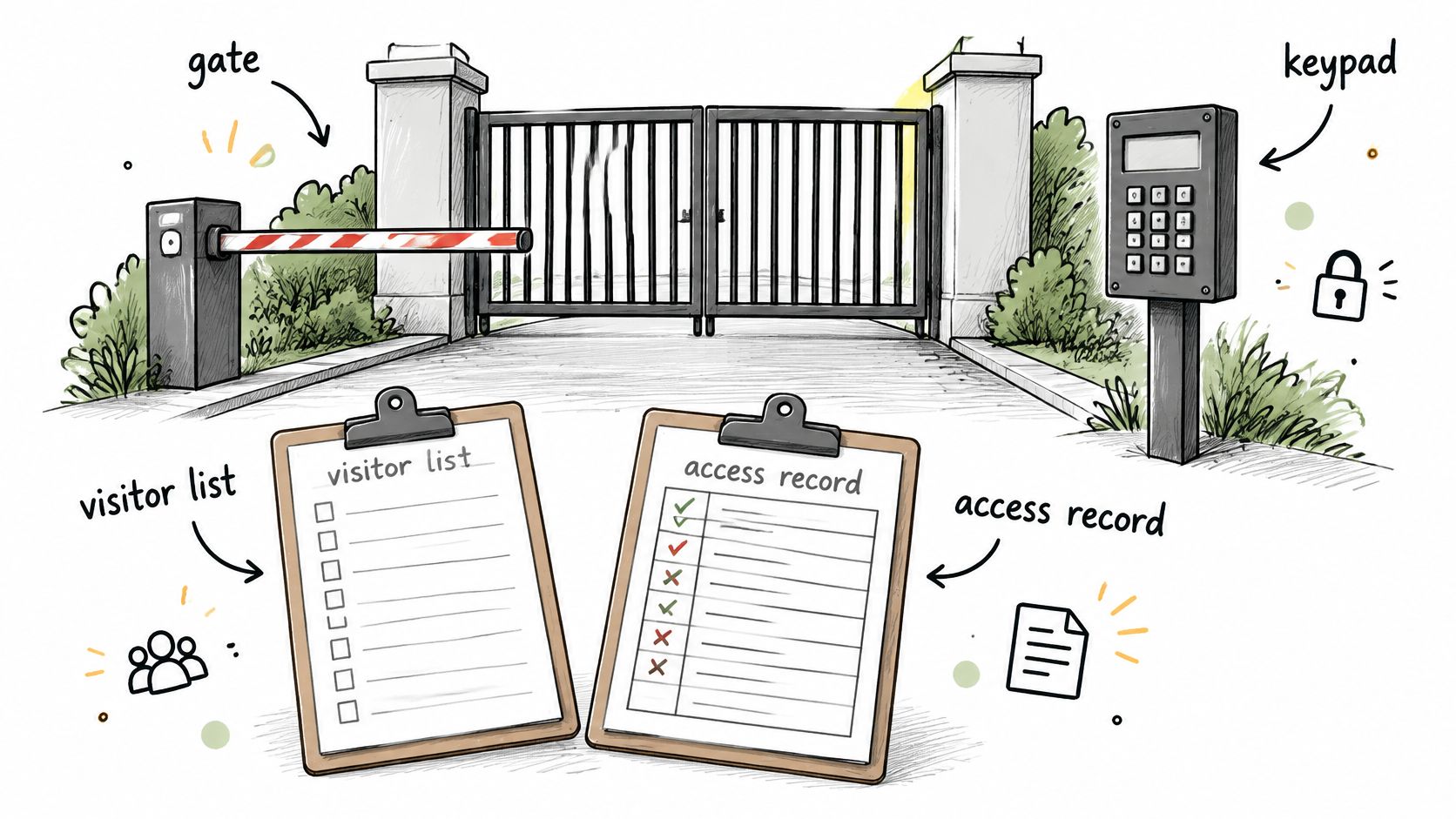
A vehicle gate, a shared keypad, or a visitor list is not a separate punishment system. It is another rule, with the same case file. A shared four-digit code cannot show who entered. A useful access record can show which entry point opened, when, and which credential was used. That record still does not replace written notice or a hearing.
Three situations, one file
A resident props the vehicle gate. A neighbor's video or a staff photo at 6:40 a.m. shows a brick holding the gate off the close-limit. The rule citation is the section that requires the gate to close after each vehicle. The evidence is the dated photo, not a conclusion that the resident is careless. The cure is to stop propping the gate and to confirm it closes. Taking the household's clicker that morning, before notice, creates a second dispute about access while the first dispute is still unheard.
A household shares a code with contractors. The keypad log, if the operator stores one, may show repeated use of one code during work hours. It will not name the painter. The notice should say what was observed, cite the rule against sharing the entry code, and set a cure: stop sharing the code, and have contractors use the visitor method the documents describe. If the only "evidence" is that contractors have been seen, say that, and do not pretend a shared code identified a person.
A short-term occupant was never registered. The rental rule requires registration before occupancy. The evidence might be a listing, a dated observation, or a credential issued to a name that is not on the roster. The cure is to register the occupant or to end the stay if the documents prohibit that rental. Shutting off the clicker, the fob, or a digital key can be the corrective step the documents allow, but only after the notice and hearing those documents and the statute require.
Cutting access first feels decisive. It usually adds a claim that the household was locked out of its own property without a chance to respond. Leave required fire access and the exit path working. Follow the gate-operator manual and local rules. Do not disable a safety feature to make a point during a dispute.
Where an access record fits
If the community keeps logs, those pages are exhibits. Print or export the relevant lines, note who pulled them and when, and put them behind the notice. Do not treat the log as the hearing.
An HOA gate access system can make the credential itself easier to tie to a person. Nimbio, for example, is a cellular add-on that wires into the operator the property already has, so it does not need Wi-Fi at the gate and does not require a new gate. Managers can issue or revoke a digital key and set an end date, while existing clickers, fobs, and keypads keep working, and a visitor can be checked by video at the gate. It does not file violations, set fines, or replace those older credentials. The declaration still has to authorize any access sanction before the board uses one. A revoked key after a completed hearing is a remedy. A revoked key instead of a hearing is another violation of the process.
Choose a Sanction Only After the Hearing
The hearing is over when the written decision goes in the file. That letter names one sanction the declaration and the statute allow, or it closes the case because the owner cured and no penalty is authorized. It should also say, in plain sentences, what the committee or board found, what the owner said, and what happens if the conduct returns.
In a Florida homeowners' association, the Homeowners' Association Act allows the board to fine an owner, tenant, guest, or invitee. The fine generally cannot exceed $100 per violation. For a continuing violation, the board may fine each day, but the total generally cannot exceed $1,000 unless the governing documents authorize another amount. Suspending use rights follows that same sequence: at least 14 days' written notice and a hearing before a committee of at least three members who are not officers, directors, employees, or certain close relatives. Another state will name different people, different days, and sometimes no dollar cap at all. Counsel, not a neighboring community's form, confirms whether these documents allow a fine, a suspension, or something else.
A lien is not the next automatic step
Associations filed 284,933 property liens in the United States in 2025, an 8.6% increase from 262,446 filings in 2024, according to property-record data compiled by Benutech Data Insights. That volume is a reason to finish the hearing record before anyone discusses collection. The file should already show the citation, the chance to cure, and the hearing. If those pages are missing, a lien discussion is early.
Where the documents allow an access sanction, carry it out only after that written decision. In the Nimbio Community Manager portal, one click revokes a key holder's entire Nimbio access, including keys that person issued to family or guests, and access ends the moment revoke is clicked. That is a clean way to carry out a decision the documents already allow. It is a poor way to punish someone who has not yet had notice.
At the next board meeting, adopt the written procedure: the six-stage file, the notice fields counsel has localized, and the violation matrix. Then run one closed practice file on an old complaint with the names removed. Walk it from the citation through a mock notice and a mock decision. Fix the template where the practice file gets vague. The next real notice should be the second time the board has seen the form, not the first.
Nimbio is a cellular add-on controller and smartphone app for electric gates, and for electric locks as a secondary use, so a gated community can issue and revoke digital keys without ripping out the operator it already has. Gate and visitor records still belong in the enforcement file, next to the rule and the hearing, rather than standing in for them. Visit Nimbio to see how the controller and app fit an existing gate.