A property manager opens the monthly invoice and sees a number that doesn't match last month, or the month before that. The gate has been busy, resident traffic changed, vendor visits spiked, and the bill followed every one of those movements. That's the exact moment usage based pricing stops being an abstract billing idea and becomes a practical budgeting problem for HOAs, property managers, and security teams.
For access control, the appeal is straightforward. Instead of paying a flat fee that ignores real gate activity, a community can pay in proportion to what the system handles, such as access events or other measurable usage. That model is showing up far beyond proptech, which is why more teams are rethinking how they bill, forecast, and control access costs, especially where physical infrastructure creates unpredictable demand.
Table of Contents
- Introduction to Usage Based Pricing for Access Control
- Understanding Usage Based Pricing Core Concepts
- Comparing Flat Tiered Subscription and Usage Based Models
- Benefits and Drawbacks for Gate and Access Control
- Implementation Steps and Key Metrics
- Example Pricing Scenarios with Nimbio in Action
- Best Practices and Safeguards You Need to Know
- FAQs on Usage Based Billing for Property Managers
Introduction to Usage Based Pricing for Access Control
A community manager might know the routine by heart, yet still dread the invoice. One month the gate sees steady resident traffic, the next month a contractor project or holiday delivery surge pushes usage higher, and the billing line item changes with it. That volatility is why usage based pricing gets attention in access control, because the bill can follow actual gate activity instead of forcing every site into the same flat charge.
That shift matters in gated communities and commercial facilities where access patterns are rarely identical. A quiet HOA, a mixed-use property, and a logistics yard all create different costs and different value from the same system. For teams evaluating options, the first question is usually not whether variable billing is possible, it's whether it can be controlled well enough to stay budgetable.
Practical rule: if a gate operator's activity is easy to measure, it can usually be priced more precisely than a flat plan would allow.
For a property team comparing options, a useful starting point is to replace key fobs for gated communities with a model that ties billing to real access demand rather than unused capacity.
Understanding Usage Based Pricing Core Concepts
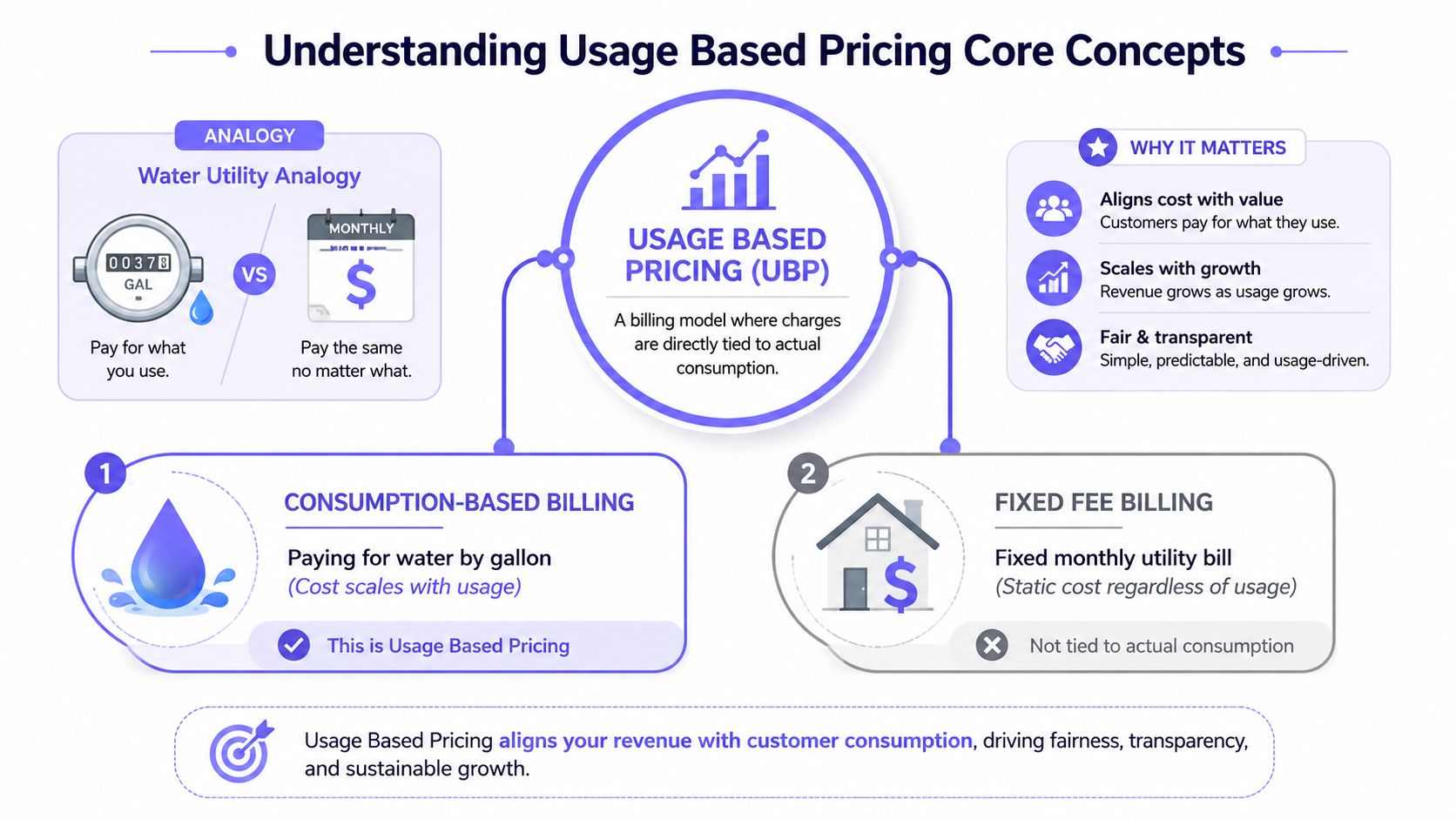
Usage based pricing is simple at the surface. Customers pay in proportion to actual consumption instead of paying a fixed fee that stays the same whether usage is high or low. A good analogy is water billing, paying by the gallon, instead of paying a fixed monthly utility amount no matter how much water ran through the pipes.
That difference changes who carries the risk. Under a flat fee, the vendor absorbs extra demand, or the customer overpays when activity is low. Under usage based pricing, the price moves with the value being consumed, which is why the model feels fair in systems with variable demand and measurable events.
Stripe's 2026 pricing guide shows how far this idea has spread, with SaaS adoption rising from 27% in 2018 to 46% in 2022, and 61% of B2B SaaS companies including usage components by 2026 (Stripe). That doesn't mean every physical system should copy SaaS, but it does show that consumption-based billing has moved into the mainstream.
What has to exist before billing can work
A usage model only works when three pieces are in place.
- A billable unit. The system has to know what counts, such as an access event, a gate cycle, or another measurable action.
- Reliable metering. The platform must capture that activity accurately.
- Customer visibility. Users need a dashboard or statement they can inspect before the invoice arrives.
If customers can't see the meter, they won't trust the bill.
That's why usage based pricing isn't just a finance decision. It's a product design choice, a data capture choice, and a customer communication choice all at once.
Comparing Flat Tiered Subscription and Usage Based Models
Access control buyers usually compare four broad pricing styles before choosing a system. Each one solves a different problem, and each one creates a different kind of friction for property managers and integrators.
A flat fee is easy to understand, but it can punish low-traffic sites that never use the full capacity of the plan. Tiered and subscription plans make invoices predictable, yet they often create artificial floors that force smaller communities to pay for features or volume they don't need. Usage based pricing is the most precise fit for changing demand, but it also brings billing volatility that many boards dislike.
The clearest way to compare them is side by side.
| Model | Predictability | Scalability | Value Alignment | Admin Overhead |
|---|---|---|---|---|
| Flat fee | High | Low to moderate | Low | Low |
| Tiered pricing | High | Moderate | Moderate | Moderate |
| Subscription | High | Moderate | Moderate | Low to moderate |
| Usage based pricing | Lower unless controlled with safeguards | High | High | Moderate to high |
The trade-off is familiar to anyone who has compared software plans. For example, teams evaluating vendor ecosystems often also understand Meraki licensing models because the same question keeps coming up, do buyers want fixed cost certainty, or do they want billing that better reflects actual activity?
How the models feel in practice
A flat fee feels safe to a board because it's easy to budget. The downside is that the site may subsidize quiet months or underused capacity.
Tiered pricing and subscriptions work better when usage is somewhat stable. They simplify approvals and renewals, but they can hide the true cost of growth.
Usage based pricing tracks activity more closely. That makes it attractive for sites with uneven gate traffic, but only if the system can meter usage cleanly and explain it without confusing the customer.
Benefits and Drawbacks for Gate and Access Control
The biggest advantage of usage based pricing in gate and access control is alignment. If a property uses the system more, it pays more, which feels easier to defend than a blanket charge that ignores real activity. That can make the entry point lower for smaller HOAs, while larger or busier sites can grow into higher usage without renegotiating the whole contract.
Another benefit is that revenue follows activity. In software markets, usage-based pricing has been associated with 20–30% higher net revenue retention because expansion happens naturally as consumption rises (Stealth Agents). The access control parallel is clear, more gate events, more billable usage, more revenue, but only when the bill remains understandable.
Where the friction shows up
The downside is predictability. A resident move-in wave, a contractor project, or a seasonal traffic spike can change the bill in ways that make board approval harder. That's where the trust question becomes central, because a model that feels fair in theory can still create discomfort if the invoice swings too much.
Integration adds another layer. Access systems need event logging, a dependable billing pathway, and a way to reconcile usage with accounting. If those parts don't line up, the model doesn't feel elegant, it feels risky.
Budgeting reality: a usage model works best when the customer can forecast it, not just receive it.
For gated communities and facilities, the decision often comes down to whether the site values lower friction at signup more than it values fixed monthly certainty. If the answer is no, the pricing model needs safeguards before it can be trusted.
Implementation Steps and Key Metrics
The mechanics matter more than the marketing. A usage based access model needs a measurable event, a reliable way to capture it, and a billing stack that can turn raw activity into a clean invoice before anyone disputes the numbers.
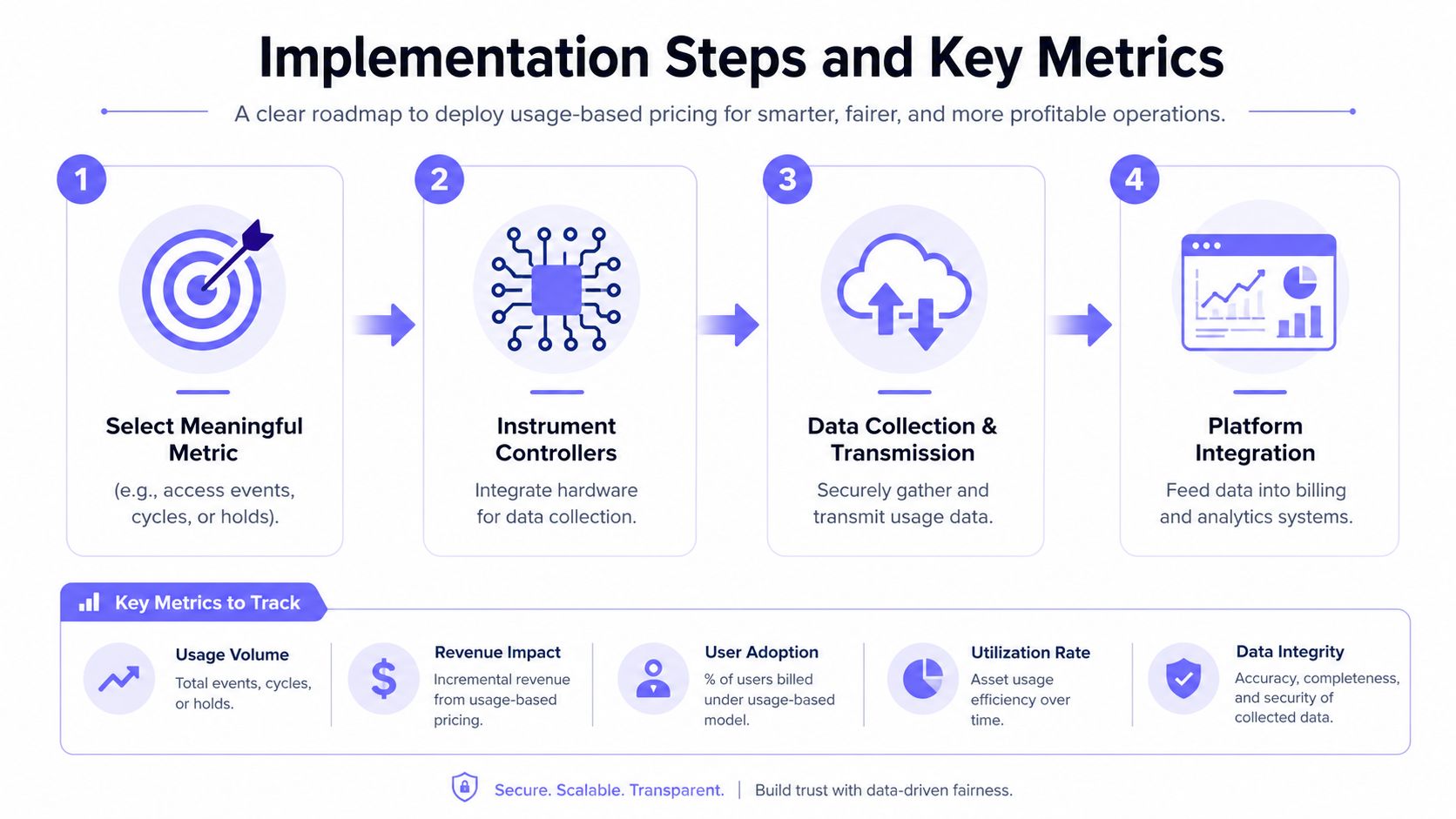
M3ter's implementation guidance is blunt about the technical sequence, choose a billable unit, instrument consumption events, and integrate with billing and ERP systems before launch (M3ter). That order matters because billing accuracy starts with meter design, not with invoice formatting.
Step 1, pick the right usage metric
The metric should map directly to value and cost. For a gate system, that might be access events, gate cycles, or another quantifiable action that a property manager can explain without a manual.
A weak metric creates confusion fast. A strong one is scalable, predictable, and easy to reconcile.
Step 2, capture usage near real time
Once the metric is chosen, the controller or gateway has to log it consistently. Near-real-time capture reduces missed events and makes it easier to spot anomalies before the month ends.
Step 3, clean and route the data
Raw usage data rarely arrives in billing-ready shape. A mediation layer can clean the records, remove duplicates, and pass the right counts into invoicing and revenue systems.
Step 4, show the customer what's happening
A dashboard turns billing from a surprise into a process. For property teams, that visibility helps explain traffic changes, confirm expected activity, and reduce disputes.
For a practical view into what this looks like on the administrative side, the Nimbio access control dashboard is the kind of interface that illustrates how usage visibility can support billing, auditability, and day-to-day oversight.
Step 5, add controls before launch
The safest systems include alerts, caps, and overage rules from the start.
- Usage alerts warn teams before a bill spikes.
- Caps and throttles protect against runaway costs.
- Clear overage rules prevent invoice disputes.
- Baseline commitments give budgeting a floor.
Without those controls, the meter can be accurate and still feel unmanageable.
Example Pricing Scenarios with Nimbio in Action
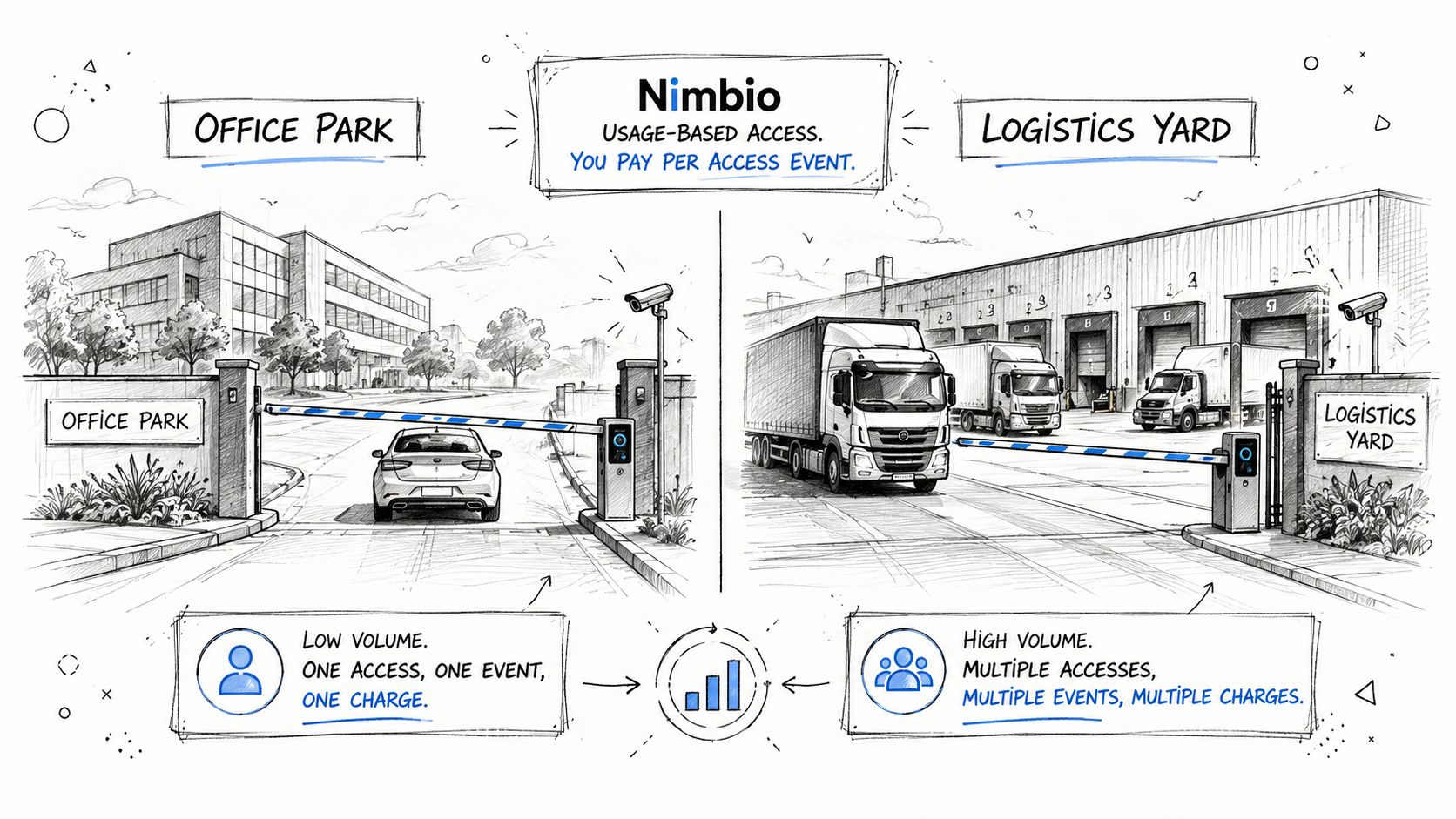
A small office park and a logistics yard can't be priced the same way if their gate activity is wildly different. One site may have predictable weekday traffic, while the other sees heavy, repeated access throughout the day. A usage model makes that difference visible instead of hiding it inside a flat subscription.
A simple commercial pricing example
In one common structure, a site might include a 500-event monthly minimum, charge $0.05 per additional event, and cap the bill at $200 to prevent spikes. That kind of structure gives the customer a baseline, adds flexibility for real usage, and still protects the budget from a sudden traffic surge.
The office park benefits from the floor, because quiet months don't force it into a larger plan it doesn't need. The logistics yard benefits from the cap, because heavier traffic won't create a runaway invoice.
For integrators, the appeal is operational as well as financial. Cellular connectivity avoids dependence on local Wi-Fi, and a hardware-agnostic retrofit means existing gates don't need to be replaced just to support meter-based billing.
Why this matters for fleets and multi-site operators
A variable model is easier to operationalize when access events can be triggered and tracked digitally across locations. That's where programmatic gate control for fleets becomes relevant, because repeatable event capture is what makes usage billing auditable.
The point isn't to make every site pay more. The point is to tie cost to actual demand in a way that property managers, owners, and installers can explain without guesswork.
Best Practices and Safeguards You Need to Know
The best usage models feel fair before the invoice arrives. That means the customer sees the meter, understands the rules, and knows where the ceiling is if activity jumps unexpectedly.
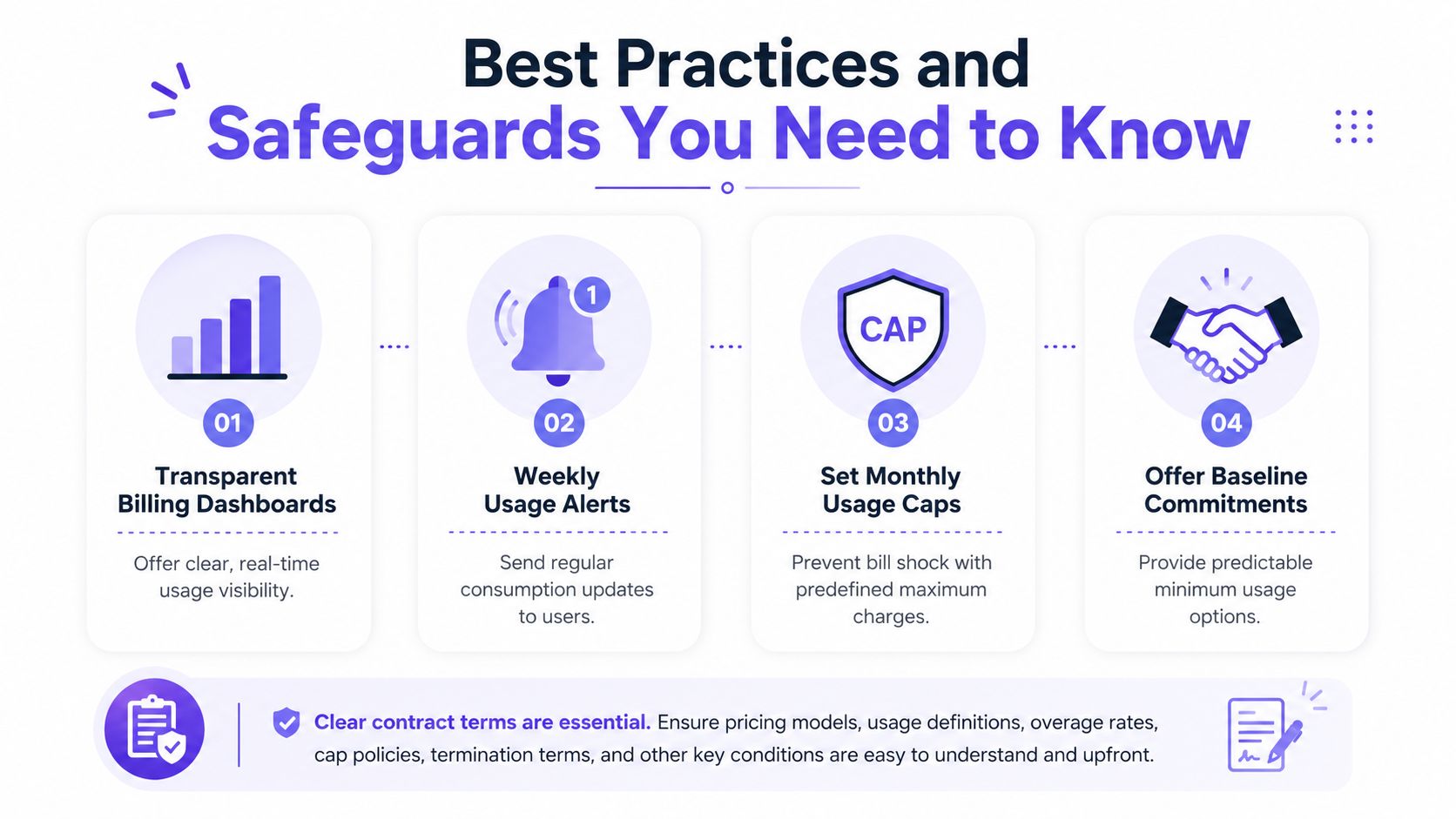
Stigg's guidance is clear, buyers need forecasting, baseline commitments, rate limits, and clear communication to avoid bill shock (Stigg). In access control, those safeguards matter even more because a bill that surprises a board can damage trust long after the traffic spike is over.
The four controls that matter most
- Transparent billing dashboards. Teams need real-time visibility, not end-of-month surprises.
- Weekly usage alerts. Regular updates help managers catch unusual activity early.
- Monthly usage caps. Caps reduce the risk of bill shock and keep approvals easier.
- Baseline commitments. A minimum commitment gives the customer a planning anchor.
Contract language should match the controls. Surge handling, dispute resolution, and overage treatment all need to be spelled out in plain English so the billing system and the board are working from the same rulebook.
A good usage model doesn't remove uncertainty entirely. It makes uncertainty manageable enough that the property can plan around it.
FAQs on Usage Based Billing for Property Managers
How can bills be forecast when usage changes every month?
Use a moving average from recent months, then add a small buffer for seasonal traffic or known events. The goal is not perfect precision, it's a forecast range that the board can approve.
Which billing cycle fits HOA planning best?
Monthly billing usually matches HOA and property management rhythms best because it lines up with reporting and cash flow review. Quarterly billing can hide volatility too long.
Which metric should a gate system use?
Pick the metric that mirrors actual cost and actual value, usually access events, cycles, or another count that staff can verify. If the metric is hard to explain, it's probably the wrong one.
How should usage data connect with accounting?
Export the usage records into the billing or ERP system on a regular schedule, then reconcile totals before invoices go out. Clean handoffs matter more than fancy reports.
A property team that wants access control billing to stay budgetable should start with the metric, not the invoice. For a closer look at how modern cloud-based access control can support cleaner usage tracking, tighter controls, and simpler retrofits, contact Nimbio and ask how its cellular gate system fits a gated community or facility without replacing existing hardware.