A property manager gets the budget request in April, the board meeting is in May, and the access-control system at the gate is already causing complaints. One director wants a cheaper fix. Another wants a full replacement. The right question isn't just what the project costs, it's what is ROI in real estate for this decision, and which return measure tells the truth.
That's where a lot of community decisions go sideways. In real estate, ROI can mean different things depending on whether the board is judging annual cash flow, holding-period profit, or equity-based performance, so two people can look at the same project and reach opposite conclusions if they're not using the same definition. For HOA boards, property managers, and investors, the metric only helps when the definition is clear first.
Table of Contents
- Defining ROI in Real Estate and Why the Definition Matters
- The Core ROI Formulas Every Investor Should Know
- How ROI Compares to ROE, Cash-on-Cash, and Other Metrics
- Step-by-Step ROI Calculation Using a Worked Example
- Key Factors That Move Real Estate ROI
- Actionable Ways to Improve ROI on Real Estate Assets
- Common ROI Pitfalls and How to Avoid Them
- Next Steps, Calculators, and Common Questions
Defining ROI in Real Estate and Why the Definition Matters
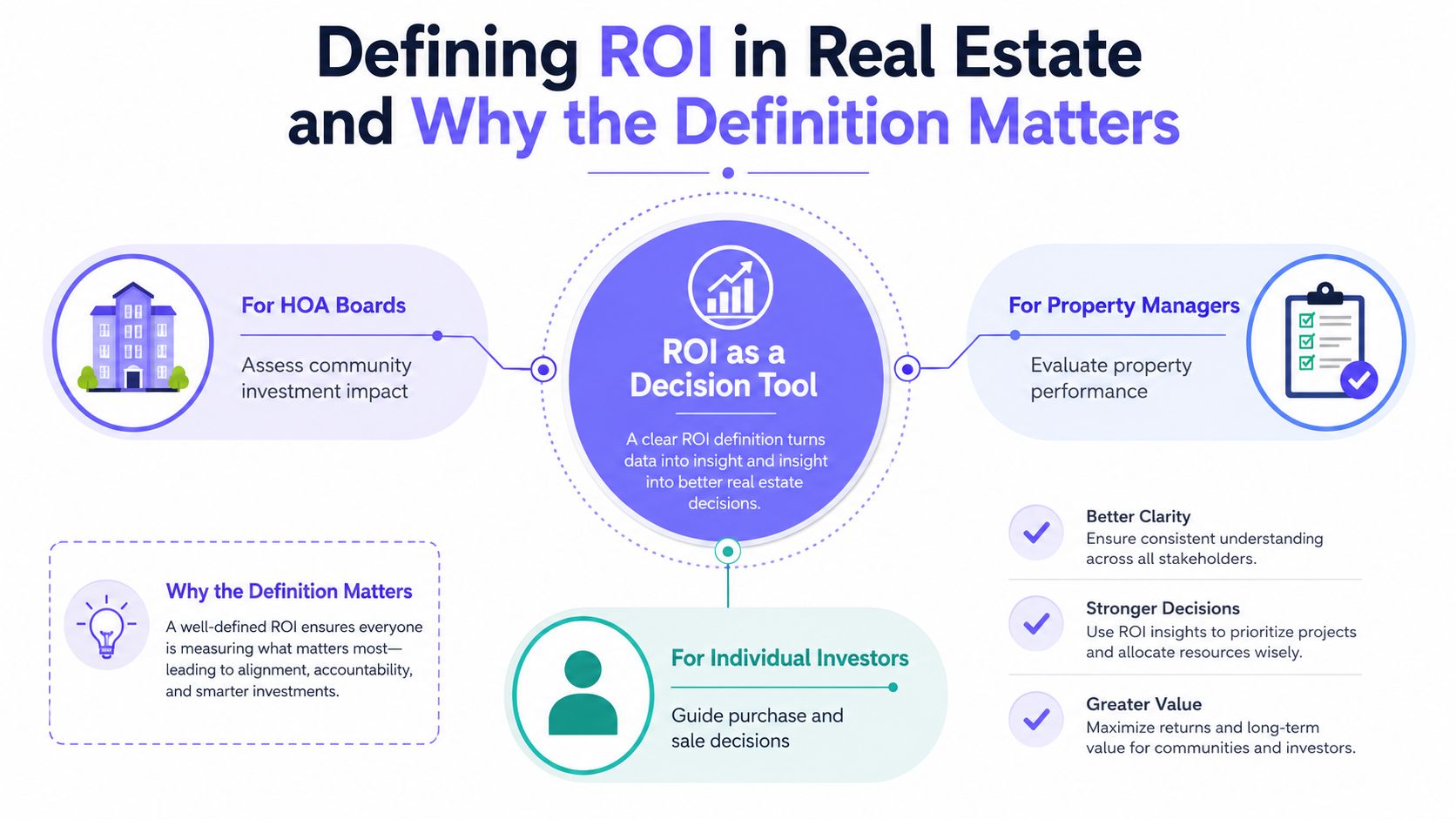
A board is comparing two gate-access upgrades. One has a low upfront price. The other has lower ongoing operating friction. If the team doesn't agree on the return metric, the vote turns into a comparison of apples, oranges, and half-finished spreadsheets.
ROI in real estate is not a single standardized metric. Industry guidance notes that the term may mean cash-on-cash return, total return including appreciation, or equity multiple-based return, which makes unnormalized comparisons misleading (Matrix Commercial Capital). The practical move is to state, up front, whether the analysis is based on annual cash flow only or on full holding-period economics.
Three common definitions used in practice
A useful working definition depends on the question being asked.
- Cash flow ROI: focuses on annual income relative to the cash tied up in the deal.
- Total return ROI: includes appreciation, debt paydown, and sale proceeds over the full hold.
- Equity-based return: measures performance against the equity invested, not just the asset's sticker price.
That distinction matters because mortgage amortization, sale proceeds, and tax effects can change the answer materially. A project that looks modest on yearly cash flow can look stronger over a longer hold, and a project that looks attractive on paper can underperform if the operating savings never show up.
Practical rule: if two deals use different ROI definitions, they should not be compared side by side until the math is normalized.
For rental properties, a quick screening tool can still be useful. PropLab's use to estimate rental yield resource is a simple way to sanity-check a deal before deeper underwriting begins.
The Core ROI Formulas Every Investor Should Know
A property manager does not need every formula on every project. The better approach is to match the formula to the decision, then keep the assumptions the same from one option to the next.
That matters for HOA boards too. A decision about an access-control retrofit is not the same as a decision about a financed rental property, yet both can be judged through ROI if the board knows which version of ROI it is using.
Simple ROI for a fast screen
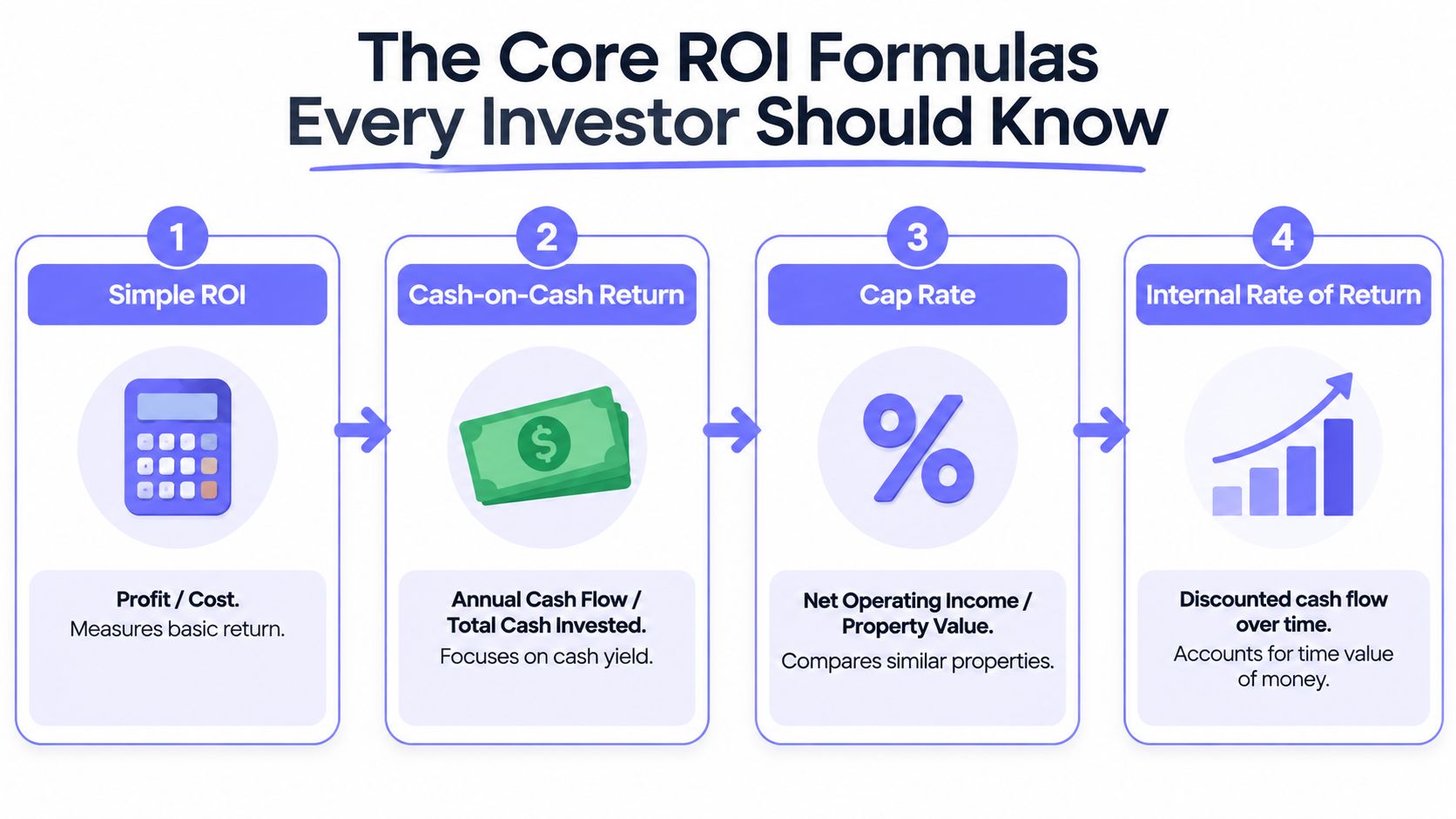
Simple ROI answers a basic question, how much profit came back compared with the total cost. In real estate, rental guidance commonly models ROI as net gain divided by total investment cost, with cost including purchase price, closing costs, repairs, and other transaction expenses (Rocket Mortgage).
The idea is similar to checking whether a project paid for itself. If a property upgrade saves money, raises income, or creates resale value, simple ROI gives a quick first look at whether the result appears worth the outlay.
Simple ROI = Net Gain ÷ Total Cost
That formula is useful when a team needs a rough screen. It is not enough for a final approval on a financed asset or on a capital project where timing and debt change the outcome.
Cash-on-cash return for properties with debt financing
Cash-on-cash return asks a narrower question, how much annual cash comes back on the cash invested. That makes it useful when financing is part of the deal, because it separates the property's cash yield from the lender's share of the capital stack.
For a board reviewing an access-control retrofit, the same logic applies. The question is not just whether the system lowers costs over time, it is whether the cash put in today is producing enough annual benefit to justify the commitment.
Cash-on-cash return = Annual Pre-Tax Cash Flow ÷ Cash Invested
This metric often gives the clearest answer for a rental property or a capital project with debt. It shows whether the cash in hand is doing enough work.
Cap rate for comparing stabilized assets
Cap rate compares a property's income to its value, which makes it useful for comparing similar stabilized assets without getting distracted by financing structure.
It works best when the operating picture is steady and the question is, “What yield does the asset produce at this value?” Two properties can have different loans and still look similar on a cap rate basis if their income and expense patterns are close.
Cap rate = Net Operating Income ÷ Property Value
That helps when two properties have different loan terms but similar operating profiles. It is less useful for a project where the future sale price and debt structure drive most of the outcome.
IRR for the full hold period
Internal rate of return (IRR) goes beyond one year. It looks at the timing of cash flows across the hold, including the sale, so it is better for a long-term decision than a single-year snapshot.
This is the formula many boards reach for when the question includes more than annual savings. If a retrofit lowers operating hassle now and also affects resale value later, IRR can show how those cash flows stack up across the whole hold.
For a broader rent-and-sell view, New American Funding rental analysis is a useful reference point before a board commits to a financing path.
| Metric | What It Measures | Best Used For | Limitation |
|---|---|---|---|
| Simple ROI | Profit relative to total cost | Fast screening | Can hide financing and timing effects |
| Cash-on-cash Return | Annual cash flow relative to cash invested | Properties with debt financing | Ignores appreciation unless paired with another metric |
| Cap Rate | NOI relative to property value | Comparing stabilized properties | Does not capture financing or sale proceeds |
| IRR | Time-weighted return over the hold period | Full holding-period analysis | More complex and assumption-sensitive |
How ROI Compares to ROE, Cash-on-Cash, and Other Metrics
A board reviewing an access-control retrofit can get the wrong answer if it treats ROI, ROE, and cash-on-cash as the same measure. They ask different questions.
ROI asks whether the project produced enough return relative to its total cost. ROE asks how well the actual equity is performing after financing is part of the picture. Cash-on-cash asks how much annual cash flow comes back against the cash that was contributed. A project can score well on one metric and look weak on another, which is why the definition has to match the decision.
The decision lens behind each metric
For HOA boards and property managers, the choice of metric changes the verdict on upgrades like access-control retrofits. A system with a low upfront cost can make ROI look attractive even if the larger benefit is lower operating hassle over time. If the board is trying to judge capital efficiency after debt and appreciation are included, ROE gives a clearer view.
A metric only helps when it matches the decision in front of the board.
Here is a simple comparison.
| Metric | What It Measures | Best Used For | Limitation |
|---|---|---|---|
| ROI | Profit relative to total cost | Comparing projects at a high level | Can obscure financing effects and timing |
| ROE | Return relative to equity invested | Assessing capital efficiency after financing | Can rise as equity shrinks, even if cash flow stays flat |
| Cash-on-cash | Annual cash flow relative to cash invested | Financed rental properties | Leaves out appreciation and sale proceeds |
| Cap Rate | NOI relative to property value | Comparing similar stabilized assets | Ignores financing structure |
| IRR | Time-weighted return across the hold | Long-horizon investment decisions | Depends heavily on assumptions |
A practical modeling workflow often starts with ROI, then brings in the other metrics where financing and timing matter. Investopedia's overview of return on investment in real estate investments is a useful reminder that the formula choice changes the story.
The same logic applies to operating software, gate systems, and security retrofits. A cloud-based access-control project can show a strong ROI because it lowers recurring costs or replaces a service line, while the cash-on-cash result may still look modest if the annual savings arrive gradually over time.
Step-by-Step ROI Calculation Using a Worked Example
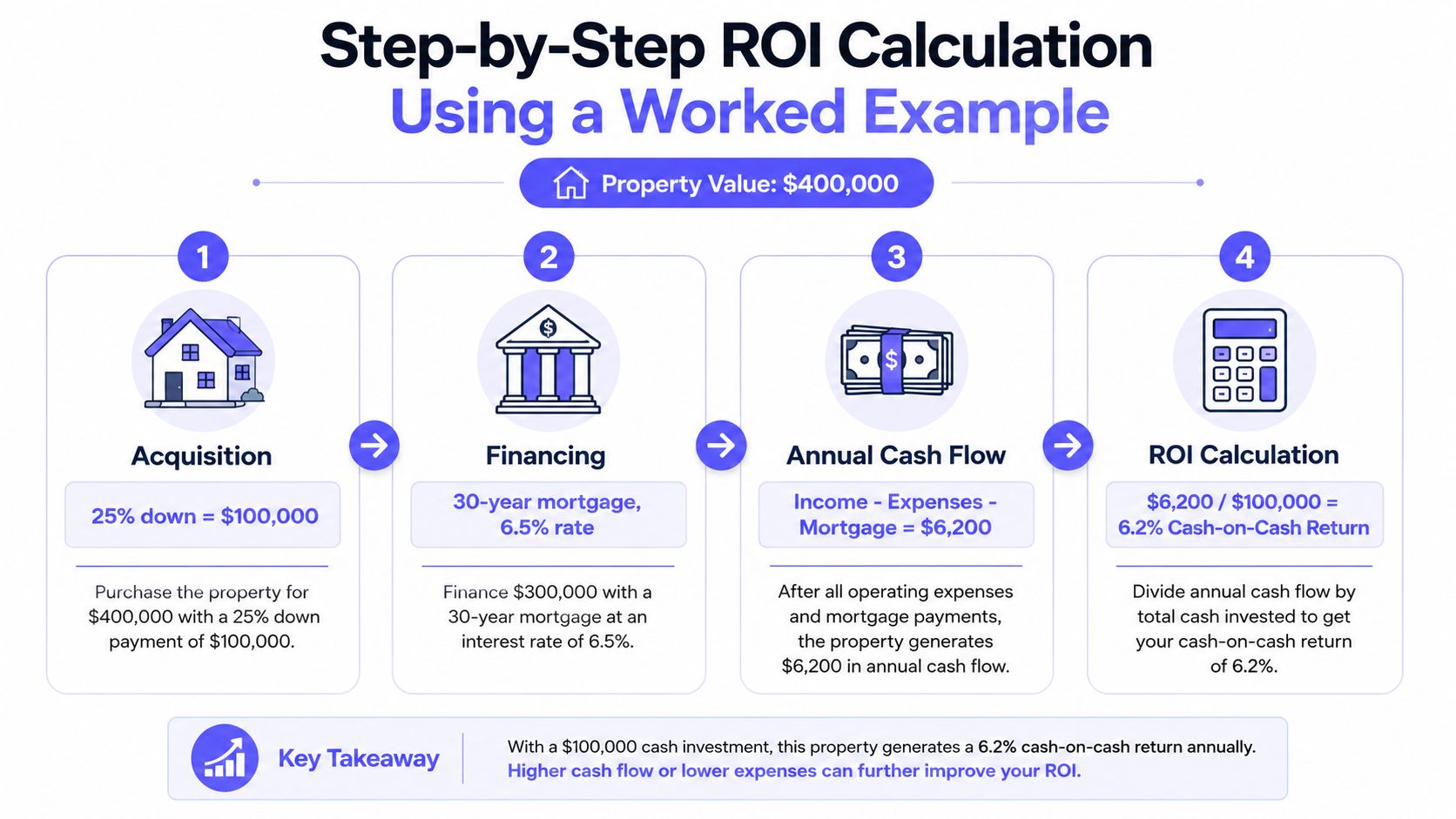
A rental property priced at $400,000 is a common model for seeing the math clearly. The board or owner puts 25% down, finances the rest over 30 years, collects $2,400 per month in gross rent, and sells after seven years.
1. Find the cash invested
The down payment is $100,000. That is the equity at risk before closing costs, repairs, and other acquisition expenses are added.
2. Measure the annual income side
Gross rent at $2,400 per month becomes the starting point for annual income. The analysis then subtracts operating expenses and mortgage payment to get annual cash flow.
3. Calculate cash flow and simple ROI
The example's annual cash flow is $6,200. Using the given acquisition basis, the cash-on-cash return is 6.2% because $6,200 divided by $100,000 equals 6.2%.
That same deal can still produce a different answer under simple ROI if the model includes the full cost base, rather than only the equity invested. That's why a board should ask which denominator is being used before approving any project.
4. Check cap rate at purchase
Cap rate compares the property's income to its value, so it is a purchase-time comparison tool rather than a financing tool. It's useful when the board wants to compare one asset against another on a pure property basis.
5. Extend the analysis through sale
The seven-year hold changes the return because sale proceeds and mortgage amortization enter the picture. An IRR model captures that longer arc, which makes it the right lens when the board cares about the full economics of owning the asset rather than just the first year.
A spreadsheet version of the model should keep these rows separate:
- Purchase price
- Cash invested
- Gross rent
- Operating expenses
- Annual cash flow
- Sale proceeds
- IRR output
The point is not that one number is always superior. The point is that the same property can look very different depending on whether the board wants a yearly income check, a purchase-time screen, or a full hold-period return.
Key Factors That Move Real Estate ROI
ROI changes because the inputs change. That sounds obvious, but the biggest mistakes usually come from modeling the wrong lever, or ignoring the one that matters most.
The levers that matter most
For a stabilized rental, the two biggest drivers are usually rent growth and operating expenses. For a flip, the biggest drivers are usually purchase price and renovation cost. Financing terms, vacancy, appreciation, and capital expenditures still matter, but they do not carry the same weight in every deal.
A practical ranking by impact
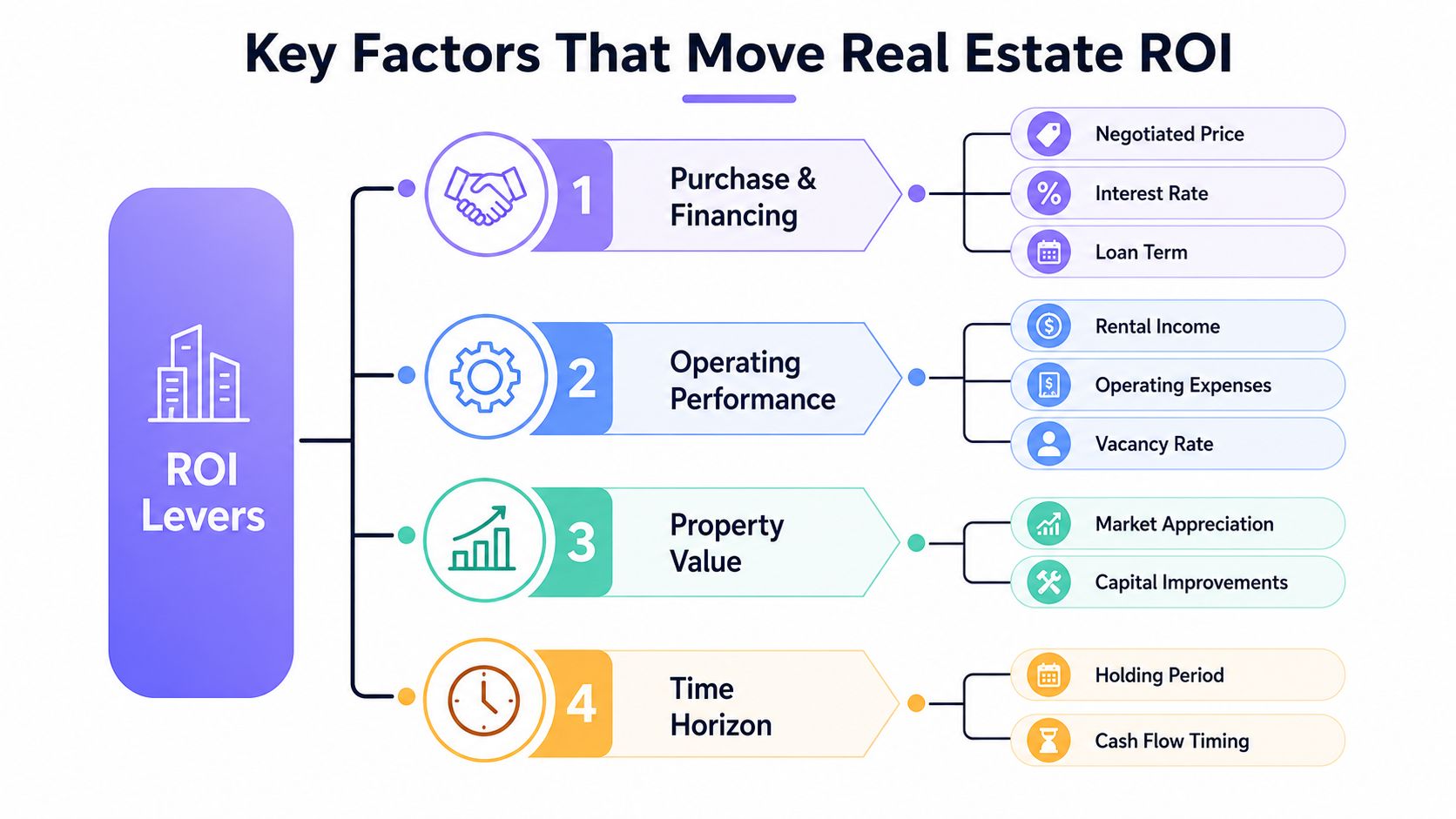
- Purchase and financing: A better negotiated price or better loan terms can improve return from day one.
- Operating performance: Income and expenses shape the cash flow numerator directly.
- Property value: Appreciation and capital improvements affect the eventual exit.
- Time horizon: Holding longer can help or hurt, depending on how long capital sits before it returns.
Practical rule: if a lever changes cash flow every month, model it first. If it only changes at sale, model it after the operating picture is solid.
The internal controls around access and entry can affect more than security. A system that reduces manual handling, shared PIN codes, or repeat replacement of fobs can change operating cost structure over time. Nimbio's real estate predictive analytics guide is one example of how operational data can be used to think about those decisions more systematically.
The same logic applies to capital planning. A board that focuses only on the sticker price can miss the cost of ongoing service calls, resident support, and replacements. That is exactly where ROI becomes a planning tool instead of a vanity number.
Actionable Ways to Improve ROI on Real Estate Assets
The fastest way to lift ROI is usually not a dramatic strategy shift. It's tightening the inputs that drive the return math.
High-leverage moves a property team can control
- Negotiate harder on purchase terms: A lower basis improves the return denominator immediately.
- Refinance when terms improve: Better financing can raise cash flow without changing the property itself.
- Reduce operating expenses: Energy efficiency, maintenance planning, and vendor control all help the cash flow side.
- Raise rents carefully: Rent growth matters most when the property is already stabilized and service quality supports it.
- Lower vacancy and turnover: Strong screening and resident experience reduce the drag from empty units.
- Add ancillary income: Parking, storage, pet fees, and similar income lines can improve the result without a major rebuild.
For tax-related planning, INTELLI's rental property tax guide can help a team think through how expenses and deductions fit into the bigger picture.
Modernizing access can improve operating ROI
Cellular, hardware-agnostic access control is worth considering when a community wants to modernize without replacing existing gate hardware. A system like Nimbio can retrofit an existing gate or building entry point, let residents use a smartphone app, and remove the recurring burden of reissuing fobs or managing untrackable shared PIN codes.
It also helps when the board wants remote visitor management instead of a constant front-desk or guard workflow. The ROI logic is simple, if the upgrade reduces recurring labor or access-management friction, the return may come from operating savings rather than immediate cash yield.
For communities exploring building-side upgrades, the boost ROI with building security resource shows how access control fits into broader asset planning.
Common ROI Pitfalls and How to Avoid Them
A lot of bad decisions start with a number that looks clean but leaves something out. The quickest way to avoid that trap is to check the assumptions before the vote.
Common mistakes
- Mixing ROI definitions: Symptom, two people get two different answers from the same deal. Fix, write down whether the board is using cash flow, total return, or equity-based return.
- Ignoring time: Symptom, a one-year result is treated like a full investment verdict. Fix, use IRR or another hold-period lens when sale proceeds matter.
- Underestimating expenses: Symptom, the pro forma looks better than the operating statement. Fix, include maintenance, reserves, and recurring service costs.
- Leaving financing out: Symptom, the model assumes all capital is cash. Fix, test the deal both with and without debt if financing is part of the plan.
- Double-counting appreciation: Symptom, the exit value gets credited twice. Fix, keep appreciation in one row only.
A short pre-deal audit helps.
- Check the denominator.
- Check the hold period.
- Check recurring expenses.
- Check financing terms.
- Check the exit assumption.
If those five items are clean, the ROI discussion gets a lot more useful.
Next Steps, Calculators, and Common Questions
The next move is to put the same logic into a spreadsheet or calculator and test a real property, not a theoretical one. That means gathering the purchase price, closing costs, rent roll, operating statements, financing terms, and hold period assumptions before any final approval.
For teams managing multiple communities or assets, modern property management tools can make the data collection side less painful and keep the operating picture organized.
Frequently asked questions
How often should ROI be recalculated?
It should be refreshed whenever a key assumption changes, such as rent, expenses, financing, or the planned exit.
When is an online calculator enough?
It's enough for a quick screen or a simple comparison. A full underwriting model is better when debt, taxes, sale proceeds, or capital projects are material.
How should ROI be reported to an HOA board or investment committee?
It should be reported with the definition attached, the time frame noted, and the key assumptions listed in plain language.
ROI is a decision tool, not a verdict. The best answer comes from pairing the metric with the actual goal being funded, whether that's cash flow, capital efficiency, or a safer, more controllable community operation.
Nimbio helps property teams modernize gate and building access with a cellular retrofit that works with existing hardware and supports remote credential management. For HOA boards and managers weighing security upgrades against ROI, that kind of operating change can be easier to evaluate when the return is tied to real labor savings, access control, and resident convenience. Visit Nimbio to see how a smartphone-controlled access system fits into a broader property finance plan.