The popular advice says one access door can serve almost any project. That approach fails as soon as the opening has a fire-rating requirement, exterior exposure, a finished architectural surface, an unusual size, or a demanding procurement schedule. The right access door depends on location, rating, finish, security, weather exposure, opening size, documentation, lead time, and fabrication needs.
The seven manufacturers below are ranked by the project problem each solves best, not by a generic claim that their products are interchangeable. The comparison covers residential, multifamily, commercial, institutional, roof, floor, exterior, fire-rated, and specialty applications.
Access doors also aren't electronic entry systems. They provide physical access to concealed building infrastructure. Property managers can pair that infrastructure with cloud-based access control or a retrofit solution such as Nimbio when gates and electronic entries also need smartphone-based credentials. For visual inspiration, Black Badge Doors' pantry door ideas show how a practical opening can also support a deliberate interior design.
Table of Contents
- 1. Acudor Products
- 2. Babcock-Davis
- 3. Elmdor
- 4. Karp Associates
- 5. Cendrex
- 6. Milcor
- 7. Williams Brothers Corporation of America
- Top 7 Access Door Brands Comparison
- Choose by Performance, Fit, and Procurement
1. Acudor Products
Best for broad specifications, unified packages, and strong submittal documentation.
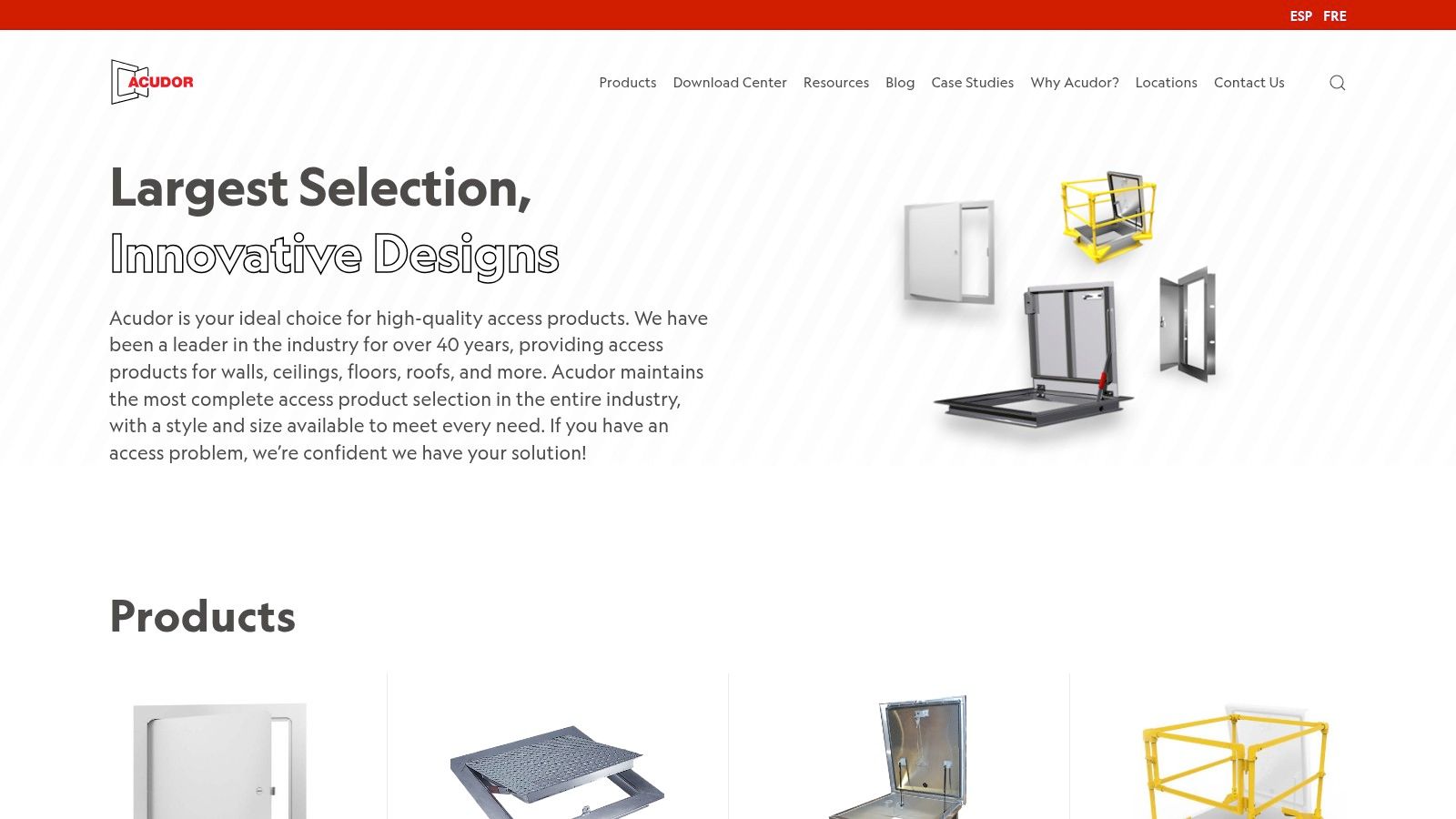
Acudor Products is the strongest starting point when a project includes several access-door categories under one specification. Its range covers wall and ceiling panels, floor doors, roof hatches, flush models, recessed designs, fire-rated assemblies, exterior doors, security products, GFRG options, and specialty configurations.
That breadth helps architects, contractors, and facility teams avoid assembling a specification from unrelated manufacturers. A project that requires both interior ceiling panels and roof access can evaluate a more unified package through Acudor's product catalog.
Why Acudor ranks first for specification depth
Acudor's download center includes BIM files, DWG files, submittals, and product data. That documentation reduces uncertainty during design review and gives contractors clearer information for purchasing and installation.
The manufacturer also supports custom fabrication for atypical openings. That matters when a standard panel leaves insufficient clearance for equipment, conflicts with framing, or fails to align with a finished architectural layout.
Practical rule: Select the access door family before finalizing the opening detail. A custom panel can solve an unusual condition, but only if the rough opening, swing, latch, and finish are coordinated early.
Common advantages include:
- Wide size and option coverage: Many common configurations are available as standard products.
- Unified roof and floor planning: Floor doors and roof hatches can support a coordinated access package.
- Specification support: Downloadable technical documents help architects and contractors prepare submittals.
- Custom fabrication: Nonstandard dimensions and project-specific conditions can be addressed.
The main purchasing limitation is procurement visibility. Acudor generally sells through distributors, and the manufacturer website doesn't display MSRP. Finish and sheen options can also vary by model, so the specification should identify the required finish rather than relying on a generic paint description.
For projects that combine physical service openings with electronic entry points, property teams can also review smartphone-controlled entry doors as a separate access-control layer. That system choice should remain distinct from the selection of a mechanical access panel.
2. Babcock-Davis
Best for stocked standard sizes and straightforward distributor purchasing.
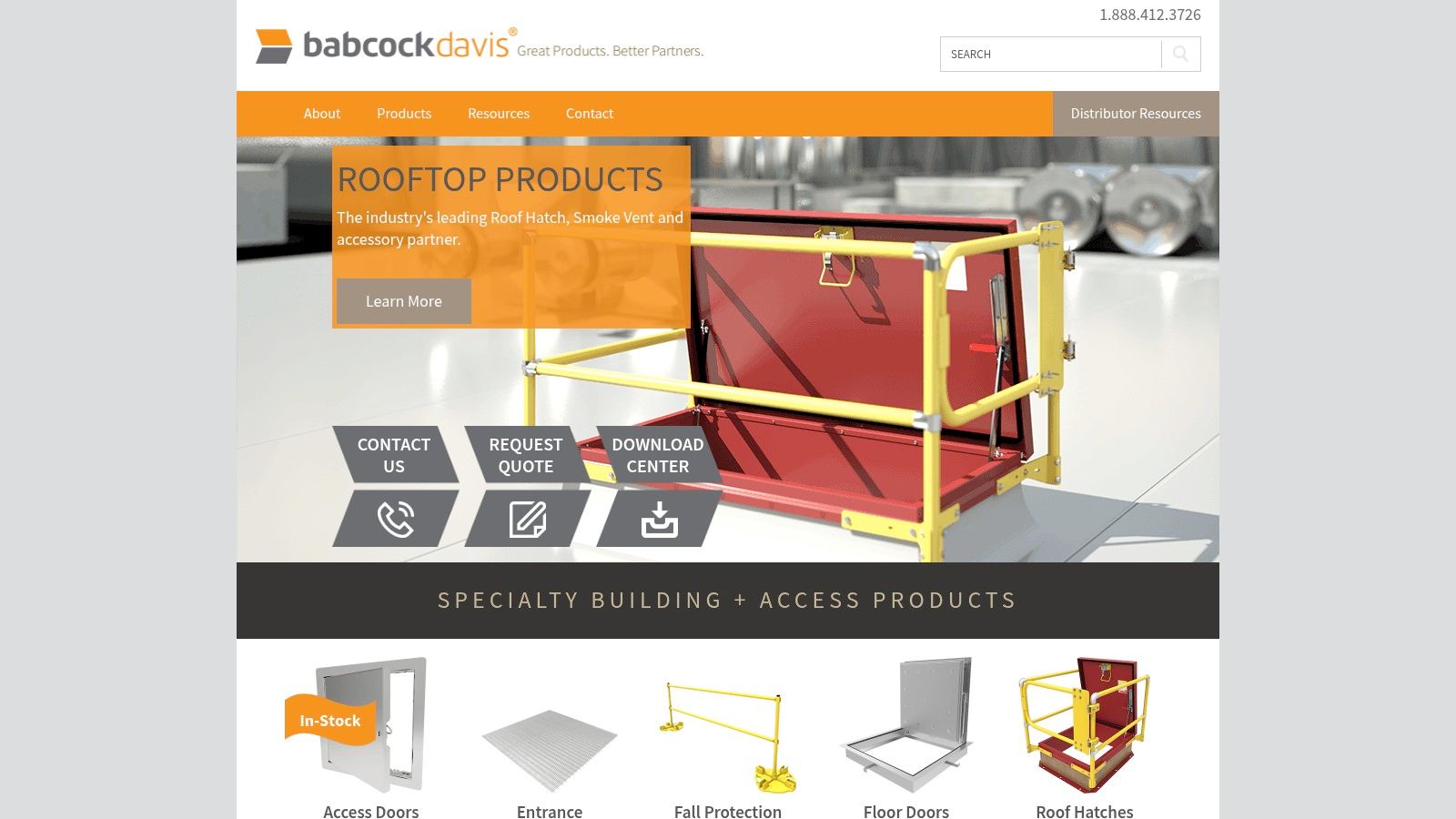
Babcock-Davis is a practical choice when availability and product segmentation matter more than unusual customization. Its catalog covers architectural, non-rated, fire-rated, recessed, exterior, roof, floor, and specialty access products, making it suitable for commercial buildings, multifamily properties, institutional work, and service areas.
The manufacturer's stocking program supports faster access to standard sizes. That gives contractors a useful path when a project schedule depends on common products rather than a custom-built panel.
A strong fit for procurement simplicity
Babcock-Davis separates product categories clearly. Specifiers can distinguish between exterior doors, drywall-flange models, recessed panels, fire-rated products, roof hatches, and floor access without navigating an undifferentiated catalog.
The company also publishes full catalog PDFs and submittal resources. Those documents are useful when a contractor needs to confirm hardware, frame style, finish, or installation requirements before issuing a purchase order.
National distributors and specialty dealers, including Grainger, provide another purchasing route. That availability can be more valuable than a technically broader product line when a replacement panel is needed during active construction or maintenance.
A Babcock-Davis selection should follow this sequence:
- Confirm the substrate: Match the model to drywall, masonry, ceiling, floor, roof, or exterior construction.
- Confirm the rating: A non-rated panel should not be substituted into a rated assembly without approval and supporting documentation.
- Confirm the stock status: Standard sizes may be available through the stocking program, while specialty finishes may require additional lead time.
- Confirm the distributor SKU: Some variants are listed as contact-for-price products rather than direct online purchases.
The trade-off is customization and price transparency. Some configurations are distributor-only, and many listings require a quote. Specialty finishes aren't always stocked, so design teams should identify those requirements before the installation window becomes urgent.
Babcock-Davis is among the best access doors choices for a repeatable standard detail, especially where a contractor values clear categories, national sourcing, and a catalog that can move quickly through submittal review.
3. Elmdor
Best for fire-rated and weather-exposed openings that need fast availability.
Elmdor, part of Morris Group International, focuses on fire-rated, security, drywall, and exterior access doors. Its product range suits projects where the access panel must perform within a demanding wall condition or resist exposure at an exterior location.
The manufacturer's fire-rated products are tested and certified to UL 10B and CAN/ULC S104, according to the product information supplied for this comparison. The relevant listing and installation requirements should still be checked against the project's wall or ceiling assembly and the authority having jurisdiction.
Where Elmdor creates the most value
Elmdor's exterior series is engineered for weather resistance and includes concealed hinges and locking options. That combination supports service openings where exposed hardware, water intrusion, or casual tampering would create a maintenance problem.
The company also maintains a large inventory, with many doors ready to ship. This is a direct advantage for contractors working through a tight installation sequence or property managers replacing damaged panels in occupied buildings.
Fire and egress decisions require separate attention. The 2024 International Building Code and NFPA 101 require a continuous, unobstructed path from any occupied point in a building, while UL states that doors must be openable from the occupant side without tools, special knowledge, or keys in the relevant access and egress configurations. The UL access and egress guidance should be reviewed whenever a panel or door interacts with life-safety paths.
Elmdor is particularly useful when the specification includes:
- Fire-rated construction: The required listing and assembly compatibility must be documented.
- Exterior exposure: Weather-resistant construction and appropriate locking hardware should be specified.
- Security-sensitive locations: Hardware should match the threat and maintenance requirements.
- Schedule pressure: Inventory availability can reduce dependence on custom fabrication.
The purchasing process remains representative rather than retail-oriented. Most orders move through distributors or manufacturer representatives, and customizations can extend lead times.
Installation teams should also coordinate frame placement, hinge clearance, latch access, and surrounding finishes. For contractors developing repeatable field procedures, best practices for door access installers can help separate physical door installation from the requirements of electronic access control.
4. Karp Associates
Best for design-sensitive interiors and concealed architectural installations.
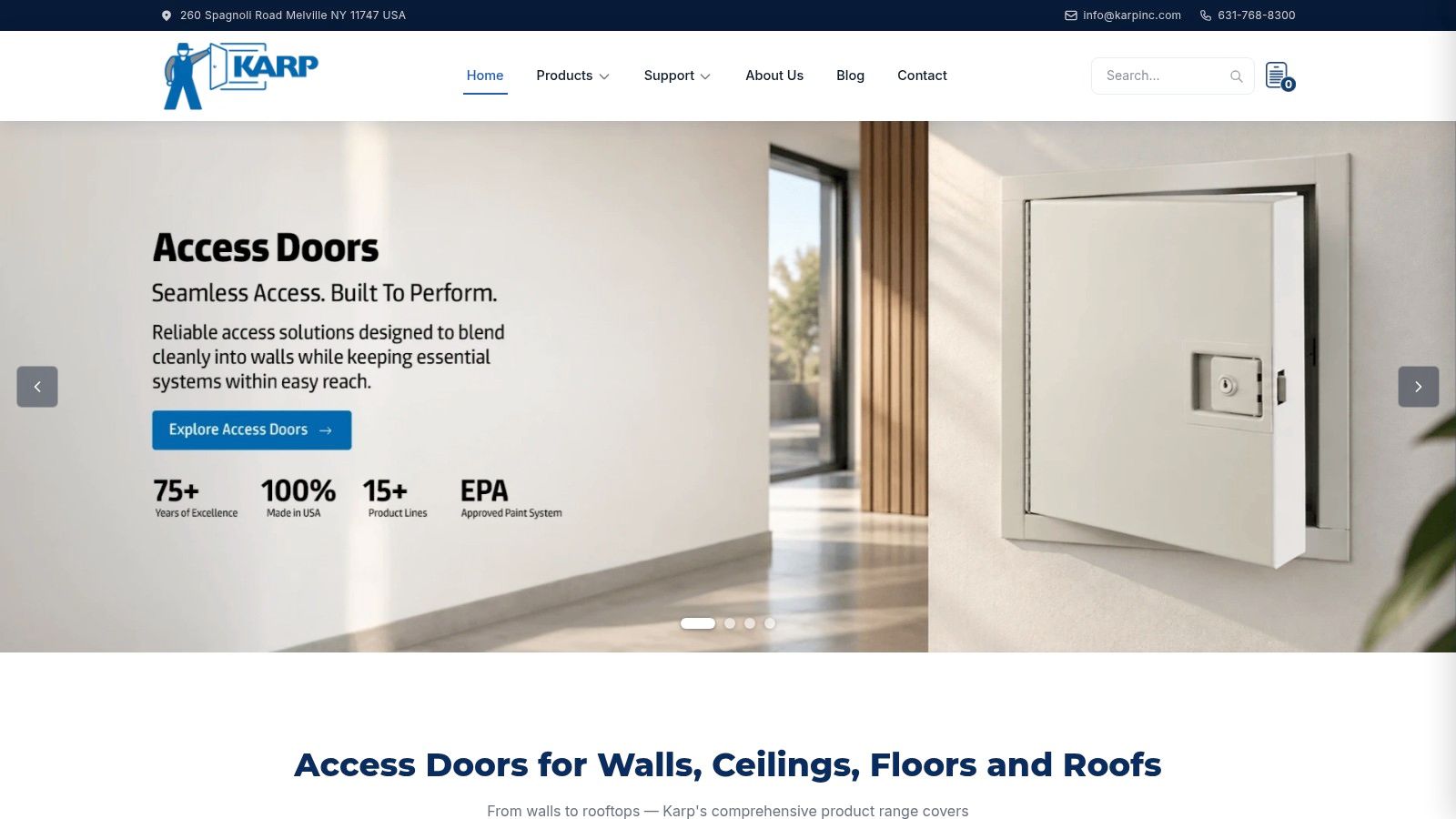
Karp Associates, also known as KARP, is the strongest fit when an access panel must disappear into a finished wall, ceiling, or feature surface. Its product families include standard, fire-rated, concealed, tile, plaster, exterior, airtight, watertight, sound-resistant, and security models.
That range gives architects more control over the visual and technical result. A visible utility panel may be acceptable in a service corridor, but a lobby, hospitality interior, healthcare space, or high-end residential project may require a concealed or tape-in installation.
Concealment requires coordination
KARP's concealed and plaster-bead options support a cleaner transition between the panel and the surrounding finish. Tile and plaster models can be selected where the access point must align with a material system rather than sit as a painted metal rectangle.
A concealed door isn't automatically the right choice. The design team still needs to coordinate the rough opening, frame depth, door swing, hinge clearance, latch operation, substrate thickness, and finish build-up. A panel that looks correct in elevation can fail in the field if the wall assembly doesn't provide the required clearance.
KARP publishes detailed submittals, specification sheets, technical guidance, FAQs, and application resources. That documentation is valuable on design-sensitive projects because it gives architects and contractors a clearer basis for resolving finish and installation questions before they become RFIs.
The strongest use cases include:
- Finished drywall: Concealed or tape-in models can preserve a continuous wall plane.
- Tile and plaster surfaces: Product families support material-specific installations.
- Exterior and wet conditions: Airtight, watertight, and exterior options address exposure requirements.
- Sound-sensitive spaces: Sound-resistant models can support rooms where acoustic control matters.
- Fire-rated assemblies: Rated models must be matched to the tested construction.
Some legacy specialty shapes, including curved doors, are no longer made. Pricing is primarily handled through distribution, and online carting is limited. KARP remains a strong choice when appearance, application support, and documentation carry more weight than instant online checkout.
5. Cendrex
Best for custom dimensions, broad material choices, and cross-border projects.
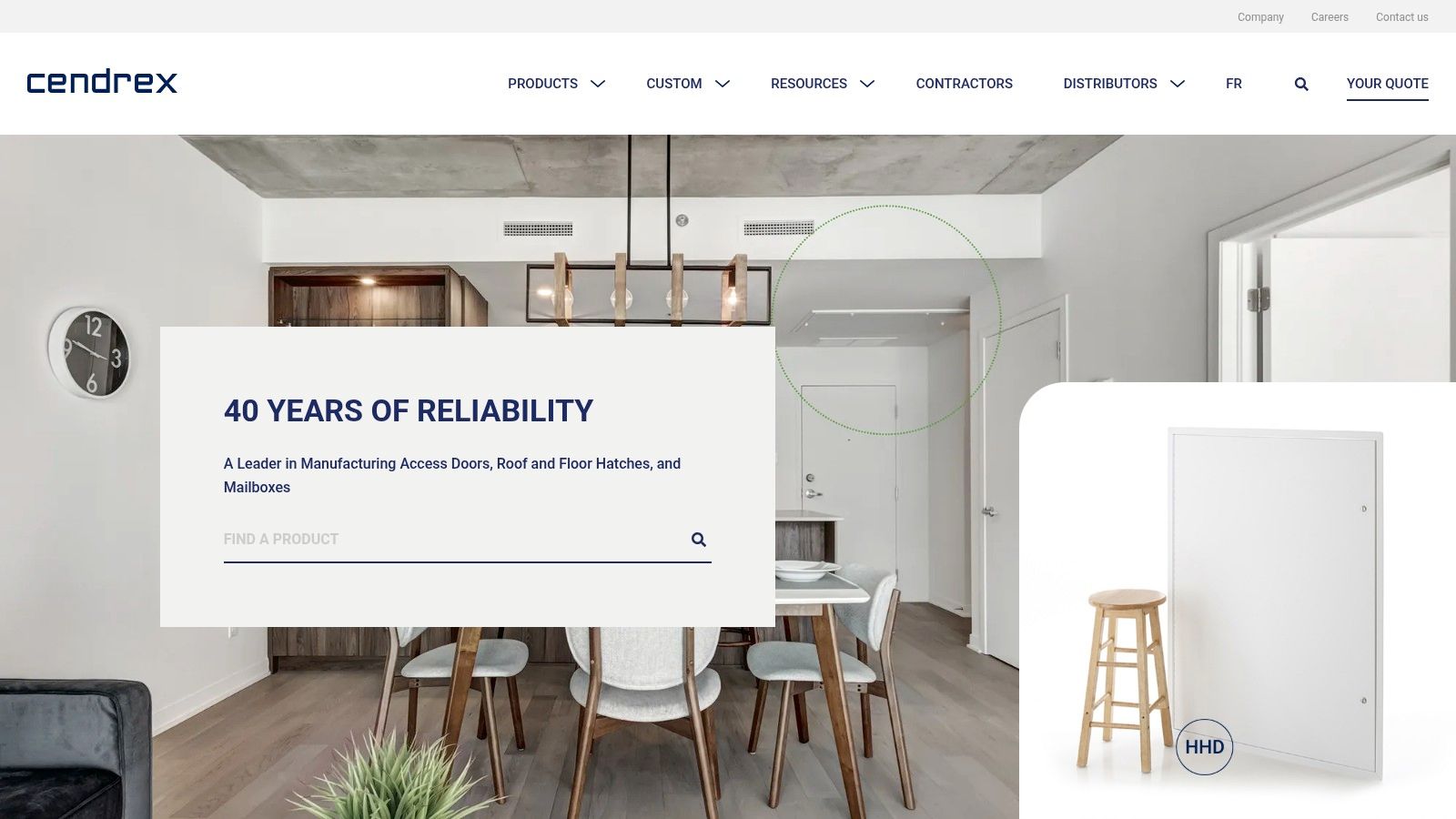
Cendrex is the clear choice when a standard access door doesn't fit the opening or the finish schedule. The manufacturer offers access doors and panels for commercial, residential, and institutional projects, along with roof and floor hatches and a broad set of material and finish options.
Its custom fabrication path is central to the value proposition. Cendrex builds custom doors from scratch and promotes rapid turnarounds for custom work, giving contractors a practical alternative to modifying a standard panel in the field.
Custom work should start with a complete opening package
A custom request should include more than width and height. The purchasing package should identify:
- Opening dimensions: Include the rough opening and the required clear access.
- Installation surface: State whether the panel belongs in drywall, masonry, a ceiling, a floor, or an exterior assembly.
- Finish requirements: Identify material, color, sheen, tile, plaster, or paint requirements.
- Hardware requirements: Specify latch, lock, hinge, access frequency, and security expectations.
- Performance requirements: Identify fire, weather, airtight, watertight, acoustic, or other project conditions.
- Documentation: Request current shop drawings, product data, and submittals before fabrication.
Cendrex supports both US and Canadian markets, which simplifies sourcing for projects that cross the border or use a common design standard across multiple locations. That broad market coverage is especially useful for multifamily, institutional, and commercial portfolios where consistency matters.
The main drawback is purchasing friction. Pricing is primarily quote-based, and public MSRP is uncommon. Some technical information appears in PDF catalogs rather than on individual SKU pages, so the project team should request a complete submittal package for the exact custom configuration.
Cendrex ranks among the best access doors manufacturers for atypical openings, unusual finishes, and projects where a custom product is more efficient than field modification. It shouldn't be selected solely because a custom option exists. Standard products remain simpler when the opening and performance requirements already align with an established model.
6. Milcor
Best for engineered access portfolios that include doors, hatches, and vents.
Milcor, now associated with the Duravent Group, brings a long-established building-products portfolio to access doors, roof hatches, floor and sidewalk doors, and heat and smoke vents. The brand was founded in 1902, a historical fact identified in the supplied manufacturer notes.
Milcor is a strong fit for projects that need more than an interior wall panel. A facility may require architectural flush doors inside, a roof hatch above, a sidewalk door outside, and a venting product elsewhere in the same property. Milcor's broader portfolio can simplify coordination across those conditions.
Performance and finish should drive the specification
Milcor offers architectural-grade flush doors as well as security and exterior variants. Its custom manufacturing capability extends across the access-solutions portfolio, which gives specifiers room to address project-specific dimensions or performance requirements.
Warranty documentation is available for hatches, doors, and vents. That documentation should be reviewed alongside the current product data, particularly on projects where the owner needs a clear closeout package for future maintenance.
Milcor is best evaluated through a portfolio lens:
- Architectural interiors: Flush doors support a cleaner finished appearance.
- Security applications: Security variants can be selected where ordinary utility hardware is insufficient.
- Roof and floor access: Hatches and floor doors address service and maintenance routes.
- Life-safety support: Heat and smoke vents require separate coordination with the applicable design and code requirements.
- Custom conditions: Custom manufacturing can resolve unusual project constraints.
The principal risk is documentation continuity. Some literature may reference legacy ownership or branding, so the design team should confirm the current manufacturer, product designation, warranty, and specification version before approval.
Milcor is primarily purchased through representatives and distributors, and online pricing is limited. That isn't a problem for a coordinated commercial project with an established representative, but it creates more friction for a small buyer seeking immediate retail checkout. Visit Milcor's current manufacturer site before finalizing a legacy specification.
7. Williams Brothers Corporation of America
Best for direct online purchasing and specialty models.
Williams Brothers Corporation of America, known as WB Doors, is the best option when the buyer wants manufacturer-direct purchasing, broad online category coverage, and fast access to standard products. Its assortment includes standard and specialty access doors, roof and floor hatches, custom options, sound-rated models, RF-shielded doors, and data-center products.
The direct e-commerce model makes it easier to compare SKUs, review product pages, and purchase without depending entirely on a local representative. That helps smaller contractors, facility managers, and installers who need a clear online path from selection to order.
A practical choice for specialty procurement
WB Doors supports its product range with submittals, CAD files, Revit and BIM resources, and specification consulting. The manufacturer also ships from multiple US distribution centers, which can reduce purchasing delays for core product lines.
The specialty range separates WB Doors from many general-purpose competitors. RF-shielded doors can be relevant to specialized technology environments, while sound-rated products may suit rooms where acoustic separation is part of the design intent. Data-center models offer another targeted path when ordinary drywall access panels aren't appropriate.
The purchasing checklist is simple:
- Read the exact SKU page: Price can vary with size and finish.
- Confirm the lead time: Specialty models may take longer than general-purpose drywall doors.
- Download the submittal: Product resources should match the purchased configuration.
- Check shipping requirements: Confirm the destination, distribution center, and delivery schedule.
- Validate installation conditions: Specialty performance depends on the surrounding construction.
WB Doors is less attractive when a project requires intensive local representative support or a tightly coordinated multi-product specification. Its online model is an advantage for direct purchasing, but the buyer remains responsible for confirming the exact finish, size, hardware, rating, and documentation.
For property teams also evaluating smartphone-based entry, the Nimbio door entry guide explains how electronic doors and gates can be managed separately from the physical access-door assembly.
Top 7 Access Door Brands Comparison
| Product | Implementation complexity | Resource requirements | Expected outcomes | Ideal use cases | Key advantages |
|---|---|---|---|---|---|
| Acudor Products | Moderate, large catalog simplifies standard specs; custom builds add complexity | Extensive documentation (BIM/DWG, submittals); distributor-based pricing | Broad off‑the‑shelf coverage; unified floor/roof packages possible | Projects needing wide range of standard/custom access doors and unified packages | Strong documentation and submittals; deep size/options coverage; custom fabrication |
| Babcock‑Davis | Low–Moderate, stocked sizes reduce spec complexity; some distributor‑only variants | Stocking program, comprehensive catalogs, availability through national distributors | Faster lead times for stocked items; straightforward selection | Fast‑turn commercial projects using standard sizes and distributor channels | Easy sourcing via distributors; clear product segmentation; stocking program |
| Elmdor (Morris Group) | Low, large inventory makes implementation straightforward; custom options lengthen process | Extensive submittals/resources; purchases mainly via reps/distributors | Rapid fulfillment for many sizes; certified fire‑rated and exterior options | Projects requiring quick delivery of fire‑rated or weather‑resistant doors | Large ready‑to‑ship inventory; UL‑rated fire products; manufacturer backing |
| Karp Associates (KARP) | Moderate, design‑sensitive options require careful specification | Detailed spec sheets, technical support, submittals; distributor sales | Reduced RFIs and better fit for concealed/design installs | Architecture‑driven projects needing concealed, plaster/tile, or airtight solutions | Strong spec documentation; design‑oriented product options |
| Cendrex | Moderate, custom fabrication path eases nonstandard installs but needs quoting | Custom shop capability, PDF catalogs, cross‑border support (US/Canada) | Fast custom turnarounds and broad finish/material choices | Projects needing bespoke sizes/finishes or cross‑border procurement | Rapid custom fabrication; broad market coverage |
| Milcor (Duravent Group) | Moderate, engineered products and custom work may require detailed specs | Custom manufacturing, warranty docs; sold via reps/distributors | Engineered performance and high finish quality | Projects needing heavy‑duty hatches, vents, or high‑quality finishes | Emphasis on engineered performance and finish quality; multi‑brand continuity |
| Williams Brothers (WB Doors) | Low, direct e‑commerce simplifies buying; specialty SKUs may add lead time | Direct online ordering, CAD/Revit/BIM resources, multiple US DCs | Transparent pricing and fast shipping for standard SKUs; access to specialty models | Buyers wanting manufacturer‑direct purchase, data centers, RF/sound‑rated needs | Direct e‑commerce and SKU transparency; specialty RF/sound models; fast shipping |
Choose by Performance, Fit, and Procurement
The best access doors selection should follow the opening, not the brand name. The project team should first identify whether the panel belongs in an interior wall, ceiling, floor, roof, exterior enclosure, rated assembly, wet location, security-sensitive area, or design-critical space.
Next, the team should confirm the required performance. Fire-rated, weather-resistant, airtight, watertight, sound-resistant, RF-shielded, and security products solve different problems. A standard flush panel shouldn't replace a listed fire-rated assembly, and a decorative interior panel shouldn't be placed in an exterior condition without confirming exposure performance.
The rough opening must be measured before the purchase order is released. The specification should identify the rough opening, clear opening, frame type, door swing, hinge location, latch or lock, substrate, surrounding finish, and maintenance clearance. For floor and roof products, the team should also confirm load, drainage, weather exposure, ladder coordination, and safe operating conditions from the current manufacturer documentation.
The ranking provides a practical shortcut:
- Broad specifications: Acudor is the strongest choice for extensive standard and custom coverage, including floor doors and roof hatches.
- Stocked availability: Babcock-Davis is well suited to common sizes, national distribution, and schedule-sensitive procurement.
- Fire and exterior performance: Elmdor is the preferred fit for documented fire-rated needs and weather-exposed openings.
- Design-sensitive installations: KARP is the leading choice for concealed, plaster, tile, and architectural applications.
- Custom fabrication: Cendrex is best when dimensions, materials, or finishes fall outside standard products.
- Engineered portfolios: Milcor suits projects that combine doors, hatches, floor access, and vents.
- Direct online purchasing: WB Doors is the most convenient option for manufacturer-direct shopping and specialty SKUs.
Current submittals should be verified before approval. Ratings, certifications, hardware, finishes, ownership references, stock status, and lead times can change, and distributor listings may not reflect the exact configuration required for the project.
The physical access door is only one part of a modern property's access strategy. The global access control market was estimated at USD 11.62 billion in 2025, with a projection of USD 26.22 billion by 2034, representing roughly a doubling over that forecast period, according to Fortune Business Insights' access control market data. That growth reflects the wider shift toward connected entry infrastructure, not a reason to treat every access product as an electronic lock.
For gates and electronic building entries, Nimbio provides a hardware-agnostic cellular retrofit. It can preserve existing gate operators, call boxes, remotes, and keypads while adding smartphone access, remote visitor management, credential scheduling, credential revocation, and entry logs without depending on Wi-Fi. Property managers, HOA boards, installers, and facility owners can use that approach when the goal is to modernize control without replacing working gate or door hardware.
Nimbio connects existing electronic gates, call boxes, and building entry systems to smartphone-based access through a cellular hardware retrofit, with remote visitor management and digital credential controls. Property managers and HOA boards evaluating the best access doors can visit Nimbio to review a practical modernization path for gates and electronic entries.