A gate with a key lock is a gate secured by a lock or latch operated with a physical key, either a mechanical lock on a manual gate or a keyed release or switch on an electric gate. That pairing is roughly 4,000 years old, and it still fails in a familiar way: offenders entered through an unsecured door or window in 40% of unlawful entries to unoccupied residences.
The board packet shows up on a Tuesday. A resident lost a gate key. A groundskeeper never brought one back. The side gate was standing open after dark, and nobody can say who last used it. A homeowner with two or three keys hits the same wall on a smaller scale.
A physical key needs no power and no app. It also can't be shut off from a desk, and it leaves no record. The hardware is only one layer. Closing habits, who holds a copy, and what happens in a fire or a power cut decide whether the gate controls the property.
Table of Contents
- What a Gate with a Key Lock Is
- Common Types of Keyed Locks Used on Gates
- Where a Keyed Gate Works Well and Where It Falls Short
- Safety and Code Requirements for Locked Gates
- Keeping a Keyed Gate Reliable Outdoors
- Adding Smartphone Access While Keeping the Key
- Choosing the Right Setup for Your Property
What a Gate with a Key Lock Is
The phrase covers two setups that should be told apart before anyone buys parts.
A manual gate carries the lock on the leaf or frame. Turning the key moves a latch or bolt, and a person pushes or pulls the gate. An electric gate already has an operator. Here the key may close a switch that starts the motor, or it may free a clutch or brake so the leaf can be moved by hand.
The key and the mechanism have to match. An Egyptian wooden lock used a sliding bolt and movable pins. A wooden key with projecting pegs lifted those pins so the bolt could move. That pin-tumbler idea is about 4,000 years old, as described in archaeological notes on early locks. Roman builders later used iron locks and bronze keys, added warded obstructions that demanded a matching key shape, and made keys small enough to wear as rings, roughly 2,000 to 3,000 years ago.
Those steps set goals that still apply: only an authorized credential should operate the gate, the parts should last, and the credential should be easy to carry. A gate with a key lock is not merely a closer. It is a credential paired to an internal mechanism, and that pair has to stay coordinated.
Everyday entry and emergency release
On a garden or pedestrian gate, the key is often the normal way in. On an automated driveway gate, the keyed manual release is usually for a power cut, a stuck operator, or a technician. Treat those as different jobs. If someone leaves the release engaged, the operator can't do its work and the gate may sit free to move.
Common Types of Keyed Locks Used on Gates
"Key lock" on a work order can mean four different pieces of hardware. Matching the name to the gate avoids ordering the wrong part.
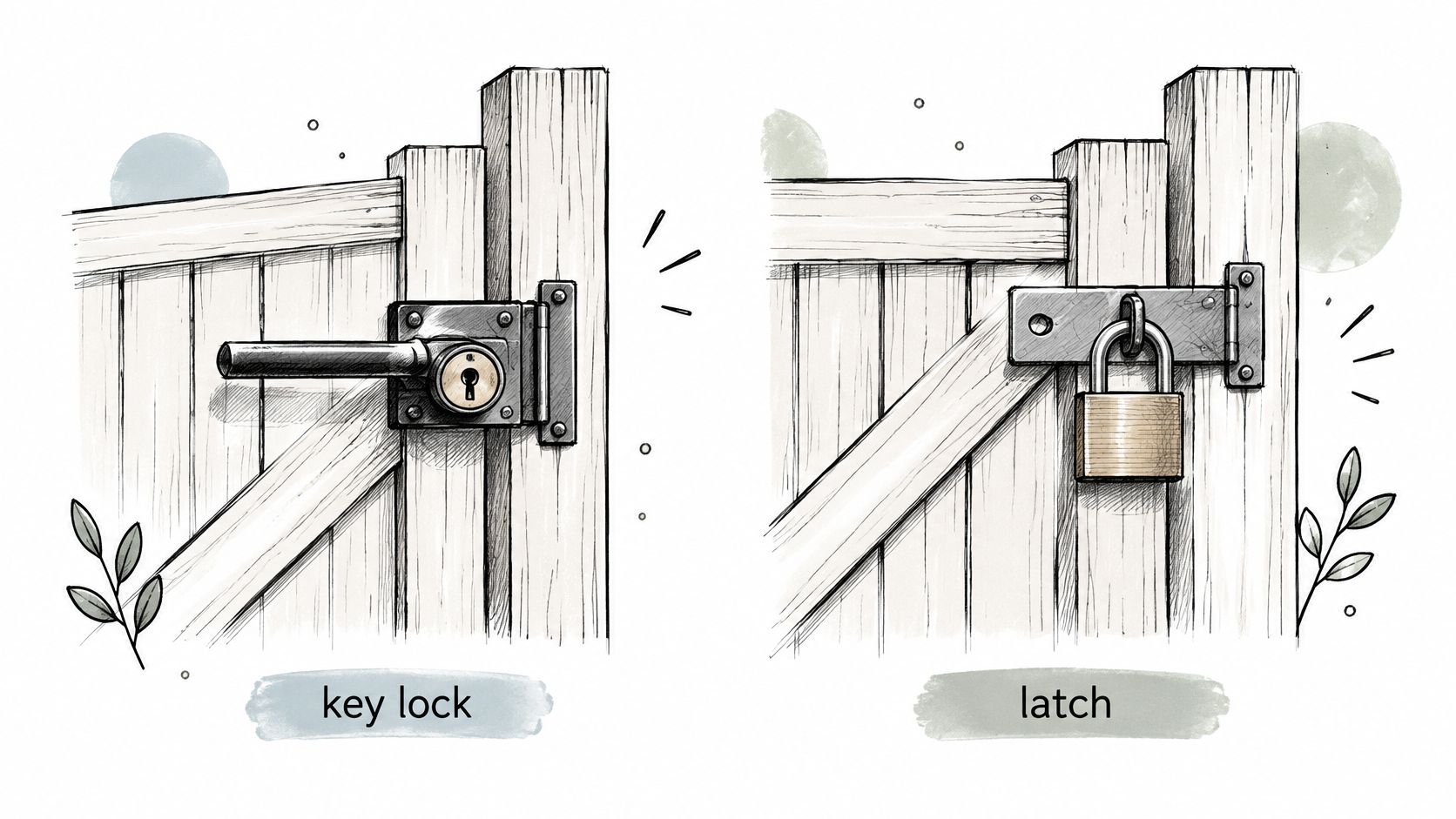
Keyed latches and deadbolt-style locks sit on pedestrian, garden, and pool-walk gates. A spring latch snaps into the strike as the gate closes. A deadbolt is thrown on purpose and stays out until someone retracts it. Latches forgive daily traffic. Bolts resist a shove better, but only if someone remembers to throw them.
Mortise cylinders drop into a pocket in a metal stile or frame. The key turns a cam that pulls the latch or bolt. They look tidy on ornamental iron. They also depend on the frame staying square. A sagging hinge loads the bolt sideways, and the key then turns hard or not at all.
A padlock and chain is common on rural, farm, and utility gates that don't have a built-in latch. Strength is obvious. So is the drawback: the chain can be cut, the shackle can be left open, and every person who needs entry either shares one key or carries a copy nobody can recall.
Keyed switches and keyed manual releases belong on electric operators. A switch is an input: turn the key, and the operator runs. A manual release disengages the clutch or brake so the leaf moves by hand during an outage or a service call. On an automated gate, that release is an emergency and service credential, not the daily front door.
Keyed Gate Lock Types at a Glance
| Lock type | Where it is used | Main strength | Main drawback |
|---|---|---|---|
| Keyed latch or deadbolt | Pedestrian and garden gates | Simple, no power | Copies can't be shut off |
| Mortise cylinder | Metal frames and ornamental gates | Fits the frame | Fails when the gate sags |
| Padlock and chain | Rural and utility gates | Works on plain leaves | Shared keys, easy to leave open |
| Keyed switch or manual release | Electric gate operators | Works in a power cut | Easy to leave disengaged |
Practical rule: If the gate has a motor, find the manual release before assuming the cylinder on the post is the daily lock. The release and the entry method are often two different keys.
Where a Keyed Gate Works Well and Where It Falls Short
A keyed lock earns its place on a property where the power can drop and the user list stays short.
Start with what a cylinder gives you. It works with no electricity and no network, so a storm that kills the operator and the cell tower still leaves you a way in. The hardware costs a fraction of a controller, a reader, and a power supply, and every resident already knows how to use it. On a manual gate, nothing about the lock depends on a radio or a server staying up.
Then watch what happens as copies spread.
Keys get cut at a hardware store, dropped in a truck, and kept by a former tenant or vendor. A copied or unreturned key can't be turned off one person at a time. The only fix is a rekey or a new cylinder, and every remaining holder needs a new key the same day. A mechanical lock also writes nothing down. After a gate is found standing open, there is no event record to check.
Discipline beats thicker steel
The weak point is usually the habit, not the hardware. A Bureau of Justice Statistics analysis found that offenders entered through a door or window that was not locked in 40% of unlawful entries to unoccupied residences. When someone was home, offenders were about as likely to use an open opening, 27%, as a door or window that was not locked, 28%. A strong latch that isn't thrown, or a gate resting on its stop, protects nobody.
A copied key works until the cylinder changes. A shared brass key also can't tell you who came through.
A house and a large property are different jobs
A homeowner managing two or three keys can keep a short list on paper, stamp the keys "do not duplicate" where the shop will honor it, and rekey after a contractor leaves. That is workable.
An HOA or a multifamily manager can't run hundreds of residents on a key board, a paper register, and a rekey bill every time someone moves. Shared keys become untraceable, and rekeying the vehicle gate plus every pedestrian leaf at once is a project, not a phone call. On that scale, gated community access control usually treats the mechanical key as the emergency credential and moves daily entry onto credentials that expire one person at a time. The lock stays. The pile of identical keys stops being the whole system.
Safety and Code Requirements for Locked Gates
A lock that looks secure can be the wrong lock if people can't get out.
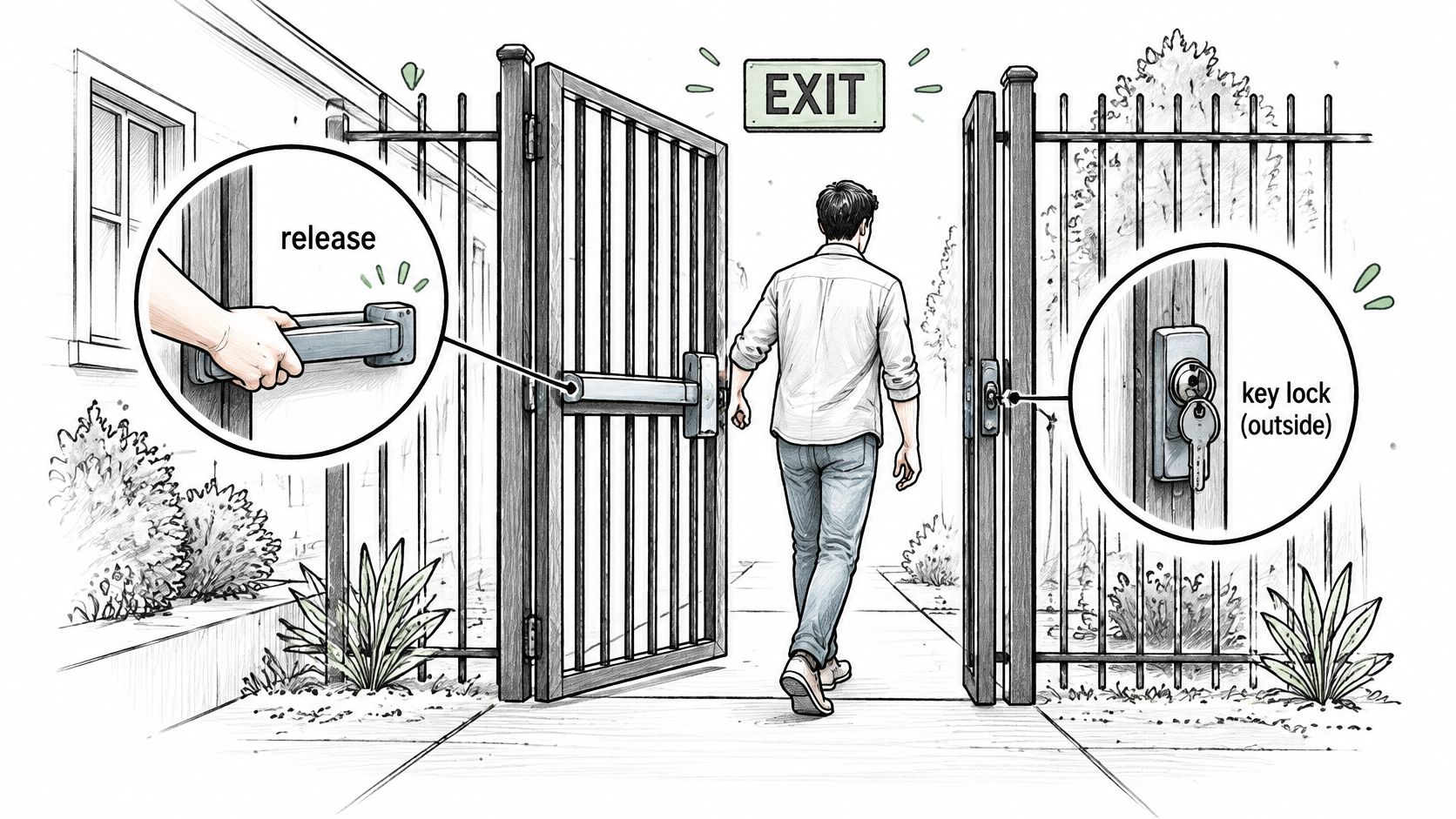
Neutral guidance on locking says occupants must be able to exit readily, without tools, special knowledge, or keys, and that releasing hardware should operate in one motion, as explained in UL's note on locking configurations for access and egress. On a gate with a key lock, that raises three checks: where any keyed override sits, whether the inside release works with an empty hand, and what the gate does when power, communications, or a controller fails.
Which gate is which
Rules are not the same for every leaf.
Pedestrian egress gates on a path out of an occupied building need free exit from the inside. A key-only latch on that face is the wrong hardware.
Vehicle gates are operator problems as much as lock problems. A keyed switch starts motion. It doesn't replace entrapment protection.
Perimeter gates that aren't on a required exit can be tighter, including keyed exit, if the authority agrees. Don't assume that because the gate is "only a fence."
Gates serving occupied buildings follow the building's exit rules, not a catalog photo.
Pool barriers add another set of rules, including self-closing and self-latching hardware and limits on how a latch can be reached. Pool code advice from Connecticut Fence Works is a useful walkthrough of those barrier details. Confirm them against the code the city adopted.
Vehicle operators and opening force
For an automated vehicular gate, a key doesn't remove the operator's duties. DASMA's summary of ANSI/CAN/UL 325 says an operator must have at least two independent entrapment-protection means for each entrapment zone, and it may run only after those means are installed and enabled. Counts depend on type and direction: horizontal slide gates need two means for opening and two for closing. Horizontal swing gates generally need two in each direction. Vertical-pivot gates need two in each direction. Vertical-lift gates need one for opening and two for closing. External devices must be monitored. A keyed switch, keypad, remote, or phone command is an authorization input. It is not a photo eye or a sensing edge.
Manual gates have a force limit where the ADA rule applies. The U.S. Access Board states that interior hinged doors and gates, and sliding or folding doors, must need no more than 5 pounds-force (22.2 newtons) to push or pull open. That figure is the continuous force to open the gate fully, not the tug that breaks a seal. Latch bolts have to be retracted before the measurement. Fire doors follow the minimum force the applicable code allows, and exterior hinged doors have no specified maximum under this provision. A stiff closer or a misaligned strike can fail the test even when the key turns smoothly.
Local building, fire, and accessibility rules vary. Check the adopted IBC and NFPA provisions with the authority having jurisdiction, and follow the operator manual for that model. Don't guess what a fault light means.
Keeping a Keyed Gate Reliable Outdoors
A water-resistance number on a box doesn't describe a winter morning when the key won't turn.
Outdoor failures are usually mechanical or chemical. A sagging gate puts constant shear on the latch, so the bolt drags instead of seating. Coastal salt eats the cylinder, the strike screws, and any exposed connector. Condensation sits inside a housing that passed a hose test in a lab. A freeze locks grease and a deadbolt in place. Dust packs a desert installation until the pins stick. High humidity swells wood posts and walks the hinges out of line.
A gate that keeps intruders out and also keeps residents out is not available. Service calls, propped-open leaves, and people forcing the release are the bill.
A short lifecycle, not a spec sheet
Hinge and latch alignment: Look at the gap every few months. The bolt should enter the strike without lifting the leaf by hand. Shim or adjust before the key becomes a lever.
Lubrication for the climate: Use a lubricant the manufacturer allows. Heavy grease holds grit on a dusty site and stiffens in a freeze. A dry or light treatment often lasts longer outdoors.
After-winter key test: Turn the cylinder through a full cycle. If it grinds, service it before the spare key snaps off in the plug.
Connectors and backup release: Where a keyed switch has wires, keep splices off the ground and covered. Confirm the manual release still frees the leaf, then re-engage it so the operator is back in control.
Four climates, four different weak points
Coastal sites attack fasteners and the keyway. Cold sites freeze the mechanism and any water in the housing. Desert heat and dust wear pins and hinges. Humid sites corrode springs and swell frames. The same latch can be fine in one of those and a monthly trouble call in another.
Secure, for a property manager, means the gate closes when it should and still opens for the people who are allowed in.
Adding Smartphone Access While Keeping the Key
The mechanical key doesn't have to be thrown away to fix the copy problem. It has to be demoted.
NIST SP 800-63B sorts authentication into three kinds: something a person knows, something a person has, and something a person is. It also calls for lifecycle control when an authenticator is lost, stolen, duplicated, expired, or revoked. A gate key is a possession factor. A shared one has almost none of that lifecycle. A copy can't be expired. A lost one forces a rekey.
A workable split looks like this.
Keep a key register. Record who holds each physical key, including vendors. Rekey when a key is gone. Don't wait for a break-in story. Restrict the brass key. Use it for emergency and service, not for every resident's daily trip. Issue digital credentials one person at a time. Give each an identity, an end date, and a schedule, and keep an event log.
That split is the cause and effect. Individual digital authorization can be revoked the hour a lease ends. A shared physical key stays valid until the metal changes.
What a retrofit actually touches
One example is Nimbio, a cellular add-on controller and a smartphone app for electric gates, with electric locks as a secondary use. It connects over cellular LTE, so the gate doesn't need Wi-Fi. It is hardware-agnostic: it wires into the operator the property already has, without replacing the gate. Existing clickers, fobs, and keypads keep working beside the app. Managers issue and revoke digital keys remotely, set an expiration date, and can let a visitor in from off site, including video verification at the gate. The mechanics of that add-on are covered in how cellular gate access works.
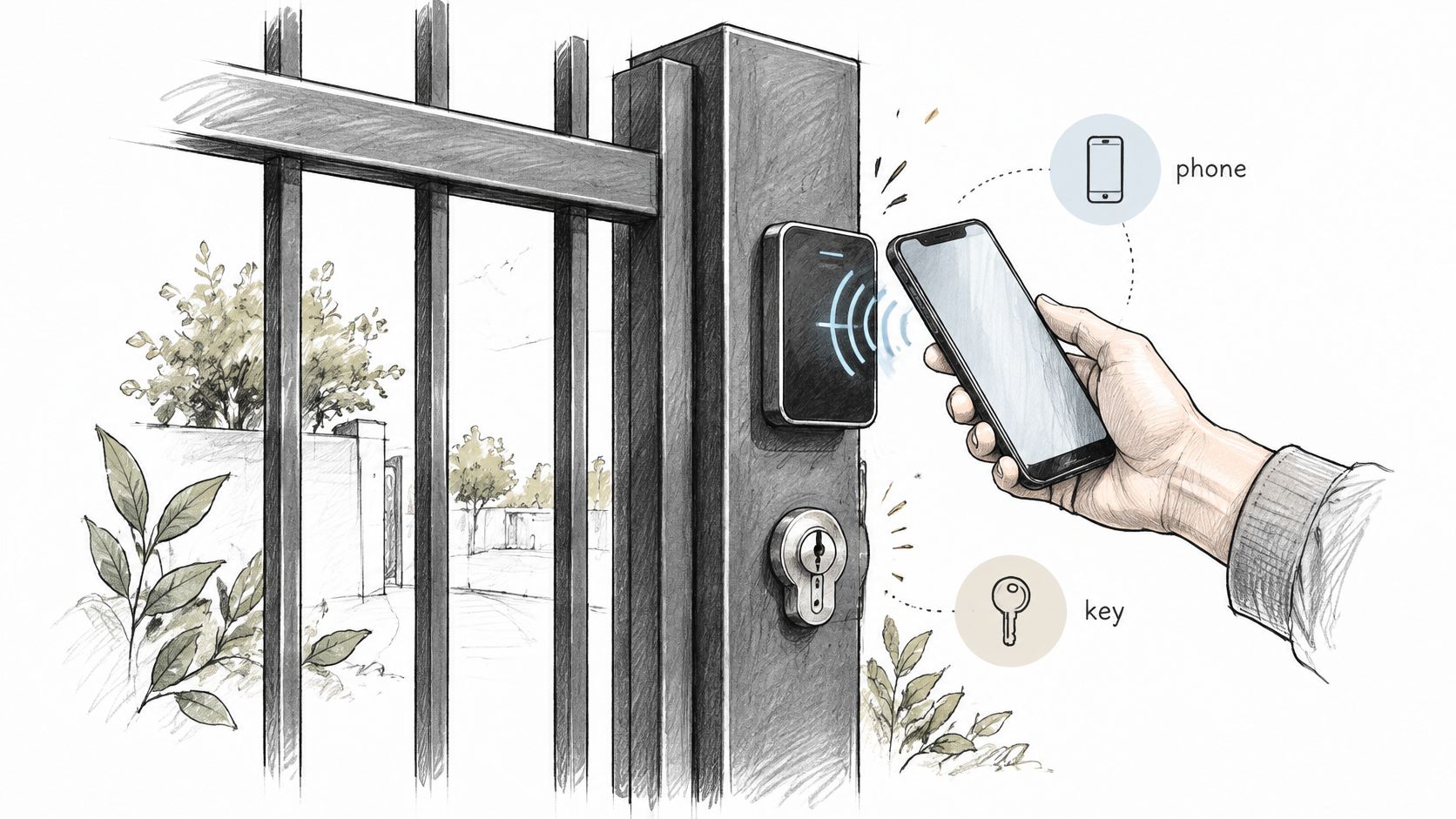
The controller is not the whole system. UL 294 covers equipment that regulates entry or exit by electrical, electronic, or mechanical means, and it defines four security-performance levels, Level I through Level IV. UL describes the controlled system as decision-making units, credential readers, outputs such as relays or locking devices, and optional recording. A retrofit should be judged across the controller, power supply, wiring, credential interface, lock or operator, and what happens when power fails. For higher-risk sites, match the UL 294 level to the risk and, where it applies, pair it with a burglary-resistant electric lock or strike evaluated under UL 1034. Those standards speak to attack resistance, communication-line security, endurance cycling, and standby power. Certifying one box doesn't certify the installed gate. Document fail locked versus fail released behavior, keep egress code-compliant, protect exposed cable, and cycle the gate under real load. Models differ, so the operator manual and a qualified technician settle the wiring.
Choosing the Right Setup for Your Property
Three paths cover most properties. Egress and entrapment protection come before convenience on every one of them.
A manual side gate at a house. Fit a weather-suited keyed latch, keep the spare list short, and rekey when a key walks off. Confirm the inside can still exit the way the local code requires, especially on a pool walk.
An electric driveway gate at a house. Leave the keyed release for outages and service. Run daily entry on the remotes already in the cars, or add a phone layer that doesn't retire those remotes. Test that the release re-engages after a drill.
An HOA or a managed property. Make digital credentials the default: one person, an end date, a log. Keep a small set of physical keys for emergency and service, in a controlled register. Don't staff the vehicle gate with a stack of identical keys.
A useful buying checklist for the electronic layer is what to look for in a gate access system. This week, audit the gate that is already there. Name the lock type. Confirm the inside release works without a key. Check that the operator's entrapment devices are present and monitored for that gate type. Turn the key cylinder and the manual release, then put the operator back in gear. After that, talk with a qualified installer about smartphone control that leaves the key as fallback.
Nimbio adds cellular smartphone control to an electric gate the property already runs, so managers can issue and revoke digital keys while the mechanical key stays available for emergency and service use. Existing clickers, fobs, and keypads continue to work beside the app, and visitors can be admitted remotely with video verification. See how that fits a gate with a key lock at Nimbio.