The commercial leasing market is estimated at $276.7 billion in 2026 in the United States, with about 385,000 businesses operating in the sector, and that scale makes business rental properties a serious operating business, not a side asset IBISWorld. In practice, the difference between a property that produces steady NOI and one that leaks value often comes down to something unglamorous, access control, auditability, and whether managers can prove who got in, when, and why.
Business rental properties sit at the intersection of real estate, operations, and risk management. That means the right tenant, the right lease, and the right gate or door system all affect the same outcome, cash flow that holds up under scrutiny.
Table of Contents
- Defining Business Rental Properties
- The Four Core Property Types
- Key Investment Metrics for Commercial Properties
- Leasing Workflow From Application to Move-In
- Property Management and Access Control Workflows
- Insurance, Liability, and Compliance
- Why Shared PINs and Fobs Quietly Hurt NOI
- Choosing the Right Systems for Modern Business Rentals
Defining Business Rental Properties
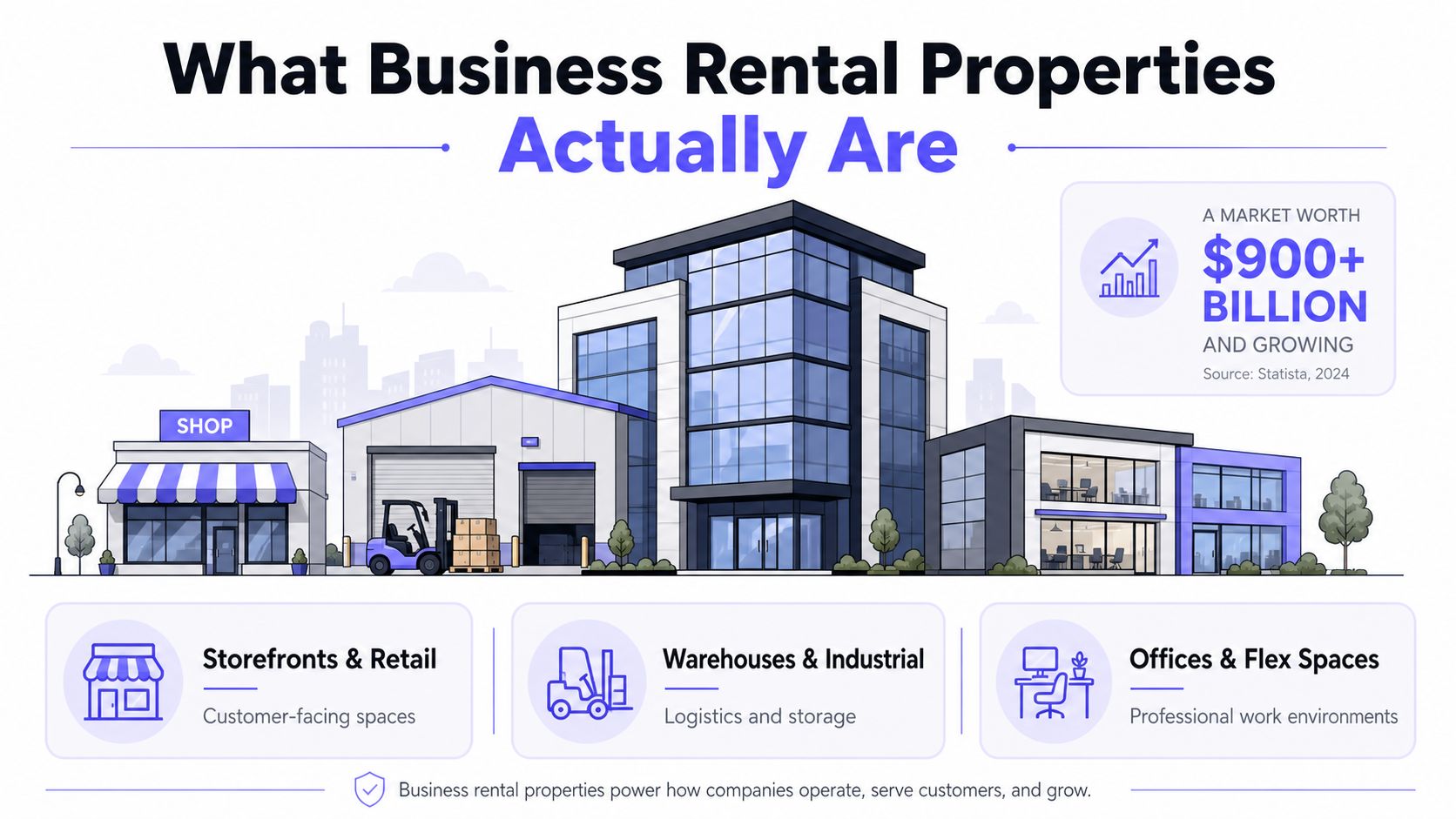
Business rental properties are real estate assets leased for operational use. That includes office suites, storefronts, industrial bays, flex space, warehouses, and short-term commercial arrangements where a tenant needs space to do business, store inventory, serve customers, or produce output.
That distinction matters because the tenant is not renting a roof over their head. They are renting part of an operating model. A florist, logistics operator, CPA firm, and medical practice all use space differently, so vacancy, access, turnover, and buildout risk behave differently too. The lease has to support how the business works day to day, or the property starts leaking time and money in places owners do not always catch right away.
The category also carries real institutional weight. Industry reporting from IBISWorld shows the commercial leasing sector at major scale, with a large base of businesses and steady revenue growth. That scale explains why owners, brokers, property managers, lenders, insurers, and security vendors all care about the same thing, whether the asset produces stable, auditable income.
Read the asset like a business system
A useful way to think about the category is to separate real estate use from tenant function. A building can be physically attractive and still be a poor business rental if the layout, access, loading, parking, or licensing profile does not fit the tenant's work.
Practical rule: A business rental property should be judged by how well it supports revenue, compliance, and controlled access, not by aesthetics alone.
That is why a property manager needs different questions than a residential landlord would. Does the space support occupancy limits, vendor access, and operating hours? Can the gate, lobby, and back door be controlled without adding friction every time a delivery driver or subcontractor shows up? Those details decide whether the asset stays orderly or turns into a constant series of exceptions.
For owners who need help thinking through the legal side of a lease structure, the AI legal assistant for business owners is a useful reference point for getting organized before counsel reviews final documents. The point is not to replace a lawyer. It is to avoid walking into a lease negotiation without the basics in hand.
The Four Core Property Types
Business rental properties usually fall into four working groups, and each one behaves differently under pressure. The wrong management playbook can turn a decent building into a constant source of callbacks.
| Type | Typical Tenant | Lease Length | Management Intensity |
|---|---|---|---|
| Commercial | Office users, retailers | Medium to long | Moderate to high |
| Industrial | Warehousing, light manufacturing, logistics | Long | Moderate |
| Flex | Mixed office, showroom, shop, or light industrial users | Varies | High |
| Short-term business rentals | Project teams, seasonal users, temporary operators | Short | High |
Commercial assets include traditional office and retail. A law firm or salon usually wants location, professional presentation, and reliable access, but the pain points are different, office tenants care about vacancy, common-area presentation, and after-hours entry, while retail tenants care about visibility, customer flow, and signage.
Industrial assets are usually more straightforward on the surface and more demanding in practice. A logistics tenant values clear loading access, secure perimeter control, and dependable vendor entry, and the wrong gate process can slow every delivery window.
Flex space is where the operational complexity rises fast. A design shop with small inventory, a contractor with an office, or a medical-adjacent tenant with backroom needs may all want the same suite for different reasons, which means the lease and access plan have to be more precise than a generic office setup.
Short-term business rentals are the least forgiving. Temporary users often need rapid onboarding, predictable credential revocation, and clean records for who entered and when, because access is supposed to disappear just as quickly as it was granted.
Match the property type to the tenant's operating burden
A financial planner doesn't need the same management style as a warehouse operator. An HOA-style business park doesn't need the same controls as a customer-facing retail strip, because the risk profile is different.
Operational takeaway: The more a tenant depends on movement, deliveries, or controlled public access, the more the property manager should prioritize auditable entry systems over convenience shortcuts.
That's also why short-term and flex users often create more operational work than the rent suggests. Their needs change quickly, and every change tends to touch access, parking, signage, and security.
Key Investment Metrics for Commercial Properties
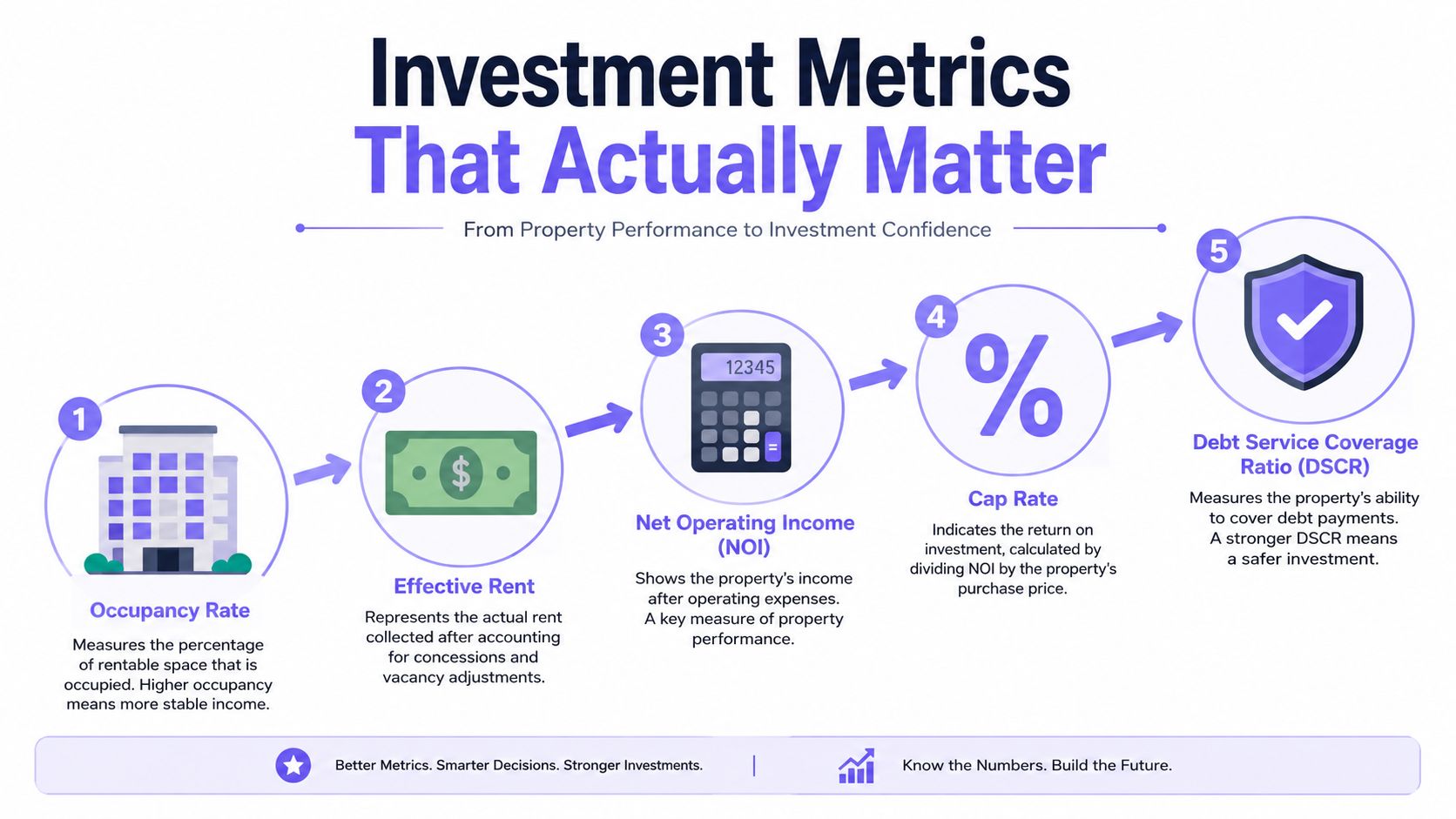
Owners often start with cap rate, but that comes too late if the building is leaking cash through weak occupancy, heavy concessions, or rising operating costs. The cleaner order is occupancy, then effective rent, then NOI, cap rate, and DSCR.
Occupancy comes before rent quality
Occupancy rate matters because it turns rentable area into revenue-producing area. That still does not mean the asset is healthy. If operating expenses rise faster than effective rent, occupancy can look strong while NOI slips, so those two numbers need to be read together Building Engines.
Office properties make that trade-off easy to see. JPMorgan cited Moody's data showing national office vacancy at 20.4% in Q1 2025, which it described as a new record high, while NAR reported office vacancy at 14.1% at the start of 2025 after 24.5 million square feet of new construction deliveries pushed vacancy upward JPMorgan. In the same market context, JLL reported 50.4 million square feet of office leasing in Q1 2025, more than 15% above Q1 2024, and 12-month leasing volume at 89% of typical pre-pandemic activity JLL.
Effective rent is the number lenders trust
Effective rent is usually lower than asking rent because it reflects concessions, free rent, and tenant-improvement allowances. Lenders and investors focus on that number because it shows the income stream after incentives, not the sticker price GrowthFactor.
A simple flex-space example shows the gap. A tenant can agree to the headline rent and still cost the owner more than expected if the deal includes upfront concessions or a heavy improvement package. The spread between asking and effective rent is where weak underwriting often hides, and it is one of the fastest ways to overstate early cash flow.
NOI, cap rate, and DSCR are downstream
NOI is the core profitability measure because it strips out financing structure and isolates the operating result. Cap rate is NOI divided by market value, while DSCR compares NOI to debt service, and rental businesses are commonly evaluated around a minimum DSCR of about 1.25x, meaning NOI should cover annual debt payments by at least 125% GrowthFactor.
Bottom line: A property can show healthy gross rent and still underperform if concessions, OpEx, or vacancy consume the spread before NOI reaches the lender.
For a close look at how those metrics connect to return analysis, the Nimbio real estate ROI guide fits well alongside a lease-up and operating review. For broker-facing teams, a marketing playbook for brokerages can help support the top of the funnel, but it does not fix a property that is poorly underwritten or expensive to operate.
Leasing Workflow From Application to Move-In
Commercial leasing is a screening system. The landlord is deciding whether the tenant's business model fits the property's use, risk tolerance, and access controls, because the wrong tenant can create more operating work than rent.
The application package usually starts with the last two years of business tax returns, and some landlords also request personal tax returns if a guarantor is involved Right Space CRE. Typical files also include articles of organization or incorporation, a W-9, and references from lenders, vendors, or prior landlords CommercialCafe. The point is not paperwork volume. It is whether the tenant has the structure and cash flow to hold the space without creating collection problems or access headaches later.
What the documents are really telling you
Each document answers a different question. Tax returns show continuity, entity documents show who's signing, and references show whether the tenant pays on time and handles vendors cleanly.
A broker can help package the file cleanly, but the owner still needs to read it like an operator. A polished submittal means little if the use case does not fit the building or if the tenant needs exceptions that would complicate future access management, delivery windows, or common-area control.
For broker-facing teams, a marketing playbook for brokerages can help align presentation with tenant expectations before the lease conversation gets serious. Presentation matters, but so does whether the property can support the promised use.
Clauses that matter in real life
The clauses that get used every day are the ones that shape operational friction.
- Permitted use: Defines exactly what the tenant can do.
- Exclusivity: Protects certain tenants from direct competition nearby.
- CAM charges: Allocates shared operating costs.
- Holdover: Sets the terms if the tenant stays past expiration.
- Assignment: Controls whether the tenant can transfer the lease.
A small medical office tenant is a good example. The application may look strong, but the landlord still needs to confirm permitted use, patient access, parking, and whether the tenant's vendor flow will create issues at the gate or lobby.
A busy property manager usually says yes when the tenant is clean on documents, realistic on buildout, and easy to underwrite. The answer turns into no when the use is vague, the guaranty is weak, or the operating burden does not match the rent.
For operators modernizing lease intake, what is digital leasing in 2026 is a helpful companion to the manual workflow many firms still use. A tighter process also makes it easier to connect lease records to a gate access API, so move-in, credential changes, and revocations do not live in separate systems.
Property Management and Access Control Workflows
A property manager doesn't just collect rent. The job is to keep the building usable, the tenants moving, and the access trail defensible when something goes wrong.
That starts with screening and continues through maintenance coordination, vendor scheduling, and access credentialing. In a commercial building, the gate, lobby, and back door are often the first operational touchpoints a tenant notices, so the access system becomes part of the service model whether management treats it that way or not.
One workflow now covers several jobs
Old-school management split these tasks into separate tools and separate people. Newer systems tie them together so onboarding, revocation, work orders, and visitor credentials live in one record.
That matters because access changes are rarely isolated. A new tenant moves in, a contractor needs weekend access, a cleaner needs a limited schedule, and a former vendor needs to be shut off immediately. If those changes live in email threads and sticky notes, the manager loses auditability the moment a dispute starts.
Operational rule: If a manager can't prove who entered, when they entered, and whether the credential was still valid, the access system is already failing.
Modern proptech changes the daily rhythm. A cellular, cloud-managed controller can keep working without depending on a local Wi-Fi network, and hardware-agnostic retrofit options let operators update existing gates instead of replacing an entire gate operator stack. Nimbio is one example of that approach, because it supports remote credential issuance, revocation, and entry logs from a central dashboard while preserving the hardware already on site.
What gets replaced in practice
The practical replacement is not just a keypad. It's the scramble that happens when a tenant shares a code, a vendor forgets a fob, or a board member needs to approve access after hours.
- Tenant onboarding: Digital credentials replace handing out physical keys or codes.
- Vendor access: Time-bound entry can be issued and revoked remotely.
- Visitor management: Entry can be tracked instead of guessed at later.
- Audit trail: Entry records are easier to review than phone logs or memory.
That single workflow is why access control belongs in the management stack, not in a separate conversation with the security vendor. The building performs better when the gate and the lease process are tied together.
Insurance, Liability, and Compliance
Commercial insurance is a lease issue as much as a policy issue. The lease usually spells out who carries general liability insurance, commercial property insurance, and, where there are employees, workers' compensation coverage. Wise For building owners, the key question is whether the coverage matches the way the property operates, especially when tenants, vendors, and visitors all have different levels of access.
General liability is the most common requirement in commercial deals, but it rarely covers every operational risk on its own. Industrial tenants often need tighter controls around loading areas, equipment, and third-party access, while retail tenants usually carry more exposure tied to visitors, signage, and customer traffic. The risk profile changes with the use case, and the insurance should follow that reality instead of assuming a one-size-fits-all lease form will do the job.
Geography matters more than most owners expect
Workers' compensation is mandatory in every U.S. state except Texas. That is more than a legal footnote. It affects how owners, tenants, and operators handle onboarding, site safety, and vendor management across markets, because the compliance burden changes as soon as employees or contractors are on site.
State rules also shape how loss events are handled after a disruption. If a property sits in a market with stricter requirements, managers need cleaner documentation around who entered, what work was done, and whether access was authorized for the task at hand. That is where the operational side of compliance starts to matter as much as the policy language itself.
For a practical claims perspective, the NW Claims Management on lost rents resource is useful when lease disruption or damage starts affecting cash flow conversations. A separate reference from the Insurance Information Institute, which outlines how commercial property policies and business interruption coverage are commonly structured, helps frame the same issue from the carrier side. Insurance language is never just about the policy, it is about what happens to income when access, operations, or occupancy gets interrupted.
Audit trails support the insurance story
Carriers, lenders, and regulators want records they can verify, not verbal assurances. If access is tracked, disputed entry is easier to investigate, and that kind of control strengthens the broader risk story around the property.
That matters most in buildings with repeated turnover, vendor traffic, or shared entrances. A property with clear logs and revocation controls is easier to defend than one where management can only guess who still has a code or fob. Clean records also shorten the back-and-forth after a claim, which helps when a loss already slowed rent collection or tenant operations.
Insurance limits are negotiated, not inherited. A property with clean procedures and documented access controls tells a stronger story than a property that relies on memory and a keypad code nobody can retire.
Why Shared PINs and Fobs Quietly Hurt NOI
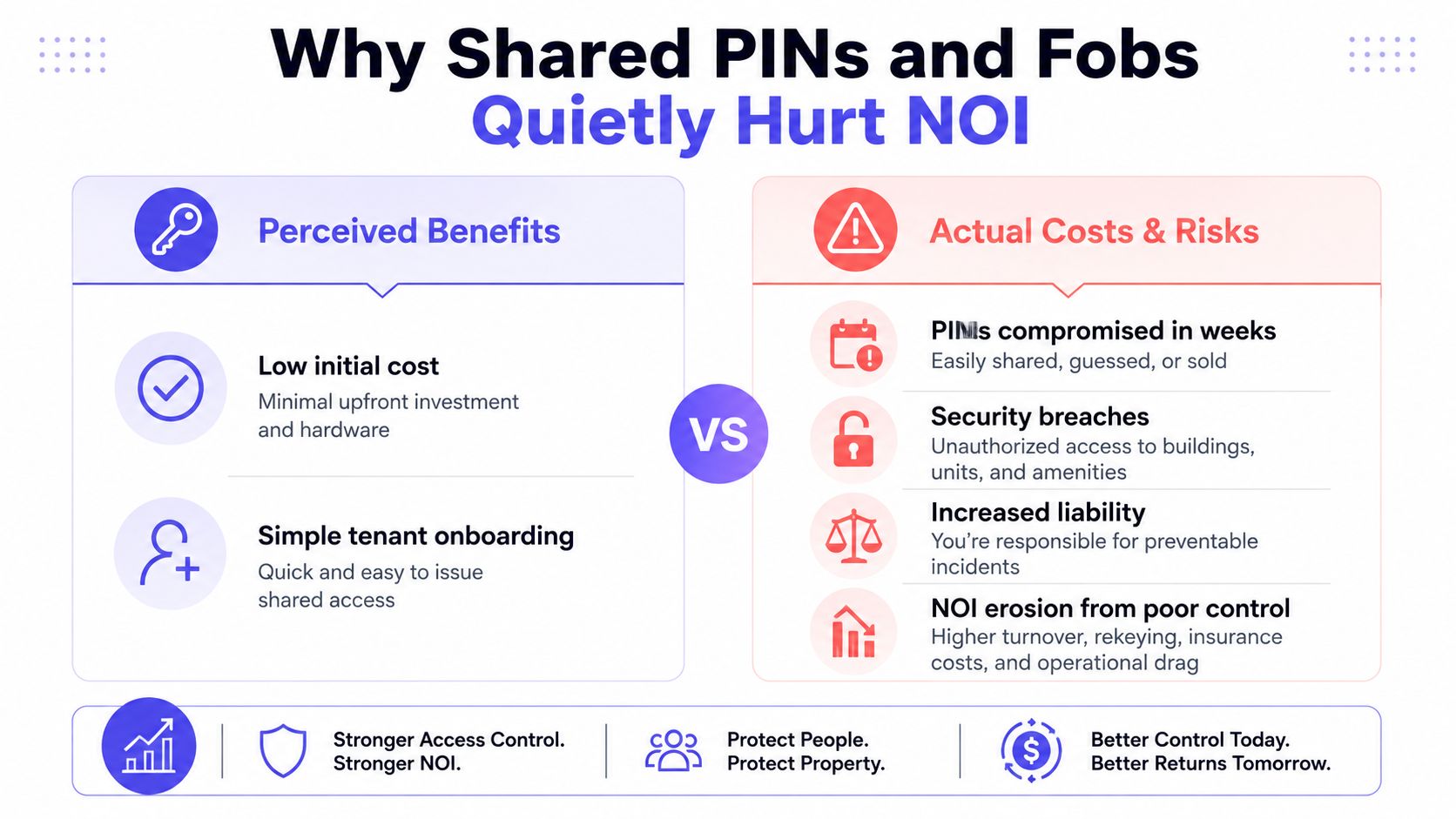
A keypad can look “good enough” for years. In reality, shared PINs and untracked fobs create a slow leak that shows up as security risk, labor drag, and avoidable friction.
The hidden cost is revocation failure
A shared PIN is useful until it isn't. Once it spreads through vendors, former tenants, employees, or board members, nobody knows who still has it, and changing it creates a fresh round of administrative cleanup.
Lost fobs are worse in a different way. They don't announce themselves; they keep working until someone realizes the old credential was never collected or disabled.
The real problem is control, not hardware
The financial issue isn't the fob itself. It's the time spent chasing access, the risk of unauthorized entry, and the inability to prove the credential history if a dispute happens later.
A modern access layer solves that by tying credentials to individuals, schedules, and logs. Cellular keyless entry that retrofits existing gates can do that without ripping out working hardware, which matters when the gate operator itself is fine and only the access method is the weak link.
That's the operational gap many owners miss. They budget for repairs after the fact, but they don't budget for the daily leakage caused by weak credential control.
Candid operator view: If access can't be revoked remotely, it isn't really controlled, it's just delayed risk.
For owners weighing upgrades, the core question isn't whether the current keypad still opens the gate. It's whether the system can prove who should still have access today.
Choosing the Right Systems for Modern Business Rentals
Stable business rental properties usually come down to three decisions. The first is tenant mix and submarket fit, the second is financial discipline around NOI, and the third is the operational stack that proves what's happening at the gate.
Use a simple operator checklist
- Tenant mix and submarket fit: Put the property in the right lane before lease-up starts.
- Financial discipline: Track occupancy, effective rent, and NOI before worrying about headline yield.
- Access and security systems: Use credentials and logs that can be revoked, audited, and scheduled.
Those decisions reinforce each other. A strong tenant mix reduces chaos, disciplined financial review prevents optimistic underwriting, and auditable access keeps the building defensible when turnover, vendors, or emergencies create noise.
For managers and owners who want a hardware retrofit rather than a full replacement, Nimbio fits into that stack as a cellular access system that can modernize existing gates without relying on Wi-Fi. It also supports remote credential management and entry logs, which helps when the same dashboard needs to serve tenant onboarding, vendor access, and after-hours control.
The practical goal is simple. Reduce the number of hidden exceptions, tighten the audit trail, and make the gate part of the property's operating system rather than a blind spot.
If a business rental property keeps losing time to shared codes, unclear access records, or manual revocation, it's time to update the system. Visit Nimbio to see how cellular gate access and audit-ready credential control can support a cleaner operating model for commercial sites.