A gate controller fails during the morning rush. Residents share a four-digit PIN because individual credentials are difficult to manage, a former tenant still has a clicker, and the HOA board can't determine who opened the gate after an incident. Meanwhile, property staff are comparing guard costs with the expense of replacing an entire access system.
Centralized access control addresses that operational gap by moving permissions, credentials, schedules, and event records into one administrative layer. Instead of treating every gate, door, keypad, or property as a separate island, managers can apply access policies from a shared source of truth.
The approach matters most for gated communities, multifamily buildings, commercial sites, and property portfolios where access changes frequently. A resident moves out, a contractor needs temporary entry, or a board member wants a report. Each event should be handled through a controlled process, not a spreadsheet, shared PIN, or visit from an installer.
The modern centralized access control market has become a substantial global industry. One 2026 industry report values the global physical access control market at USD 11.80 billion in 2026, with a projection of USD 21.17 billion by 2033 and a 8.7% CAGR from 2026 to 2033. Another 2026 report estimates the broader market at USD 10.81 billion in 2025, rising to USD 18.51 billion by 2030 at an 11.4% CAGR (physical access control market analysis).
This guide explains how centralized access control works, how it compares with decentralized systems, and how property teams can implement it without automatically replacing functioning gates. It also shows why cellular retrofits, smartphone credentials, visitor management, and searchable logs are becoming practical tools for HOA security and smart communities.
For teams evaluating property operations software alongside entry management, a resource on how to find the right property management platform can help connect access workflows with broader resident and portfolio administration. A cellular access option such as Nimbio can then serve as the entry layer for existing electronic gates and doors.
Table of Contents
- Introduction to Centralized Access Control for Modern Properties
- What Centralized Access Control Means and How It Works
- Centralized vs Decentralized Access Control Compared
- Benefits Risks and Security Considerations You Must Weigh
- Implementation Checklist and Migration Steps for Any Property
- Auditing Logging and Measuring ROI Across Your Portfolio
- Choosing the Right Centralized Access Control Path Forward
Introduction to Centralized Access Control for Modern Properties
A centralized system gives an authorized administrator one place to decide who can enter, where they can enter, and when access should work. The system then sends or applies those rules across connected entry points.
That distinction is important. A community can have electronic gates and still operate in a decentralized way if each controller, keypad, or building has separate credentials and separate logs. Centralization describes the management model, not the presence of electronic hardware.
For an HOA board, the difference appears in everyday tasks:
- Resident turnover: A manager can revoke a departing resident's digital credential instead of collecting every clicker.
- Contractor access: Staff can create time-limited permissions without handing out a permanent shared code.
- Visitor entry: Residents or managers can approve guests remotely, subject to the property's policy.
- Incident review: Administrators can inspect entry activity rather than relying on recollection.
- Multi-site oversight: A portfolio manager can apply consistent rules across properties from one dashboard.
Shared PINs create a particularly difficult accountability problem. Once a code is distributed, the property may know that the code was used, but not which individual entered. Individual mobile credentials connect the event to a user identity more clearly, while still allowing managers to revoke or adjust access when circumstances change.
Nimbio's cellular hardware-plus-subscription model illustrates a retrofit-oriented path. Its controller can connect compatible electronic gates, call boxes, and building entry systems to smartphone-based access management while preserving existing remotes and keypads. The approach is relevant where a property wants centralized management without discarding a functioning gate operator.
Practical rule: A centralized access system should make routine access changes easier, not create a new manual process behind a modern dashboard.
The strongest business case usually comes from repeated administrative friction. If staff frequently reprogram credentials, answer access calls, investigate gate events, or coordinate entry across several properties, a central policy layer can reduce the number of disconnected tasks.
What Centralized Access Control Means and How It Works
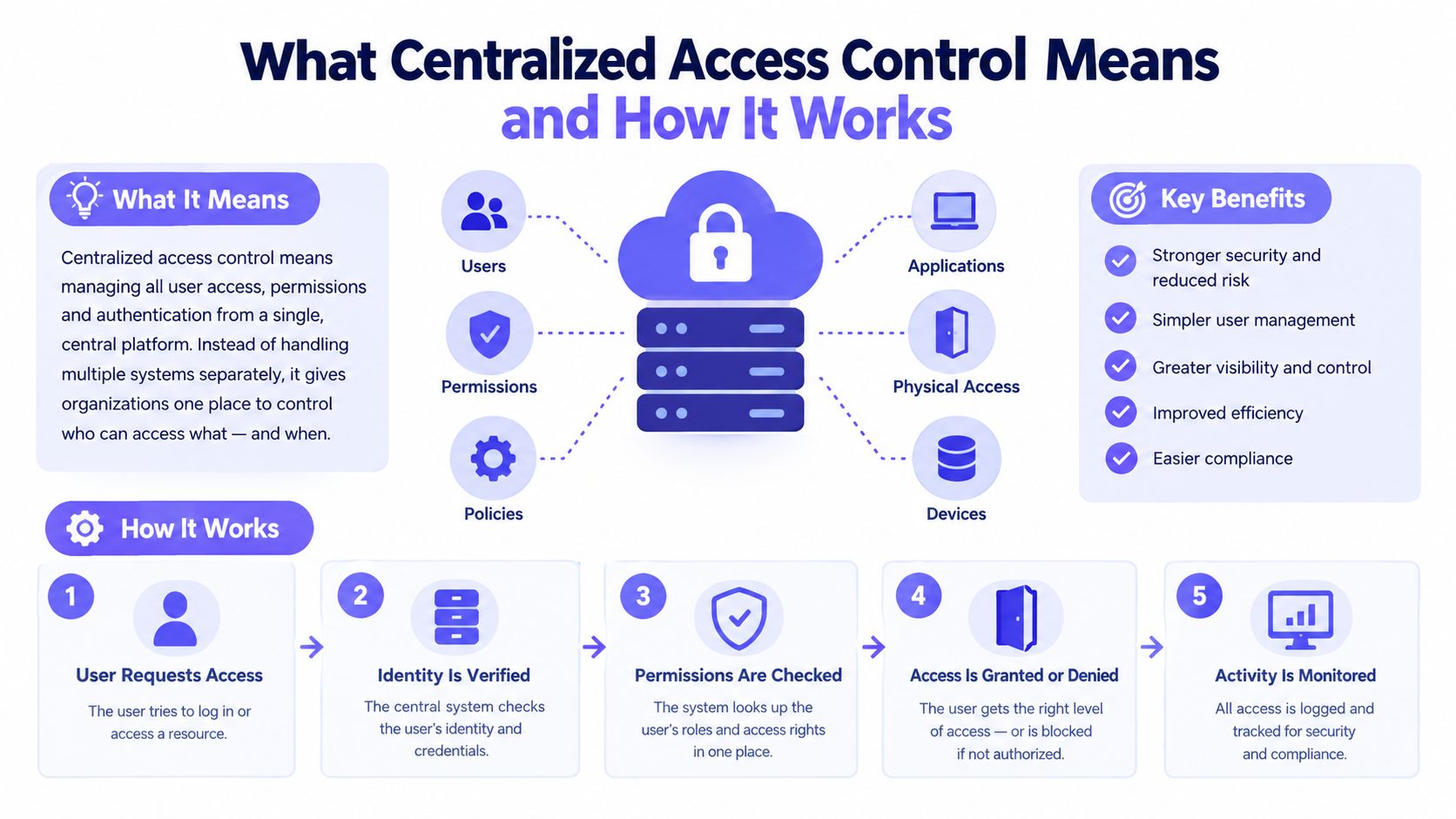
A useful analogy is a property with one control room instead of a separate manager beside every gate. The control room holds the approved access rules, while each gate or door checks those rules before allowing entry.
NIST describes centralized authorization as a model in which a provider maintains a central authorization database for users and accounts. OWASP's access-control pattern separates policy administration, policy decisions, enforcement, and attribute retrieval, allowing rules to be defined once and applied consistently across requests (NIST access-control guidance).
Centralized access control is a single authoritative policy layer that manages permissions across multiple entry points, users, services, or sites.
The four working parts
The architecture becomes easier to understand when divided into responsibilities:
- Identity verification: The system checks the credential, account, mobile identity, or other approved identifier presented by the person.
- Policy administration: An administrator assigns roles, locations, schedules, and restrictions.
- Policy decision: The central service determines whether the request meets the active rules.
- Policy enforcement: A gate operator, lock, intercom, or controller carries out the allow or deny decision.
The system may also retrieve attributes such as a resident's property, a contractor's assignment, or a credential's active schedule. That information helps the policy engine make a more precise decision than a universal PIN can provide.
Suppose a landscaping contractor needs entry during an approved service window. A manager can assign access to the relevant gate and schedule without giving the contractor a credential that remains active indefinitely. If the contract ends, the manager changes the central record, and the permission can be revoked without visiting each entry point.
This design supports least privilege, meaning each person receives only the access needed for the assigned role. It also supports separation of duties, so an administrator who manages resident credentials doesn't automatically need unrestricted control over every security or audit function.
Property managers evaluating the identity side of the architecture can use an identity access management guide to understand how authentication, authorization, and user lifecycle controls relate to entry systems. For gate-specific deployment context, Nimbio explains how cellular gate access works.
The central advantage is consistency. A role or schedule changes once, rather than being recreated separately at every gate, door, or site. That reduces policy drift, where one location still permits access that another location has already removed.
Centralized vs Decentralized Access Control Compared
Centralized and decentralized systems solve different operational problems. A centralized model favors consistent administration and portfolio-wide visibility, while a decentralized model keeps decisions closer to each individual door, gate, or site.
The choice often depends on how many locations exist, how frequently credentials change, how much audit evidence the organization needs, and how much local operation must continue during a network or platform problem.
Centralized vs Decentralized Access Control at a Glance
| Criteria | Centralized Model | Decentralized Model |
|---|---|---|
| Management | Administrators manage permissions from one policy layer or dashboard. | Each gate, door, or site may require separate administration. |
| Credential changes | Revocations and role updates can be applied from a central record. | Staff may need to update multiple local systems. |
| Policy consistency | One approved rule can apply across connected locations. | Rules can vary between controllers or properties. |
| Auditability | Events can be aggregated into a shared, queryable view. | Evidence may be split across local logs and consoles. |
| Local independence | The central platform becomes an important operational dependency. | A local controller may continue operating independently. |
| Best fit | Multi-site portfolios, gated communities, multifamily properties, and teams needing shared oversight. | Small, isolated sites with stable users and limited administrative complexity. |
A decentralized arrangement can be practical for a single private gate with few users and infrequent changes. It can also preserve local autonomy where a site has specific compliance or connectivity requirements.
Centralization becomes more compelling when one team manages several properties or when access changes have consequences across a broader estate. The manager doesn't need to remember which local console contains a former employee's credential or which site still uses an old contractor code.
Many portfolios use a hybrid model. Central administrators control identities, roles, schedules, and reporting, while local hardware preserves selected functions during a temporary loss of connectivity. This arrangement can balance consistent governance with operational resilience.
The critical evaluation question isn't whether a product is cloud-managed. It is whether the system has a clear source of truth, dependable local behavior, and an administrative model that matches the property's staffing and risk profile.
Benefits Risks and Security Considerations You Must Weigh
Centralization improves control by reducing the number of places where staff must make decisions. It also concentrates responsibility, which means the platform, administrator accounts, network path, and recovery procedures deserve careful review.
For gated communities and multifamily properties, the practical benefits include:
- Remote credential control: Managers can grant, revoke, or schedule access without sending staff to every entry point.
- Individual accountability: Smartphone credentials can replace shared PINs that don't identify the person using them.
- Portfolio visibility: A manager can review activity across properties through a common administrative view.
- Faster response: Staff can react to a lost credential, resident move-out, or suspicious attempt from a remote location.
- Lower physical dependency: Cellular gate connectivity can avoid reliance on local Wi-Fi coverage at remote or hard-to-wire entrances.
Cellular connectivity is often preferred for retrofit gate and intercom deployments because it avoids dependence on local network coverage. Industry guidance also identifies cellular, LTE, and 5G as suitable for remote gates and hard-to-wire sites, while Wi-Fi can be affected by coverage gaps, credential issues, interference, or an ISP outage (cellular wireless gate intercom guidance).
Where centralization creates exposure
A single platform can become a single point of dependency. If the control plane fails, an administrator account is compromised, or a policy is misconfigured, the impact can extend across multiple sites.
Centralized access control also creates a larger misconfiguration blast radius. A mistakenly broad role, incorrect schedule, or faulty integration can affect more than one gate.
Security teams should require:
- Strong administrator authentication, with separate accounts rather than shared admin credentials.
- Role-based permissions, so property staff, installers, board members, and auditors receive appropriate access.
- Protected logs, with restricted log administration and controlled deletion rights.
- Local resilience, including documented behavior when the central service or connection is unavailable.
- Change review, especially for policies that apply across an entire portfolio.
A hybrid architecture can keep selected decisions or operating functions local while preserving central oversight. That approach doesn't eliminate dependency, but it can limit disruption during connectivity problems and support properties with distinct local requirements.
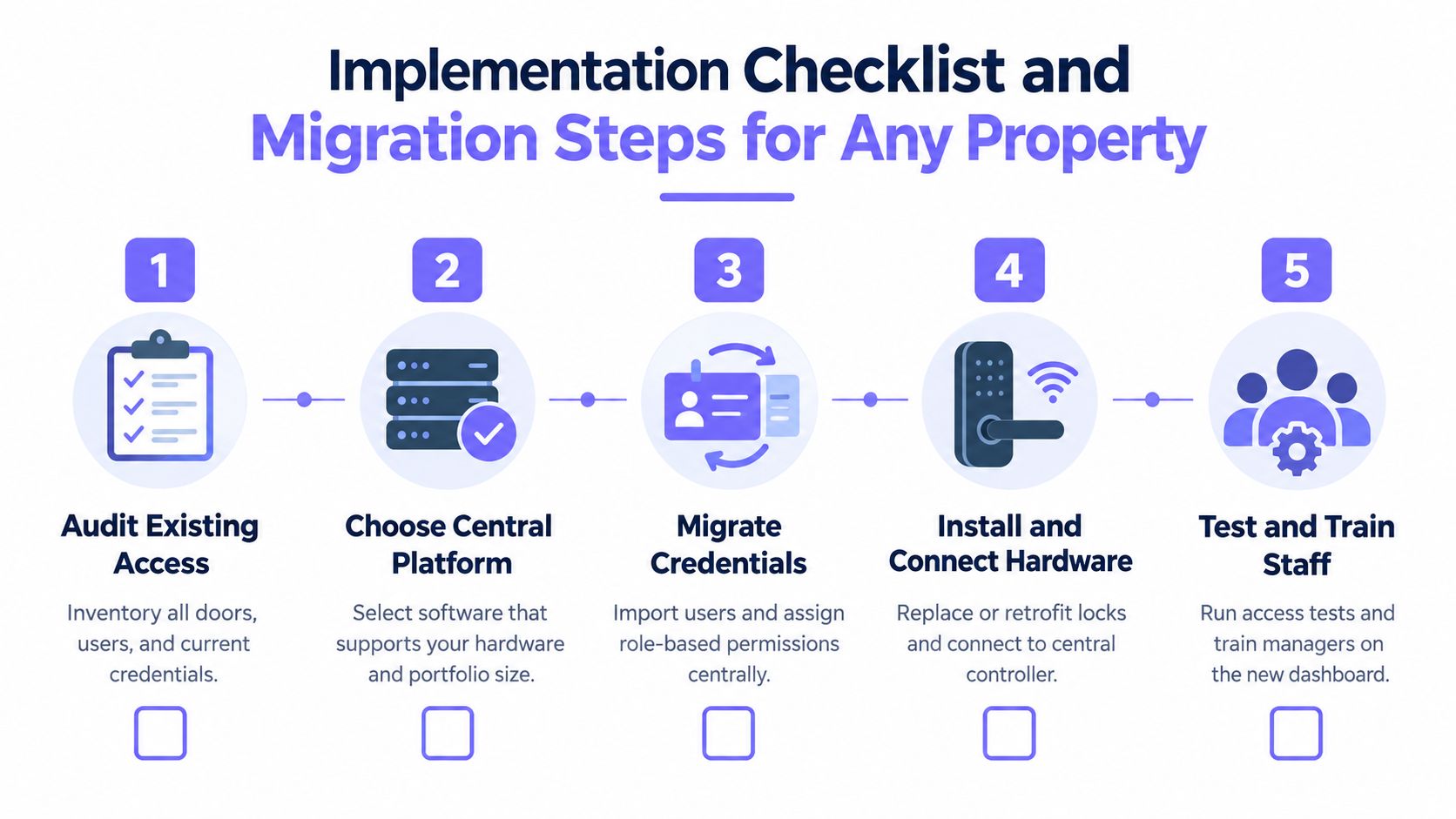
Implementation Checklist and Migration Steps for Any Property
A successful migration starts with the property's existing access reality, not with a software demonstration. Managers and installers need an accurate inventory of gates, operators, doors, credentials, users, schedules, and failure procedures.
1. Audit the existing system
Record every entry point and identify the hardware controlling it. For a gated community, the inventory may include vehicle gates, pedestrian gates, call boxes, clubhouse doors, pool entrances, and maintenance access.
The audit should also identify:
- Current credentials: Fobs, clickers, keypads, visitor codes, and mechanical keys.
- User groups: Residents, tenants, board members, employees, vendors, guards, and emergency personnel.
- Access schedules: Standard resident access, service windows, deliveries, and hold-open periods.
- Operational gaps: Shared PINs, missing remotes, unclear ownership, and undocumented overrides.
- Connectivity conditions: Wi-Fi coverage, cellular availability, power, and controller location.
2. Choose a compatible central platform
The platform should support the property's hardware and administrative needs. A hardware-agnostic retrofit is useful where the gate operator already works and replacement would create unnecessary construction, downtime, or expense.
Nimbio's controller is designed to retrofit existing electronic gates, call boxes, and building entry systems, including operators from manufacturers such as LiftMaster, Viking, FAAC, Nice, DoorKing, and Mighty Mule. Installers should verify compatibility, power requirements, signal conditions, and safe control behavior before approving the design.
3. Map roles and credentials
Create roles based on actual responsibilities rather than individual exceptions. A resident might receive access to a vehicle gate, while a maintenance vendor receives a scheduled credential for selected entrances.
Property teams should define:
- Who can administer users
- Who can approve visitor access
- Who can view logs
- Who can change schedules
- Who can install or troubleshoot hardware
- Which roles require board or ownership approval
This structure prevents the dashboard from becoming a new version of the old key ring, where too many people receive unrestricted access.
4. Pilot before portfolio rollout
A pilot can use one gate, one building entrance, or one property. Test resident entry, visitor workflows, credential revocation, temporary permissions, hold-open scheduling, power recovery, cellular performance, and local fallback behavior.
Installers should test both normal and abnormal conditions. A system that works during a demonstration but fails when a resident has a dead phone, a visitor requests entry, or connectivity drops isn't ready for broad deployment.
5. Train staff and communicate clearly
Managers need a short operating procedure for onboarding, offboarding, visitor approval, incident review, and emergency escalation. Residents need simple instructions for installing the app, requesting guest entry, and reporting a lost device.
Clear communication reduces support calls and discourages staff from creating informal shared credentials. It also gives HOA boards a defensible record of how access policies were introduced and reviewed.
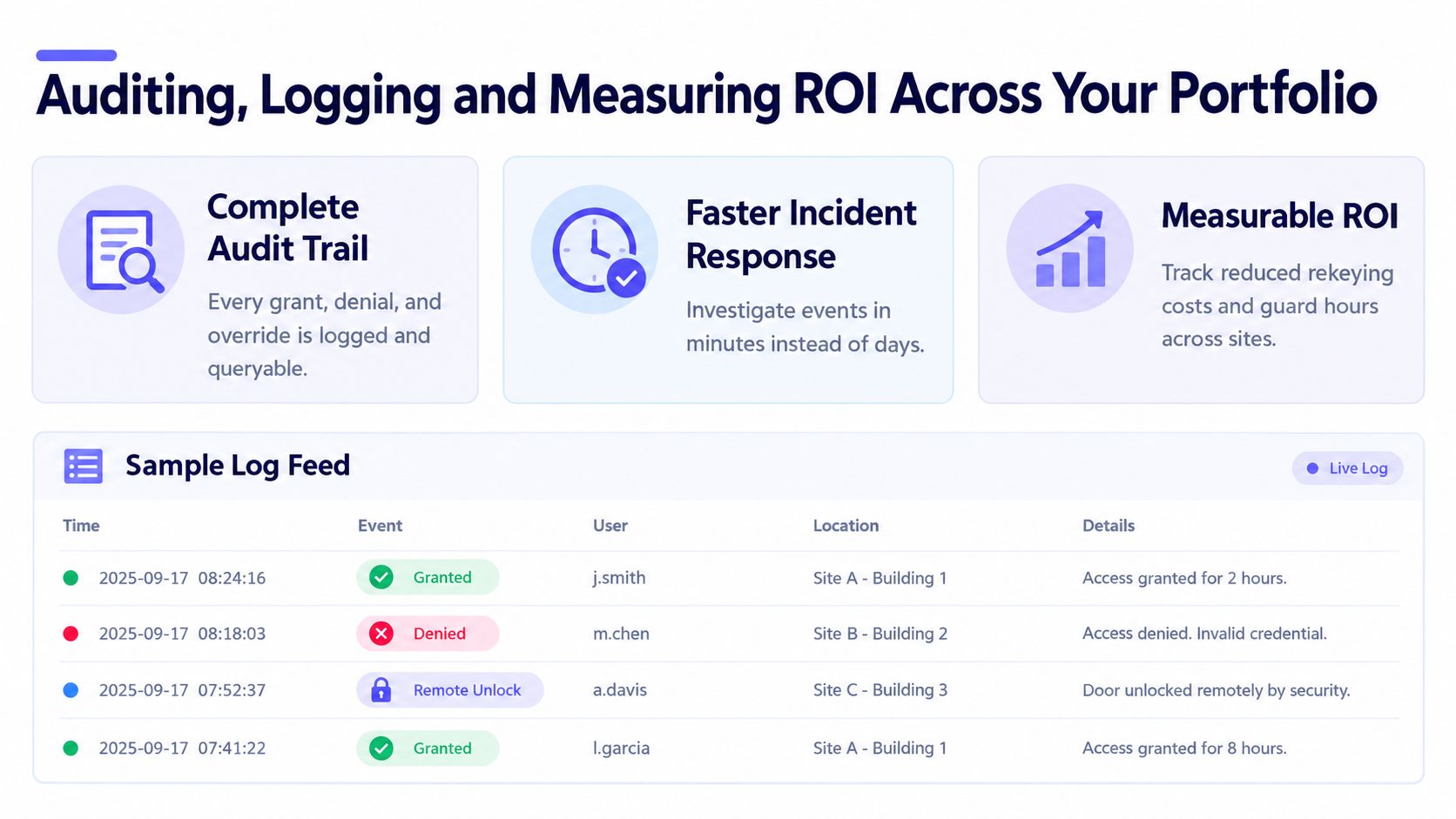
Auditing Logging and Measuring ROI Across Your Portfolio
Centralized access control becomes valuable during an incident, an ownership review, or a compliance audit because it turns entry activity into searchable evidence. A useful event record should show the identity involved, the entry point, the time, the decision, the credential or policy path, and relevant administrative changes.
Modern platforms commonly log access attempts automatically, including approved and denied events. For property managers and board members, that record provides accountability beyond the question of whether a gate opened. It can help establish what happened, who was authorized, and whether the system applied the intended rule (centralized access control and audit logging).
Build an audit process, not just a log feed
A dashboard alone doesn't make an audit defensible. Fragmented evidence can still appear when approvals sit in email, incident notes sit in tickets, and exports come from separate consoles. Guidance on IT controls highlights the need for log retention, policy versioning, and correlation across systems when access decisions and records are centralized (ITGC benchmarking insights).
A practical governance routine includes:
- Reviewing administrator permissions: Access to logs should be limited to the people who need it.
- Protecting sensitive actions: Independent security guidance recommends dual authorization for sensitive actions such as deleting audit data, along with regular review of log access permissions (audit and accountability guidance).
- Recording policy changes: Managers should preserve who changed a permission, schedule, or role and why.
- Setting retention rules: The HOA or property owner should define how long event records remain available.
- Testing exports: Staff should confirm that reports can be searched, filtered, and shared when an incident requires review.
Property teams can use these entry gate audit trail tips to turn raw events into a repeatable review process.
Connect records to operating value
ROI shouldn't be reduced to a vague claim that the system is more efficient. Boards and owners can compare the operating activities that centralization is meant to change, such as:
- Guard coverage and dispatch needs
- Rekeying or credential replacement
- Staff time spent managing access
- Unplanned installer visits
- Time required to investigate incidents
- Resident support requests related to entry
The purpose of measurement is accountability. A board can review whether remote visitor management reduces unnecessary onsite intervention, while a commercial owner can compare access administration across facilities. The numbers should come from the property's own invoices, staffing records, support tickets, and system logs, not from an assumed industry benchmark.
Choosing the Right Centralized Access Control Path Forward
Centralized access control is usually a strong fit when a property has multiple entry points, frequent credential changes, several user groups, or more than one location. It also makes sense when an HOA or owner needs consistent policies and evidence that can be reviewed without visiting each controller.
The evaluation should focus on practical capabilities:
- Retrofit compatibility: The system should work with existing gate operators and electronic locks where replacement isn't necessary.
- Cellular resilience: Remote gates shouldn't depend entirely on inconsistent local Wi-Fi.
- Credential lifecycle control: Administrators should be able to grant, revoke, and schedule access remotely.
- Visitor management: Residents and staff should have a controlled way to approve guests without relying on shared codes.
- Auditability: Logs should be searchable, protected, exportable, and tied to clear administrator permissions.
- Operational resilience: The vendor should document what happens during connectivity, power, or platform interruptions.
- Update support: Over-the-air updates can help keep deployed hardware current without repeated site visits.
Cost comparisons should account for installation, hardware, subscriptions, support, credential administration, guard coverage, and future gate replacement. Property leaders researching regional pricing can also review this overview of Perth business access control costs before building a local procurement model.
For communities and multifamily properties that want smartphone-controlled access without replacing functioning gates, a cellular retrofit can provide a practical route to centralized access control. The next step is a property audit that identifies shared PINs, unmanaged credentials, connectivity weaknesses, and the specific events the board or management team needs to see.
Nimbio provides cellular controllers and smartphone-based access management for electronic gates, call boxes, doors, and locks, with remote credentials, visitor access, scheduling, and searchable entry logs. Property managers, HOA boards, and installers can visit Nimbio to review retrofit options and assess the right centralized access control setup for the property.