A bad gate becomes everybody's problem fast. A property manager inherits the complaints, the leasing team gets the angry calls, and tenants start treating the entrance like a daily gamble instead of a routine. That's why commercial gate access control should be treated as a connectivity and credential-management decision, not a metal-buying exercise.
On a well-run site, the gate is the operational front door. If it hesitates, deliveries stall, emergency response slows, and the property looks less controlled than it should. The smartest move is usually not ripping everything out, but modernizing the access layer that sits on top of a gate operator that still has plenty of life left in it.
Table of Contents
- Why Commercial Gate Access Control Matters More Than Ever
- What Commercial Gate Access Control Actually Includes
- Comparing the Main Access Technologies for Commercial Gates
- Integrating Gate Access With Facility Management Systems
- Managing Visitors and Remote Access in Real Time
- Pricing Models and ROI for Commercial Gate Access
- How to Evaluate a Commercial Gate Access Control Vendor
- Choosing the Right Path Forward for Your Property
Why Commercial Gate Access Control Matters More Than Ever
A property manager at an industrial park doesn't usually call security because the gate is dramatic. He calls because the keypad only works on the third try, the vendor truck is stuck outside again, and somebody in accounting is asking why guard coverage keeps appearing on the invoice. One failing entry point starts to spread into tenant complaints, late deliveries, after-hours lockouts, and avoidable labor expense.
That's the core function of commercial gate access control. It is not just about opening steel. It is about making sure the site stays usable, traceable, and easy to administer when people, vehicles, and schedules get messy.
The broader market says the same thing. The global physical access control market reached $12.47 billion in 2022 and was projected to grow at an 11.2% CAGR from 2023 to 2030 WorldMetrics. In other words, businesses keep investing in electronic entry because the old way keeps creating friction.
The gate is the front line
When a gate works, nobody notices it. When it drags, every delay gets blamed on the property.
That's why a weak access layer hurts more than a worn motor. A single device can create a chain reaction that touches tenants, delivery schedules, visitor handling, and reputation. In many sites, the old operator still has mechanical life left, but the credential path and remote management are what really need attention.
Practical rule: If the gate hardware still cycles cleanly, don't replace it just to get smarter access. Retrofit the connectivity and credentials first.
A cellular retrofit fits that logic. It lets the existing gate keep doing the physical work while the access layer moves into a cloud-managed model. For many commercial sites, that's the path of least resistance and the lowest disruption.
The market data backs up the shift toward managed access. Commercial buildings represented 42% of the physical access control market share in 2023, and installations increased 15% year over year GITNux. That's not a fad, it's a sign that operators want controlled entry that can be administered without constant on-site intervention.
What Commercial Gate Access Control Actually Includes
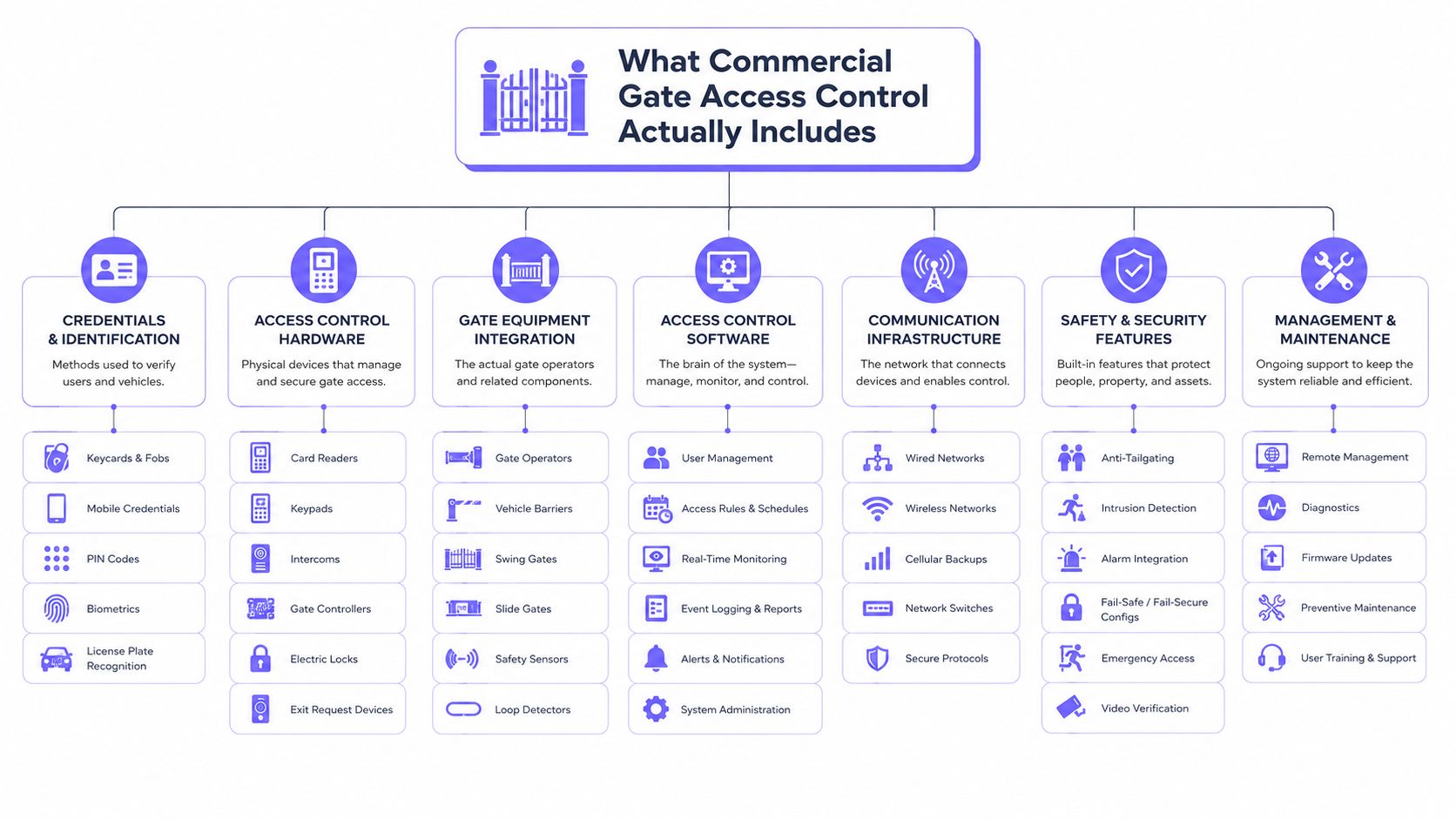
Think in layers, not products. A commercial gate system usually has a physical operator, a connectivity path, and a credential layer, and the system only feels reliable when all three are working together.
The three layers buyers should separate
- Physical barrier. This is the gate arm, slide, or swing operator. It does the movement, nothing more.
- Connectivity. This is the link that carries the open command. It can be cellular, IP, or another radio-based path.
- Credentials. This is how the system decides who gets in, through codes, cards, mobile access, intercom approvals, or similar methods.
That separation matters because many legacy sites blame the wrong layer. A gate can be mechanically sound and still feel broken because the credential method is fragile, local, or hard to administer. A shiny reader does not help if nobody can update access remotely.
Commercial gate access control gets stronger when the credential layer becomes flexible. Resident-controlled entry and visitor-managed entry are not the same workflow, and a decent system should treat them differently. Residents need fast, repeatable access, while visitors, vendors, and deliveries need approvals, time limits, and logs.
A lot of older systems fail in the same place. They bolt a keypad onto a gate and call it access control, but the administrator still has no clean way to issue, revoke, or audit credentials without driving to the site. That is a management problem, not just a hardware problem.
Cellular often solves the weakest layer first. It keeps the existing operator in place and replaces the brittle access path with cloud-managed control. That is why retrofits are so often easier to defend than full replacements.
Comparing the Main Access Technologies for Commercial Gates
The buyer mistake is obsessing over the newest device instead of asking four questions. Is it secure enough, does it stay up, what does it cost to install, and how much staff time will it burn later?
| Access Technology Comparison for Commercial Gates | Security | Uptime Risk | Install Cost | Admin Burden |
|---|---|---|---|---|
| Keypad | Moderate, codes can be shared | Low hardware risk, higher user error risk | Low | High, codes need ongoing changes |
| Card or fob | Better than shared codes, still transferable | Moderate, readers and controllers must stay healthy | Moderate | Moderate, credential lifecycle takes work |
| Audio or video intercom | Stronger visitor verification | Depends on call handling and staffing | Moderate to high | High, someone has to answer or approve |
| Wired IP | Strong integration potential | Lower once properly installed, but infrastructure dependent | High | Moderate, usually centralized |
| Cellular retrofit | Strong for controlled access and remote admin | Dependent on carrier coverage, but no local Wi-Fi dependency | Lower than full replacement | Low, remote changes are simple |
A keypad is cheap, but it's also shareable. That makes it a weak fit anywhere turnover, vendors, or outside contractors are common.
Card and fob systems improve control because credentials can be assigned to specific people. Still, they usually depend on an on-prem controller and enough backend discipline to keep permissions current.
Intercoms are valuable when the site needs visitor verification. They also demand attention, which means they work better when staff response is predictable and someone can pick up.
Wired IP systems are the cleanest answer on paper. They integrate well and can anchor a broader security stack, but trenching, conduit, and low-voltage work make them expensive and slow for retrofits.
A cellular retrofit is usually the sensible choice when the gate already exists and the property doesn't want weeks of construction to solve a credential problem.
For sites comparing options, the right internal question is simple. Is the property buying a better gate, or a better way to manage access? The second answer is usually the correct one.
For a practical overview of the cloud-connected model, see how cellular gate access works.
Integrating Gate Access With Facility Management Systems
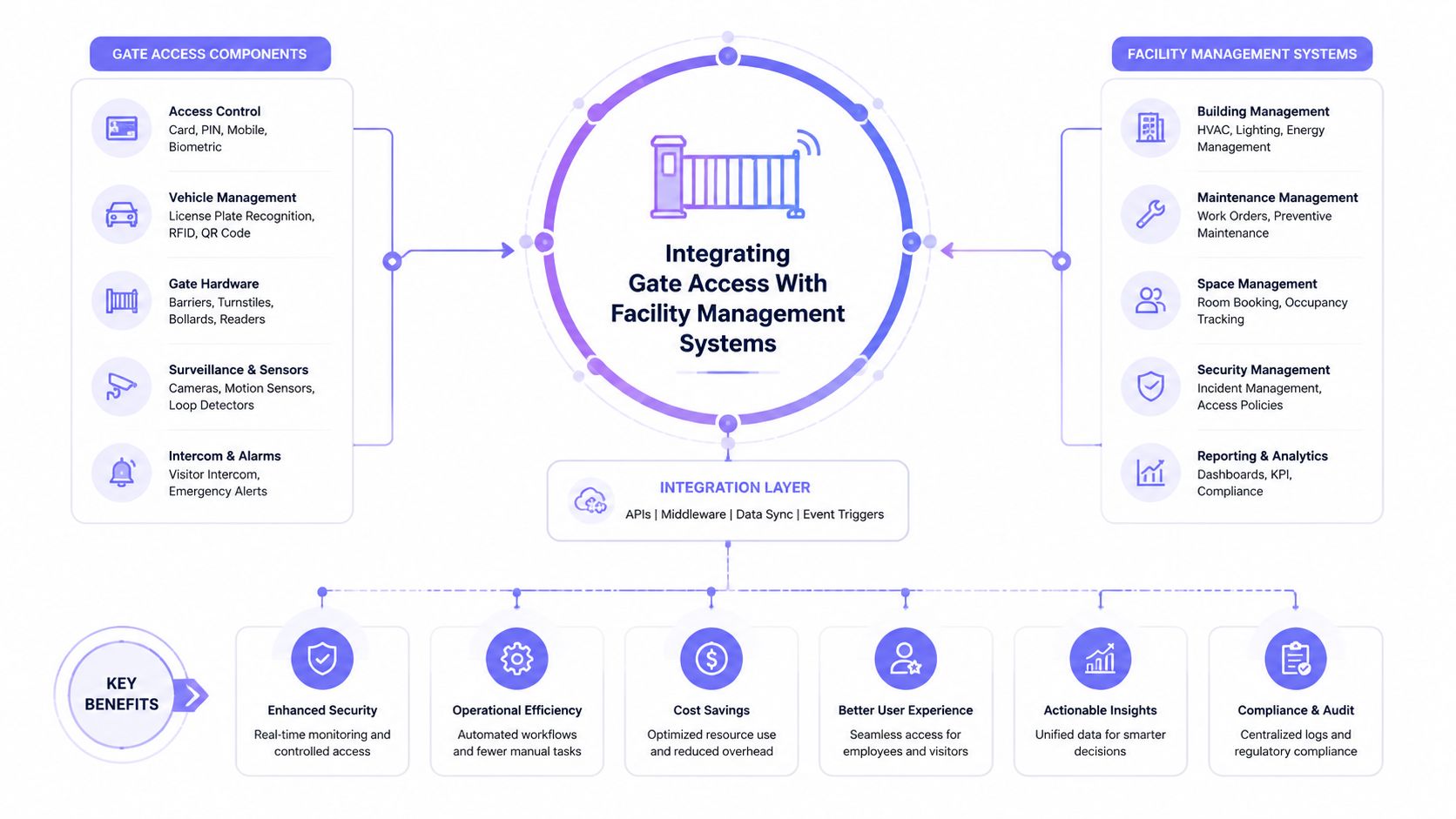
A gate that doesn't talk to the rest of the property is just isolated hardware. It may still open, but it won't help a manager keep records aligned, staff informed, or cameras pointed at the right moment.
Where the gate data should go
- Property management software. Resident directories and access rights should stay aligned with leases in tools like Yardi, AppFolio, or Buildium.
- Video platforms. Gate events should trigger camera call-ups in systems such as Genetec, Milestone, or Avigilon.
- Intercom directories. Visitor workflows should let someone dial a unit, get approval, and open the gate without sending a guard.
- Enterprise dashboards. Multi-site teams should see gate events beside door controllers and elevator controls when they already manage those systems centrally.
The useful questions are about data flow, not brand names. APIs, webhook events, and bridging methods like ONVIF or OSDP matter more than whatever logo sits on the front panel. If the events don't move cleanly, the integration claim is mostly marketing.
That is where platforms can become more practical than standalone hardware. For teams trying to stitch access, visitor handling, and operations together, a resource like integrate platforms with Wisely can be useful because it focuses on getting systems to exchange usable data instead of just sharing a rack.
A well-integrated gate changes how staff work. Leasing doesn't have to chase maintenance for every access update. Security doesn't have to guess what happened at the gate after an incident. Cameras and entry logs can finally tell the same story.
The point is simple. Access control is only half about opening the gate. The other half is making the event useful after the fact.
Managing Visitors and Remote Access in Real Time
At 8:14 a.m., a delivery driver arrives with a package that needs to make it inside before a resident leaves for work. The gate opens through a mobile workflow, the event is logged, and the site has a record of who came through without anyone leaving a desk.
At 11:02 a.m., leasing gets a request for a same-day guest. A manager issues a single-use credential from the dashboard, sets the time window, and avoids handing out a permanent code that will stay alive long after the visit ends.
At 2:47 p.m., the lawn vendor arrives. Because the vendor list is already built, the credential works without a phone call or a manual override.
At 5:30 p.m., a resident is still off-site when a delivery shows up. She gets notified, checks the gate camera from her phone, and releases the gate herself.
The workflow that keeps repeating
Every one of those moments follows the same sequence.
- Identify the visitor or vehicle.
- Authenticate the credential.
- Log the event.
- Notify the right person.
- Release the gate.
- Audit the record later if needed.
That sequence is where cellular retrofits earn their keep. They let staff issue, revoke, and schedule access without standing at the gate or waiting for a technician.
For properties that need visibility as well as control, real time monitoring in access control is the feature that turns gate events into live operational data rather than just a history file. It matters because property teams want fewer interruptions and clearer accountability, not another inbox to manage.
Operational truth: Visitor handling gets messy when access lives in a keypad code. It gets manageable when access lives in a credential system with timestamps, expiration, and remote approval.
Remote access is not a luxury anymore. It's the difference between a gate that supports the property and one that forces the property to support the gate.
Pricing Models and ROI for Commercial Gate Access
The cheapest solution on day one is often the most expensive over time. Buyers should compare staffing, construction, and cloud-managed retrofit costs as three different business models, not three versions of the same thing.
| Five-Year Cost Comparison: Guard, Wired Replacement, and Cellular Retrofit | Cost Category | Staffed Guard Gate | Full Hardware Replacement | Cellular Retrofit |
|---|---|---|---|
| Labor or service | Continuous guard coverage | Minimal staffing, but admin and support still exist | Minimal staffing, but admin and support still exist | Low ongoing admin |
| Installed infrastructure | Low hardware footprint | New gate hardware, controllers, and wiring | Existing gate stays in place |
| Access administration | Manual, labor-heavy | Moderate to high, depends on the system | Low, cloud-managed |
| Ongoing connectivity | Not the main issue | Higher infrastructure complexity | Monthly connectivity and dashboard fee |
| Five-year operating direction | Highest cost burden | Middle to high | Lowest of the three paths |
A staffed gate is expensive because people are expensive. In most US markets, a single guard runs $45,000 to $70,000 per year loaded with benefits, overtime, and turnover, and the site still needs a backup plan.
A full replacement is a different kind of budget drain. A typical rip-and-replace install runs $8,000 to $25,000 per gate in hardware, plus $2,000 to $6,000 per gate in trenching, conduit, and low-voltage wiring when no pathway already exists. For retrofits, that extra construction is usually the biggest budget killer.
A cellular retrofit keeps the gate operator and replaces the access layer. That path usually runs roughly $1,500 to $3,500 per gate for the reader and controller, plus $20 to $50 per month per gate for connectivity and the cloud dashboard.
A four-gate property makes the decision easy to see over five years. The cellular approach lands near $30,000, the wired replacement near $60,000 to $90,000, and the guard gate near $1.2 million. The payback story is hard to ignore.
That is why the ROI case for cellular is usually strong. Once guard coverage drops and truck rolls for new resident codes or access changes stop, payback often arrives in under 18 months.
How to Evaluate a Commercial Gate Access Control Vendor
Don't start with a brochure. Start with the questions that tell the truth.
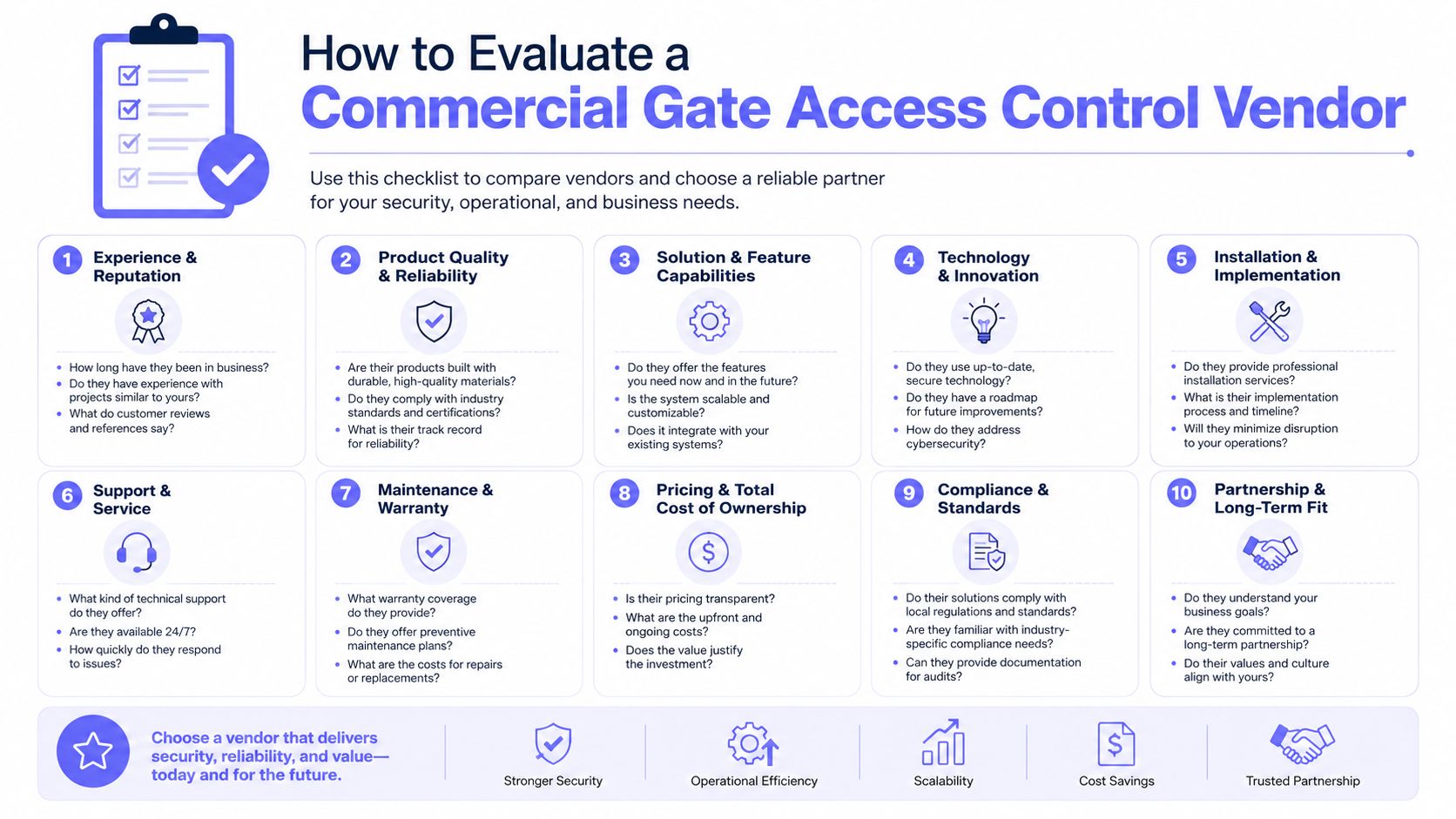
The checks that matter
- Cellular coverage: Ask which carriers are supported and what happens if signal drops at the gate.
- Uptime commitment: Demand a written service target backed by SLA penalties, not marketing language.
- Audit logs: Every credential event should be timestamped, attributable, and exportable.
- Warranty scope: Confirm whether the modem is covered separately from the controller board.
- Installer model: Find out whether the installer is in-house or subcontracted.
- Loaner access: Ask whether spare units are stocked for fast swaps.
- Similar references: Request at least three commercial properties of comparable size.
- After-hours support: Call the support line before signing anything.
- Remote change handling: Verify that permissions can be changed without site visits.
- Recovery behavior: Ask exactly what the system does if the network becomes unstable.
A vendor can have polished hardware and still be a weak choice if it can't handle the boring realities of property management. Coverage, support, and logs matter more than a flashy app screen.
That's also where cellular deserves special scrutiny. It should be treated as a first-class channel, not an afterthought bolted onto an operator that was never designed for remote administration.
Nimbio is one example of a cellular retrofit system that turns existing gates and building entry points into smartphone-controlled access using cloud-managed credentials and visitor workflows. It's the kind of product category buyers should compare against wired replacements when the site already has workable gate hardware.
A good vendor will answer these questions directly. A bad one will redirect the conversation to the demo.
Choosing the Right Path Forward for Your Property
The strongest candidate for a retrofit is a site with a working gate operator, usable cellular coverage, and limited appetite for IT complexity. In that setup, the hardware stays, the credential layer moves to the cloud, and installation is measured in hours instead of weeks.
Poor signal, frequent power problems, or strict on-premise requirements can still push a property toward wired IP. Even then, the credential decision should stay separate from the infrastructure decision. Mixing those two questions is how projects get overbuilt.
The core lesson is simple. Connectivity, uptime, and credential flexibility decide the winner, not the shiniest panel at the gate. A polished keypad system on a copper line can still lose to a plain-looking cellular retrofit that administrators can manage from anywhere.
For property managers, HOA boards, installers, and residents, the practical move is to modernize the access layer first. The gate itself may be fine. The way it communicates, logs, and grants access is usually what needs fixing.
If the gate on your property is still mechanically sound but hard to manage, Nimbio is built for that exact problem. It turns existing commercial gates and entry systems into cellular, smartphone-controlled access with remote credential management and visitor workflows. Visit Nimbio to see how a retrofit can replace old access friction without replacing the gate.
Securing gates or doors at a commercial property?
See how cellular access control works for commercial sites. Explore Commercial Gate & Door Access Control →