A resident pulls up to the gate after dark, or a tenant pushes on the lobby door and expects it to open with a credential. Behind that simple moment, a small device in the frame decides whether the latch releases, and that device is the door electric strike.
For property managers, the useful way to think about it is this: the strike is the mechanical half of a modern access system. The lockset, handle, and latch stay in place, while the strike becomes the controlled release point, which is why electric strikes are so often used for retrofit projects, HOA security, and building entries that need to work with cloud-based access control or a cellular controller instead of a full lock replacement. That retrofit logic is also why a system can keep existing hardware and layer in newer control methods like smartphone credentials, visitor access, and remote administration.
The hard part is rarely understanding the idea. It's choosing the right strike, wiring it correctly, and avoiding the field problems that make a door work on the bench but fail once the frame settles or the door starts pushing back.
Table of Contents
- What a Door Electric Strike Actually Does
- Inside the Hardware: How a Strike Releases a Door
- Fail-Safe vs Fail-Secure and Why It Matters
- Where Electric Strikes Came From and Why Voltage Still Varies
- Mounting Styles and Choosing the Right Strike for the Door
- Voltage, Current, and Strength Numbers That Matter
- Wiring Strikes to Readers Controllers and Smartphone Apps
- Installation Best Practices and Why Doors Fail Before Strikes Do
What a Door Electric Strike Actually Does
A door electric strike replaces the fixed strike plate in the jamb and turns a normal mechanical lock into a remotely controlled opening. The lockset, handle, and latch still do the everyday work, while the strike decides whether the latch stays captured or gets released.
That's why the part often gets misunderstood. Many owners assume the whole lock needs replacement, when the actual upgrade is much smaller, less invasive, and easier to retrofit into an existing frame. The strike is the controllable piece, not the entire locking system.
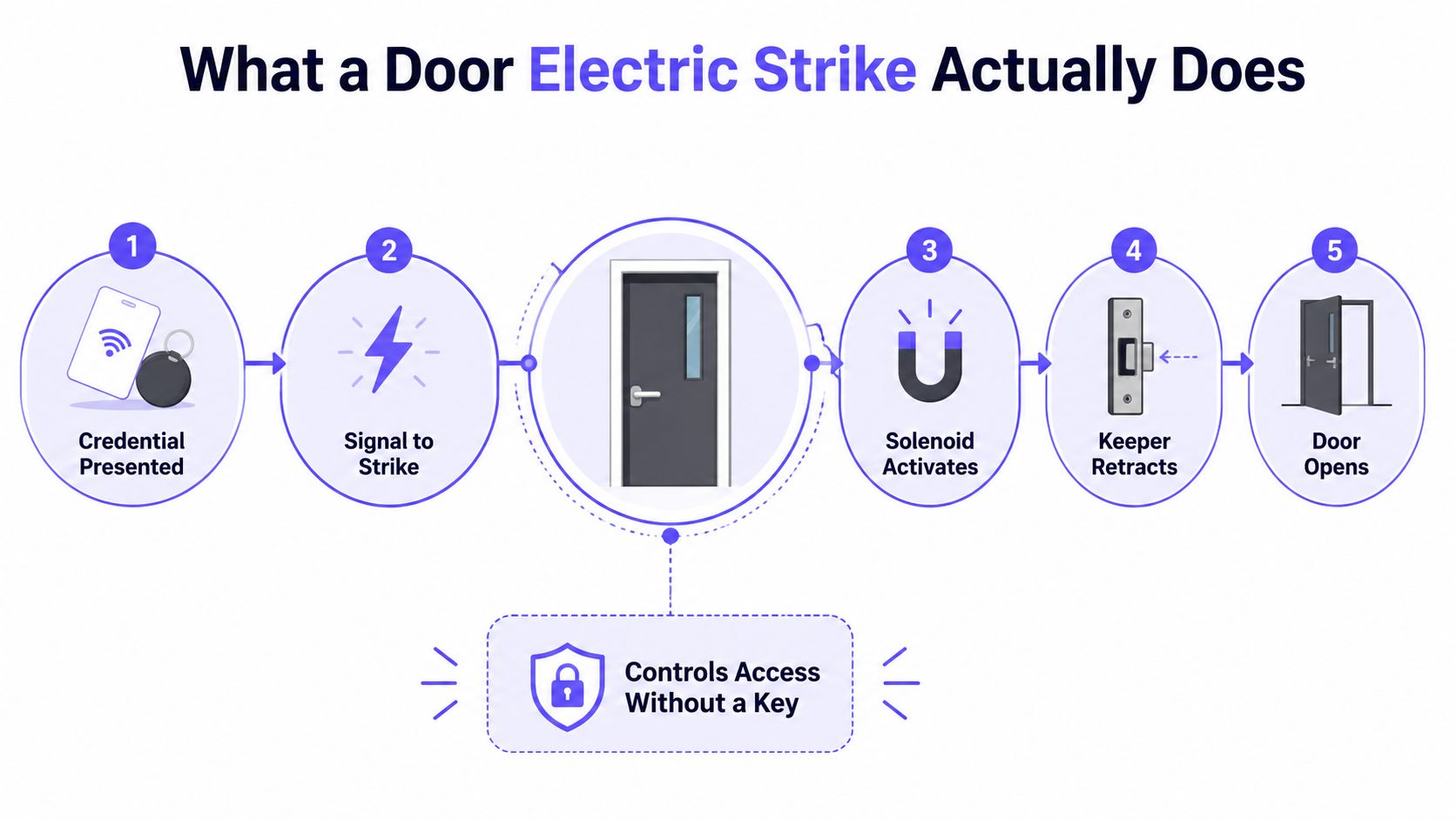
The basic vocabulary
- Keeper, the moving part that lets the latch escape.
- Faceplate, the visible plate on the frame.
- Jamb, the frame side where the strike sits.
- Solenoid, the electromagnetic part that moves the keeper.
Practical rule: if the door hardware already works manually, the strike usually should be chosen to fit that existing lock geometry rather than forcing the door into a new system.
For a quick overview of how entry hardware fits together, the entry door security features guide is a useful companion because it frames the strike as one piece of a larger opening.
| Decision | Key Question | Trade-Off |
|---|---|---|
| Fail-safe or fail-secure | Should the door unlock or stay locked if power is lost? | Life-safety release versus continuous security |
| Voltage | What does the controller and PSU actually supply? | Longer wire runs versus simpler low-voltage setups |
| Mounting style | Does the lockset call for cylindrical, mortise, rim, or surface-mount? | Retrofit ease versus exact hardware fit |
| Control source | What tells the strike to release? | Basic push button versus app, reader, or intercom |
A good strike doesn't just “open a door.” It preserves the latch, respects the frame, and gives the owner a controlled release point that can be managed locally or through a smarter system.
Inside the Hardware: How a Strike Releases a Door
A strike works like a relay for the latch. The latch still does the holding, and the strike decides whether that latch stays caught or gets a clear path to move.
What moves, and what stays still
The keeper is the part that moves. When the strike gets power, the solenoid shifts the keeper out of the latch's path, and the latch retracts or slides free as the door opens.
That is why the latch still matters so much. The strike is not replacing the lockset's job, it is controlling the latch's exit path.
The easiest comparison is a railroad switch. The train keeps traveling the same route, but the switch decides whether the path stays blocked or gets cleared. A strike does the same thing for the latch.
What an installer sees
A technician on site sees a faceplate sitting in the frame, a keeper behind it, and wiring running back to a controller or power source. When the system works, the keeper shifts cleanly and the latch clears without drag.
When it does not, the failure can look electrical even when it is mechanical. A sticky keeper, a bent frame cutout, or a latch that does not line up can make the release feel weak or inconsistent.
The strike is only one moving part in a chain. If the latch cannot reach the keeper cleanly, power alone will not fix it.
That mechanical simplicity is a big reason the category has lasted so long. Historical accounts place electric strikes in the 1880s, with one cited early date of 1883, another reference to the late 1880s, and a later design shift in 1976 that moved the solenoid inside the strike body. The core job has stayed the same for more than 140 years, which says the basic architecture was already solving the right problem.
For a building manager, that history matters because it explains the product's biggest strength. The strike is not a gadget that replaces the door, it is a durable mechanical release layer that fits into an existing opening and pairs naturally with a cellular controller or an app-based access system. If you need to compare that retrofit approach with gate hardware, you can find a magnetic gate lock as a reference point for a different kind of electrically controlled opening.
Fail-Safe vs Fail-Secure and Why It Matters
This choice comes down to one question, what should the door do when power disappears?
Fail-secure keeps the strike locked during a power loss. Fail-safe releases the strike when power is lost, which supports egress on doors people must use to exit during an emergency.
That difference feels minor until it is applied to an actual property. A main gate, a lobby entry, or a storage room usually needs to stay secure if a circuit goes down. A path of egress needs different behavior because life-safety comes first.
Side by side
| Mode | Power Lost | Best Fit | Trade-Off |
|---|---|---|---|
| Fail-secure | Stays locked | Entry doors, gates, restricted areas | Security stays intact during an outage |
| Fail-safe | Releases | Egress doors, life-safety paths | Security is reduced when power drops |
Fail-safe setups depend on continuous-duty DC operation, because the hardware must stay energized to remain locked. That affects power planning, relay behavior, and backup design.
Fail-secure is more familiar to property managers because it matches the expectation that a door or gate should not swing open just because a breaker trips. Fail-safe is the correct choice where a code path requires release on power loss.
For a retrofit decision, the rule is straightforward. If the opening is part of the exit path, it needs fail-safe behavior. If it is an entry-only door or a gate, fail-secure is usually the starting point, subject to local code and the exact opening.
For gate projects that need a hardware alternative on the locking side, it can also help to find a magnetic gate lock when the opening is better served by a different kind of holding force than a strike release.
Where Electric Strikes Came From and Why Voltage Still Varies
Electric strikes look modern because the control layer has changed, but the hardware standards underneath them are old enough to explain a lot of today's confusion. The category traces back to the late 19th century, when early strikes helped New York City residents release a common entry door from inside their apartments while urban electricity was spreading. A cited historical review also notes a change in 1886, and another account describes a major modern shift in 1976 when the solenoid moved inside the strike body.
Why 12, 16, and 24 volt systems still coexist
Those different voltages are not random. They reflect different eras of transformers, access panels, and strike designs, so modern buyers still run into 12 V, 16 V, and 24 V AC or DC options on datasheets.
Historically, 16 VAC was common, and AC solenoids were generally limited to intermittent duty, described in one industry source as 10 seconds or less of power. That's why older AC strikes tend to buzz when energized.
By contrast, continuous-duty DC solenoids made quieter operation practical and opened the door to fail-safe designs, because constant power can hold the lock while power loss releases it. The same source describes continuous duty as 10 seconds to constant on, which shows how tightly strike hardware is engineered around duty cycle limits.
What that means for a 2026 retrofit
A modern controller still has to match the strike's electrical expectations. A mismatch between voltage, current, or duty cycle can create binding, weak release, or outright failure.
The safest habit is to treat the strike and its power source as a pair. If the controller expects one kind of output and the strike expects another, the retrofit becomes unreliable fast.
The older standards are still around because the industry never fully replaced them. Instead, it layered newer control methods on top of legacy low-voltage hardware, which is why a current project can still call for 12 VDC, 16 VAC, or 24 VDC depending on the frame, the lockset, and the panel already on site.
Mounting Styles and Choosing the Right Strike for the Door
The strike has to match the lockset the way a shoe has to match the foot. The same part does not fit every opening, and the wrong geometry can make a good product fail on day one.
The four common mounting styles
- Cylindrical, used with standard round latch hardware.
- Mortise, matched to mortise lock bodies built into the door.
- Rim, paired with rim-type exit devices and surface-style applications.
- Surface-mount, chosen when the frame needs a simpler retrofit path.
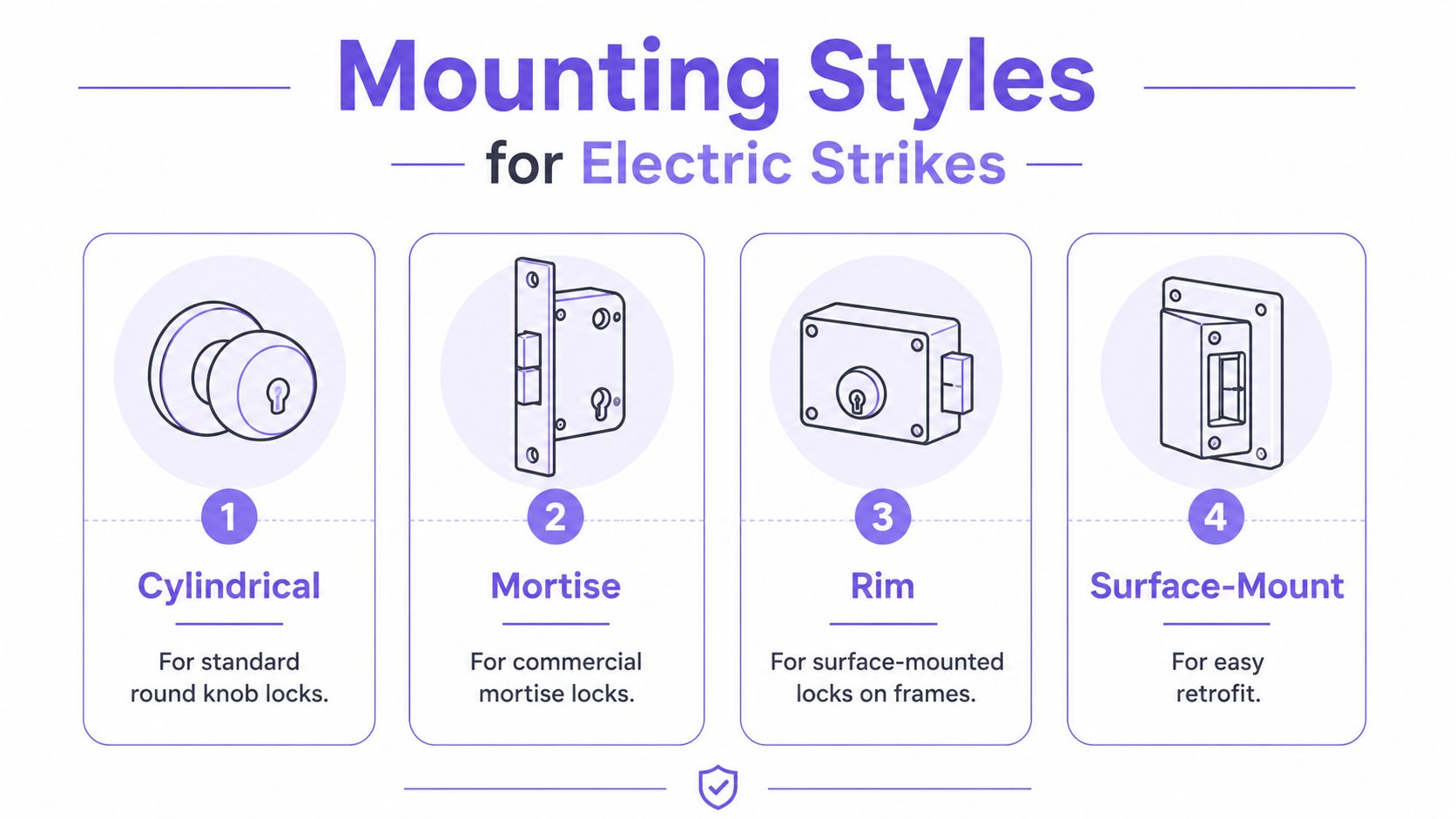
What changes in the field
An aluminum storefront door often needs a different solution than a wood-frame residential entry. An HOA gate usually needs a commercial-grade strike because traffic and wear are not the same as a low-use office door.
The mistake that causes the most trouble is choosing a style that looks close but doesn't line up. When the keeper misses the latch path, the door preloads, and the strike seems weak even though the problem is fit.
Installer's shorthand: if the latch, frame cutout, and keeper don't agree, the hardware will fight itself before it ever sees a credential.
For a retrofit conversation with a vendor, the right questions are simple:
- What lockset is already on the door?
- What cutout is already in the frame?
- Does the door swing and latch cleanly by hand?
- Will the opening see occasional use or constant traffic?
The last question matters more than many buyers expect. A light-use door can tolerate a smaller, simpler strike. A busy community entrance usually needs a more durable commercial unit that can handle repetitive releases without becoming the weak link.
Voltage, Current, and Strength Numbers That Matter
A retrofit quote gets clearer fast when the discussion stays on three items, voltage, current, and endurance. Those figures tell a property manager more than a model name ever will, because they show how the strike will behave in the frame, on the wire run, and after repeated releases.
Reading the numbers without getting lost
A UL-tested cylindrical or mortise strike can be rated for 12 or 24 VDC, draw 300 mA at 12 VDC or 150 mA at 24 VDC, and carry 1,000 lb static strength, 50 ft-lb dynamic strength, and 250,000 UL-tested cycles (BEA product guide).
A higher-end commercial series is listed at 1,500 lb static strength, 70 ft-lb dynamic strength, and 1,000,000 cycles, with continuous-duty power requirements of 0.60 A at 12 VDC, 0.40 A at 16 VDC, 0.33 A at 24 VDC, and 0.25 A at 28 VDC (Von Duprin data sheet).
| Spec | Residential-Grade Cylindrical/Mortise | Commercial-Grade Series |
|---|---|---|
| Voltage options | 12 or 24 VDC | 12, 16, 24, or 28 VDC |
| Current draw | 300 mA at 12 VDC, 150 mA at 24 VDC | 0.60 A at 12 VDC, 0.25 A at 28 VDC |
| Static strength | 1,000 lb | 1,500 lb |
| Dynamic strength | 50 ft-lb | 70 ft-lb |
| Cycle endurance | 250,000 cycles | 1,000,000 cycles |
Those numbers sound abstract until you connect them to the door. Static strength is the hold-up force the strike is built around, dynamic strength speaks to how it behaves under impact or abuse, and cycle endurance tells you how much repetition the mechanism is meant to take before wear becomes a concern. For a property manager, that is the difference between a quiet side entrance and a door that will be asked to release all day.
Why higher voltage often helps
Higher voltage usually means lower current. On a long cable run, that helps because lower current reduces voltage-drop risk between the controller and the strike.
The wiring path matters as much as the hardware. A short run inside a small office is one thing, but a controller feeding a gate or distant frame has to deliver enough power at the strike end, not just at the panel.
A retrofit decision is easier when the opening's use pattern is clear. A low-traffic office door can often use a lighter-duty unit, while a community gate or busy lobby opening needs a strike whose endurance rating matches the amount of use it will see.
That same logic is why the hardware should be treated as the mechanical half of an app-based entry system, not as a standalone part. A cellular controller can manage credentials and schedules, while the strike handles the release at the frame, and the same stack shows up in other low-voltage applications too, including the gym access control systems discussion.
For retrofit planning, ask the vendor for the voltage, the current at that voltage, and the cycle rating. If the opening needs to tie into a broader release setup, the same conversation may also lead to a smart lock release for gates solution, where the controller stays hardware-agnostic and the strike or lock hardware stays in place. Those answers usually tell you whether the unit belongs on a quiet side entrance or on a heavily used access point.
Wiring Strikes to Readers Controllers and Smartphone Apps
The strike itself is simple on purpose. It opens when the right voltage reaches the input wires, which makes it easy to trigger from a push button, keypad, card reader, or a smarter controller.
The strike as the mechanical endpoint
A reader or keypad decides who gets access. The controller sends the release signal. The strike just does the physical opening.
That simplicity is why the part adapts so well to modern retrofit systems. A property can keep the existing frame and strike, then layer app-based entry, visitor credentials, and remote oversight on top through a controller that talks to the opening through a relay.
For a broader look at how access hardware stacks up in other environments, the gym access control systems discussion is relevant because the same control logic often applies, credential in, relay out, door or gate release.
How the modern stack fits together
- Push button, used for simple release from a staffed location.
- Keypad, used for PIN-based entry without a physical key.
- Card reader, used for fobs, cards, or prox credentials.
- Cellular controller, used to add app-based access without relying on local Wi-Fi.
One option in this category is a cellular retrofit controller that wires into an existing electric lock through a relay and keeps the existing hardware in place. In a setup like that, the strike remains the trusted mechanical release point while the smartphone becomes the credential.
That's a useful model for HOAs and property managers because it preserves what already works and only modernizes the control layer. It also avoids the common mistake of replacing a usable strike or gate operator just because the entry experience needs an upgrade.
For readers comparing hardware paths, a smart lock release for gates can be a cleaner retrofit than replacing the entire locking assembly when the existing strike already fits the door or gate.
Installation Best Practices and Why Doors Fail Before Strikes Do
The most common strike failure in the field is not an electronics problem. It's usually a door-condition problem.
When the door pushes against the keeper, the strike can buzz, chatter, or refuse to release. Sagging hinges, a tight weatherstrip, frame movement, and seasonal expansion can all create preload that makes a perfectly good strike look defective.
What to check before swapping hardware
- Check hinge integrity, because sagging leaves the latch sitting low or high in the keeper path.
- Verify latch alignment, because the bolt has to seat cleanly before the strike can release it.
- Measure the gap, because uneven spacing often points to frame movement or door twist.
- Confirm voltage under load, because a meter reading at rest doesn't prove the strike is getting what it needs when energized.
A strike that works on the bench can fail on the installed door because the door itself is the variable. That's especially common in HOAs and older properties where seasonal shifting and repeated use slowly change the geometry of the opening.
A service call that starts with “the strike is dead” often ends with hinge adjustment, frame correction, or a latch realignment.
The practical maintenance habits are simple. Inspect the opening regularly, keep the moving parts clean and lightly lubricated where appropriate, and tighten faceplate screws before they loosen enough to affect alignment.
When a controller logs repeated release attempts, that data can help separate a wiring issue from a door issue. A cell-based retrofit controller is useful here because it turns the opening into something the manager can inspect and manage without being physically on site every time a resident says the door stuck.
For direct help with the mechanical side, troubleshooting latch alignment is the kind of follow-up that saves time before a part gets replaced unnecessarily.
A well-chosen electric strike gives a property manager something valuable, a secure opening that still works with the hardware already on the door. Nimbio adds the modern control layer on top of that kind of retrofit, with cellular access, app-based credentials, and remote visitor management that don't depend on Wi-Fi. If the next project needs a smarter gate or entry upgrade without replacing the existing hardware stack, visit Nimbio and review the retrofit options with the team.
Securing gates or doors at a commercial property?
See how cellular access control works for commercial sites. Explore Commercial Gate & Door Access Control →