From 1990 through 2000, nearly 25,000 people in the United States suffered injuries linked to automatic gates, including roughly 9,000 children younger than 15, according to the U.S. Consumer Product Safety Commission. The agency also recorded 32 deaths tied to automatic gates since 1985, 20 of them children. Those numbers show why practical driveway gate ideas start with site layout, clearance, and safe operation before anyone picks a paint color or scroll pattern.
The right gate for a property depends primarily on three physical realities: how much clear room sits beside the opening, how the driveway slopes, and how much visual privacy the site needs. Picking a layout that fights the ground leads to binding tracks, premature motor wear, and safety gaps that no decorative finish can hide. Even the surface beneath the opening matters, especially in cold climates where driveway ideas that handle spring thaw help prevent frost heave from throwing gate hardware out of alignment.
Eight common residential and commercial gate configurations stand out for real-world reliability, each with clear spatial and maintenance trade-offs. Properties that already have a working electric operator can also add modern smartphone access without tearing out a sound physical gate.
Table of Contents
- 1. Standard Sliding Gate
- 2. Cantilever Sliding Gate
- 3. Swing Gate
- 4. Bi-Fold Gate
- 5. Vertical Lift Gate
- 6. Solid Privacy Panel Gate
- 7. Ornamental Wrought Iron Gate
- 8. Mesh or Wire Infill Gate
- Movement, space, and best use for each driveway gate design
- Match the Gate to Your Space, Then Modernize the Access
1. Standard Sliding Gate
A standard sliding gate runs sideways on wheels along a metal track embedded in or bolted to the driveway surface. Because the panel never swings inward or outward, it fits properties with a steep approach or a short distance between the street and the garage.
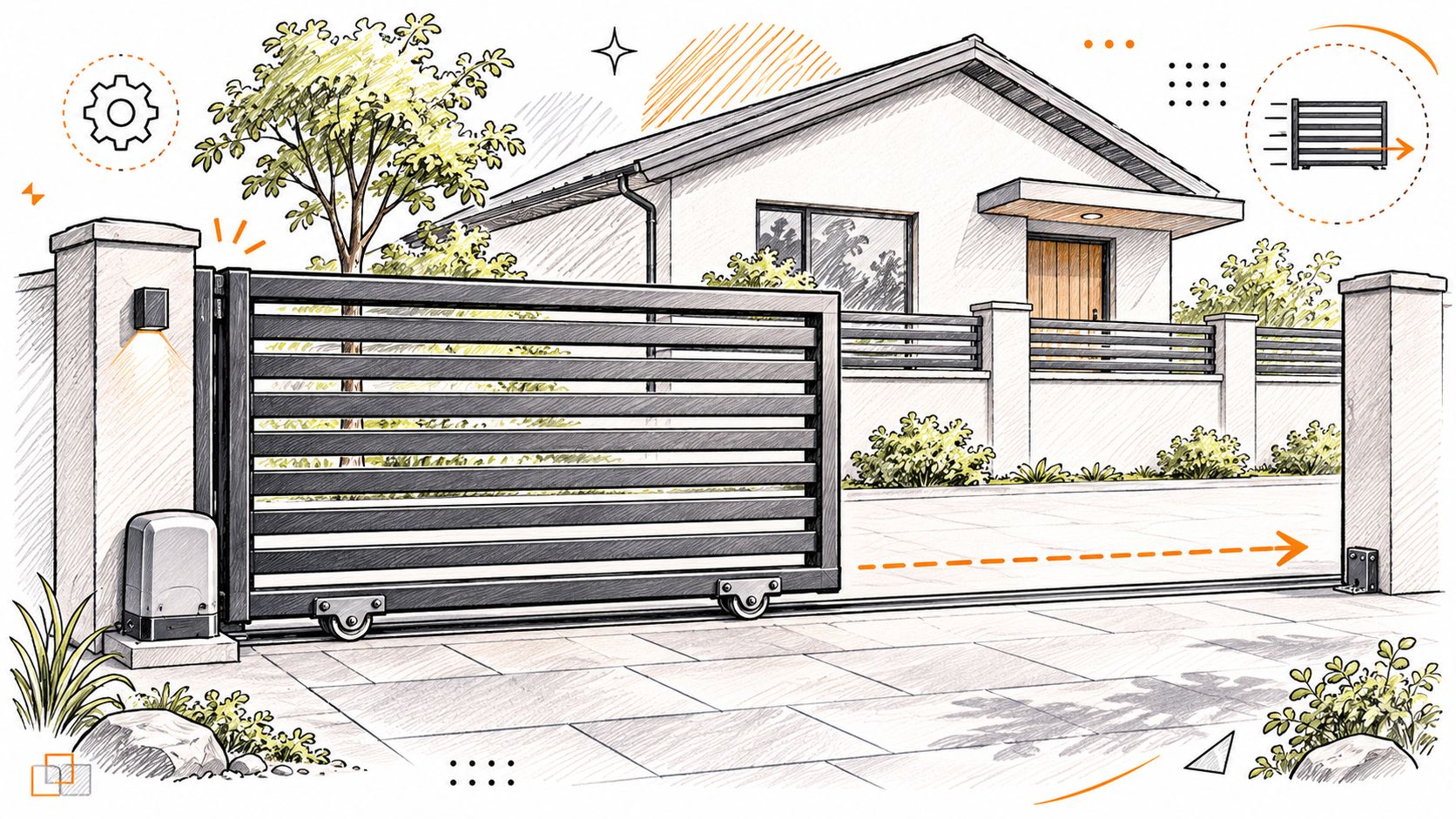
The trade-off sits along the fence line. A sliding leaf needs an unobstructed straight run beside the driveway at least as wide as the opening itself, plus room for the drive unit and receiver post.
Track Care and Pinch-Point Safety
Ground tracks collect gravel, fallen leaves, and standing rainwater. If water pools along the rail and freezes overnight, the wheels bind and strain the drive motor. Cutting a shallow trench drain or sloping the apron away from the track keeps the path clear through wet seasons.
Sliding panels also create hazards at both ends of travel, where the leading edge meets the latch post and where the tail rolls beside a wall or fence. According to the Door and Access Systems Manufacturers Association safety brochure, installers must pair non-contact photoelectric sensors with contact safety edges at pinch points and guard exposed weight-bearing rollers that could catch hands, fingers, or feet.
Consider a hypothetical suburban home with a short, sloped driveway where a parked pickup sits close to the street. A single sliding leaf clears the bumper cleanly, provided the homeowner keeps the side run free of shrubs and confirms the operator's weight and length limits in the manufacturer manual. Because models from brands like LiftMaster and DoorKing handle mounting and force settings differently, a qualified technician should match the operator to the finished gate weight.
- Measure the full side-run clearance before ordering a panel, accounting for utilities, trees, and fence posts.
- Build positive drainage away from the track so silt and ice don't jam the rollers.
- Upgrade an existing electric operator with a cellular add-on controller rather than replacing the gate; for example, Nimbio wires into the operator already on site over cellular LTE with no Wi-Fi required, keeps existing clickers, fobs, and keypads working, and lets managers issue or revoke time-limited digital keys or verify visitors by video. Readers can review how cellular gate openers work to see the retrofit approach.
2. Cantilever Sliding Gate
Consider a hypothetical mountain property where winter plows push slush across the apron and gravel washes down the lane after every storm. A ground-mounted track would foul within weeks. A cantilever sliding gate solves that ground problem by suspending the entire gate leaf above the driveway on an enclosed overhead or rear roller carriage.
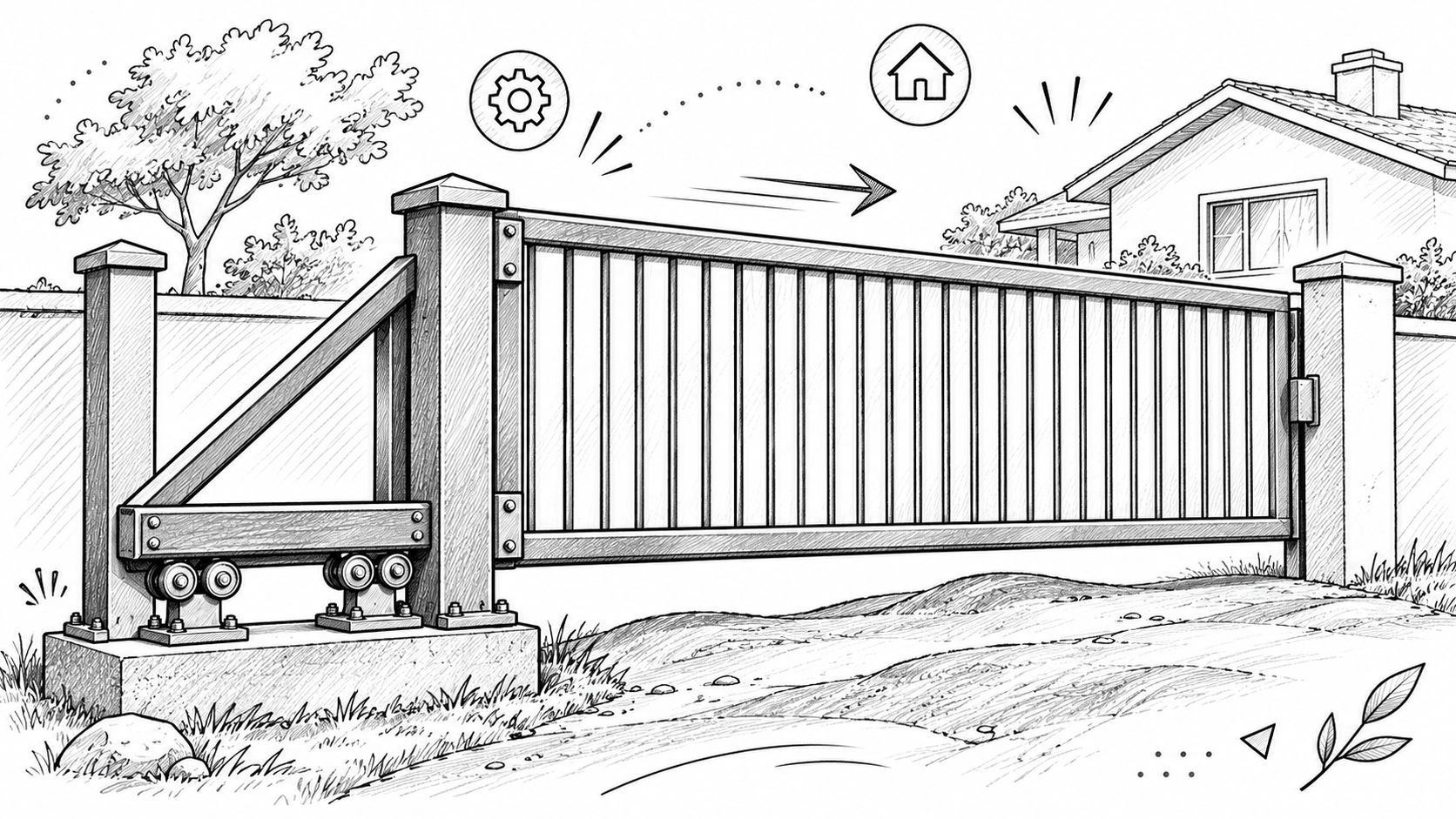
Two heavy support posts anchored in deep concrete footings hold the internal or external roller trucks on one side of the opening. The gate frame extends past the driveway width into a counterbalance tail, allowing the leaf to glide across the opening without ever touching the pavement.
Site trade-off: Eliminating the ground track costs you extra side space. A cantilever frame needs a counterbalance tail behind the support posts, so the total straight run beside the driveway is significantly wider than the opening itself.
Climate Resilience and Footing Demands
Design coverage from Culturizm points out that long-term reliability depends on matching gate geometry and hardware to freeze-thaw movement, snow accumulation, drainage, and local weather rather than picking a style for day-one looks alone. Because a cantilever leaf floats above uneven asphalt, brick pavers, or shifting gravel, minor frost heave won't halt daily cycles the way it jams a bottom track.
That suspended weight puts heavy strain on the support posts. Before pouring concrete, an installer should verify that the footing depth, post wall thickness, and carriage rating suit both the gate's span and local wind exposure.
Operator selection requires the same caution. Not every slide operator is built for cantilever geometry or heavier counterbalance frames, so check the manufacturer manual for approved configurations. Once installed, schedule routine inspections of the roller trucks, guide brackets, and rear travel zone so wear shows up before the gate sags.
3. Swing Gate
Swing gates remain the default mental image for residential entrances, and for good reason. Hinged at one or both sides, a single-leaf or double-leaf swing gate uses straightforward mechanical hardware, requires no side-run fence clearance, and suits classic and modern architecture alike.
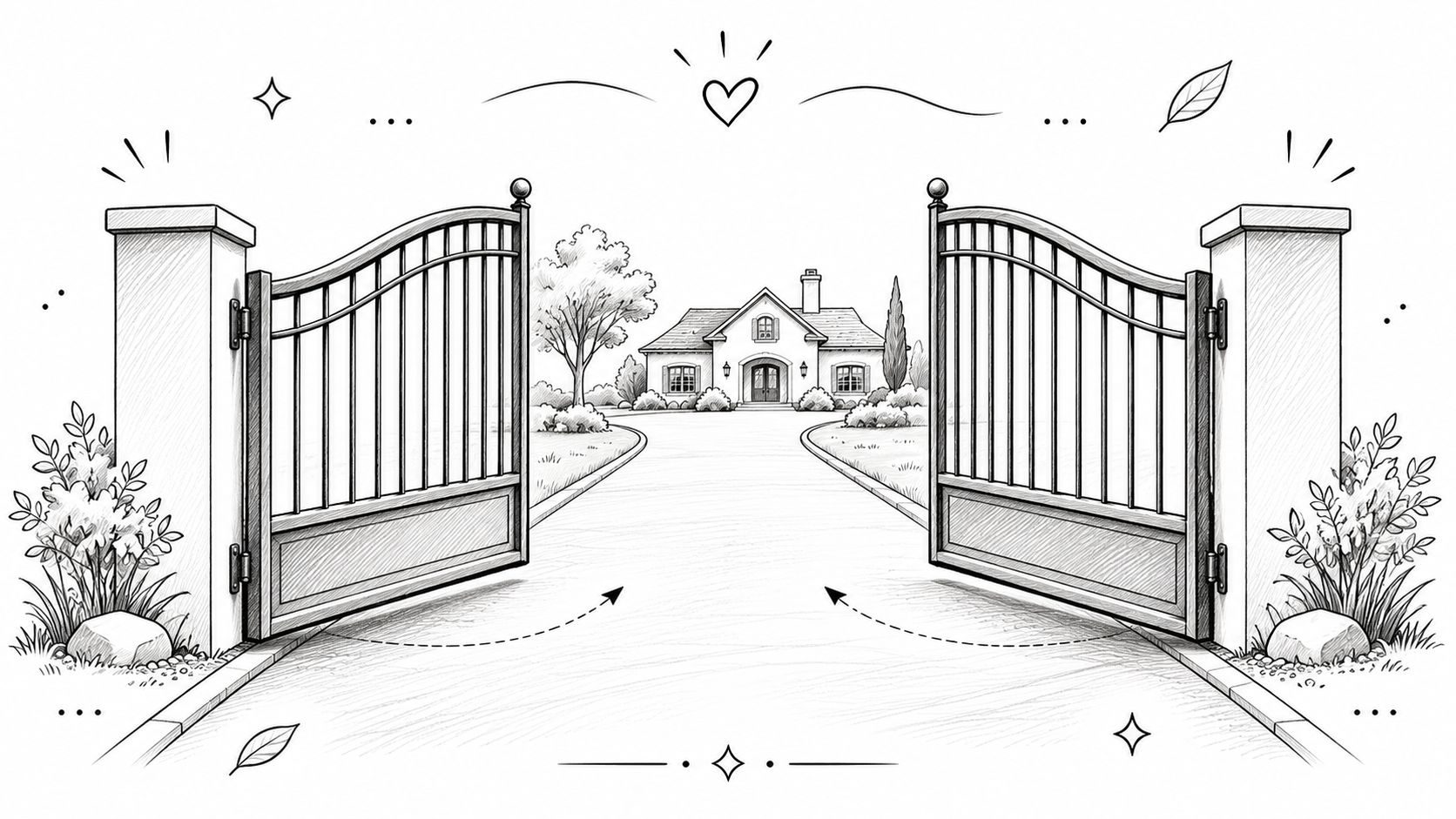
Double-leaf setups split the weight across two posts and cut the depth of the swing arc in half compared with a single wide leaf. Single-leaf designs work well on narrower openings where one clean panel makes structural sense.
Slope Limits and Entrapment Rules
Ground slope breaks more swing-gate plans than any other factor. If the driveway climbs uphill into the property, an inward-swinging leaf will drag against the pavement unless specialized uphill hinges raise the panel as it opens. Swinging outward toward a public road is rarely permitted because the leaf can block sidewalks or oncoming cars.
Automation also brings strict safety rules. Technical guidance from the Door and Access Systems Manufacturers Association on UL 325 and ASTM F2200 explains that ANSI/CAN/UL 325 governs the gate operator and its entrapment protection, while ASTM F2200 covers the gate's physical construction. Under UL 325, entrapment means a condition in which a person is caught or held in a position that increases the risk of injury, and each entrapment zone requires at least two independent protection means, with external sensors continuously monitored by the operator. Local building and fire codes vary, so confirm jurisdiction rules before digging post holes.
- Stake out the full swing arc with string and park the property's longest vehicle inside the apron to confirm the leaves won't clip bumpers or mirror housings.
- Match the linear actuator or articulated arm operator to both leaf length and finished weight, checking the manufacturer manual for duty-cycle limits.
- Follow the operator manual or hire a qualified technician to wire and align monitored photo eyes and safety edges, because sensor models differ by brand.
In a hypothetical flat suburban lot with deep setback from the curb, a double swing gate paired with linear actuators gives clean daily entry. If the property later wants smartphone entry alongside existing remotes, reviewing a cellular gate opener buying guide helps owners evaluate retrofit controllers without replacing working swing arms.
4. Bi-Fold Gate
When a driveway is too short for a full swing arc and lacks clear fence line for a sliding leaf, a bi-fold gate splits the difference. Each side uses two hinged panels that fold back against one another like closet doors as the gate opens, shrinking the clearance depth needed behind the entrance.
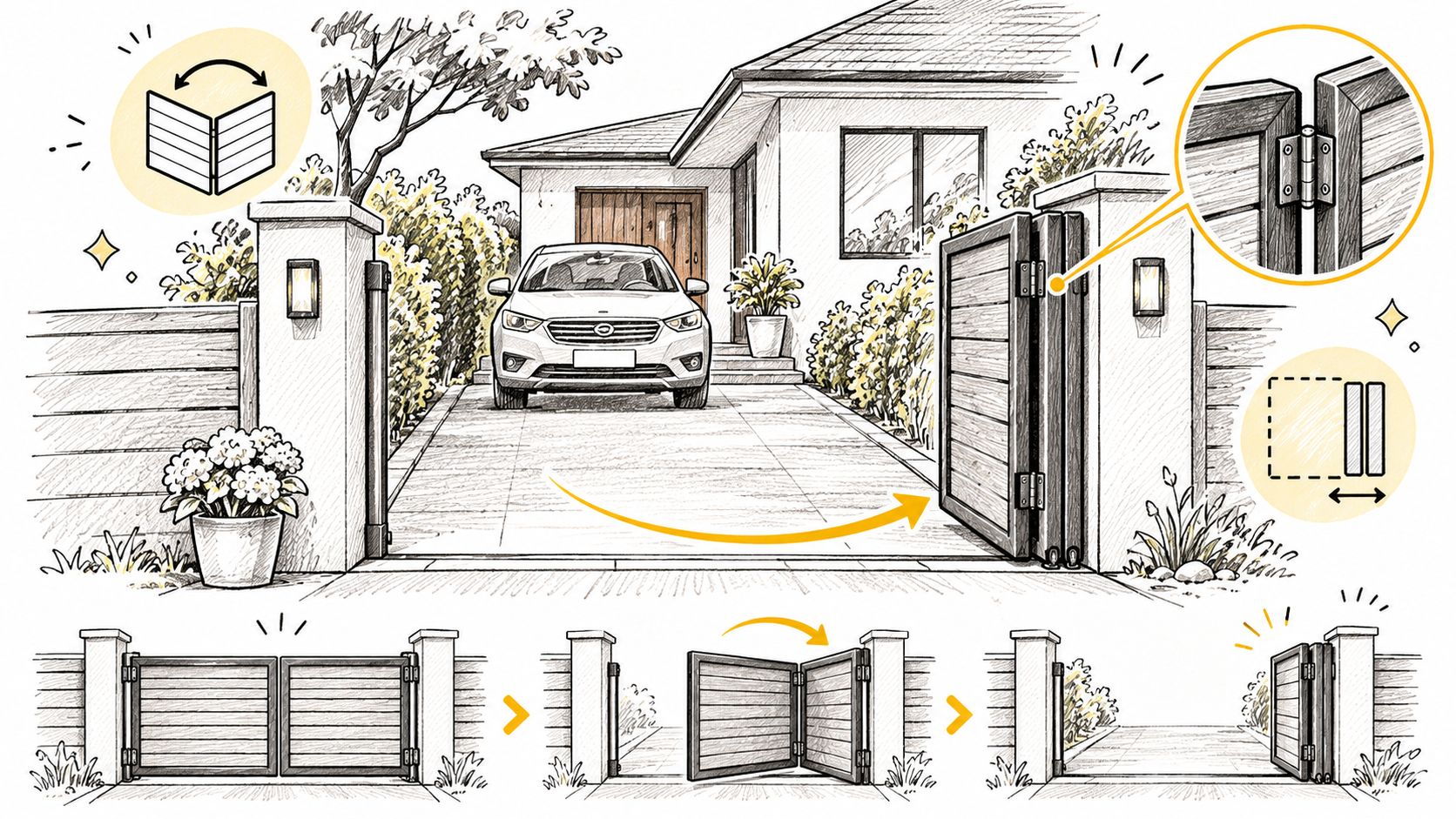
Bi-fold setups also cycle faster than wide swing leaves because the folding geometry clears the lane quickly. That speed appeals to busy urban homes, tight parking courts, and commercial driveways where waiting cars back up into street traffic.
Extra Hardware and Pedestrian Separation
Speed and tight geometry come with mechanical complexity. Folding panels depend on mid-leaf hinges, guide tracks or overhead linkages, and specialized drive arms that absorb twisting loads on every cycle. More pivot points mean more places for play, alignment drift, or rust to appear if nobody inspects them.
Ask any prospective installer to show completed bi-fold jobs on openings of similar width before signing a contract. Poorly braced folding leaves bind quickly once hinges settle.
Narrow urban entries also tempt people on foot to slip through the vehicle lane while the panels are moving. Safety documentation from DoorKing stresses that a vehicular driveway gate shouldn't serve as the normal pedestrian entrance; sites need a separate walk-through gate, guarded pinch points, and posted warnings keeping pedestrians clear of the moving path and fixed posts.
Imagine a hypothetical townhome courtyard bounded by brick walls on both sides of a short entry apron. A trackless bi-fold system clears parked cars inside the wall without needing side slide space, while a separate sidewalk walk gate keeps deliveries and residents away from the folding hinges. Confirm in the manufacturer manual that the chosen operator is specifically rated for bi-fold kinematics, and inspect every hinge pin and linkage at least once a year.
5. Vertical Lift Gate
A vertical lift gate skips horizontal movement altogether. Mounted between two structural guide towers, the panel rises straight up on chains or cables driven by a heavy-duty operator, clearing the entire lane overhead.
That layout fits sites with zero room to spare at ground level. According to ResearchAndMarkets, the U.S. gates market reached $4.70 billion in 2024, with the residential segment accounting for 43.19% of market revenue that year. Vertical lift assemblies bridge both sides of that market, showing up on tight hillside residential lots as well as commercial yards and parking structures where side clearance doesn't exist.
Overhead Clearance and Lift Maintenance
Trading ground space for vertical space shifts the physical constraints upward. Utility lines, overhanging tree branches, garage soffits, and tall delivery trucks all become hard clearance limits. If a box truck or moving van approaches a vertical lift gate that opens only to standard car height, the roof will strike the raised lower rail.
Structural engineering is also more involved than a standard swing or slide installation. The guide towers must carry the full dead weight of the panel, counterweights or springs, and wind pressure at full elevation.
Consider a hypothetical narrow hillside residence carved between two retaining walls, where neither a swing arc nor a side slide run can fit. A vertical lift gate provides controlled vehicle access within the exact footprint of the driveway width. Before choosing this layout, confirm the maximum vehicle height required for deliveries and emergency vehicles, verify local height permits, and commit to the manufacturer's inspection schedule for lift chains, cables, and safety brakes through a qualified gate technician.
6. Solid Privacy Panel Gate
A solid panel asks more of the ground it sits on than any other infill style. Posts, footings, and operator all carry the consequences of closing off sightlines completely with tongue-and-groove wood, solid steel sheets, aluminum planks, or composite boards with no open gaps. Where open picket designs shed wind, a solid privacy panel gate catches it, and that single difference drives most of the hardware decisions.
Solid panels pair with sliding, swing, or bi-fold frames and match perimeter privacy walls cleanly. Owners weighing full visual screening sometimes compare translucent or glazed boundary options first, like those detailed in this glass panel fence guide for Yorkshire, before committing to a fully opaque gate at the driveway.
Wind Load, Sightlines, and Re-Testing Sensors
Blocking the view also blocks the wind. A solid panel works like a sail, transferring heavy gusts directly into the frame, hinges, and operator gear train. An operator sized for an open bar gate of the same width will overheat or strip gears when asked to push a solid wood or steel panel in crosswinds. On exposed or sloped lots where wind funnels between structures, I would size the operator a class above the panel's calm-day weight and confirm the rating against the manufacturer manual.
Solid faces also blind exiting drivers to sidewalk foot traffic and approaching cars. A mounted convex mirror or an entrance camera gives drivers a clear check before pulling onto the street, and local zoning rules often cap solid front-yard gate heights near street corners to preserve sight triangles.
Safety testing can't stop at initial installation either. Guidance on UL 325 gate safety from Evergreen Electric Gates advises mapping every entrapment zone, combining monitored photoelectric sensors with contact edges so both non-contact and contact detection are covered, testing reversal during commissioning, and re-testing whenever landscaping, fencing, or driveway surfaces change.
- Have a fabricator size the steel sub-frame, posts, and operator for both finished panel weight and local wind gusts.
- Check city and HOA height rules for solid front-yard barriers before ordering custom panels.
- Plan driver sightlines with mirrors or cameras so solid privacy doesn't create a blind exit onto the road.
On a corner lot backing onto a busy boulevard, a solid composite sliding gate cuts road glare and street visibility, while a convex mirror at the exit post lets drivers spot cyclists before clearing the apron. The trade-off is fixed: maximum screening at the property line, paid for in heavier hardware, stricter operator sizing, and extra attention to exit sightlines.
7. Ornamental Wrought Iron Gate
Ornamental ironwork has anchored property entrances for generations. Historical overviews from Custom Driveway Gates trace how 19th-century wrought iron broadened gate design by combining durability with decorative detail, and how 20th-century automobiles turned private driveways into everyday vehicle entries.
Today, most "wrought iron" driveway gates are fabricated from welded tubular steel or solid bar stock styled with pickets, arched top rails, scrolls, and finials. Open picket spacing lets wind pass straight through, cuts sail load compared with solid panels, and preserves clear sightlines for drivers entering or leaving the property.
Weight Ratings and Rust Prevention
Decorative steel isn't light, especially when built with solid pickets or heavy scrollwork. Undersized hinges will sag within a few seasons, causing the latch edge to drag or miss the receiver. Before selecting an operator, weigh the finished fabrication or get an exact weight sheet from the shop and compare it against the operator's published rating in the manufacturer manual.
Moisture settles wherever horizontal bars, scroll rings, and picket welds meet. Ask the fabricator whether the finished gate will be hot-dip galvanized before powder coating or primed with a zinc-rich barrier, since plain wet paint over raw steel flakes fast in wet or coastal air.
Walk the gate line at the start of every spring and fall. Touching up a dime-sized paint chip at a weld joint takes five minutes and prevents deep rust from spreading under the coating.
In a hypothetical gated HOA entrance built decades ago with arched iron double-swing leaves, the steel structure often has decades of life left even when the old keypad and clickers feel outdated. Pairing that existing hardware with a modern community gate access system preserves the historic entrance while bringing remote credential control to the board and residents.
8. Mesh or Wire Infill Gate
A mesh or wire infill gate pairs a rigid steel or aluminum perimeter frame with welded wire mesh, expanded metal, or perforated steel sheets. It sits right between open iron pickets and solid privacy panels, keeping small dogs, wildlife, and windblown trash out while letting air and partial visibility pass through.
Because the infill weighs less than solid wood planks or sheet steel, it places lighter strain on hinges, rollers, and electric operators. Even so, the outer perimeter frame and posts still need full sizing for the finished span and daily cycle count.
Choosing Aperture Size and Keeping Panels Flat
Mesh selection starts with what the gate needs to block. Tighter welded wire squares keep small pets inside the yard, while perforated metal sheets soften sightlines from the street without creating a full wind wall.
Large expanses of thin wire mesh can ripple or bow over time if they aren't supported properly. Ask the fabricator to weld intermediate vertical pickets, horizontal mid-rails, or diagonal cross-bracing behind the mesh so the panel stays dead flat under operator force.
Consider a hypothetical rural property with dogs and heavy autumn leaf fall. A powder-coated aluminum frame filled with tightly spaced welded wire keeps pets safely inside the driveway boundary without blocking views down the gravel lane. After windstorms or heavy mud splatter, rinsing the mesh openings with a garden hose clears packed leaves and debris so extra damp weight doesn't throw the panel out of balance.
Movement, space, and best use for each driveway gate design
| Item | How It Moves | Space Needed | Best For |
|---|---|---|---|
| Standard Sliding Gate | Rolls sideways along a ground-level track | Clear side run about equal to the gate width | Limited swing space and level, straight driveways |
| Cantilever Sliding Gate | Slides on raised rollers without a ground track | Clear space beyond the opening for the gate to travel | Uneven drives or areas prone to track debris and snow |
| Swing Gate | Pivots on hinges, with one or two leaves | Clear swing arc on one side of the opening | Entries with ample room to swing |
| Bi-Fold Gate | Hinged panels fold back as the gate opens | Less swing room than a standard swing gate | Narrow entrances with limited clearance |
| Vertical Lift Gate | Rises vertically along guides | Clear overhead height above the opening | Properties with limited side and swing space |
| Solid Privacy Panel Gate | Solid panel can slide, swing, or fold | Depends on the operating style; allow room for its path | Privacy-focused properties |
| Ornamental Wrought Iron Gate | Can slide, swing, or fold | Depends on the operating style | Formal or classic entrances |
| Mesh or Wire Infill Gate | Can slide, swing, or fold | Depends on the operating style | See-through access control with a lighter infill |
Match the Gate to Your Space, Then Modernize the Access
Picking from these driveway gate ideas works best when the site dictates the mechanism first and the facade dictates the infill second. A tight, sloped entry points toward a standard sliding, cantilever, or bi-fold layout; a flat lot with deep setback opens the door to single or double swing leaves; a boxed-in lane with strict side boundaries calls for vertical lift engineering. From there, solid panels, ornamental iron, or wire mesh match the wind exposure, visibility needs, and upkeep schedule the property can support.
Before any concrete is poured or a new operator is bolted down, check municipal permits, HOA architectural rules, and local fire-department access requirements. Because gate codes and emergency-access rules vary by city and county, verifying setbacks, height caps, and power-failure release steps early prevents expensive rework.
Adding Smartphone Access Without Replacing a Working Gate
Many residential properties, multifamily sites, and gated communities already have a structurally sound gate and a working electric operator. Ripping out a functioning steel or wood gate just to gain phone entry wastes good hardware.
Technical guidance on UL 325 and ASTM F2200 compliance from Power Gate Openers lays out what a qualified technician should check before wiring any smart access controller into an existing operator: document the operator's control input, power availability, accessory voltage, relay requirements, duty cycle, and fail-safe behavior during a power or communications outage. The access control layer must stay isolated from the safety circuits. A remote-open trigger should initiate a normal gate cycle without ever bypassing monitored photoelectric sensors, contact safety edges, inherent force limits, manual emergency release, or local stop controls.
A cellular add-on controller fits neatly into that retrofit model. By connecting over cellular LTE instead of site Wi-Fi, it wires directly into the existing operator while existing clickers, fobs, and keypads keep working alongside the smartphone app. Property managers and HOA boards can issue or revoke digital keys remotely, assign expiration dates for contractors or guests, and verify visitors via video before opening the lane. Clear entrance signage also cuts down on delivery confusion and keeps pedestrians out of moving zones, and checking how to choose a gate sign helps match legible warning and visitor instructions to the entrance style.
Because wiring terminals and safety inputs vary across operator brands and models, check the manufacturer manual and work with a licensed gate or low-voltage technician before making changes. Property owners and community managers exploring a retrofit can review cellular gate access features or reach out to confirm compatibility for a specific gate model before scheduling installation.
If a property already has a working electric driveway gate, adding smartphone control doesn't require replacing the physical gate or running Wi-Fi to the street. Nimbio offers a hardware-agnostic cellular LTE add-on controller and smartphone app that wires into existing gate operators while keeping current clickers, fobs, and keypads working, letting property managers issue time-limited digital keys and verify visitors with video remotely. Visit Nimbio to see how cellular access control pairs with your current gate setup.