The broken access system is usually the first thing staff notice and the last thing they want to touch. Lost fobs, shared gate codes, resident complaints about visitors, and vendor delays pile up into the same daily drag, and that's where operational efficiency improvement becomes practical instead of abstract.
For property managers, efficiency is not just about trimming expenses. It's about keeping the gate moving, reducing staff interruptions, and making the community feel easier to live in without weakening security.
Table of Contents
- The High Cost of Inefficiency in Property Management
- Your Framework for Assessing Current Operations
- Pinpointing High-Impact Inefficiencies
- Implementing Process and Technology Solutions
- Measuring Success with the Right KPIs
- Sustaining Gains and Planning for the Future
The High Cost of Inefficiency in Property Management
A property manager's day can vanish into repeat work. One resident needs a new access credential, another forgot a fob, a vendor is waiting at the gate, and a board member wants to know why the front entrance still relies on a patchwork of old hardware and manual workarounds.
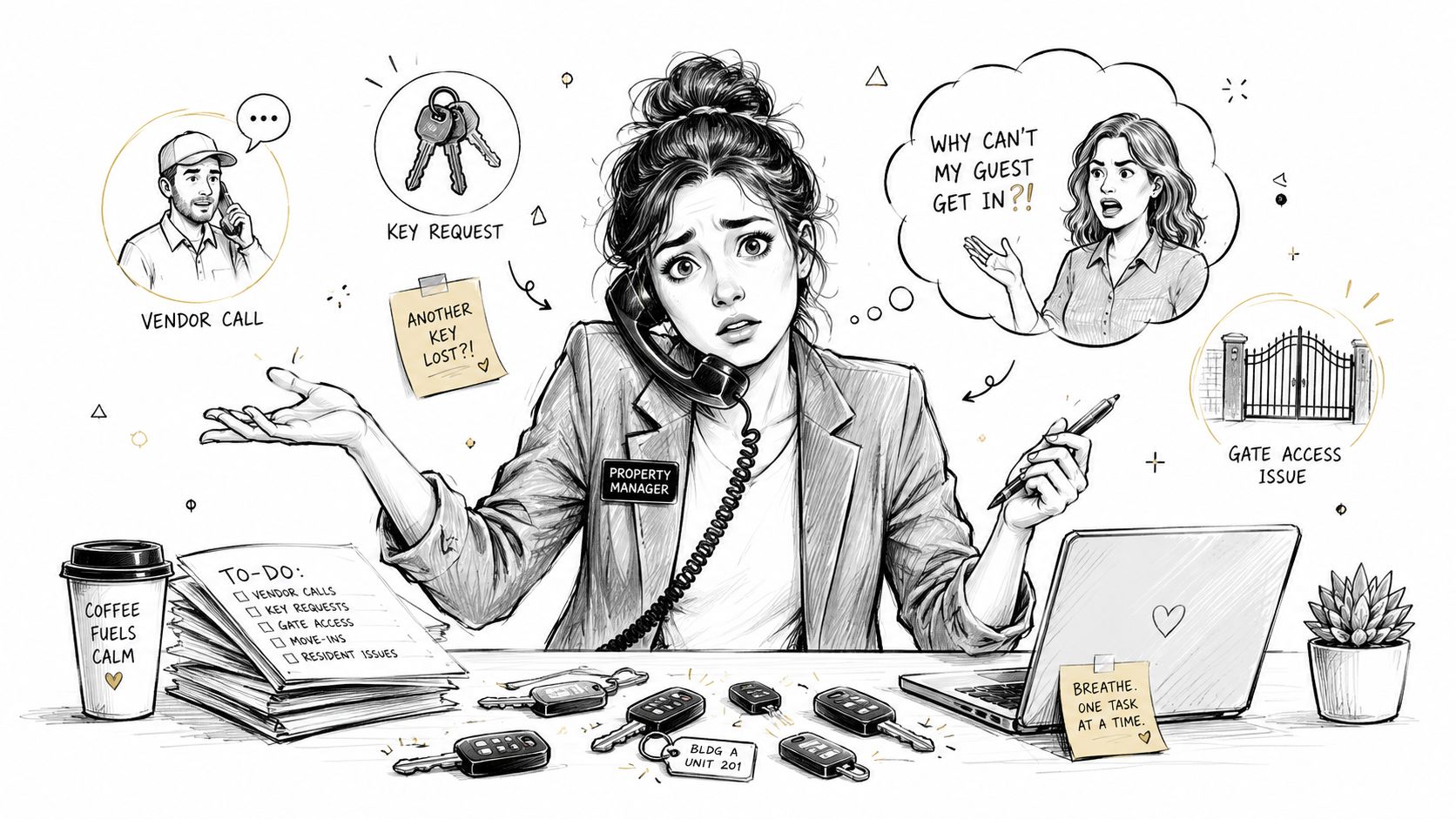
That friction is more than a staffing headache. It slows resident service, creates security exposure, and leaves the property feeling dated.
Why access control sits at the center of the problem
Access control shows operational inefficiency quickly. A gate that needs manual overrides, a visitor process that depends on phone calls, or a stack of obsolete fobs all generate repeat work that never really goes away.
McKinsey's efficiency benchmark is useful because it separates levels of improvement. Digitizing work can deliver a 20% to 50% impact, while simpler process streamlining typically produces 5% to 15%, and organizational redesign another 5% to 10%. McKinsey's efficiency benchmark shows why better operations depend on redesigning how work flows, not just cutting headcount or squeezing vendors.
For property teams, the target is not “less effort” in the abstract. The target is fewer access exceptions, fewer interruptions at the front desk, fewer calls to open the gate, and fewer resident complaints tied to outdated entry processes. If you need a practical reference point for that shift, the same logic applies when teams manage HOA communities remotely and still have to keep access moving without adding more manual coordination.
Practical rule: If a task keeps landing on the manager's desk every week, it is probably a process problem, not a people problem.
The hidden cost is the attention that gets pulled away from higher-value work. A manager who spends time chasing gate access or reissuing credentials has less time for resident retention, vendor oversight, and preventive planning.
When that pattern repeats, residents feel it first. They may not say operational efficiency improvement, but they notice when access is smoother and service is faster.
Your Framework for Assessing Current Operations
The right assessment starts with the work, not the software. Property managers need a clean view of where time is being lost, where errors happen, and which workflows create the most resident frustration.
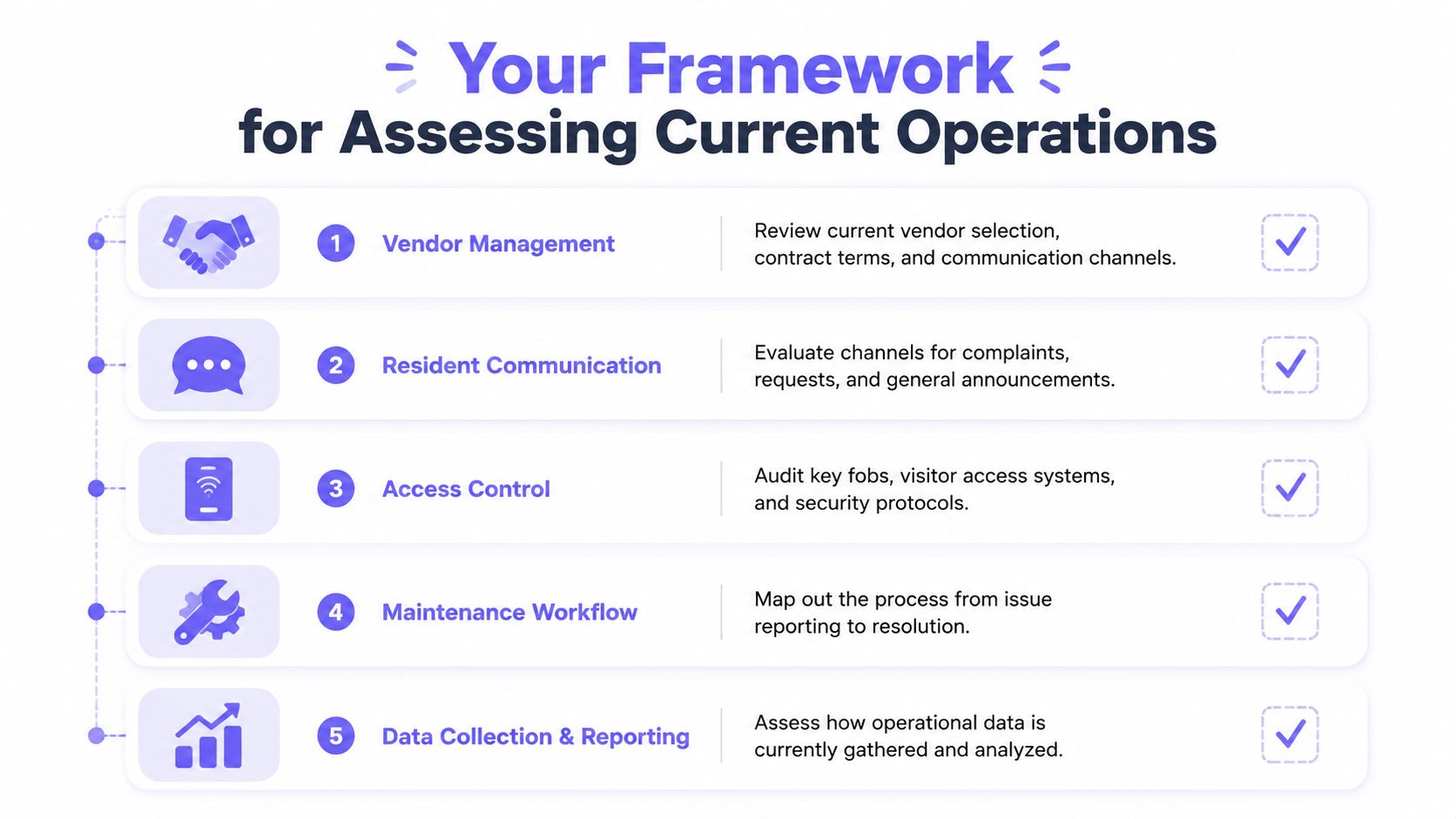
The fastest way to get that view is to audit the property in five areas.
- Vendor Management: Review who shows up when, how often they need help, and where approvals get stuck.
- Resident Communication: Track how complaints, requests, and announcements move through the property.
- Access Control: List every fob, keypad, shared code, visitor workaround, and manual override.
- Maintenance Workflow: Map how an issue moves from resident report to vendor completion.
- Data Collection and Reporting: Check what gets tracked, who reviews it, and how often it drives action.
Start with the questions that expose waste
The most useful audit questions are simple.
- Where do staff repeat the same action more than once?
- Which requests require the most follow-up before they get resolved?
- What happens when a resident forgets a credential after hours?
- Who is allowed to approve access, and how is that decision recorded?
- What gets tracked today, and what gets handled from memory?
That approach lines up with a measurement-first sequence. An operational guide recommends installing automated data collection, establishing a baseline, and using analysis to isolate the largest issues before redesigning or automating anything. The measurement-first sequence matters because automating a bad workflow only preserves the bad workflow.
A stable baseline is more valuable than a clever shortcut.
Property teams often skip this part because the pain is obvious. But obvious problems are not always the biggest ones. A front gate might feel like the main issue, while the actual time sink is repeated manual credential resets or poor visitor coordination.
Build a baseline without special software
A manager can start with a paper log, a spreadsheet, or the current property system. The point is to capture patterns, not perfection.
Track a few items for two weeks:
- How many access requests come in each day
- How many are repeat requests
- How often staff have to intervene
- Where the process breaks down
- Which issues create resident complaints
Once that baseline exists, the property has something concrete to improve against. Without it, every change becomes a guess.
Pinpointing High-Impact Inefficiencies
Not every problem deserves the same level of attention. The best property teams focus on the small number of issues that consume most of the time, most of the exceptions, and most of the complaints.

That is where Pareto thinking helps. In plain terms, it means looking for the vital few problems that drive the majority of pain, instead of treating every issue as equally urgent.
Sort the data before changing the process
A property manager reviewing a baseline should group issues by type.
- Access exceptions
- Visitor delays
- Maintenance handoff problems
- Vendor arrival confusion
- Resident communication gaps
Then ask which category eats the most staff time, which one causes the most resident complaints, and which one most often creates security risk. The answers rarely point to the noisiest issue, they point to the most repeated one.
A useful example is shared credentials. If a gate code, a keypad process, or a fob system creates constant exceptions, that is a signal to redesign the workflow rather than keep adding workarounds. The same logic applies to vendor access that depends on phone calls, memory, or a front office queue.
Use control, not guesswork
Operational improvement guidance also emphasizes statistical process control so normal variation is not confused with real degradation. The operational improvement framework makes a useful point here, when a point falls outside control limits, it should trigger investigation rather than being treated like routine noise.
That matters in property management because some delays are normal while others are structural. A one-off contractor delay is different from a recurring gate access failure that keeps resurfacing every week.
The point of the analysis phase is to avoid “fix everything” behavior. Teams get farther when they choose one or two key areas, such as access control or visitor management, and remove the friction there first.
Decision rule: Fix the issue that creates the most follow-up, not the issue that feels the most visible.
That is how operational efficiency improvement turns into a real advantage. The property stops solving a dozen small irritations and starts removing the process that creates them.
Implementing Process and Technology Solutions
The strongest improvements usually start with simple process cleanup. Standardize visitor check-in, define who approves access after hours, and stop relying on informal handoffs that only one staff member understands.
When the process is stable, technology becomes a force multiplier. In access-heavy properties, that often means moving from manual gate work to cloud-based access control that can be managed remotely and logged automatically.
Compare the old method with the modern one
| Method | Security Risk | Management Overhead | Resident Convenience |
|---|---|---|---|
| Physical fobs and clickers | Higher, because lost credentials create exposure | High, because replacements and resets keep coming | Low to moderate |
| Shared keypad codes | High, because codes spread easily | High, because codes need frequent resets | Moderate at first, weaker over time |
| Cellular keyless entry | Lower, because access can be granted or revoked digitally | Lower, because staff manage credentials remotely | High, because residents use a smartphone app |
Cellular systems also reduce a common failure point. Cellular access control systems stay online during local internet outages because they use a cellular network, not the property's Wi‑Fi. That resilience matters when the goal is to keep gates and doors working even if the building network is down.
For gated communities, that is a major operational advantage. It means resident access is less dependent on local infrastructure and less vulnerable to the exact outages that cause the most frustration.
A few tools and practices tend to work especially well together:
- Pre-approved visitor rules: Use defined access rules instead of ad hoc approvals.
- Digital credential management: Grant, revoke, and schedule access without reissuing physical devices.
- Entry logs: Keep a record of who entered and when.
- Role-based access: Give staff only the permissions they need.
For teams comparing workflow options, efficient support operations in 2026 is a useful resource because the same principle applies, reduce back-and-forth, standardize responses, and make the system easier to manage at scale.
Where the property needs a retrofit rather than a full replacement, a hardware-agnostic platform can preserve existing gate operators and reduce disruption. That is often the cleaner path for HOAs and multifamily communities that want a modern access layer without a full rebuild.
Nimbio is one option in that category. Its cellular-based controller turns existing gate or building entry hardware into smartphone-controlled access, which lets property staff manage credentials and visitor access remotely while keeping the existing gate operator in place.
For a community focused on resident convenience, that also connects cleanly with an apartment gate entry app. The key benefit is not novelty, it is fewer manual steps between request and entry.
Measuring Success with the Right KPIs
The right metrics make improvement real. Without them, a property can spend money on new tools and still have no clear proof that operations got better.
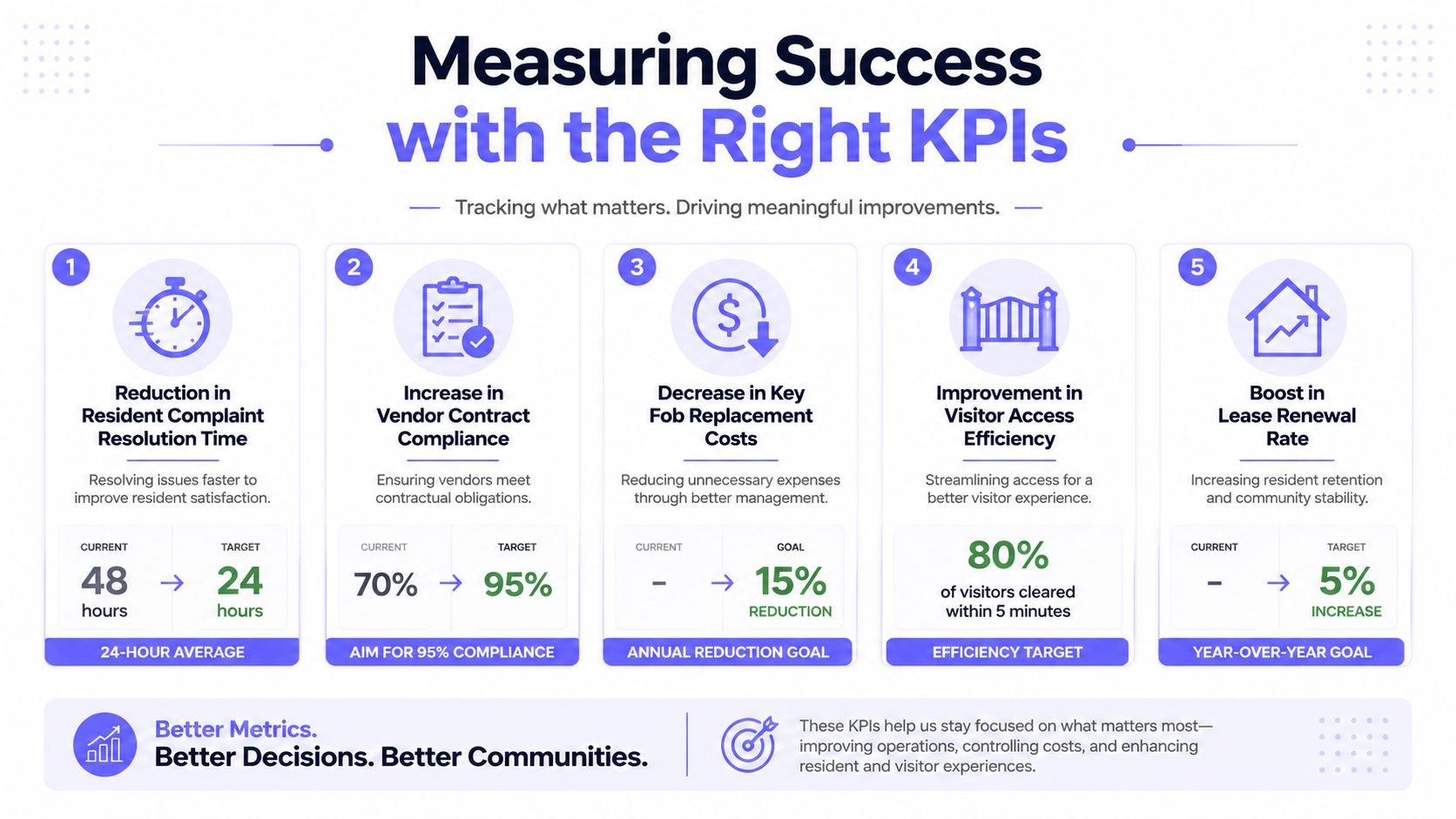
The most useful KPIs are tied to daily pain points. They should show whether staff are saving time, residents are getting faster service, and the property is cutting avoidable friction.
Pick metrics that connect to the workflow
Start with a short list that reflects how access work gets handled.
- Staff hours saved on access tasks
- Reduction in resident complaint resolution time
- Decrease in key replacement costs
- Visitor access speed
- Rate of access-related incidents
A useful improvement framework turns goals into specific, measurable targets supported by KPIs and manages them through phased implementation, deadlines, resource allocation, and risk review. Good operational change depends on that kind of discipline, especially when property teams are trying to reduce manual work without creating new failure points. The operational improvement guidance makes the same point, gains last longer when the rollout is managed instead of improvised.
For access-heavy properties, dashboards matter because they show more than device counts. A guide for HOA access control helps managers focus on visibility, auditability, and response speed, which are the things residents feel when access is working well.
Prove value with before-and-after comparisons
The cleanest KPI story is simple, baseline, change, result.
- Before: How long did access requests take?
- After: How long do they take now?
- Before: How many manual interventions happened in a typical week?
- After: How many are still needed?
- Before: How often were residents blocked or delayed?
- After: How often does that still happen?
For leadership teams and HOA boards, that is easier to trust than a general claim that the community feels better. It shows whether the change removed work from the system.
Track the metric that staff can influence directly, then review it often enough to catch drift early.
That same discipline is what helps drive major OEE improvement in other operations. In property management, it means keeping the improvement visible, comparing current performance with the baseline, and making sure the process does not slide back into old habits.
Sustaining Gains and Planning for the Future
Operational efficiency improvement only lasts when it becomes part of the operating rhythm. If teams stop reviewing the process, old habits come back, workarounds return, and the property drifts toward the same bottlenecks it had before.
The best safeguard is a simple cadence. Review the baseline, compare it with current performance, and ask where exceptions are creeping back in.
Choose technology that can evolve without a rebuild
Future-proof systems matter because property needs change. A platform that can receive over-the-air updates keeps improving without forcing a hardware swap, which is a better fit for communities that want long-term value from a retrofit.
That matters in a market that is still expanding. The U.S. Electronic Access Control System Manufacturing industry is projected to reach $3.2 billion in 2026, according to IBISWorld's industry outlook. The projection points to continued investment in modern access infrastructure, especially where older systems are creating avoidable work.
Property managers should treat that as a signal, not a sales pitch. Access control is moving from a hardware-first problem to an operations problem, and the properties that adapt earlier usually spend less time fighting basic friction.
Keep the improvement loop active
A simple sustaining plan works well:
- Review KPIs on a fixed schedule
- Watch for recurring exceptions
- Refresh staff training when processes change
- Retire workarounds that no longer add value
- Reassess access points when community needs shift
The point is consistency, not complexity. The property does not need a new project every month, it needs a habit of looking at what is slowing the operation down.
When that habit is in place, access control stops being a recurring headache and starts acting like a stable part of the operating model. That is the ultimate payoff of operational efficiency improvement in property management.
If a gate, call box, or resident access process is still creating daily interruptions, start with a simple operational assessment and document the biggest bottlenecks this week. Then compare that baseline against a cellular retrofit or another access upgrade, and use the results to decide where the next improvement should go. A CTA for Nimbio.