A pedestrian swing gate is a hinged walk-through opening intended for people only, kept physically separate from any vehicular gate so pedestrians stay outside the moving vehicle gate's path. Its hinges, latch, access controls, and emergency-exit arrangements need to work together, rather than just keep the opening locked.
A property manager may be facing complaints about a gate that won't latch, residents walking through the driveway entrance, or a proposed smartphone upgrade. Before approving new hardware, the property needs a clear decision about who uses the entrance, how they pass through it, and what happens when something fails.
Table of Contents
- What a Pedestrian Swing Gate Is and Why It Matters
- How a Pedestrian Swing Gate Works and What It Is Made Of
- Safety and Accessibility Codes That Apply
- How It Compares to Other Pedestrian Barriers
- Where Pedestrian Swing Gates Make Sense in Practice
- Automation and Retrofit Options for Existing Gates
- Emergency Behavior and What Most Articles Skip
- Buying, Installation, and Maintenance Checklist
What a Pedestrian Swing Gate Is and Why It Matters
A gate that was supposed to control access can become a daily workaround. Residents prop it open, visitors wait in the driveway, and maintenance staff repeatedly adjust the latch without resolving why it keeps missing.
Those symptoms call for a review of the whole entrance. A pedestrian swing gate includes the moving panel, supporting posts, hinges, closing hardware, latch, and any electronic access equipment. The approach and departure spaces matter too, especially when someone has to stop, present a credential, and pull the gate toward them.
Start with the pedestrian route
The first design question is where people walk. A convenient opening that requires someone to cross vehicle movements or stand beside a moving gate is a poor starting point, regardless of the access-control equipment attached to it.
The Door and Access Systems Manufacturers Association's gate-system safety guidance calls for a clearly visible, dedicated pedestrian entrance separated from moving vehicular gates. It also identifies entrapment concerns beneath moving gates where gaps are greater than 4 inches but less than 16 inches, and hazards associated with openings exceeding 2.25 inches in applicable configurations.
A pedestrian entrance should be the obvious route, not the route residents discover after trying the driveway gate.
A useful assessment separates three decisions:
- The route: Where pedestrians approach, wait, pass through, and leave.
- The barrier: Whether the gate can move, close, and latch without obstructing that route.
- The authorization: Who receives access and how visitors request entry.
Changing authorization won't correct a badly positioned gate. Likewise, replacing the panel won't solve an inconvenient credential process that encourages residents to prop it open. Property managers should identify the actual failure before requesting quotes for a replacement.
How a Pedestrian Swing Gate Works and What It Is Made Of
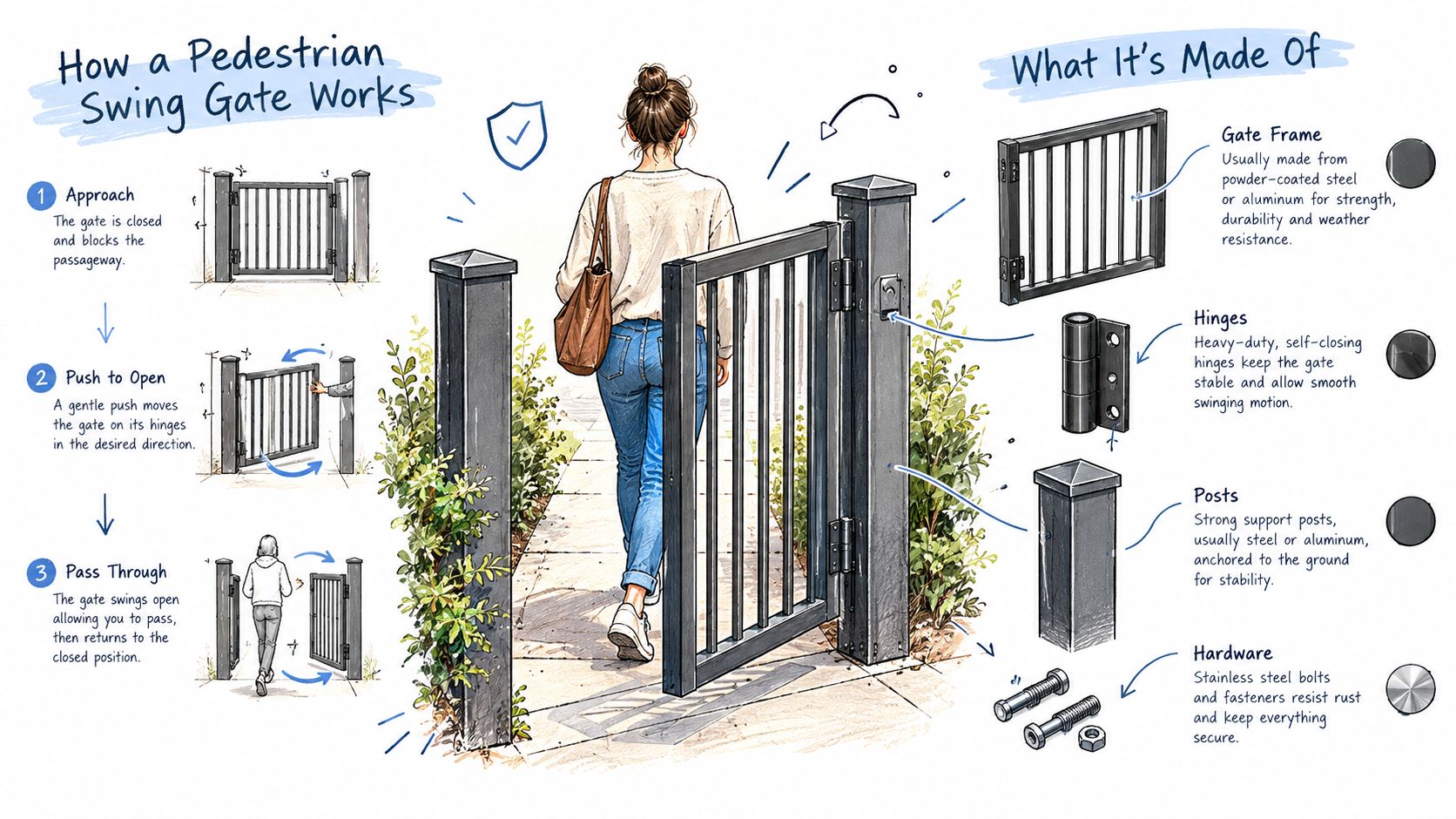
The leaf is the moving gate panel. Hinges support it at the post, while the latch holds the opposite edge closed. A closer returns the leaf after passage; a powered operator, where appropriate, moves it automatically.
The swing envelope is the entire area the leaf travels through. That space must remain usable throughout opening and closing, including when a person pauses beside the gate or approaches from the opposite direction.
Measure the passage, not just the panel
The California Public Utilities Commission's pedestrian rail-crossing guidance identifies a minimum path width of 48 inches (1,220 mm) and describes typical swing-gate installations as approximately 3 feet by 3 feet, with the gate top about 3 feet 6 inches above ground. Its discussion also references a 32-inch clear-width minimum in Caltrans guidance.
These are transportation-context references, not universal dimensions for every property. Local accessibility requirements vary, and the installer should establish the required clear passage before selecting a gate.
Frame width and usable opening aren't interchangeable. The opened leaf, hinges, stops, and projecting hardware can affect the space available for a wheelchair, stroller, or luggage.
Choose materials and hardware together
Material options worth discussing with a fabricator include galvanized or powder-coated steel, aluminum, wrought iron, and treated wood. Rather than choosing on appearance alone, the specification should address gate weight, finish maintenance, exposure, and compatibility with the proposed hinges and closer.
For coastal or poolside exposure, the supplier should document the suitability of both the finish and hardware. A decorative panel specification isn't enough to establish corrosion resistance for the assembled entrance.
The Neasden Hardware hinge selection advice provides a useful starting point for discussing hinge options with a supplier. Final selection should follow the actual hardware documentation and gate design, including swing direction, nearby obstacles, and ground clearance.
Safety and Accessibility Codes That Apply
Standards names often appear together in proposals, but they address different parts of the installation. A property manager should ask the installer to explain which requirements apply to the proposed equipment and which authority will approve the completed entrance.
ANSI/CAN/UL 325 addresses automated operator safety, while ASTM F2200 addresses automated gate construction. DASMA technical publications explain related installation and protection practices; they aren't a substitute for the applicable standard, equipment instructions, or local approval.
Entrapment protection is directional
According to DASMA's ANSI/CAN/UL 325 entrapment-protection guidance, automated swing-gate operators require at least two independent entrapment-protection means in each direction of travel where an entrapment zone exists. Permitted combinations can include inherent force limiting, non-contact photoelectric sensors, contact edge sensors, or other accepted methods; a direction without an entrapment zone may qualify for an exception allowing a single method.
That distinction matters. Counting sensors around the entrance doesn't establish that every hazardous movement is protected. The installer needs to identify the opening and closing hazards separately, including hinge-side draw-in areas and places where the leaf approaches a wall or post.
Practical rule: A command to open the gate must never become permission to bypass its protective devices.
The design review should distinguish between:
- Authorization equipment: Apps, keypads, readers, and call stations that request access.
- Movement protection: Devices and operator functions that address hazardous motion.
- Accessible passage: Clear opening, approach space, usable hardware, and operating effort.
Confirm what applies locally
Federal transportation guidance, industry standards, and locally adopted building or fire requirements aren't interchangeable. A rail-crossing recommendation shouldn't be presented as a blanket requirement for an HOA entrance, and an accessibility width alone doesn't establish a compliant installation.
Local requirements vary. The property should obtain confirmation of applicable accessibility provisions, permits, emergency-egress rules, and inspection requirements from the relevant authority and a qualified installer.
A proposal that merely says “code compliant” leaves too much unresolved. The useful version identifies the operator, its intended application, the protected hazards, and the approval basis.
How It Compares to Other Pedestrian Barriers
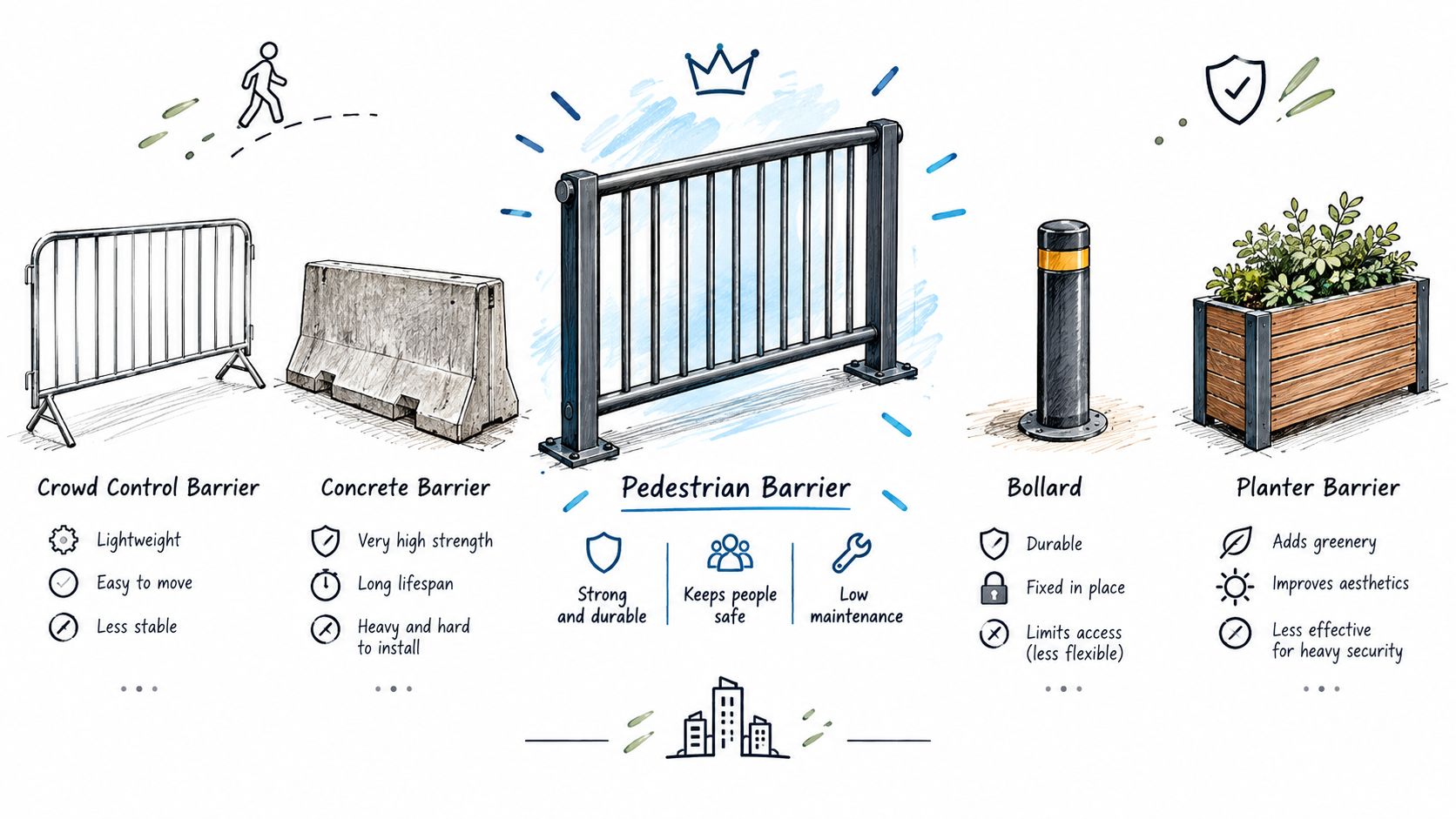
The right comparison starts with the operating problem. An entrance intended to admit residents with shopping bags needs a different assessment from a staffed checkpoint that regulates individual passage.
A pedestrian swing gate belongs on the shortlist when the property can provide its swing space and wants a familiar walk-through opening. Other barriers deserve consideration when individual passage control, constrained geometry, or vehicle exclusion is the main objective.
Compare the whole entrance
| Option | Decision it helps address | Question for the supplier |
|---|---|---|
| Full-height turnstile | Controlled individual passage | What accessible and emergency routes accompany it? |
| Waist-high turnstile | Managed pedestrian entry | How will the property handle bypass attempts and bulky items? |
| Optical speed gate | Managed flow through monitored lanes | Is the selected model suitable for the exposure and operating environment? |
| Fixed bollards | Vehicle exclusion | Is pedestrian authorization actually required? |
| Sliding pedestrian gate | A layout with limited swing space | What protection and maintenance does its travel arrangement need? |
| Locked pedestrian door | Entry through a building envelope | Which locking and egress hardware suits the opening? |
A keypad isn't a barrier type. It is an authorization device that can serve a gate or door. A magnetic lock is also a component, so comparing a "maglock entrance" with a swing gate can obscure the choice about the physical opening.
Compare scope before price
There's no dependable cost band without a site and equipment specification. Quotes should separate fabrication, foundations, electrical work, access controls, protective devices, commissioning, and ongoing service.
For wheelchair users, strollers, and luggage, the evaluation should include the complete passage sequence, not just nominal lane width. For outdoor installations, bidders should document suitability for weather exposure rather than assume indoor equipment will work outside.
As a selection rule, favor a swing gate when straightforward passage and manageable hardware are the priorities. Investigate turnstiles or speed gates when controlling individual passage or handling concentrated arrivals dominates the decision, but require a site-specific demonstration rather than a throughput promise.
Where Pedestrian Swing Gates Make Sense in Practice
Hypothetical single-family property: A homeowner has an automated driveway gate, but visitors on foot use the vehicle opening. A separate walk-through entrance belongs where a visitor can reach it directly, identify the access device, and wait without standing in the driveway.
That doesn't mean cutting a small door into the existing vehicle leaf. ASTM F2200's pedestrian-access provisions require positioning that prevents contact with the moving vehicular gate and prohibit incorporating the pedestrian gate into the vehicular panel or the adjacent fence section covered by that panel when open; local requirements vary.
Residential and workplace examples
Hypothetical HOA or multifamily property: Residents approach a shared entrance carrying groceries or pushing strollers. The design should let them present a credential from a usable position and pass through without having to hold the gate against its closer while maneuvering around a post.
The HOA board should assess both sides of the opening. A convenient entry arrangement can still produce an awkward exit if the latch, reader, or approach space was considered from only one direction.
Hypothetical warehouse property: Employees leaving a parking area need a route to the building that doesn't direct them through the loading entrance. The pedestrian gate should connect with the intended walking route, rather than deposit people into a vehicle maneuvering area.
The operating plan should also identify who handles visitor requests and contractor credentials. That management question belongs alongside the physical layout when evaluating commercial gate access control.
Channelized crossing example
Hypothetical transit property: A fenced walkway directs pedestrians toward a controlled crossing. Gate placement, opening direction, closing behavior, and accessible passage must be assessed together under the applicable transportation guidance.
The fence and approach should support the intended route instead of making a shortcut look easier.
Across these settings, the useful design test is practical: can a person recognize the entrance, reach its controls, pass through, and continue along the intended path? An attractive gate panel can't compensate for an entrance that fails that test.
Automation and Retrofit Options for Existing Gates
A retrofit and a new automated gate installation solve different problems. A retrofit changes selected functions of an existing entrance; a new operator installation changes how the gate moves and introduces a separate equipment-selection and safety review.
Before choosing either approach, the property should establish whether the existing leaf, supports, closing action, and latch are serviceable. Adding electronic control to an unreliable mechanical entrance leaves the original problem in place.
Decide what needs to change
A qualified installer should distinguish among the available changes:
- Controlled release: Evaluate a compatible electric strike or magnetic lock for a manually operated entrance.
- Credential choice: Consider a keypad, card or fob reader, intercom, or call box according to how residents and visitors obtain access.
- Remote administration: Assess an add-on controller where managers need to change access without attending the property.
- Powered movement: Select an operator specifically intended for pedestrian use, rather than repurposing a vehicular operator.
DASMA's guidance on pedestrian and vehicular gate applications states that vehicular gate operators aren't intended for pedestrian gates. It also addresses protecting gaps larger than 2.25 inches (57 mm) between gates and fixed objects, and recommends smooth gate bottoms with hardware or sensor projections no greater than 0.5 inch (13 mm) beyond the base; applicable local requirements vary.
Keep access control separate from movement safety
One cellular retrofit option is Nimbio, which connects over LTE without Wi-Fi at the gate and wires into the existing gate operator without requiring gate replacement. Existing clickers, fobs, and keypads keep working alongside its smartphone app, while property managers can issue and revoke digital keys remotely and set expiration dates.
The explanation of retrofitting legacy gate operators is relevant when the installed operator is staying. For projects involving separate industrial controls, ATEK Distribution control solutions can serve as a discussion resource, not proof of compatibility with a particular gate.
Wiring, protective-device selection, and commissioning must follow the selected manufacturers' manuals. Models differ, so a qualified technician should verify the actual equipment rather than apply a generic relay diagram.
Emergency Behavior and What Most Articles Skip
“Always locked” isn't a complete safety strategy. It describes an entry condition without answering whether someone can leave during a fire, power failure, actuator fault, lost phone, or communications interruption.
Fail-safe generally describes locking hardware that releases when power is lost. Fail-secure generally describes hardware that remains secured without power, but that description alone doesn't establish whether mechanical egress remains available. The selected lock's documentation and locally applicable fire and egress requirements must determine the arrangement.
Separate secure entry from safe exit
The property should obtain a written explanation of what happens when each part of the system fails. A lost credential, unavailable communications service, failed lock supply, and jammed gate are different events and shouldn't receive the same vague answer.
The Federal Railroad Administration's swing-gate guidance describes gates opening away from tracks, returning closed automatically, and using channelization to discourage bypassing. The associated California guidance calls for one-hand operation without tight grasping and at least 1.5 seconds to close from a 70-degree open position; these are rail-crossing references, and local requirements for other properties vary.
Secure entry and usable emergency exit are separate design obligations.
Record the response before an incident
The emergency plan should cover:
- Manual release: Identify the manufacturer-approved procedure, who may perform it, and where instructions are kept.
- Evacuation: Confirm the approved exit route and how access schedules interact with emergency operation.
- Backup power: Have the installer document what it supports and how it is inspected.
- Visibility: Review signs and lighting from both approaches.
- Drills and records: Record observed failures, corrective work, and any available event logs.
These are planning checks, not instructions to defeat a lock or disconnect an operator. Hardware-specific testing and release procedures belong in the manufacturer's manual and the property's approved emergency plan.
Buying, Installation, and Maintenance Checklist
A useful buying package defines the entrance before naming the controller. Bidders should receive the intended route, user needs, existing-equipment details, exposure conditions, and required emergency behavior so their proposals address the same job.

Before approving the work
- Equipment documentation: Require the operator's intended application, applicable listing information, and installation manual.
- Gate construction: Ask the installer to document the applicable construction standard and resolve hazardous geometry.
- Protection design: Obtain the opening- and closing-direction hazard assessment and specified protective methods.
- Local approval: Confirm permits, accessible passage, fire-egress requirements, and any HOA appearance restrictions.
- Acceptance records: Specify the documentation, demonstrations, and unresolved-item list required before handover.
The dimensional and protection requirements discussed earlier belong in this documented review. A general assurance that the installer has “done plenty of gates” isn't a substitute for equipment-specific decisions.
Agree on maintenance responsibilities
The service proposal should identify who inspects hinges, gate alignment, closing action, latching, sensor condition, and any backup supply. Adjustment methods and intervals should come from the selected manufacturers' manuals, not a generic maintenance schedule.
Property staff should also know which observations require taking the entrance out of normal service and calling a qualified technician. Repeated latch failures, damaged hardware, and protective-device faults shouldn't become routine workarounds.
For a sound existing installation, the cellular gate access system buyer's guide can help frame questions about a control retrofit. A replacement proposal should explain what cannot reasonably be retained; a retrofit proposal should identify exactly what changes and what stays.
The approval decision should leave the property with a usable pedestrian swing gate, documented emergency behavior, and a clear service responsibility, rather than merely a new way to request entry.
For properties retaining a suitable electric gate, Nimbio offers a cellular add-on controller and smartphone app that work alongside existing access devices. Property managers can visit the site to discuss the existing equipment and whether smartphone access fits the proposed pedestrian swing gate retrofit.