A gate that sticks, reverses, or stops answering remotes creates the same chain reaction almost every time. Residents complain, vendors wait at the entrance, and the property manager gets forced into a rushed buying decision. That’s usually when people search for top rated gate openers and start comparing brands, motor sizes, and feature lists.
The problem is that a “top rated” solution isn’t always a brand-new operator. Sometimes the gate motor is worn out and replacement makes sense. Sometimes the operator is still doing its job, but the access method is outdated, hard to manage, and impossible to audit. Those are two very different problems, and treating them the same usually wastes budget.
The category is large enough that this decision matters. The global gate openers market was valued at US $1.15 billion in 2024 and is projected to reach US $1.83 billion by 2031, growing at a 6.the majority CAGR, with Chamberlain Group, Nice S.p.A, and ASSA ABLOY controlling nearly 40% of the market, according to Report Prime’s gate openers market company analysis. For managers dealing with aging LiftMaster, Nice, DoorKing, or Viking equipment, that installed base creates a practical opportunity to upgrade intelligently instead of replacing hardware by default.
A smarter buying process starts with one question. Is the gate opener failing mechanically, or is the property just missing the access control features people now expect from a cellular gate opener?
Table of Contents
- Choosing Your Next Gate Opener Starts Here
- Swing vs Slide Understanding the Core Gate Opener Types
- Decoding the Specs Key Features That Truly Matter
- Your Pre-Installation and Compatibility Checklist
- Replace or Retrofit The Smart Decision Pathway
- Advanced Security for HOAs and Commercial Properties
- Frequently Asked Questions About Gate Openers
Choosing Your Next Gate Opener Starts Here
A good gate purchase starts with the gate, not the brochure. Too many buyers begin with brand rankings and skip the more important question of whether the site needs a swing operator, a slide operator, or just a smarter control layer on equipment that already works.
That distinction matters because gate systems fail in different ways. Some fail at the motor or gearbox. Others fail at the user side. Lost remotes pile up, keypad codes get shared too widely, and no one can tell who opened the gate or when. In those cases, replacing the whole operator can solve the wrong problem.
What property managers should evaluate first
Before comparing the top rated gate openers on the market, narrow the decision to three issues:
- Gate movement: Does the gate swing inward or outward, or does it travel horizontally on a track or cantilever system?
- Daily use: Is this a private residence, a multifamily entrance, a service yard, or a commercial site with repeated traffic?
- Current pain point: Is the failure mechanical, electrical, or administrative?
Practical rule: If the gate leaf is sound and the operator still moves it reliably, the weak point may be access control, not the machine itself.
The strongest buying decisions usually come from matching the job to the hardware category first, then deciding whether the site needs replacement or modernization. That’s why some of the most useful “ratings” aren’t customer-star summaries at all. They’re fit-for-use judgments based on weight, duty, access method, and serviceability.
A useful way to think about “top rated”
For a homeowner with a light swing gate, a compact residential unit may be a strong fit. For a commercial entrance with heavier leaves or frequent cycling, that same opener may struggle, overheat, or wear out early. The label top rated gate openers only helps when it’s tied to the actual application.
A better approach is simple. Rate the opener on how well it matches the gate you have, the traffic you manage, and the level of access control your property needs to enforce.
Swing vs Slide Understanding the Core Gate Opener Types
A property manager usually feels this decision on a Monday morning. Residents are stacking up at the entrance, a delivery truck is waiting, and the question is no longer which opener sounds best on paper. The main question is whether the gate type fits the site well enough to justify a new operator, or whether the existing gate can stay in place and get a smarter control upgrade instead.
How swing gate openers fit the site
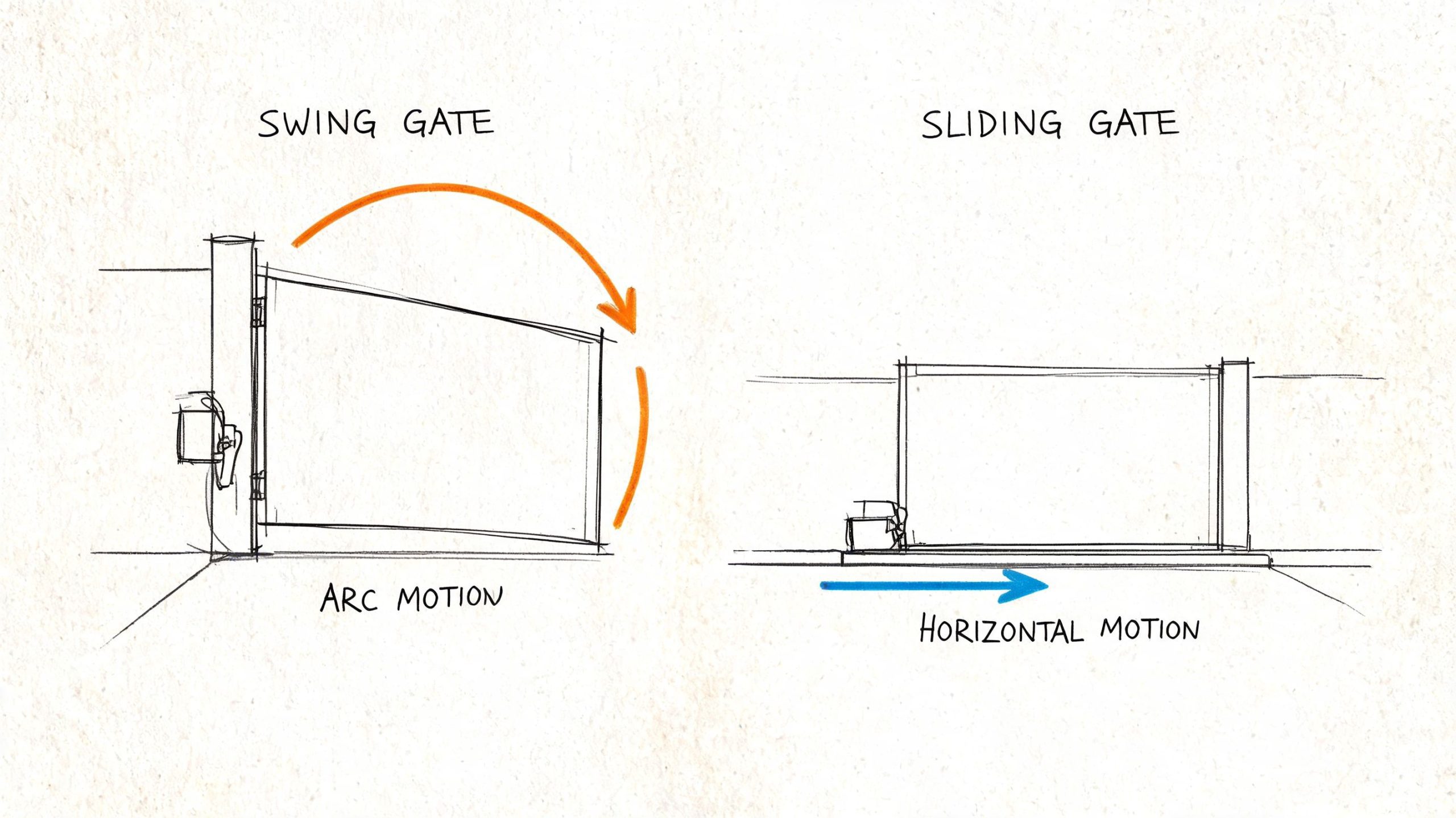
Swing operators work well when the entrance has enough clearance for the gate leaf to travel freely and consistently. On older properties, that is the first thing to verify. A swing gate may look serviceable, but if the hinges are worn, the apron has shifted, or the leaf catches on grade, a new opener will inherit the same strain every time it cycles.
The main swing styles are articulated arm, linear ram, and underground operators. Each solves a different site problem. Articulated arms help where post geometry is awkward. Linear rams suit cleaner layouts with predictable hinge alignment. Underground units protect appearance, but they usually cost more to install and service.
This is also where replacement versus retrofit starts to matter. If the swing gate structure is straight, the hinges are sound, and the operator still moves the leaf without fighting the gate, replacing the whole system may be unnecessary. Many properties get a better return by keeping the mechanical side in place and upgrading the access control layer with a modern cellular-based controller, especially when the actual problem is outdated entry management, poor credential control, or missed visitor calls.
How sliding gate openers fit the site
Sliding operators make more sense when there is limited depth behind the opening, frequent wind exposure, or a need to move heavier gates with more predictable force. They avoid the wide arc of a swing gate, which is often the deciding factor at commercial entries, multifamily sites, and service roads.
The trade-off is different maintenance. A slide gate depends on lateral travel space and reliable support. With track systems, debris, worn rollers, and surface movement can create recurring service calls. Cantilever systems remove the track from the driveway surface, but they need proper support hardware and room for the gate to store fully open.
From an operations standpoint, slide systems are often easier to justify for busy properties because they usually tolerate repeated cycles better and handle larger leaves more comfortably. But that does not automatically mean full replacement. If the slide gate frame, rollers, and operator are still in working order, a retrofit can improve security and day-to-day control at a much lower cost than tearing out the whole entrance.
| Criterion | Swing Gate Opener | Sliding Gate Opener |
|---|---|---|
| Movement style | Opens in an arc | Travels horizontally |
| Space needed | Needs clear swing path | Needs lateral run space |
| Common fit | Driveways, estates, smaller residential entries | Commercial entries, tight-depth sites, heavier gates |
| Sensitivity to grade | More affected by slope, hinge condition, and drag | More affected by track, roller, or cantilever condition |
| Wind exposure | Large solid leaves create higher load | Often easier to manage in exposed sites |
| Upgrade path | Good retrofit candidate if gate leaf and hinges are still sound | Good retrofit candidate if slide path and support hardware remain stable |
| Visual style | Traditional gate appearance | More utilitarian, often preferred for secure perimeters |
Choose based on the site’s physical limits first. Then look at cost. A mismatched gate type creates ongoing labor, resident frustration, and repeat repair invoices. A well-matched gate gives you a clearer decision on the next step, full operator replacement or a smart retrofit that extends the life of equipment you already own.
Decoding the Specs Key Features That Truly Matter
Spec sheets are where buyers either protect the property’s budget or create future service calls. Marketing language doesn’t move a gate. Motor sizing, safety devices, power options, and realistic capacity do.
Motor strength is about margin, not marketing
Buyers often look at a listed gate weight and stop there. That’s a mistake. The operator isn’t only fighting weight. It’s also dealing with hinge resistance, track condition, gate length, wind load, and cycle frequency.
For heavy-duty work, top-rated gate openers use 60W all-copper motors capable of handling dual-leaf gates up to 1,100 lbs per leaf, while many mid-tier residential models fall in the 300 to 900 lbs range. That difference is important because undersized motors are more likely to overwork in busy environments, as noted in Zumi Access’s heavy-duty gate opener benchmark review.
Buy for the worst normal day, not the calm easy day. A gate that only works comfortably under ideal conditions isn’t properly sized.
A practical reading of the spec sheet looks like this:
- Gate weight rating: Use it as a baseline, not a target.
- Gate length: Long leaves make the operator work harder, which increases demand.
- Traffic pattern: A residential gate with occasional openings doesn’t behave like a shared community entrance.
- Environmental load: Wind and poor alignment add resistance fast.
The rest of the spec sheet that deserves attention
Motor size gets attention, but it shouldn’t be the only line item reviewed. Several other specs usually decide whether an installation feels dependable six months later.
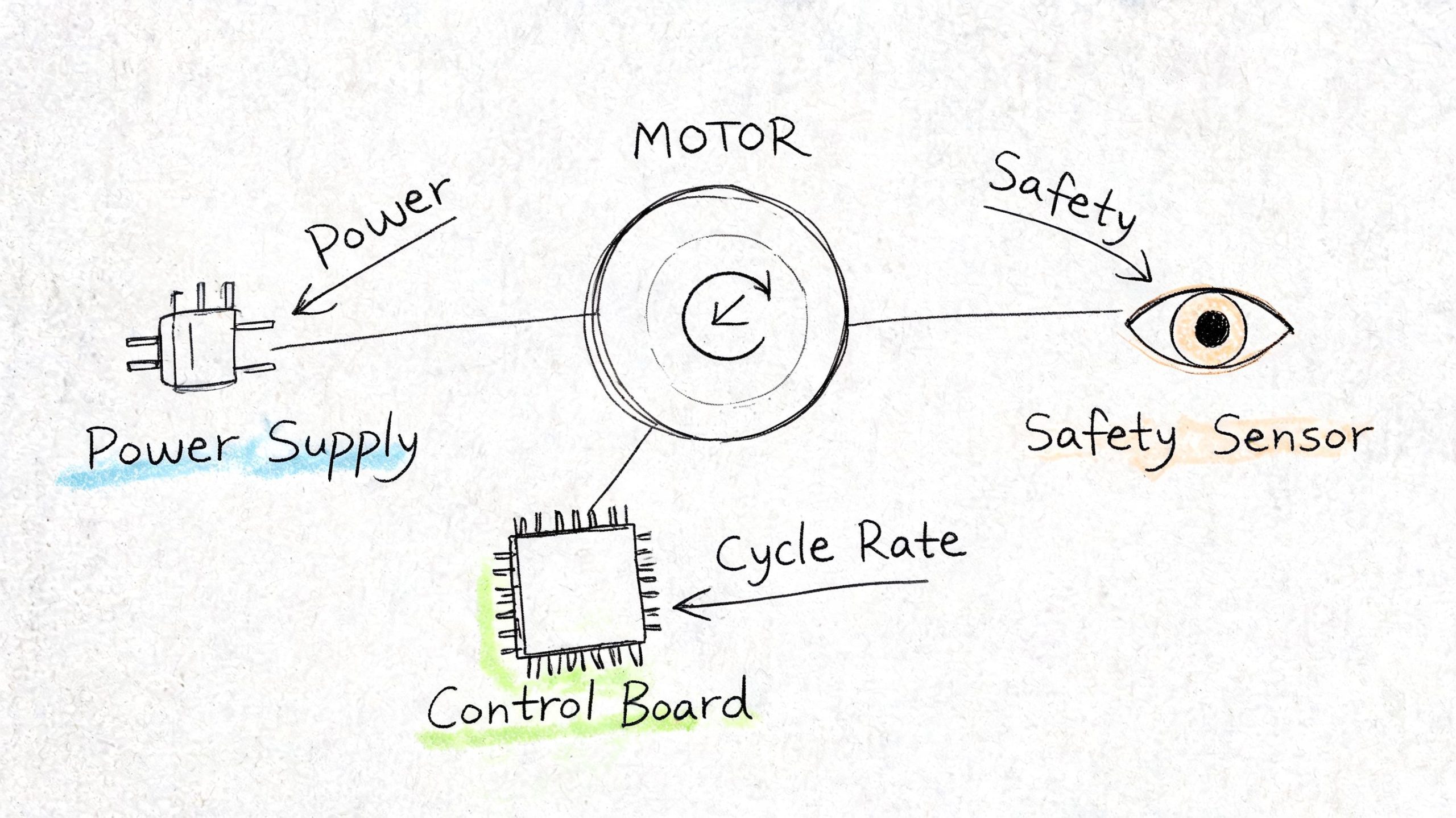
- Power type: DC systems are often easier to pair with battery backup and solar setups. AC systems may still fit hardwired locations well, but the site conditions should decide.
- Safety inputs: Photo-eyes, obstruction sensing, and monitored safety devices aren’t optional in practice. They protect people, vehicles, and the operator itself.
- Operating speed: Faster isn’t always better. At a busy entrance, smooth repeatable movement usually matters more than aggressive opening speed.
- Control board flexibility: An operator that accepts external inputs cleanly gives the property more room to add keypads, loops, intercoms, or cellular access later.
- Manual release: Every gate needs a straightforward fallback when power or electronics fail.
Many buyers chasing the top rated gate openers focus on horsepower-style bragging rights. Experienced installers usually care more about safety logic, power resilience, and whether the operator still has enough margin after the gate has aged, sagged a little, or started seeing rough weather.
Your Pre-Installation and Compatibility Checklist
A surprising number of gate opener problems start before the opener is ever installed. The site itself tells the truth. If the gate doesn’t move properly by hand, no motor will make it reliable for long.
Site checks that prevent expensive mistakes
Run through these checks before ordering equipment or approving a proposal:
- Move the gate manually: It should travel smoothly without dragging, sticking, or racking.
- Inspect hinges, rollers, and track: Mechanical friction gets blamed on operators all the time.
- Confirm power availability: The best opener on paper becomes expensive fast if trenching, rewiring, or battery planning was ignored.
- Check drainage and grade: Water, mud, and uneven surfaces create recurring service issues.
- Review site rules: HOA standards, fire access requirements, and local gate safety expectations can change the hardware choice.
A gate operator should automate a sound gate, not compensate for a damaged one. If the gate leaf is twisted, the hinges are loose, or the slide track is fouled, repair that first.
Compatibility should be verified before ordering
Compatibility isn’t only about matching a new opener to a gate. It’s also about understanding what the existing system can still support. Many older electronic operators can accept updated control inputs even when their original remotes or directories feel outdated.
That’s where retrofit planning becomes useful. Instead of replacing a functional operator just to gain smartphone-based control or remote management, many properties can add a cellular controller to the electronics already in place. For teams trying to confirm whether an existing setup can be modernized, the simplest next step is checking a current gate compatibility guide.
If the operator still responds properly to a dry-contact trigger and the mechanics are healthy, the site may be a retrofit candidate rather than a replacement project.
Replace or Retrofit The Smart Decision Pathway
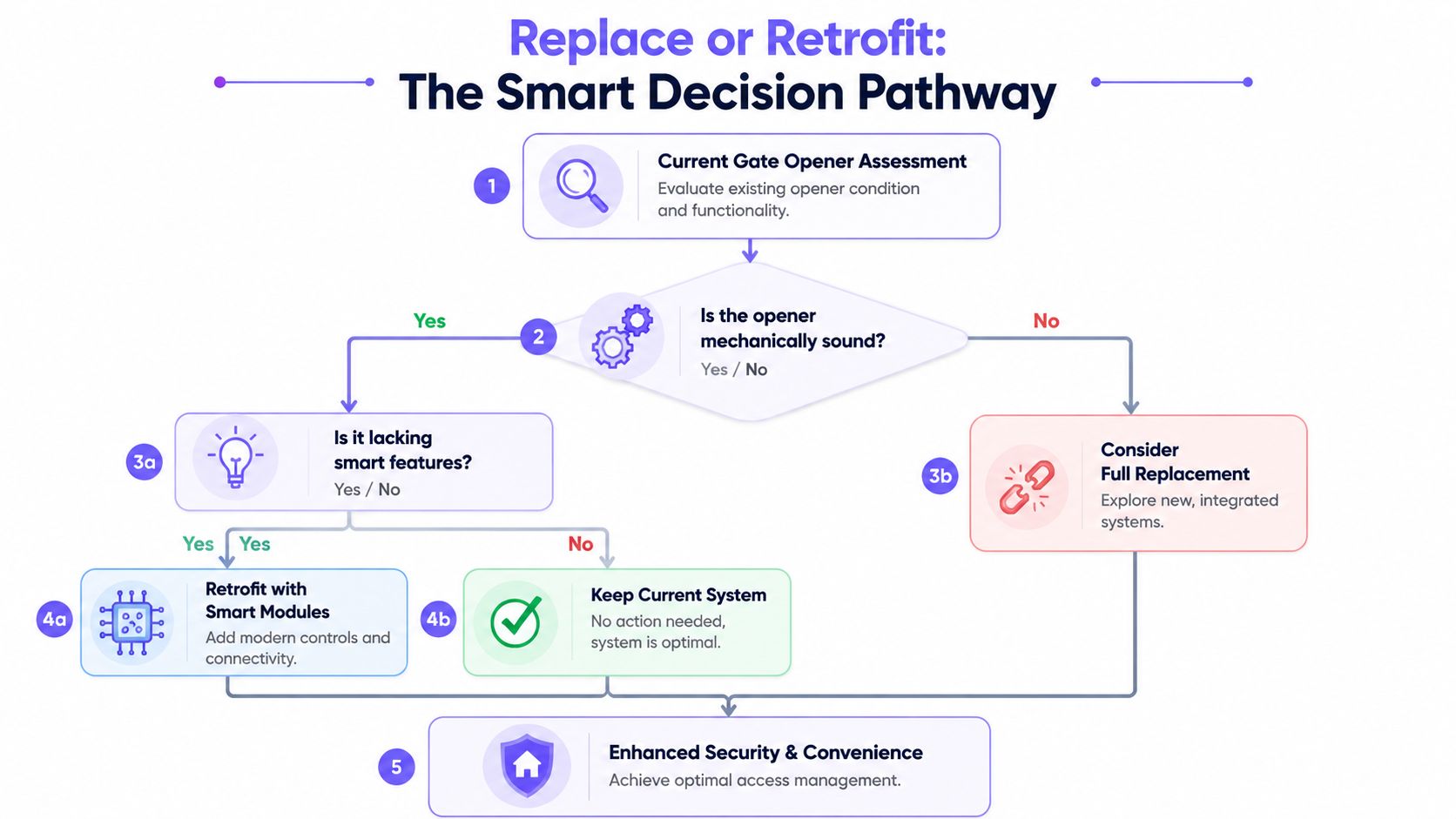
This is the decision most buying guides skip. They compare brands as if every gate problem requires a new machine. In practice, many properties don’t have an opener problem. They have an access control problem.
When replacement is the right call
Full replacement is usually the correct move when the operator is no longer mechanically trustworthy or no longer matched to the gate it serves.
Replacement makes sense when:
- The operator is failing mechanically: repeated breakdowns, stripped drive components, or unreliable motion.
- The gate has changed: a heavier or longer leaf may have outgrown the original motor.
- The system is unsafe or unsupported: damaged controls, outdated safety behavior, or parts that can’t be serviced reasonably.
- The site layout changed: traffic patterns or physical constraints may now favor a different operator type.
The cost side matters here. Most content about gate systems focuses on buying new equipment in the $2,000 to $5,000+ range, which is useful when the machine itself needs to go. But that same framing misses the many sites where the operator still works and only the controls need to evolve, as noted in Elite Gates’ discussion of gate equipment brand comparisons and modernization gaps.
When a retrofit is the better investment
If the gate opens and closes reliably but the property still depends on shared codes, unmanaged remotes, or outdated entry hardware, replacement is often the expensive answer to the wrong question.
A retrofit is usually the stronger option when:
- The gate operator is mechanically sound
- Residents or staff need phone-based access
- Management needs entry logs and remote administration
- The property wants less disruption than a full operator swap
- The site runs mixed brands across multiple entrances
That’s where solutions that modernize gate entry systems fit. A retrofit controller can add smartphone control, remote permissions, and event visibility to an existing electronic gate without replacing the operator itself. For many HOAs and commercial sites, that’s the cleaner operational decision because it preserves working infrastructure and upgrades the part users interact with every day.
If the motor is healthy and the complaints are about remotes, codes, vendors, or after-hours access, the budget should probably go to smarter control, not a new operator.
The practical decision path is simple. Replace when the machine can’t do the mechanical job anymore. Retrofit when the machine still works but the access experience and admin controls belong to an older era.
Advanced Security for HOAs and Commercial Properties
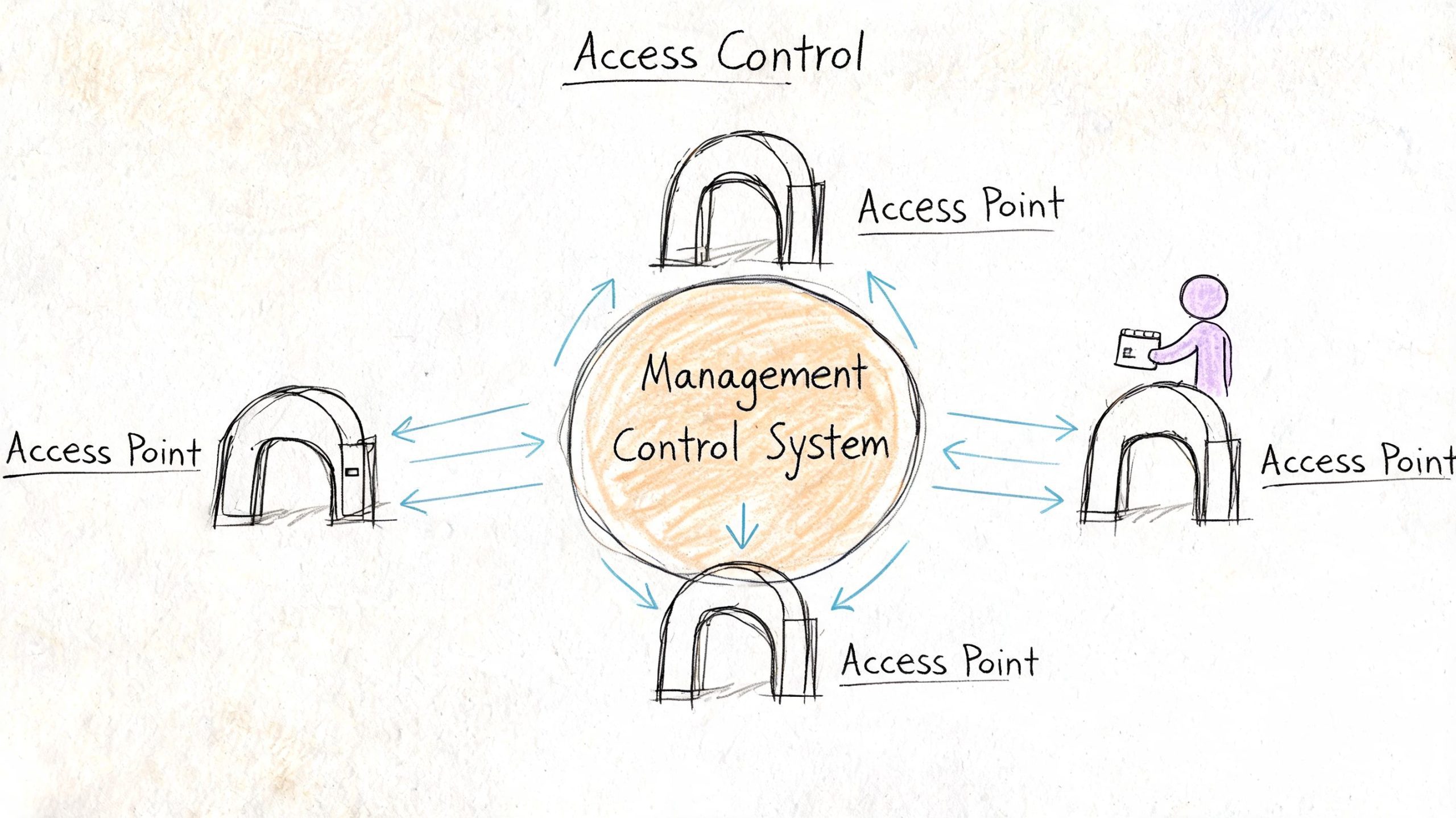
For HOAs, multifamily sites, yards, and business properties, gate performance is only half the issue. The other half is control. Who can get in, when they can get in, and whether management can prove what happened after a problem is reported.
Old access habits create avoidable risk
Traditional gate setups often rely on habits that are easy to live with until something goes wrong. Shared PINs get passed around. Former vendors keep old remotes. Staff changes happen faster than credentials get cleaned up. Then a board or manager gets asked who entered, and there’s no reliable record.
That’s one reason hardware choice and perimeter design need to be treated together. Properties evaluating stronger physical barriers may also want to review examples of purpose-built security gates so the operator, gate structure, and access policy are aligned from the start.
What modern access control changes operationally
Modern access control improves more than convenience. It changes daily administration in ways that reduce confusion and tighten accountability.
A stronger setup usually gives management the ability to:
- Grant access by user: no need to keep one shared code active for everyone.
- Revoke credentials quickly: useful for staff turnover, vendor changes, or resident moves.
- Set schedules: deliveries, cleaners, and contractors can get time-bound access rather than permanent access.
- Review entry history: when an incident happens, managers need records, not guesses.
- Coordinate locks with the gate: a gate and lock should behave as one controlled opening, not two loosely related devices.
For sites that need the smart integration of gate locks, pairing access control logic with a smart integration of gate locks helps prevent weak points at the entrance.
A gate isn’t secure because it has a motor. It’s secure when the property can control credentials cleanly and respond quickly when access needs change.
Top rated gate openers should face more critical judgment. A highly regarded operator may still leave a property exposed if the credential model is sloppy or impossible to administer centrally. For HOAs and commercial properties, the access layer often determines whether the gate improves security or just automates an old problem.
Frequently Asked Questions About Gate Openers
How long do automatic gate openers usually last
Service life depends on sizing, usage, weather exposure, and gate condition. A properly matched opener on a well-maintained gate will usually last much longer than an undersized unit fighting drag, poor alignment, or heavy wind exposure. In real-world terms, the gate’s condition often shortens lifespan before the motor design does.
Can a property manager install one without a professional
Some light residential systems are approachable for capable installers, but many gate projects should be handled by a professional. The biggest risks aren’t usually the bolts or brackets. They’re safety devices, force settings, wiring integration, and making sure the gate itself is structurally ready for automation.
Are solar-powered gate openers reliable
They can be, but only when the site has enough sunlight and the opener’s workload matches the power setup. Solar works better when the gate is correctly sized, the battery is maintained, and the entrance doesn’t see more cycling than the power system can comfortably support.
What maintenance should be expected
Most maintenance is mechanical. Hinges, rollers, tracks, brackets, alignment, and safety devices need periodic inspection. Control systems also need review so codes, credentials, and permissions don’t become a security mess over time.
For many properties, the smartest long-term move is separating motor maintenance from access modernization. The operator will always need physical upkeep. The access layer should be easy to manage, update, and audit without adding new administrative burden.
Nimbio helps properties update existing electronic gates, call boxes, and entry systems with smartphone-based access control over cellular service, while keeping the installed gate hardware in place where replacement isn’t necessary. For HOA boards, property managers, and owners deciding between a full operator swap and a smarter retrofit, Nimbio is worth evaluating as part of that decision.
For a broader framework on evaluating vendors and systems, see the guide on how to choose a cellular gate access system.