Why do so many locked cabinets fail even when the cylinder looks heavy and the key feels solid? Most buyers choose hardware by browsing product photos rather than looking at how the latch grabs the frame and what threat the cabinet faces.
The main types of cabinet locks split into mechanical assemblies (cam locks, pin-tumbler or tubular keyed locks, sliding bolts, push-button combinations, and child-safety latches) and electronic units controlled by keypads, RFID credentials, or motorized latches. Their security levels range from basic child deterrence to burglary-resistant electrical hardware, and each family fits a specific job. A latch built to stop a toddler from grabbing kitchen cleaner won't slow down someone prying open a tool locker, while a heavy keyed deadbolt on a household cupboard often gets left open because adults get tired of hunting for the key.
Picking reliable cabinet hardware starts from the inside out. Looking at the internal mechanism first makes it much easier to spot where a lock is strong, where it gives way under pressure, and which cabinet belongs with which lock.
Table of Contents
- Cabinet Lock Types at a Glance
- How Cam Locks Work and Why They Dominate
- Child-Safety Latches Versus Security Locks
- Electronic Cabinet Locks, Standards and Failure Points
- Matching Each Lock Type to Its Cabinet
- Confirm the Lock Type Before You Buy
Cabinet Lock Types at a Glance
Cabinet locks fall into a handful of mechanical and electronic families that differ in two fundamental ways: how the bolt or tongue engages the frame, and how an authorized person releases it. Practitioners sort these locks through two separate lenses. Operating principle separates keyed cylinders, combination mechanisms, manual bolts, and electronic credentials, while installation form separates rotating cams, adhesive or screw-mounted interior latches, and surface-mounted or mortised bolts.
That distinction matters more than a simple keyed-versus-keyless split. A mechanical cabinet lock provides physical retention and nothing else. An electronic lock can add identity checks, access schedules, and an entry log so property managers know who opened a cabinet and when. Even electrified furniture and illuminated or electro-chromatic bathroom cabinets have their own North American safety framework under UL 962, which covers both electrified and non-electrified furniture products rated up to 600 volts AC, though local building and electrical requirements vary by jurisdiction.
Comparing Mechanisms, Security, and Power
The table below lines up the primary lock families side by side. Use it to locate the cabinet hardware you're considering before diving into the failure points of each category.
| Lock type | How it engages | Relative security | Power needed |
|---|---|---|---|
| Cam lock | Cam rotates behind the cabinet frame | Medium, tied to cam engagement and cylinder quality | None |
| Pin-tumbler or tubular keyed lock | Keyed cylinder drives a bolt or latch | Medium, tied to cylinder build and key control | None |
| Sliding-bolt or deadbolt-style lock | Bolt engages a fixed strike directly | Medium to high, tied to bolt depth and mounting | None |
| Push-button or combination lock | Correct code releases the latch | Low to medium, set by code management | None |
| Magnetic lock | Magnetic key or card releases the latch | Low for child latches; higher for powered mag locks | None for magnetic-key latches; electrical power for electromagnetic locks |
| Child-safety latch | Adhesive or screw-mounted latch inside the door | Low, built against children rather than thieves | None |
| Electronic keypad, RFID or smart lock | Credential triggers a motorized or solenoid latch | Medium to high, set by hardware and certification | Battery or mains |
How to Read the Security Column
Treat the relative security column as a qualitative judgment about lock architecture rather than a certified test rating. Two locks in the same row can behave like completely different products once installed on a real door.
Actual resistance to tampering comes down to cylinder design, key control, cam length, cabinet material thickness, and how well the housing resists drilling or forced rotation. A thin particleboard drawer fitted with a heavy steel deadbolt still fails at the wood before the bolt ever bends. Conversely, a well-fitted cabinet enclosure with tight frame clearance gets far more mileage out of a compact mechanical lock.
A cabinet lock is only as strong as the door panel, mounting fasteners, and frame lip holding it in place.
Find your cabinet's closest match in the table first. From there, match the mechanism to the specific risk the cabinet faces, whether that's curious hands, casual snooping, weather exposure, or regulated inventory.
How Cam Locks Work and Why They Dominate
Open a filing cabinet, utility enclosure, office locker, or server-rack door, and you'll almost certainly see a cam lock inside. This architecture dominates commercial and residential cabinetry because it converts a quarter or half turn of a key or tool into a positive mechanical hold with very few moving parts.
A standard cam lock assembly has three main pieces: a keyed or tool-operated cylinder, a retaining nut or clip that clamps the body to the panel, and a flat or offset metal tongue (the cam) attached to the back of the plug. According to the Locksmith Ledger overview of cam and cabinet locks, common installations rely on 90-degree or 180-degree rotation to swing that cam behind the cabinet frame and back out again. Because one compact cylinder adapts to swinging doors, pull-out drawers, display cases, vending equipment, and electrical panels by swapping cam shapes, facility teams can standardize hardware across an entire property.
Where Cam Locks Hold Up and Where They Give Way
Buyers often fixate on the keyway when judging a cam lock. In practice, physical resistance comes primarily from cam engagement depth, cam metal thickness, and how well the cylinder resists forced rotation with a wrench or screwdriver. If the housing spins inside a round mounting hole, an attacker doesn't need to pick the pins at all.
When a property needs a more specialized key profile than a standard flat wafer key, installers often specify tubular-key cam locks. These models arrange pins radially around a circular keyway, making them common on vending machines and technical equipment cabinets where casual key duplication is a concern.
Outdoor and industrial cabinets introduce another layer of wear. Moisture, dust, and salt air can seize internal wafers and corrode thin steel cams, so outdoor enclosures call for corrosion-resistant bodies and gasketed seals. Always verify the exact ingress or sealing rating directly from the manufacturer's own specification sheet rather than assuming a sealed-looking collar keeps water out.
Measurements to Verify Before Ordering
Ordering a replacement cam lock without measuring the door almost always leads to returns or sloppy security. Check these five dimensions before buying:
- Measure panel thickness so the cylinder barrel extends far enough through wood or sheet metal for the retaining nut to grip full threads.
- Check mounting-hole geometry, noting whether the cutout is a round hole or includes D-shaped flat sides that stop the body from twisting.
- Confirm cam offset (straight, bent inward, or bent outward) so the tongue aligns cleanly with the inside lip of the frame.
- Match the rotation angle and direction (90 degrees or 180 degrees, clockwise or counterclockwise) to the cabinet's door swing.
- Check frame clearance behind the door face so the rotating cam clears shelves, wiring harnesses, or drawer dividers.
Even a hardened cylinder fails operationally if the cam barely grazes the strike lip or binds hard against the frame every time someone turns the key. A binding cam puts constant torque on the key blade until it snaps inside the cylinder.
Child-Safety Latches Versus Security Locks
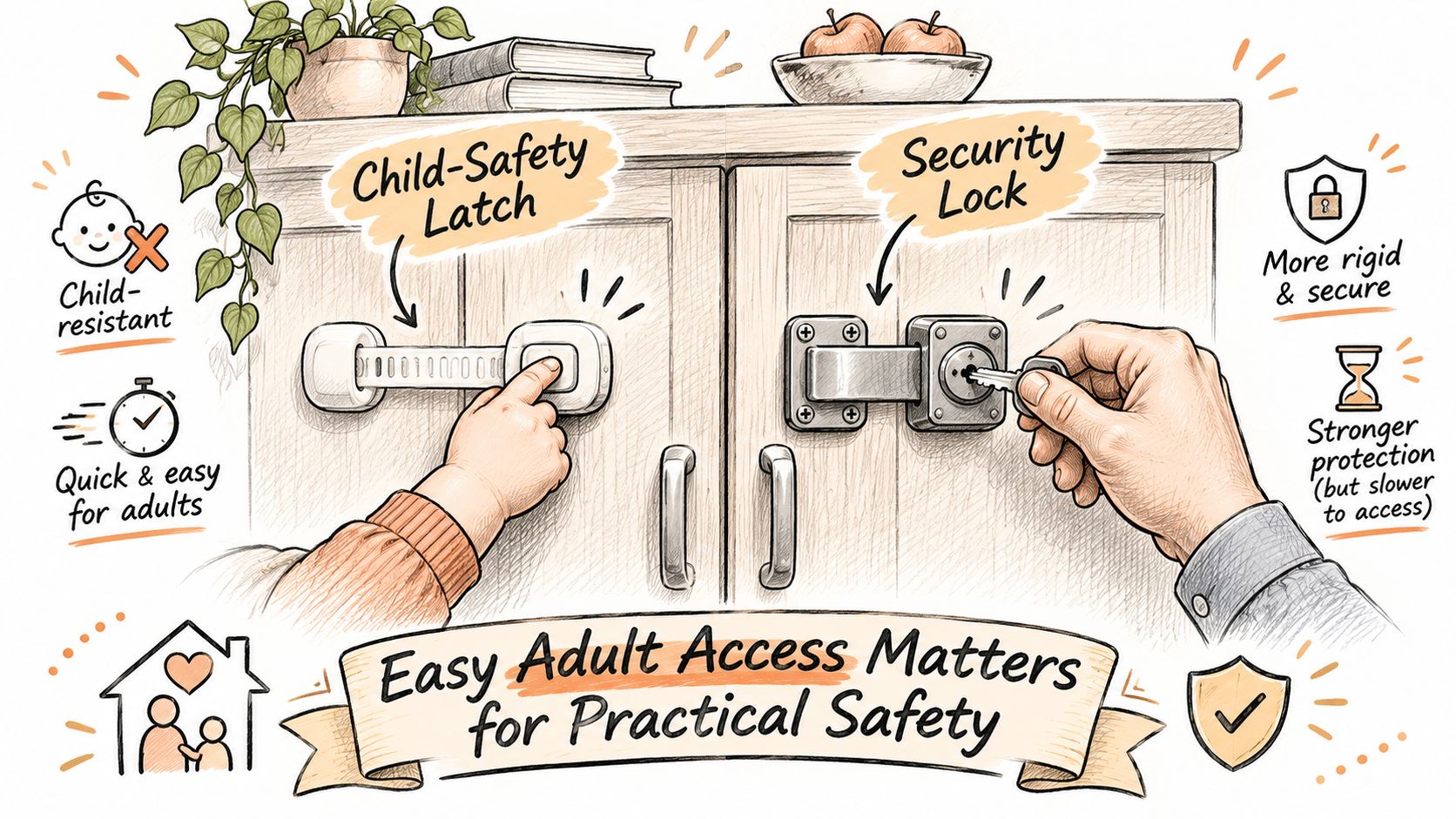
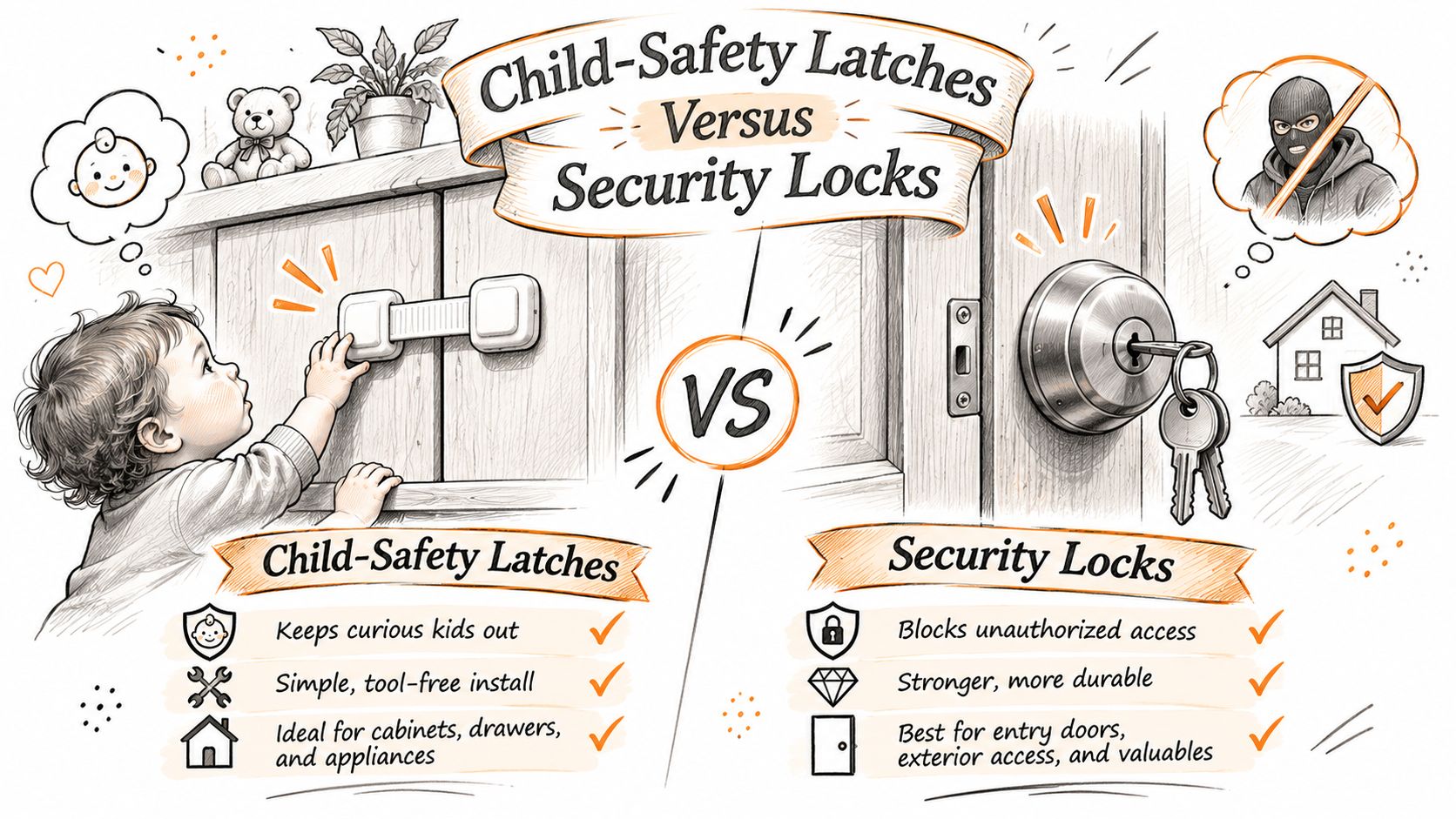
The strongest lock on the hardware shelf isn't automatically the safest choice for a home. Put a complicated keyed bolt on an under-sink cupboard, and busy adults start leaving the door propped open after grabbing dish soap, erasing the protection completely.
The U.S. Consumer Product Safety Commission home childproofing guide recommends cabinet locks for medicines, household cleaners, matches, cigarettes, knives, and similar household hazards. That same guidance stresses two practical conditions at once: adults must be able to open the latch easily, and the hardware must hold up against a child's repeated pulls and tugs.
What Child-Safety Standards Actually Measure
Many buyers assume a sturdy interior cabinet latch doubles as a light security lock. It doesn't. The CPSC summary of ASTM F3492-21 defines that consumer safety specification specifically for locks and latches mounted inside residential cabinet doors or drawers to restrict access by children younger than 48 months.
Under ASTM F3492-21, a tested latch installed in its prescribed mounting configuration must withstand at least 45.3 lbf (20.6 kgf) before disengaging, breaking, or damaging a component. That threshold stops a toddler pulling on a drawer handle, yet an adult with a pry bar or determined grip can defeat it quickly. These devices aren't built to protect valuables, cash, or regulated hazardous materials from adults or older children.
Release mechanics and door gaps matter just as much as pull strength. In CPSC staff materials for ASTM F15, regulators separated single-action releases (discussed with a 10-pound release force threshold) from dual-action latches and tool-operated units such as magnetic keys, while specifying a maximum allowable cabinet gap of 1.25 inches when the door pulls against the engaged latch so small fingers can't reach through. Those same materials also highlight hazards from small detachable parts, sharp edges, and narrow openings.
Why Installation Surfaces Make or Break the Latch
A strong latch body can't rescue a weak bond to the door. During review of the ASTM F3492-21 sample specification, CPSC staff noted incident data showing failures with both adhesive pads and screws, underscoring that the test assembly mounts each device on test blocks strictly according to the manufacturer's instructions.
Installation reality: A latch tested with wood screws on solid maple won't hold the same load when stuck with foam tape to painted laminate or glass.
Specialty residential cabinetry complicates mounting even further. Custom kitchens featuring flush-inset doors or mirrored panel pantry entrances often leave little flat wood frame for screw-mounted hooks and can shed adhesive strips if surface prep is rushed. Always check the lock manufacturer's manual for approved door materials, adhesive cure times, and emergency release procedures, and bring in a qualified installer when modifying custom cabinetry or unsure how a fastener will hold.
Electronic Cabinet Locks, Standards and Failure Points
Electronic cabinet locks replace or supplement physical keys with keypad codes, RFID cards, magnetic credentials, or motorized latches. Property managers and facility operators turn to them when mechanical keys become a liability: shared supply closets, medication cabinets, server racks, or staff lockers where credentials change frequently and administrators need a record of every opening.
The mechanism swap trades one weakness for another. A cam lock fails when someone picks the cylinder or duplicates the key. An electronic lock fails when its battery dies, its network drops, or its software loses support. Understanding that tradeoff starts with knowing how widely each type is used. According to the Reed Intelligence cabinet-lock market analysis, mechanical cabinet locks accounted for 56.8% of the cabinet-lock market in 2024, while electronic cabinet locks were projected to grow at an 11.6% CAGR. Mechanical cylinders remain the practical baseline for low-cost offline cabinets, yet connected and standalone electronic locks keep gaining ground wherever accountability matters.
Where Electronic Locks Introduce New Failure Modes
Dead batteries are the most common snag, especially in remote utility rooms where staff ignore early low-battery chirps until the motor stalls completely. A lock that looked strong in the catalog becomes a sealed box with no way in.
Connectivity architecture shapes how a lock behaves when networks hiccup. Local Bluetooth and standalone keypad locks keep working without internet service, whereas cloud-connected Wi-Fi or centrally managed systems can lose real-time credential updates when local routers drop offline. Staff turnover creates another blind spot: if one departing administrator owns the sole master account or programming credential, the property can end up locked out of its own cabinets.
Before approving an electronic cabinet lock purchase, ask the vendor these seven operational questions:
- What fallback credential opens the cabinet if the primary RFID card, app, or keypad stops responding?
- How early and how visibly do low-battery warnings trigger, and can an external 9-volt battery or USB port jump-start a dead lock?
- How long does the lock or management platform retain audit logs, and can administrators export them cleanly?
- How long will the manufacturer provide firmware updates and security patches for the hardware?
- Does the unit include a mechanical key override, and how is that override cylinder protected against picking?
- Can individual motors, latches, or keypads be replaced without cutting new holes in the cabinet?
- What happens to local operation if the manufacturer discontinues cloud services or reaches end-of-life support?
Matching Electronic Hardware to UL Standards
Not every electronic cabinet latch is tested for forced entry. The UL overview of UL 294 and UL 1034 draws a sharp line between access-control electronics and physical burglary resistance.
UL 294 covers access-control system units, including autonomous access-control locks, verifying electrical safety, reliability, and access-control performance. UL 1034 covers burglary-resistant electric locking mechanisms such as electric deadbolts, electric door strikes, and electromagnetic locks, evaluating hardware against static-force, dynamic-force, and endurance test factors. Because local building, fire, and security requirements vary widely, confirm with local authorities which standard applies to regulated rooms or enclosures.
Ask every vendor three things before trusting an electronic lock's security claim: which exact standard the mechanism passed, which component was tested, and whether the certification covers the full lock assembly.
A sleek keypad wired to an unrated plastic solenoid latch still offers credential convenience, yet it shouldn't be mistaken for a UL 1034 burglary-resistant deadbolt. The same gap between appearance and resistance applies at every scale: a lock housing can look armored while the latch bolt behind it shears under modest force. When evaluating connected access systems across a broader property, reviewing Nimbio security and encryption details helps clarify how credential handling and communication security fit alongside physical hardware ratings.
For electric gates and electric locks serving shared properties, cellular connectivity avoids the Wi-Fi dead zones that plague remote enclosures. For example, how Nimbio works uses a cellular LTE add-on controller that needs no Wi-Fi at the gate and lets property managers issue and revoke digital keys remotely, while existing clickers, fobs, and keypads keep working. Because the controller wires in parallel to the equipment already installed, a property can layer modern credential management onto older hardware instead of replacing operators that still function.
Matching Each Lock Type to Its Cabinet
Which threat is this cabinet facing? A heavy cam cylinder on a medicine door can look like real security and still fail the person who never needs a key: a child who only has to tug the door. Start with the threat, then pick the simplest mechanism that stops it without blocking the adults who open that cabinet every day.
The 2026 HJ Precision cabinet-lock buying guide lists cam cabinet locks at USD 0.50 to 3.00 and electronic cabinet locks at USD 20 to 150. Use those bands as a cost check after the mechanism already fits the cabinet.
| Cabinet and threat | Suitable lock type | Typical price |
|---|---|---|
| Medicines or cleaners at home, child access | Child-safety latch | Interior latch, priced as child hardware |
| Office filing cabinet or locker, basic privacy | Cam lock | USD 0.50 to 3.00 |
| Equipment or electrical enclosure, outdoors | Sealed cam lock, checked against its rating | Cam lock plus a published ingress rating |
| Shared cabinet with changing codes | Push-button or combination lock | Mechanical code hardware, no battery |
| Records or medication needing an access log | Electronic keypad or RFID lock | USD 20 to 150 |
Walking Through Each Threat Scenario
A household cabinet of medications or corrosive cleaners is a child problem, not a burglary problem. An interior child-safety latch slows a young child and still lets an adult release it quickly. If the release is awkward, people prop the door, and the latch stops doing any job at all.
Office filing cabinets and personal lockers mostly face casual curiosity, not power tools. A mechanical cam lock works like a mailbox latch: the tongue turns behind the frame, privacy is basic, batteries never enter the picture, and a lost key means a cheap replacement rather than a service call. That same cam fails the moment the threat is a pry bar or a copied key left with a former coworker.
Outdoor utility boxes and electrical cabinets add rain, grit, and temperature swings to tampering. A corrosion-resistant, sealed cam lock only earns that job if you check the manufacturer's published ingress rating. A shiny cylinder with no rating still freezes or rusts, and the tongue stops turning for the technician who is supposed to get in.
Shared maintenance closets used by rotating contractors fail on key copies, not on lock mass. A mechanical push-button or dial combination removes the physical key so a supervisor can change the code when a vendor leaves. Properties that also hand out gate and door credentials can line those models up against cabinet codes in the Nimbio guide to gate access keys. A combination still fails if the code is written on the door frame or never rotated.
Cabinets holding regulated records, narcotics, or high-value diagnostic tools need an account of who opened them. An electronic keypad or RFID lock stores an access log and lets a manager cancel one person's credential without rekeying the door. A sleek keypad on an unrated latch still only proves that someone typed a code. It does not, by itself, prove the cabinet resisted force.
A Hypothetical Clinic Storage Example
An outpatient clinic keeps controlled medication in a metal supply cabinet used by three nursing shifts. A keyed cam lock keeps casual visitors out. When a vial is missing, nobody can tell which shift opened the door, or whether an old spare reached a former employee.
An RFID or keypad lock on that same cabinet changes the record. Each nurse uses a unique credential, the lock stores the time, and the manager cancels a departing employee's access in seconds. A physical override key stays in the director's safe so a dead battery does not trap the medication.
Confirm the Lock Type Before You Buy
Standing in a hardware aisle or reviewing a supplier quote is the moment to catch installation mismatches before drilling into a cabinet door. Run through these checks directly at the cabinet or over the phone with the vendor.
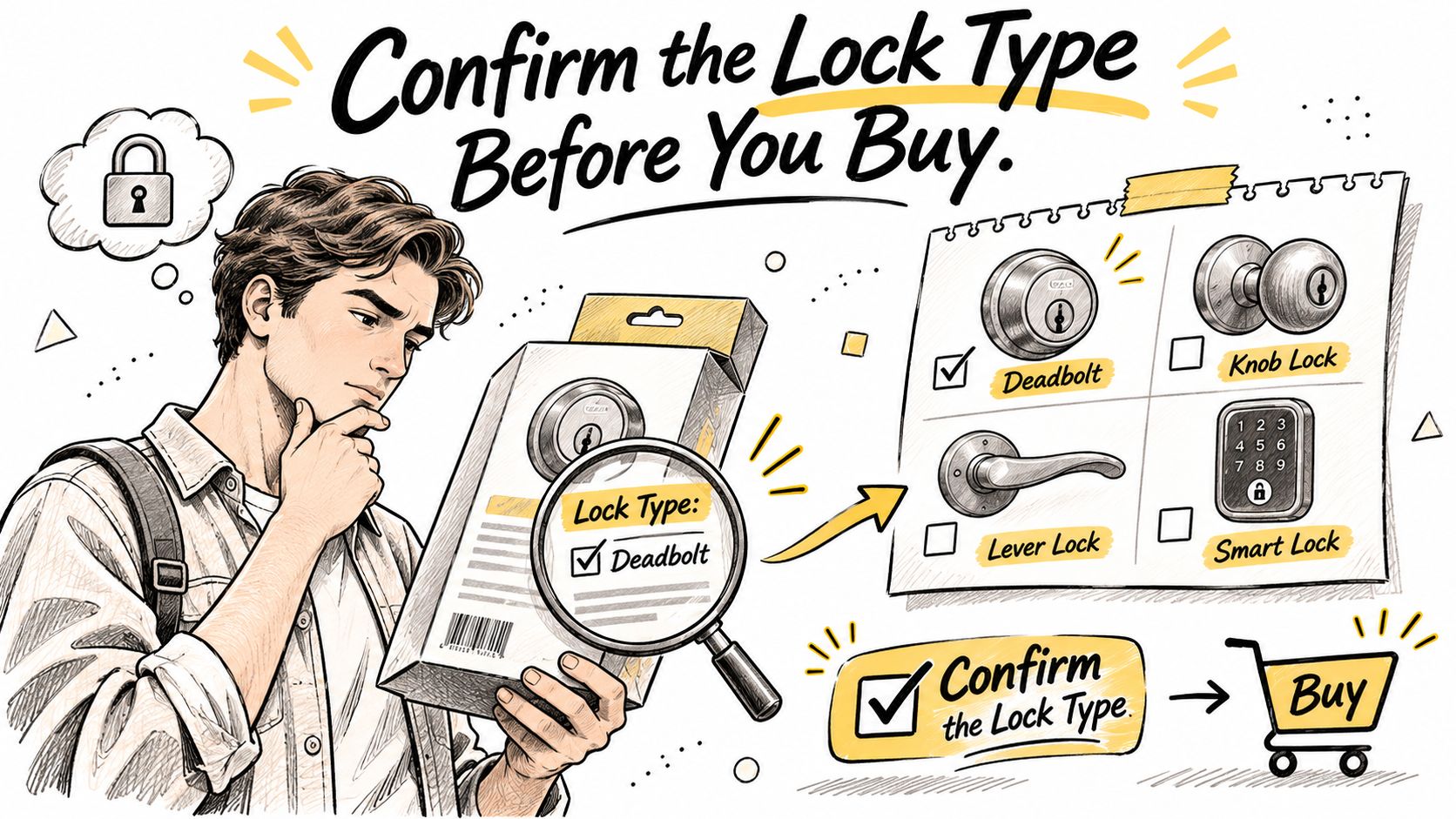
Six Checks Before Opening Your Wallet
- Verify the tested attachment method on your exact surface. If a manufacturer tested a latch with wood screws, don't assume double-sided adhesive tape delivers the same holding strength on laminate, metal, or glass.
- Cross-check mechanical clearances against the spec sheet. Confirm panel thickness, cam engagement depth, and rotation angle against your cabinet frame before ordering so the latch neither misses the strike nor jams shut.
- Request full certification documentation for electronic units. Confirm which security or access-control standard the lock passed and verify whether the certificate applies to the complete installed assembly or only an internal subcomponent.
- Test the backup access plan on paper first. Confirm whether the lock offers a physical key override, external backup power contacts, and clear low-battery alerts before putting critical supplies behind an electronic latch.
- Check local regulations for controlled access points. Fire codes, healthcare storage rules, and property guidelines vary by municipality, so confirm local compliance before swapping hardware on regulated cabinets or doors.
- Read the manufacturer's manual before cutting or wiring. Because models differ in voltage requirements, mounting templates, and troubleshooting sequences, follow the official manual for wiring or repairs, or hire a qualified technician rather than guessing.
Retrofitting Enclosures Tied to Property Access Systems
Cabinet locks often sit next to larger building access hardware, especially in mailrooms, equipment sheds, and gate operator housings. When upgrading electronic locks tied into a property's broader entry infrastructure, it pays to check compatibility before retrofitting so voltage, switching inputs, and enclosures line up cleanly.
If a locked enclosure or electric lock connects to a property's electric gate or door entry system, reach out to contact the Nimbio team for guidance on pairing cellular access control with existing hardware.
Managing types of cabinet locks alongside perimeter gates and doors gets simpler when electric access points stay reliable without needing local Wi-Fi. Nimbio's cellular LTE controller and smartphone app wire into existing electric gates and electric locks while keeping current clickers, fobs, and keypads active, allowing property managers to issue and revoke time-limited digital keys and verify visitors by video remotely. Explore how cellular access control fits your property by visiting Nimbio.