Can a door that stays firmly closed still be unsafe? Yes. Magnetic door handles use magnetic attraction either to retain a door directly or to operate a latch, but a secure installation depends on the complete door assembly, including its frame, release hardware and emergency behavior.
The phrase magnetic doors handles can describe very different products, from a cabinet catch to an electrically powered access-control lock. For property managers, HOA boards and homeowners, the useful starting point isn't the finish or handle shape. It's identifying what holds the door, what releases it and whether the opening serves an exit route.
Table of Contents
- How Magnetic Door Handles Hold a Door
- Where Magnetic Handles Are Used in Practice
- Reading Holding Force Ratings Before You Buy
- Emergency Exit and Power-Loss Rules for Magnetic Locks
- Do Magnetic Handles Make a Door More Hygienic
- Check Fire-Door and Code Rules Before You Install
How Magnetic Door Handles Hold a Door
A magnetic door handle or latch uses a permanent magnet or an electrically energized coil to attract a matching metal component. On an electromagnetic lock, that component is called the armature. On an interior latch, the matching frame component is generally called the strike.
The everyday comparison is a fridge magnet against a steel door, but door hardware needs a mechanism designed for its intended opening. Some products hold the door through magnetic attraction alone. Others use a magnet to move a mechanical latch bolt into the strike.
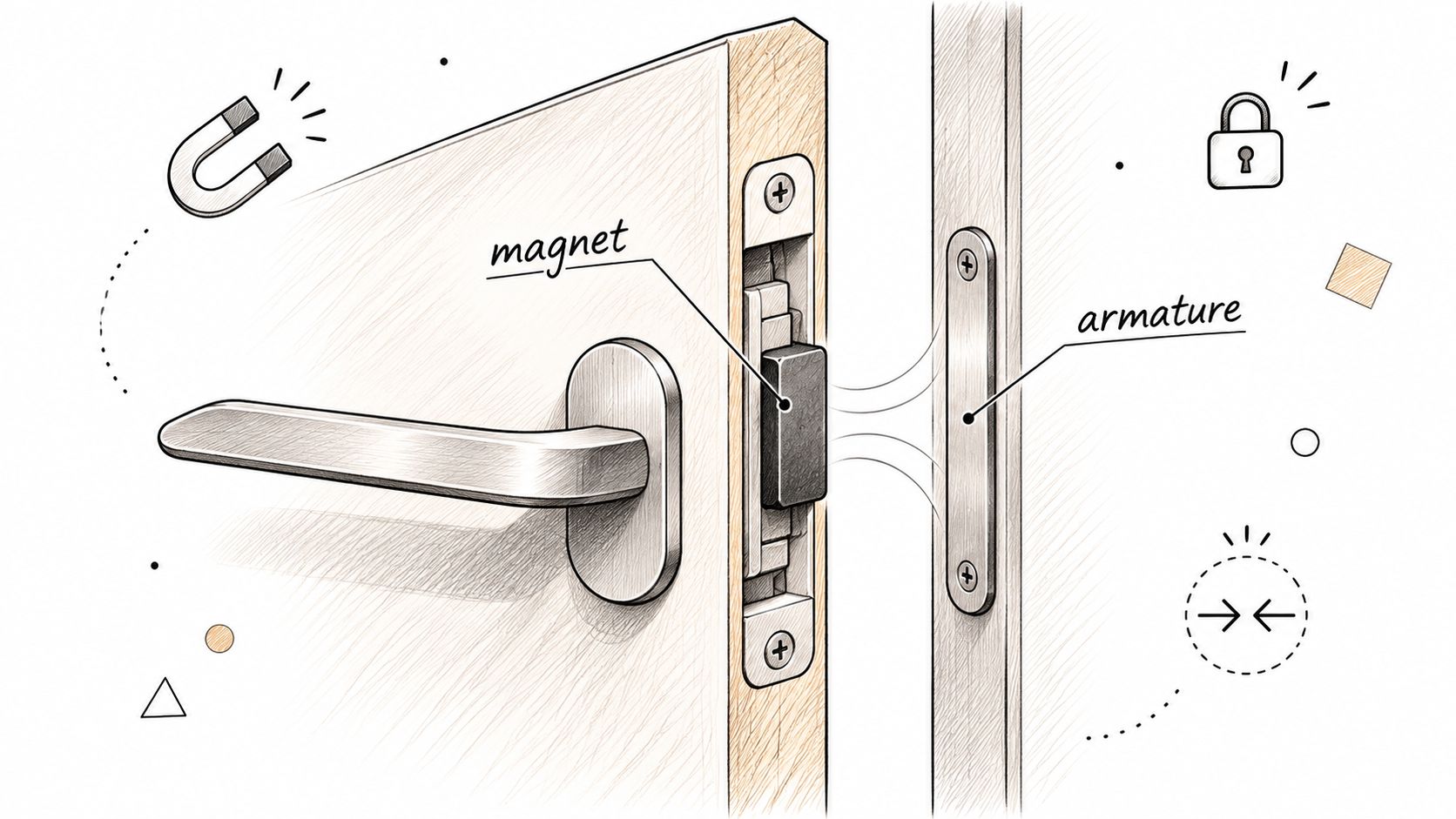
Magnetic handle types and what each one needs
The important split is between passive hardware and powered locking hardware. Passive magnets need no electrical supply; electromagnets need continuous power to maintain their magnetic hold.
| Type | Typical location | How it holds | Needs continuous power |
|---|---|---|---|
| Cabinet catch | Kitchen and cabinet doors | A magnet attracts a metal plate or matching magnet on the door | No |
| Interior magnetic latch | Interior doors and closets | Magnetic attraction retains the door or draws a latch bolt into the strike, according to the mechanism | No |
| Electromagnetic lock, or maglock | Access doors, stairwells and perimeter gates | An energized coil holds the armature flat against the magnet | Yes |
| Mortise magnetic lock | Recessed into the door and frame | A recessed electromagnetic version uses a powered magnetic bond; a passive magnetic mortise latch operates a mechanical bolt | Yes for an electromagnetic version; no for a passive latch |
Mortise describes the recessed installation, not the power requirement. That distinction matters because a product advertised as a magnetic mortise lock isn't necessarily a concealed maglock. The product description needs to identify the actual mechanism.
The handle may not provide the holding force
On an access-controlled door, the visible pull handle may provide something to grasp. A separate electromagnetic lock at the frame secures the opening. Changing the handle won't necessarily change the door's holding strength or access-control behavior.
Likewise, an interior magnetic latch doesn't automatically provide privacy. A bathroom or bedroom installation may need a separate privacy function and an appropriate emergency release.
Identification rule: A product's appearance doesn't establish whether it's a catch, a latch or a security lock.
Before choosing replacement hardware, the owner or installer should identify the existing mechanism and obtain its product documentation. Door use determines the relevant safety obligations, while the mechanism determines which power, release and compatibility questions need answering.
Where Magnetic Handles Are Used in Practice
Residential kitchens and closets are straightforward applications for magnetic catches. Their job is usually to keep a panel closed, not to control entry. A handle-free cabinet front may also need a separate push-to-open mechanism, because a magnet alone doesn't necessarily push the door outward.
Interior passage doors have a different task. A hallway door needs predictable operation, while a bedroom or bathroom may also need privacy. Hardware selected for a cupboard shouldn't be treated as a substitute for a door latch because both products use magnets.
Match the hardware to the opening
Commercial and industrial properties use magnetic retention and locking hardware across a broader range of openings. The DataIntelo magnetic catches and latches market overview describes residential and industrial applications, but those broad categories don't establish whether a particular product suits a particular door.
Door weight, frame construction, frequency of use and exit-route status provide more useful selection criteria. Stairwell entrances, elevator lobbies and perimeter gates also require coordination with the property's access and safety arrangements.
Hypothetical example: A homeowner selecting a passive magnetic latch for a lightweight timber hallway door faces a relatively simple fit-and-function decision. A property manager considering an electromagnetic lock for a heavy steel shared-stairwell door needs an assembly assessment and an egress review, not merely a stronger version of the same latch.
A multifamily property may also need remote entry management. Information about cellular gate controllers for multifamily properties concerns that control layer, which is separate from the physical hardware holding a door closed.
Before selecting a use case, the decision-maker should answer:
- Setting: Is the opening a private home door, a shared entrance or a commercial door?
- Construction: How heavy is the door, and what is the frame made of?
- Traffic: How often is it opened, and who uses it?
- Egress: Is it on an exit route?
Reading Holding Force Ratings Before You Buy
Holding force is the pull needed to separate an electromagnetic lock from its armature under a defined test. Makers usually state it in pounds-force (lbf) or newtons. A box rating describes that pull on a prepared sample. It does not, by itself, describe how secure the finished door will be.
A direct analogy is a tow rating on a hitch. The number assumes a sound vehicle, a correct attachment, and a straight pull. Change the angle, loosen the bolts, or let the frame flex, and the published figure no longer describes the job.
Holding-force ratings and what each one means
ANSI/BHMA A156.23 sorts electromagnetic locks into grades and sets a minimum static holding force for each grade under its own test method. The Builders Hardware Manufacturers Association overview of ANSI/BHMA A156.23 covers holding-force testing along with operational, strength, and impact tests. A claim that cites the standard should name the certification and the product grade. Local rules still decide what an opening is allowed to use.
| Rating | What the source says | Practical use |
|---|---|---|
| Grade 3 holding force | Minimum 500 lbf static holding force under the A156.23 test for this grade | Light interior doors, and only when the frame and mount can develop that force |
| Grade 2 holding force | Minimum 1,000 lbf static holding force under the same test method | Ordinary commercial doors once alignment and reinforcement are confirmed |
| Traffic-control designation | A label for managing passage, not a substitute for a security grade | Do not treat it as proof the assembly resists forced entry |
| Commercial exterior or high-security designation | Marketing language that still needs a named grade and assembly documentation | Match the product to exposure, door construction, and the security task |
| Grade 1 holding force | Minimum 1,500 lbf static holding force, the upper grade in this scheme | Heavier or higher-risk doors only if the whole assembly can carry that load |
A higher grade still applies only inside that test scheme. Comparing two brochure phrases, without the grade and the test basis, does not tell you which lock is appropriate.
Why installed performance can be lower
The magnet and the armature have to meet face to face, stay aligned, and see the load in the direction the test assumed. A door that sags even slightly reduces contact area. The bond then lets go below the number printed on the carton.
Side loading, dirt or paint on the faces, loose screws, and a frame that was never reinforced all change the result. Often the weak point is the attachment or the frame, not the magnetic bond.
A stronger magnet doesn't repair a weak frame.
Holding force also misses some attacks. A slow, straight pull and a sudden impact load the assembly in different ways. Where the application needs both, ask for documented static-pull and dynamic-impact performance, not a single headline figure.
On an exterior opening, specify the door, the frame, the mounting, and the environmental exposure together. On a gate, keep the device that holds the leaf closed separate from the system that decides who may enter. That split is part of what to look for in a gate access system.
Match the tested grade to how the opening is used and how exposed it is. The largest advertised holding-force number is not automatically the right one.
Emergency Exit and Power-Loss Rules for Magnetic Locks
Electromagnetic locks are normally fail-safe: removing power from the magnetic holding mechanism releases its bond. However, a compliant exit arrangement may also require release through door-mounted hardware, a panic device, a sensor bar or a lever, according to the opening and jurisdiction.
The Allegion guidance on electromagnetically locked egress doors explains why the lock and release arrangement must be evaluated together. Access authorization and safe exit are different functions. A credential reader addresses entry permission, not the complete exit requirement.
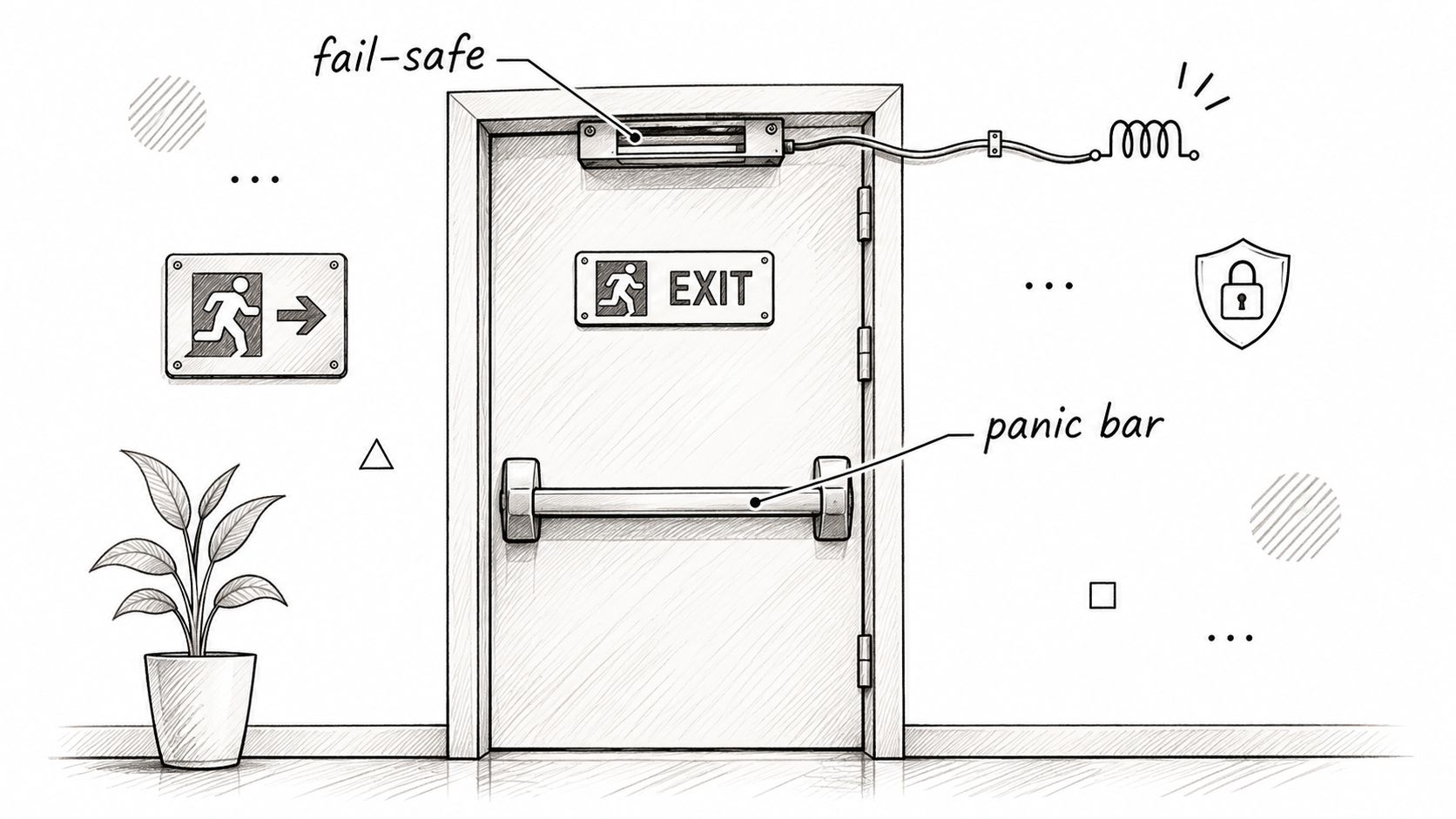
Fail-safe isn't fail-secure
A fail-secure device retains its secured condition when power is lost, although its exit-side operation must still suit the application. An electromagnetic bond cannot remain energized without a power source.
The iDigHardware explanation of electromagnetic locks distinguishes this power-loss behavior and describes release inputs such as fire-alarm connections, auxiliary exit switches and request-to-exit devices. The required arrangement depends on the adopted code and lock configuration.
Fail-safe behavior creates an entry-security trade-off. Removing power can release a door that the property normally keeps secured, so the team needs to plan how the opening behaves during outages.
Hypothetical example: A service entrance fitted with a maglock releases during a storm-related power failure. The property manager then discovers that the opening permits uncontrolled entry as well as exit. That outcome should have been considered during design, alongside emergency access and the property's operating procedures.
Backup power changes the situation because loss of utility power doesn't necessarily remove power from the lock. The installer must establish what happens when the normal supply fails, what happens when backup power operates and how emergency release works in each condition.
Local exceptions aren't universal permissions
Calgary provides a specific jurisdictional example: where the applicable exception is used, its electromagnetic-lock bulletin requires operation with no more than 90 N, release within 15 seconds and testing at intervals of no more than 12 months.
The bulletin also requires the release process to be irreversible once initiated and prevents the lock from securing again before the door has opened. Those provisions aren't general permission to delay every exit. Local building and fire requirements determine which arrangements are permitted.
Safety boundary: An access-control command must never be assumed to provide the required emergency-release function.
A coordinated acceptance check
A qualified installer should use the manufacturer's manual and the locally approved design to complete the acceptance check. Models differ, so generic wiring or bypass instructions aren't an appropriate substitute.
- Establish the exit function. Confirm whether the opening serves an exit route and identify the authority approving the arrangement.
- Identify the release mechanism. Record which device initiates release and the applicable operating-force requirement.
- Verify the power scenarios. Have the installer test approved release behavior under normal and backup-power conditions.
- Confirm emergency passage. Establish that occupants can leave without presenting a credential when emergency release is required.
Fire-alarm behavior, emergency-release inputs, access-control commands and door-position behavior should be evaluated as a connected system. A fire-rated opening also needs a device approved for the rated assembly, not an electrically functional installation.
Do Magnetic Handles Make a Door More Hygienic
No. A magnetic closure does not disinfect a surface, and the handle alone does not establish infection prevention. Magnetic operation, reduced touching and antimicrobial materials are separate features, so evaluate each one on its own evidence.
A door handle also works as part of a complete opening. Hygiene claims come after the assembly already satisfies its holding-force, egress, power-loss and fire-door requirements; a cleaner-feeling handle is not a substitute for a compliant door.
A peer-reviewed study of copper-nickel-coated door handles found lower bacterial or overall bioburden than control handles in several tests, while its authors called for larger randomized controlled trials to establish whether coated handles reduce healthcare-associated infections. The material studied was a coating, not magnetic closure itself.
Surface measurements aren't clinical outcomes
A surface test measures what was detected on a sampled area under particular conditions. A clinical outcome concerns whether people became infected. Evidence for the first does not automatically prove the second.
Reduced handle contact can also move touching elsewhere. Occupants may grasp a door edge, press a push plate or use another shared access point. Treat the door like a chain of contact points: if one link is removed, the next link carries more use. Cleaning plans should follow those actual contact points rather than the product's hygienic appearance.
| Hardware approach | Contact points | Cleaning access | Maintenance consideration |
|---|---|---|---|
| Hands-free operator | Reduces the need to grasp a handle during normal use | Door edges and activation areas still need attention | Operator and activation devices need product-specific servicing |
| Push or pull design | Contact concentrates on plates, bars or pulls | Broad accessible surfaces can simplify cleaning | Loose fittings and damaged finishes need attention |
| Conventional handle | Users normally touch the lever or knob | Undersides and junctions can be missed | Moving parts and surface condition need inspection |
Keep guest supplies separate from hardware care
In a spa, guest-use consumables such as disposable face towels for spas belong to a different purchasing category from door-hardware cleaning products. A towel intended for guests should not be assumed suitable for disinfecting a coated handle or powered fitting.
Cleaning frequency, material compatibility and user behavior deserve attention alongside occupancy and ventilation. Maintenance staff should follow the hardware manufacturer's care instructions, especially for coatings and electrical components, since an unsuitable cleaner can damage the very surface meant to stay easier to maintain.
Antimicrobial coatings supplement cleaning; they don't replace it. A claim that a magnetic handle makes a property hygienic needs evidence identifying the exact feature tested and the outcome measured.
Check Fire-Door and Code Rules Before You Install
The British Columbia fire-code guidance distinguishes electric mortise devices that mechanically control a latch bolt from magnetic locks that may delay egress only when the applicable building-code conditions are satisfied. Devices affecting only the access-side handle may be permitted under the stated conditions, including the absence of a deadbolt.
The guidance also distinguishes surface-applied and recessed hardware on labeled doors. Surface-applied magnetic units may be installed without relabeling when the door manufacturer provides written confirmation, while preparation for recessed hardware must occur at a location covered by the label's service. Local requirements vary, so these distinctions shouldn't be treated as approval for an unrelated property.
Pre-installation decisions
The approval process should establish the opening's identity before anyone orders hardware or modifies the door.
- Identify the labeled assembly. Determine whether the door and frame form a fire-rated opening, and retain the identifying information.
- Document the proposed hardware. Obtain the holding-force evidence, mounting details and compatibility information for the complete assembly.
- Approve the release arrangement. Record the intended egress and power-loss behavior, including any backup supply.
- Check the applicable rules. Confirm local building, fire and accessibility requirements with the relevant authority.
- Obtain written manufacturer confirmation. Establish whether the proposed preparation and hardware are permitted on that door.
- Assign qualified installation. Require the installer to use the product-specific manual and approved design, since models and assemblies differ.
A neat recessed installation can involve more significant door preparation than a visible surface-mounted device. Appearance shouldn't determine the mounting choice before the approval route is established.
Keep access control separate from door approval
For a gate retrofit, Nimbio's controller wires into the existing gate operator without requiring gate replacement; physical installation is completed by independent professional gate technicians or local low-voltage installers. That control upgrade doesn't replace the assessment of locking hardware, emergency operation or the opening itself.
Before removing or replacing a call box, the property manager should confirm local gate-access requirements. Existing emergency-access arrangements shouldn't be changed because residents can use a different entry method.
The next step for magnetic door handles is a documented review with the local building or fire authority before modification. For a gate or electric-lock project, the property team can use the compatibility contact page to discuss the proposed control connection separately from the door's approval.
Nimbio offers a cellular LTE add-on controller and smartphone app for electric gates, with electric locks as a secondary use, so no Wi-Fi is needed at the gate. Property managers evaluating magnetic locking hardware can visit Nimbio to discuss remote access control while keeping the existing clickers, fobs and keypads working alongside the app.