Apartments advertised as “dogs allowed” permit ordinary dogs as a class, but the label doesn't mean every dog, size, or breed can move in. The written pet addendum determines whether a particular dog qualifies and what rules apply.
That distinction matters before an application fee is paid. A listing can say pets are welcome while the lease limits breed, adult weight, number of animals, or fees. For renters, the practical question isn't only whether dogs are allowed, it's whether the property's written terms include their dog.
Table of Contents
- What Dogs Allowed Still Leaves Out
- Count Weight and Breed Rules in the Lease
- When a Dog Is Not a Pet
- Pet Fees Deposits and Damage Charges
- How to Confirm a Dog Can Move In
- Leash Waste and Shared Space Rules
- Publish the Dog Policy and Control the Gate
What Dogs Allowed Still Leaves Out
The phrase “dogs allowed” answers one question: the property hasn't banned ordinary dogs outright. It doesn't settle whether a specific dog meets the property's requirements. Think of the listing as the sign on the door and the pet addendum as the rules inside.
National figures show why renters should verify the details rather than rely on the label. The 2025 Pets and Housing data reports that 79% of rental properties say they allow pets, but only 8% are free of breed or weight restrictions. Among pet-accepting properties, about 80% impose breed limits and 64% impose weight limits. These are national research findings, not the rules at any one building.
| Policy point | Share in 2025 housing data | What to confirm in writing |
|---|---|---|
| Says pets are allowed | 79% of rental properties | Request the pet addendum, not only the ad |
| Free of breed and weight restrictions | 8% | Don't assume an ad that lists no limits has none |
| Breed limits among pet-accepting properties | About 80% | Ask whether mixes and similar-looking dogs are included |
| Weight limits among pet-accepting properties | 64% | Get the maximum adult weight and how it's measured |
Pet access also differs by state. Michelson Found Animals' 2025 report puts the share of rental properties allowing pets at 39% in Hawaii, compared with 91% in Texas and Arizona. Separately, the ASPCA's renter survey summary says that more than 80% of 1,000 surveyed renters reported that a pet-friendly policy played a major role in deciding where to live.
A renter should turn each policy row into a direct question before paying an application fee: What breeds are excluded? How is a dog's adult weight assessed? Are mixes included in breed rules? What fees apply? For added context on how a disagreement over a pet rule can affect a tenancy, the Law Office of Bryan Fagan's guide to pet policy disputes and eviction risks discusses the consequences of unresolved lease disputes.
Count Weight and Breed Rules in the Lease
An apartment's pet decision usually consists of several separate rules, not one yes-or-no answer. The lease may set a maximum number of animals, list prohibited breeds, impose an adult-weight cap, and specify money terms. A dog can meet one requirement and fail another.
The U.S. News guide to landlord pet policies says many apartment policies allow only one or two pets per unit. It also reports that properties using a weight limit often set it at no more than 25 pounds. That figure describes a common cap in the guide, not a national law and not the share of properties that impose a weight limit.
| Rule | Pattern often seen | Dog it can still exclude |
|---|---|---|
| Number of animals | Many policies allow only one or two pets per unit | A second or third dog |
| Adult weight | Where a cap exists, often no more than 25 pounds | A dog above that written cap |
| Breed list | The lease may ban named breeds | A listed breed, and sometimes a mix if the addendum says so |
| Insurance or local law | Can drive or limit a restriction | A dog the written policy still bars after local law is checked |
For a hypothetical example, a 40-pound dog could be refused at a building that advertises dogs if the addendum has a lower weight cap. A second dog could also be refused where one dog is permitted. Breed rules might appear in the lease, come from the property owner's insurance terms, or reflect both; whether a particular restriction is enforceable depends on local law and the documents that apply.
Mixes can be a tricky case. A renter should ask whether the rule names specific breeds only or also covers dogs identified by appearance, and get the answer in writing. For a fuller explanation of common lease wording, this guide to pet lease addendum clauses can help readers identify what to check.
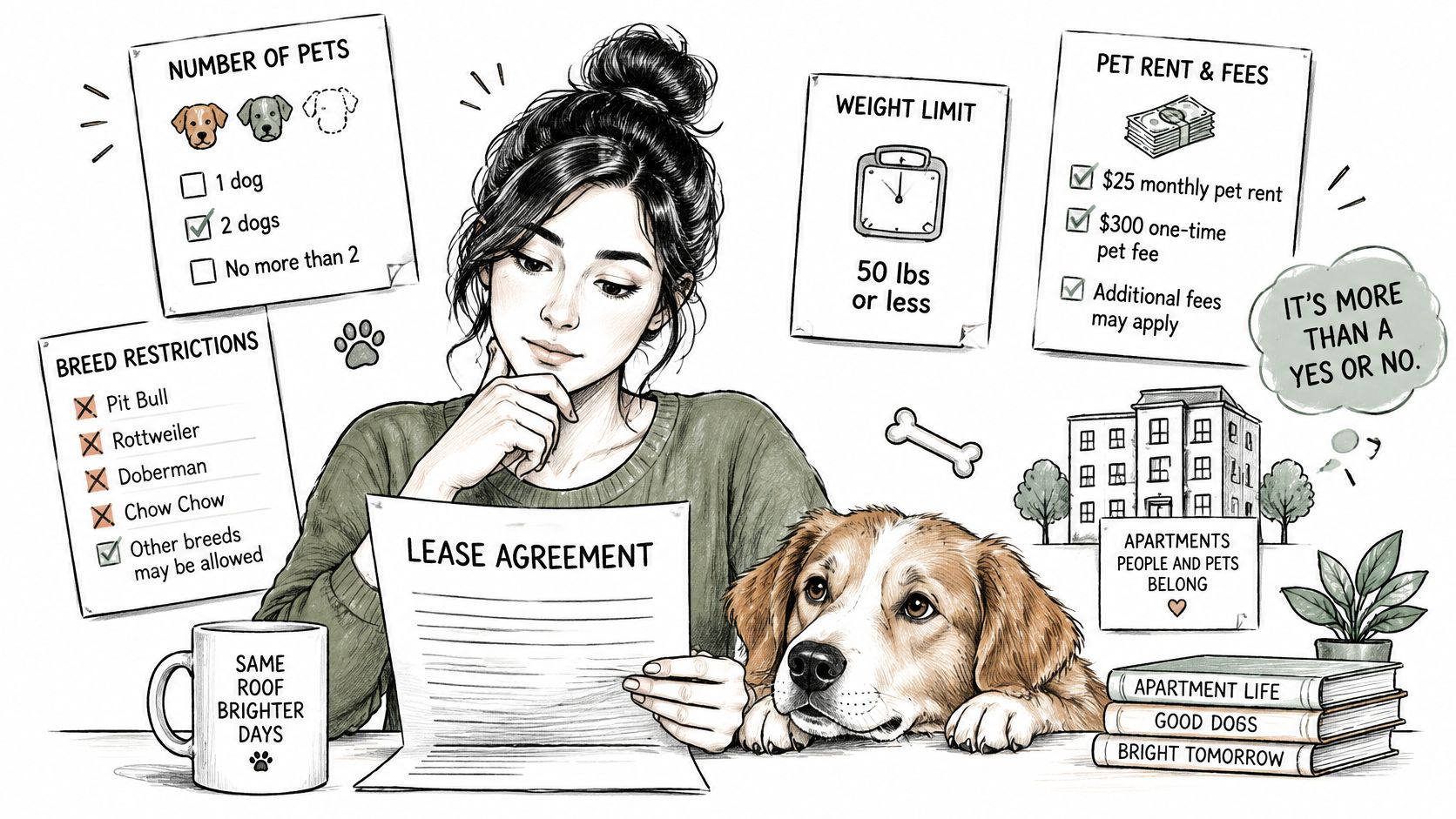
In an HOA community, recorded covenants and board rules can add limits on top of the lease. Renters should review those documents as well as the property's pet addendum. If the addendum doesn't identify the dog's permitted count, adult weight, and breed status, the renter doesn't yet have a clear answer.
When a Dog Is Not a Pet
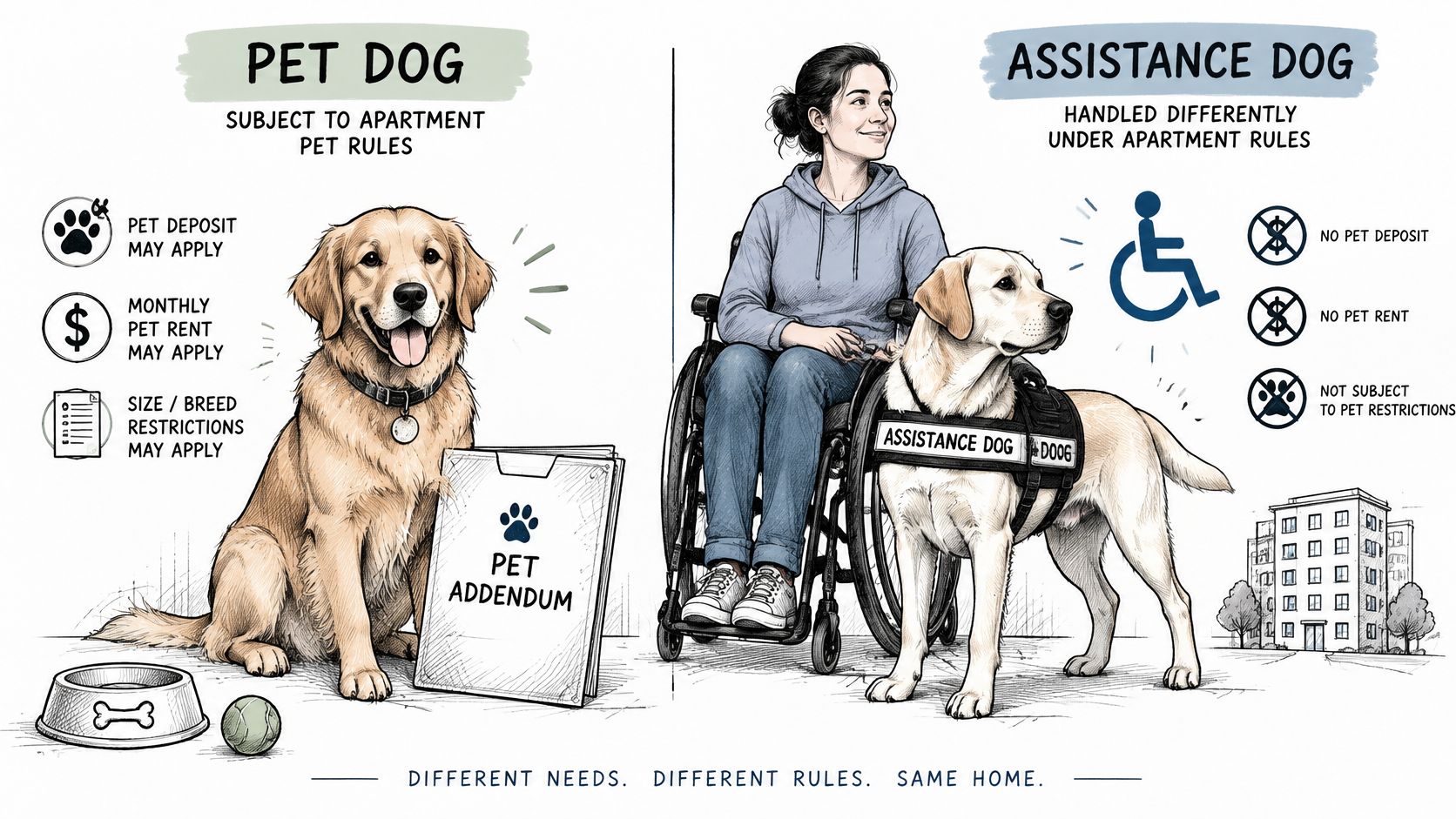
An ordinary household dog follows the property's pet policy. A dog requested as an assistance animal because of a disability is handled through a different process. Under the U.S. Department of Housing and Urban Development's Fair Housing Act guidance, a housing provider generally evaluates the request as a reasonable accommodation instead of automatically applying ordinary pet restrictions.
A housing provider may deny a request only for defined reasons. These include an undue financial or administrative burden, a fundamental change to the operation of the property, a direct threat that can't be reduced through another accommodation, or significant property damage that can't be mitigated. An automatic pet-rule denial is not a substitute for evaluating the accommodation request.
Hypothetical: A resident with a 70-pound dog requests an accommodation after the property sets a 25-pound pet cap. The cap doesn't automatically decide the request, because the provider must consider it under the assistance-animal process rather than treating the dog as an ordinary pet.
Practical rule: A pet addendum and an assistance-animal request are different files. Property managers should keep the processes separate and document the request and decision consistently.
What information can be requested
If the disability-related need is apparent, the provider shouldn't ask for extra medical details without a reason. If the need isn't apparent, the provider may ask for reliable information related to the disability and the need for the animal. The request should focus on that connection, not on collecting a resident's full medical history.
An approved assistance animal shouldn't be subject to pet breed or size rules just because those rules apply to ordinary dogs. Nor should lobby, elevator, or amenity procedures become an indirect way to penalize an approved animal. Property managers who are reviewing building entry solutions for disabled residents should also make sure access procedures support approved accommodations.
Local procedures can add steps, and requirements can depend on the circumstances. This is a general explainer, not legal advice; renters and housing providers should consult a qualified fair-housing professional or attorney about a specific request.
Pet Fees Deposits and Damage Charges
The fee question turns on whether the dog is an ordinary household pet or a qualifying assistance animal. For an ordinary dog, a landlord may charge a pet fee, deposit, monthly pet rent, or require pet insurance when the lease and applicable law allow it. For a qualifying assistance animal, those charges generally can't be imposed as the price of approval.
| Charge | Ordinary household dog | Qualifying assistance animal |
|---|---|---|
| Pet fee or pet rent | May be charged if the lease and local law allow | Generally may not be required |
| Pet deposit | May be charged if the lease and local law allow | May not be required as a condition of approval |
| Pet-insurance requirement | Check the lease and local law | Generally may not be required |
| Repair cost after damage | Charge under the normal damage policy | Same ordinary damage policy as other tenants |
The Texas Department of Housing and Community Affairs' assistance-animal guidance explains the distinction, including HUD's position for federally subsidized multifamily housing: an owner can't require a fee or security deposit as a condition of allowing an assistance animal, but may recover repair costs under regular damage practices.
The no-fee rule doesn't remove responsibility for damage. If an assistance animal damages an apartment or a common area, the provider may charge for that damage using the same ordinary damage policy applied to tenants generally. A damage charge should be tied to actual damage and handled under the property's established process, not relabeled as a pet fee.
Ask for every pet charge in writing before move-in, including the one-time fee, refundable deposit, monthly pet rent, and what the lease treats as damage rather than ordinary wear.
State and local law may further limit pet deposits. Renters should check the relevant state or local housing agency rules alongside the lease, rather than assuming another property's terms apply. Property managers should also keep assistance-animal requests out of the pet-fee screening process.
How to Confirm a Dog Can Move In
A renter can check whether a dog qualifies before paying fees or signing a lease. The useful documents are the current pet addendum and, for an HOA community, the applicable HOA pet rules. A listing or broker's summary may not include the restrictions that determine eligibility.
Get the current rules. Request the written pet addendum and any HOA pet rule. Don't rely on an online listing or a verbal summary.
Match the dog to each limit. Confirm the allowed number of animals, breed restrictions, adult weight cap, and how the property evaluates mixed breeds. If a rule is unclear, ask for its written definition.
Write down every charge. Separate any application cost from the pet fee, refundable deposit, and recurring pet rent. Ask when each charge is due and what portion, if any, can be refunded.
Confirm required records. Ask whether the property needs a license or vaccination record where local rules require it, and whether it uses behavior records. Don't assume a document is required unless the property identifies it.
Use the right track for an assistance animal. A disability-related request should go through the accommodation process, not the ordinary pet application. A pet fee shouldn't be paid to begin that request.
Check the daily route. Ask about leash, waste, lobby, and elevator rules for the paths the dog will use. A rule that works on paper should also be clear for ordinary trips in and out of the building.
Plan visitor entry. If a sitter or dog walker needs to enter a gated community, ask how they'll be admitted and how access will end when the visit is over. Property managers responsible for managing gate access for residents should make sure the process identifies who is authorized and when that authorization ends.
Get approval in writing. The approval should identify the dog and confirm the applicable rules before the renter signs. An oral yes from leasing, a photo of a listing, or a rule forwarded from an old lease year isn't written approval.
Leash Waste and Shared Space Rules
Permission to keep a dog doesn't settle how it must be handled in shared areas. Leash, supervision, and cleanup requirements help residents understand what conduct is expected in halls, elevators, lobbies, shared paths, and gate areas.
HUD's public-housing pet ownership guidance defines a common household pet as a domesticated animal traditionally kept in the home. It states that cats and dogs in common areas must be appropriately and effectively restrained and under the control of a responsible individual. That guidance applies to public housing, not every private lease, but it offers a concrete model for writing clear conduct rules.
Hypothetical: A dog pulls a trailing leash into an elevator during the evening rush. A rule that says “keep the dog under control” leaves room for argument. A rule requiring a named adult to hold the leash gives residents a clear standard to follow.
Put expected conduct in writing
A useful policy states that the person accompanying the dog must maintain control in shared areas, keep the dog on a leash where required, and remove waste promptly. It should also define nuisance conduct in observable terms, such as repeated uncontrolled barking or lunging, and explain how residents report damage or a safety concern.
Vaccination, licensing, and similar records should be required where local law calls for them. The policy should also name a consistent response to reported incidents: a warning first, then a documented incident if the conduct continues, followed by the lease remedy that applies. A deposit can help address physical damage where permitted, but it doesn't replace an incident process.
Assistance animals need their separate accommodation procedures; ordinary pet rules shouldn't be applied to them automatically. Local requirements vary, and property owners should confirm their policy with counsel and their insurer before adopting it. Clear rules help residents understand what's expected without relying on uneven enforcement or unwritten assumptions.
Publish the Dog Policy and Control the Gate
“Dogs allowed” is only a starting point. Publish a written policy that spells out the rules for ordinary pets: whether dogs may live in the property, limits on number, breed or weight, required records, pet fees, leash and waste expectations, and how incidents are handled. Keep a separate written process for assistance-animal requests, since that is a different track from pet permission.
For gated properties, state who may bring a dog through the entry and how a dog walker or sitter gets access. A manager can issue a time-limited digital key for a visit and revoke access when it is no longer needed, including if a resident reports a lost phone. Nimbio lets property managers revoke keys remotely. Its cellular-based controller works without Wi-Fi at the gate, connects to an existing gate operator, and allows clickers, fobs, and keypads to keep working alongside the app. Where enabled, visitors can also be admitted remotely through GuestView video calls.
This is one way apartment access control can support a written dog policy. Property users remain responsible for following applicable laws and rules, including requirements for access-control and security devices.
Keep the pet decision in the lease file and record entry activity in the access log. To request a quote, managers can contact Nimbio with details about the property and gate setup.