Why does a swing gate crawl against the closed post while the motor still runs? Replacing the operator is the usual next step, and it often skips the linkage that pushes the leaf. A stalling swing gate usually traces to arm geometry, hinge drag, or an undersized operator. The free-swing check comes before any motor or phone change, and a phone open command can't correct those faults.
A gate swing arm is the linkage that moves the leaf. Its type, its fit to the operator rating, and the entrapment hardware around it decide whether that leaf finishes the arc.
Table of Contents
- What a Gate Swing Arm Does
- Common Swing Arm Types and How They Move
- Sizing the Arm for Weight Length and Cycles
- Diagnosing a Swing Arm That Binds or Stalls
- Entrapment Zones Around a Moving Arm
- Add Phone Access Only After the Mechanical Check
What a Gate Swing Arm Does
Take a hypothetical gated-community entrance where the leaf stops about a hand's width short of the latch every evening. The board still clicks and the motor still hums, so the property manager orders a new operator. Look at the linkage first. A gate swing arm is the bar, folding pair, or actuator rod that joins the operator to a bracket on the gate. It isn't the motor, and it isn't the leaf.
A door closer makes the same job obvious. The closer body supplies force. The closer arm delivers that force while its angle changes as the door swings on its hinges. On a gate, the operator supplies force at a shaft or a screw, and the arm delivers that force to the leaf while the hinges turn. Near fully closed and fully open, the arm sits at a poor angle. The same motor effort gives less useful push, the leaf slows, and a force limit can trip with nothing in the path but that geometry.
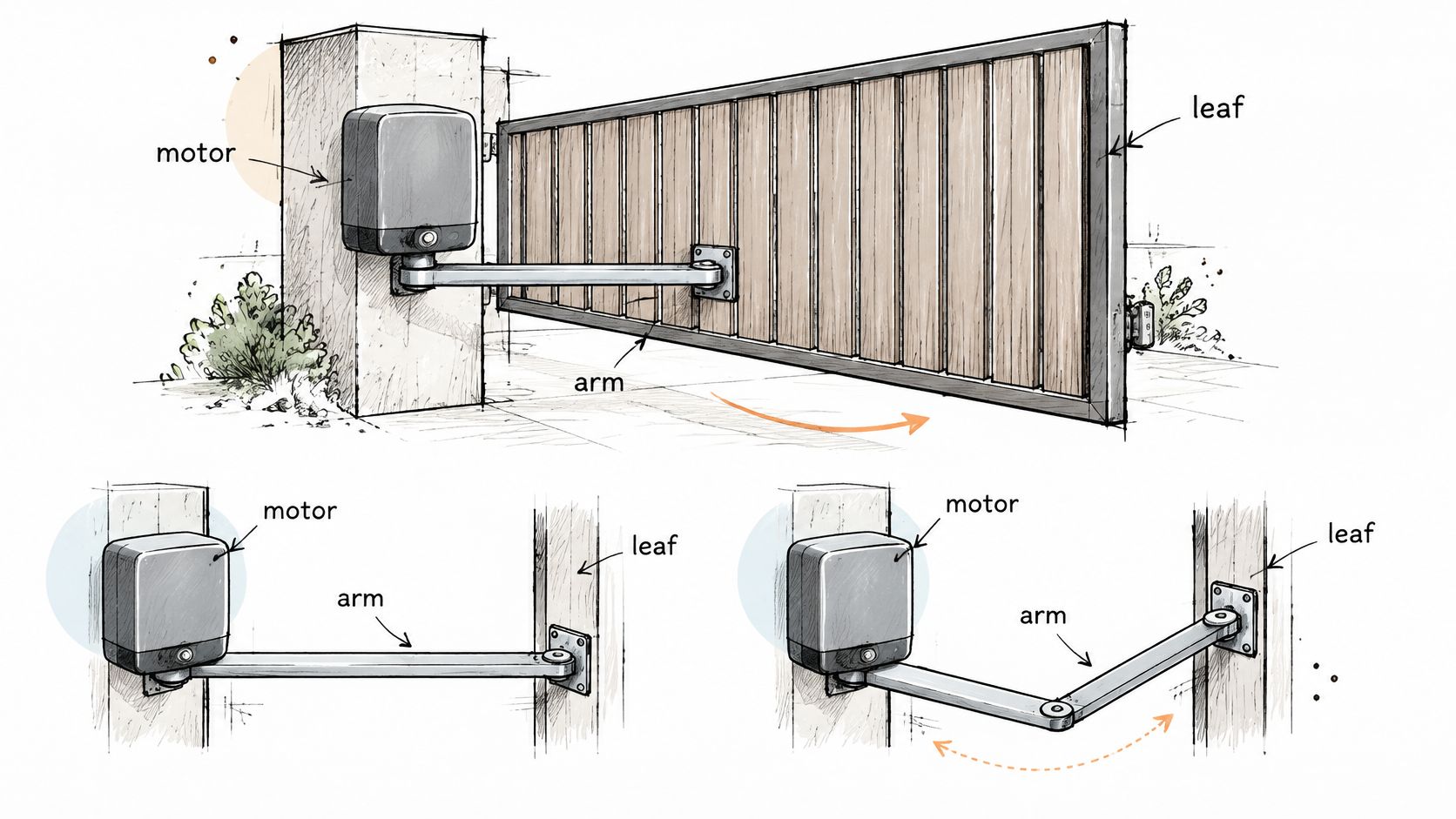
Separate the arm from the parts beside it
A gate that stops short can be failing in any of these places.
- Control board. It starts, stops, and reverses the operator. A missed command is an electrical fault, not a bent arm.
- Hinges. They carry the leaf. Drag, sag, or a leaning post makes the arm fight the gate on every cycle.
- Stops. A stop that meets the leaf too early ends travel before the arm has finished its arc.
- Leaf. Length, weight, cladding, and wind set the load. The arm only transmits what the operator can produce.
The same hardware can overlap a post or the leaf and pinch a hand. That risk sits in the moving shape of the arm, so it remains when the person who sent the open command is somewhere else on the property.
A slide gate moves in a straight line. It doesn't use this rotating linkage, and a slide-gate stall is a different inspection.
The checks that follow
Name the hardware in a set order before anyone adds a new way to open the gate. Arm types come first, then load and cycle fit, then operator compatibility, then a binding check, then the entrapment devices that must stay active if an open command later comes from a phone. A page on how cellular gate openers work describes the command path. It doesn't change the arm, the hinges, or the operator rating.
Common Swing Arm Types and How They Move
Stand at the hinge post and watch one full open. You can sort the hardware without a model number. If the linkage folds, it's an articulated arm. If a rod slides out of a tube, it's a linear actuator, often called a ram. If one rigid bar turns with an output shaft, it's a straight push arm. The table is the scan view of how each one moves, the layout it suits, and the limit to watch.
| Arm type | How it moves | Typical fit | Main limit |
|---|---|---|---|
| Articulated or scissor arm | Two linked pieces fold as the leaf swings | Side-mounted residential operators with room beside the post | Overlapping pinch zone as the pieces close |
| Linear actuator or ram | A screw or hydraulic rod extends and retracts | Heavier leaves or sites with limited side clearance | Stroke length and end-of-travel angle |
| Straight push arm | One rigid arm on a rotating shaft pushes and pulls | Operators built around an output shaft | Weak push when the bracket angle is poor |
Clearance and the pinch a hand can reach
An articulated arm uses two linked pieces that fold as the leaf opens. It's common on residential side-mounted operators, and the fold needs a clear pocket beside the post. A wall, a shrub, or a stored bin in that pocket stops the pieces from closing, and the leaf stalls partway. The pinch is the overlapping joint. A hand between the two pieces, or between the arm and the leaf, sits in that fold as the gate moves.
A linear actuator, screw-drive or hydraulic, pushes a bracket as the rod extends and retracts. It fits a heavier leaf and a site with little side room, because the body stays closer to the leaf line instead of sweeping a wide fold. The useful stroke has to cover the whole travel. Too short a rod leaves the leaf shy of open or closed. The pinch is the narrow gap at the rod and bracket, especially where that bracket passes a post or the leaf edge.
A straight push arm is one rigid member on a rotating output shaft. Bracket position decides whether the leaf gets a strong push or a weak one. If the arm is nearly in line with the leaf at the closed stop or the open stop, the shaft turns and the leaf barely moves. The pinch is the rigid arm crossing the leaf or swinging past the post. That's the gap people reach through when they pull the leaf by hand.
A type isn't a capacity
Classify the linkage by whether it folds, slides inside a tube, or stays one rigid bar. Then stop. The right type still fails if the leaf is heavier, longer, or busier than the operator rating. That rating is the next check, and it belongs to the model on the nameplate, not to the shape of the arm.
Sizing the Arm for Weight Length and Cycles
Weight, length, and cycles belong to the operator model, not to swing arms as a class. Two arms can look alike and still be wrong for the same leaf. Read the nameplate and the data sheet for that model, then measure the leaf on the hinges.
Read the leaf before the catalog photo
Work through the checks in this order.
- Leaf length. A longer leaf needs more torque at the hinges, even when the metal looks light.
- Leaf weight with its cladding. Count pickets, a solid skin, and decorative iron. A bare frame isn't the moving weight.
- Solid panel versus open pickets in wind. A solid leaf acts like a sail. Open pickets shed most of that load.
- Slope. An uphill open makes the operator lift the leaf. A downhill open lets the leaf run away from the arm.
- Hinge drag. Dry or bent hinges add a load the data sheet never assumed.
- Cycles in an hour. Count full open-close cycles at that entrance, not how many cars live on the property.
One published sheet shows how specific those limits get. The DoorKing Model 6002 specification identifies a 24 VDC actuator, a maximum gate weight of 500 pounds, a maximum gate length of 14 feet, a useful rod stroke of 14 inches, and a rated operating frequency of 10 cycles per hour when AC power is connected. The same specification states that the gate must reverse upon contact with a rigid object, or stop or reverse when a non-contact sensor is activated. Those figures are one actuator. They aren't a rule for other brands.
| Check | What to read or measure | Published example or rule of use | If it does not match |
|---|---|---|---|
| Actuator power | Operator data sheet | DoorKing 6002 is a 24 VDC actuator | Do not choose an arm by voltage appearance alone |
| Leaf weight | Weight of the leaf including cladding | DoorKing 6002 maximum 500 pounds | A heavier leaf needs a different listed operator |
| Leaf length | Length of the moving leaf | DoorKing 6002 maximum 14 feet | A longer leaf changes torque even if it looks light |
| Rod stroke | Useful travel of a linear arm | DoorKing 6002 useful rod stroke 14 inches | Too little stroke leaves the leaf short of open or closed |
| Cycles per hour | Full open-close cycles at that entrance | DoorKing 6002 rated 10 cycles per hour on AC power | A busier entrance can overheat light-duty equipment |
| Obstruction response | What the leaf does on contact or sensor trip | DoorKing 6002 must reverse on a rigid object, or stop or reverse on a non-contact sensor | Do not raise force to hide a mechanical problem |
Traffic and wind the nameplate doesn't feel
A busy community entrance can outrun a light-duty cycle rating even when the leaf is under the weight limit. A guard shift, school pickup, or shared drive with repeated openings will heat a light-duty motor long before the leaf is too heavy on a scale. A wind-loaded solid leaf can overload an arm that looks correct for the length, because a calm-day weight ignores the sail.
Practical rule: If the leaf exceeds the nameplate, change the operator or the leaf. Don't expect a different access method to add capacity.
Diagnosing a Swing Arm That Binds or Stalls
The common mistake is replacing the operator before anyone shows that the leaf swings freely. A new motor fails the same way if the hinges drag or the geometry is wrong. The sequence below is a check, not a repair procedure for every brand. Models differ. Follow that operator's manual, and send indicator lights and error codes to the manufacturer or a qualified technician. Don't guess what a lamp means.
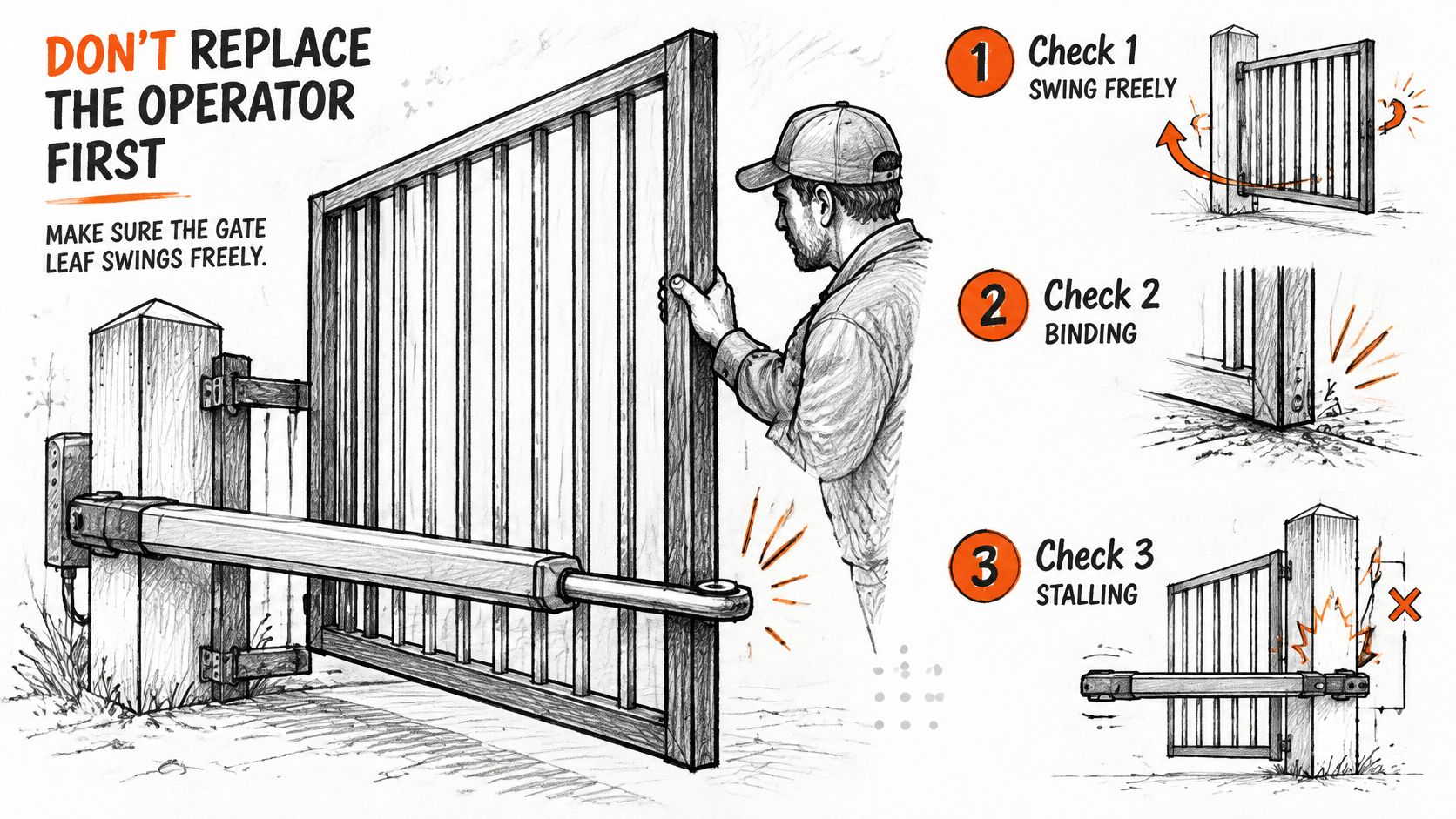
Free swing before any parts order
- Disconnect the operator so the leaf can be moved by hand. Pull the pin or release the clutch the manual names. If the leaf won't move without the motor, the motor isn't the first fault.
- Swing the leaf through its full arc and note tight spots, sag, or a hinge that scrapes. You shouldn't have to lift the leaf. A spot that needs a shove will stall the operator in the same place.
- Inspect hinges, brackets, and the pad under the operator for movement. A bracket that shifts, or a pad that rocks, changes the arm length every cycle.
- Compare the arm geometry with the manual for that model. One installation manual places the attachment point generally 36 to 48 inches from the hinge, and sets swing-arm length at half the distance between the closed and open gate reference points. Other models differ. Use your manual's dimensions if they disagree.
- Check that the arm is level, that joints are secure, and that no welded or bolted joint has slipped or bound at the end stops. A twisted arm or an out-of-plane leaf makes one side of travel easy and the other side a grind.
- Reconnect only after the leaf swings freely. Then confirm the gate stops or reverses on an obstruction, using the test in the operator manual. Don't raise the force setting to muscle past a bind.
Geometry the open button can't fix
The DASMA sheet on swing-gate operator installation says permanently mounted controls should be positioned at least 1.83 m (6 ft) from moving gate parts where applicable, with the gate visible during operation, and it ties shaft torque to pivot location, leaf length, weight distribution, wind, hinge friction, slope, and stop position. Near fully closed and fully open, available push falls while the torque the leaf demands goes up. Current climbs, movement slows, and the force limit can reverse the gate with nobody in the path.
A controller that supplies only an open command can't compensate for an undersized operator, binding hinges, or wind loading. A cellular open, a keypad code, and a clicker all ask the same shaft to do the same work. For model-specific terminals on one common actuator, smartphone gate access wiring for LA400 shows an add-on using the existing open input. That page is a wiring reference. It isn't a reason to skip the free-swing check.
Entrapment Zones Around a Moving Arm
The arm is part of a hazardous machine. While the gate opens or closes, it can form an overlapping "scissoring" zone that traps a hand or an arm between the arm, the leaf, a post, or another fixed object.
A phone or remote command can start that motion when nobody is standing at the gate, so the command doesn't remove local protection. DASMA guidance aligned with ANSI/CAN/UL 325 requires most horizontal swing-gate installations to use at least two independent entrapment-protection means in each direction of travel where an entrapment zone exists. Acceptable categories are inherent force limiting, non-contact photoelectric sensors, contact edges, and constant-pressure controls. The mix depends on the operator and the site, and local requirements vary.
Clearance along the whole arc
DASMA's installer guidance on ASTM F2200 says the leaf should not create an entrapment hazard against a fixed object, and it identifies 16 inches as the minimum distance between a swing gate and a fixed object for avoiding that zone. If that distance can't be held, the zone needs the secondary entrapment protection UL 325 calls for. Mounting the leaf at the back of the column avoids a trap against the column. If that layout is impossible, protect the space instead. Open and closed photos miss the middle of the arc, so check every post, wall, and curb the leaf approaches. Local requirements vary.
A retrofit has to trigger the existing listed operator rather than bypass its safety circuit. After any integration, test photocells, edges, reversal, and force limits in both directions, especially at the arm overlap and the hinge-side pinch. Don't defeat a limit switch to gain a few more inches of travel.
People, and a leaf that can fall
Safety guidance for automated swing gates says pedestrians should be directed to a separate entrance and exit, and the moving gate area should be arranged so people don't contact the gate while it's in motion. Clearly visible warning signage should tell them to stay clear of the path. That ASTM F2200-related guidance also requires no protrusions along the bottom of a swing gate, and protection against the gate falling over if it becomes disconnected from its supporting hardware. A bottom projection can catch a person. A detached leaf can fall on its own. A new arm, or a new way to start that arm, doesn't make an unsafe leaf compliant. Local requirements vary.
Test both directions at the arm overlap and the hinge-side pinch before the gate is left in service.
Add Phone Access Only After the Mechanical Check
Keep the existing gate swing arm, and add a phone open command, only when three facts are true. The leaf is inside the operator rating. The arm completes its arc without binding. The entrapment devices still reverse or stop the gate in both directions. If any of those checks fails, a qualified technician fixes the gate before new electronics go on the operator.
A phone command is only a contact at the operator. If the arm binds partway through the arc, that contact still starts a motor that can't finish the move, and repeated tries heat the drive.
A retrofit uses the operator's existing open input. It leaves clickers, fobs, and keypads working, and it doesn't replace the arm or the operator. Nimbio is one example of a cellular add-on that needs no Wi-Fi at the gate. It wires into the operator a property already has, in parallel with the existing dry-contact input, so those legacy devices keep working. A manager can issue or revoke a digital key and set an expiration date, and a visitor can be let in remotely with video verification. The same hardware works with swing, slide, overhead, mag lock, and strike types, while the arm and the listed operator stay the ones already on that leaf.
Physical work on a community or commercial gate should be done by an independent gate technician and checked against local rules. A short set of fit questions is in what to look for in a gate access system. Identify the arm type, read the operator nameplate, run the free-swing and reversal tests, and only then add a phone command in parallel with the devices already on site.
When the arm finishes its arc and the safety devices still stop the leaf, phone access can sit beside the clickers and keypads already on the property. Nimbio is a cellular add-on for an electric gate that needs no Wi-Fi at the operator, leaves that operator in place, and lets a manager issue or revoke a digital key with an expiration date. See how that fits a swing gate that's already safe to move at Nimbio.