A new board member opens the shared inbox on a Monday morning and finds a past-due insurance invoice, three gate complaints, a landscaping bid that expired last week, and no record of who approved any of it. That inbox is where most HOA trouble starts, and it's also where good management starts. To learn how to manage an HOA, a board doesn't need more volunteer hours. It needs a fixed calendar, written approval rules, separate plans for operating money and reserves, and records that survive the next election.
The pattern below treats everyday items, including gate access, vendor credentials, and entry logs, as governance controls. Each task gets a date, a named owner, and a file where the decision lives.
Table of Contents
- The Annual Calendar Every HOA Board Runs
- Set Decision Rules Before the Next Vote
- State Rules That Set Your Budget and Records Deadlines
- How to Build a Reserve Plan and Budget
- Vendors and Gate Systems That Outlast Board Turnover
- Who Can Open the Gate and Who Sees the Logs
- Communication and Compliance Without Surprises
- Adopt Three Written Systems at the Next Meeting
The Annual Calendar Every HOA Board Runs
The scale is the reason informal habits fail. The Foundation for Community Association Research's 2024 statistical review estimates approximately 369,000 community associations in the United States, covering about 28.8 million housing units and serving approximately 77.1 million residents. A separate 2024 Foundation for Community Association Research dashboard identifies more than $21 billion in annual community-association assessments.
Those national totals are a benchmark, not a template for one community. They do show why a board can't run on memory. Assessments pay for recurring work such as landscaping, utilities, insurance, and management, while reserves pay for major future projects.
Recurring Tasks at a Glance
| Task | How often | Who owns it | Why it matters |
|---|---|---|---|
| Annual operating budget | Once a year, before the fiscal year | Board treasurer with manager | Covers recurring costs such as utilities, insurance and management |
| Reserve study update | Periodically, and when costs or conditions change materially | Board with a professional preparer | Keeps funding tied to current replacement costs |
| Reserve funding review | Once a year | Board | Compares contributions, earnings, inflation and completed work against the plan |
| Bank reconciliation | Monthly | Manager, checked by a second board member | Catches errors and unauthorized payments early |
| Financial statements to the board | Monthly | Manager | Shows operating cash, reserves, delinquencies and budget variances |
| Access and permission review | After every election and after any key holder change | Board and manager | Removes access for people who no longer need it |
| Vendor insurance and credential check | Before each contract renewal | Board | Confirms contractors are covered before they work on the property |
To make this the board's own calendar, pull the governing documents, mark fixed dates for elections, budget adoption, filings, and inspections, and add a reminder ahead of each deadline. A task also needs a backup owner, because volunteers travel, resign, and get busy.
Calendar check: Any task without an owner or a date is the one that will be missed.
Set Decision Rules Before the Next Vote
Most disputes about a vote aren't about the outcome. They're about whether the board had the authority to act and whether anyone can prove how the decision was made. The declaration, bylaws, rules, and applicable local law set that authority, so the board should work from those documents instead of past practice.
Communication belongs in the same control system. The Foundation for Community Association Research reserve study funding survey identifies communicating funding needs as the leading challenge at 64%, followed by explaining the study at 59%. Clear decision records make that communication easier because the board can show the reason, not just announce a result.
Five Steps to a Defensible Record
List the approvals. Pull the governing documents and write down every approval the board must give, from spending and contracts to rule changes and architectural requests. This list stops the board from discovering a required owner vote after work has started.
Set spending thresholds. Separate what the manager can approve, what needs a board vote, and what needs a vote of owners. Put dollar limits and emergency exceptions in writing so a burst pipe doesn't turn into an argument about authority.
Adopt the annual calendar. Put budgets, elections, inspections, contract renewals, and compliance filings on one board-approved calendar. Renewal dates matter because a contract that auto-renews has effectively been approved without a discussion.
Run meetings on paper. Require a written agenda, a quorum check, minutes, and conflict-of-interest disclosures. For material contracts, require competitive bids and keep the losing bids too, since they show the board compared options.
Open a decision file. For each major decision, file the business reason, bids, insurance requirements, contractor credentials, the signed contract, and a post-completion review. The review can be short. It should state whether the work matched the contract and whether the vendor should be used again.
Informal committees, undocumented email votes, and unverified vendor recommendations weaken that record. So does letting one board member approve a payment and also reconcile the bank account. Dual approval for disbursements and monthly reconciliation by a second person cost little time and remove the most common source of suspicion.
The board can adopt a one-page authority matrix this month. Each row names a category of decision, the person or body that approves it, any dollar threshold, and where the approval is recorded. Once owners can see how decisions are made, they argue less about whether the process was invented for one case.
State Rules That Set Your Budget and Records Deadlines
State law often sets the deadline, not the board's preference. The examples below show how different the mechanics can be, and they're examples only. A board should confirm which statute covers its association with counsel before relying on any row.
Maryland law on reserve funding requires an annual proposed budget to go to lot owners at least 30 days before adoption, according to Maryland statute section 11B-112.2. California's Department of Real Estate reserve study guidance requires a visual inspection at least once every three years for qualifying major components and an annual review of the reserve study. Washington law treats a reserve study as separate from, and supplemental to, the operating budget under Washington's homeowners association statute. Colorado's Division of Real Estate HOA guidance states that an association may require a written records request at least 10 days before inspection or production and must maintain a policy governing investment of reserve funds.
| State | Rule | What the board does |
|---|---|---|
| Maryland | Proposed budget sent to lot owners at least 30 days before adoption; reserve amount must match the latest study and be deposited by the last day of the fiscal year | Budget the recommended reserve amount and review its adequacy every year |
| California | Visual inspection at least once every three years for qualifying major components; reserve study reviewed every year | Track which components qualify and log each inspection and review |
| Washington | Reserve study kept separate from and supplemental to the operating budget; covers major work too infrequent for the annual budget | Keep reserve planning distinct from the operating budget and assign the reserve account to a named board member |
| Colorado | Owners may request records in writing, which may be required at least 10 days before inspection or production; reserve investment policy required | Publish where requests go, which records are available and how inspection or copying is arranged |
The practical step is simple. Put each state rule on the board's calendar next to the owner who will meet it, and keep the source link in the same file. A deadline that lives only in a statute book won't remind anyone in October.
How to Build a Reserve Plan and Budget
The operating budget pays recurring costs such as utilities, insurance, landscaping, security, repairs, and management. Reserves pay for large, infrequent replacements. Mixing the two lets a board look balanced this year by borrowing from a roof, a road, or a gate operator that will fail later.
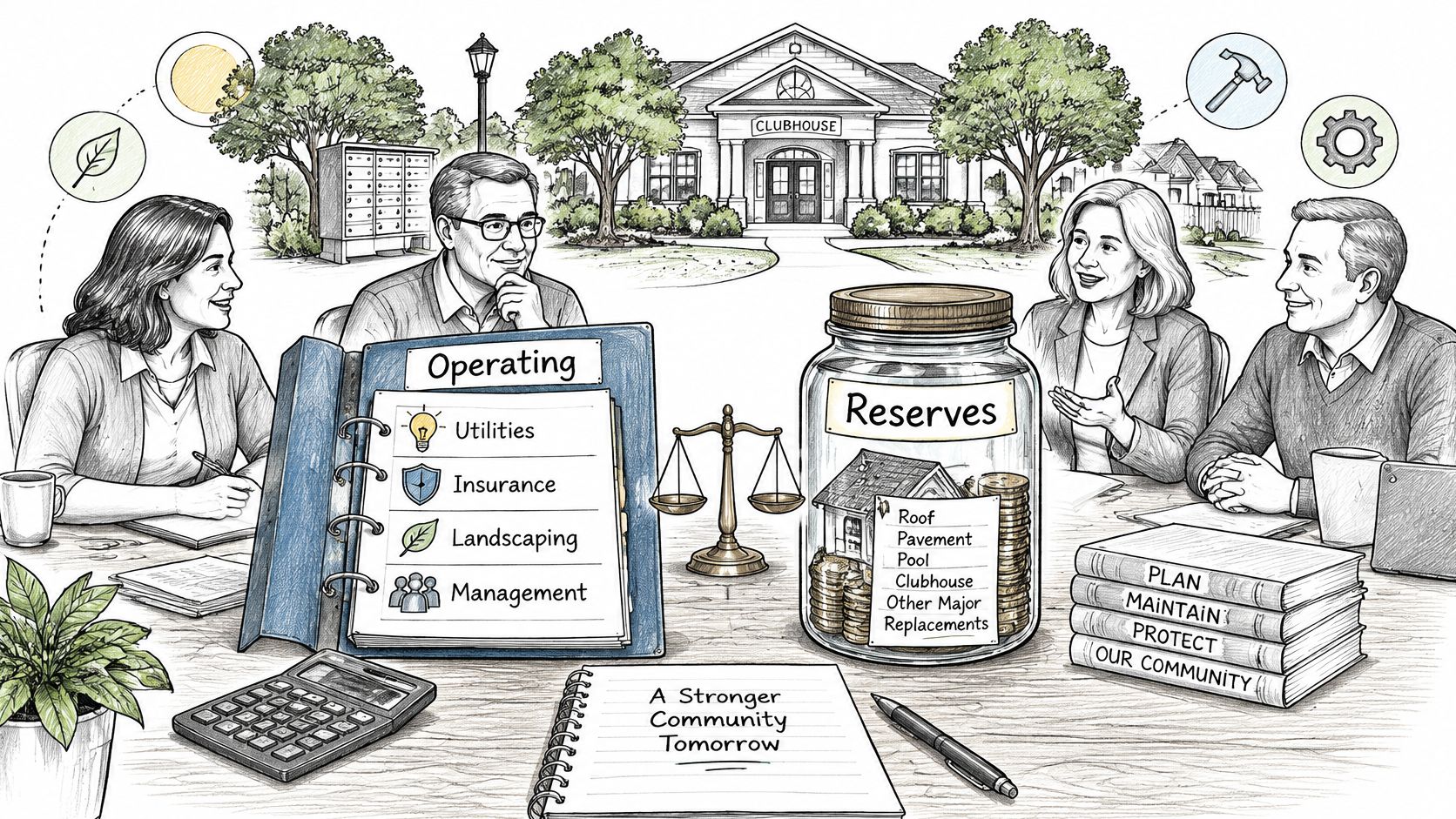
Industry guidance in CooperatorNews on protecting reserves describes reserve expenses as commonly roughly 15% to 40% of an association's total budget, with a practical benchmark of at least 70% of the fully funded reserve balance and below 30% treated as a high-risk condition. Those figures explain why reserve planning can't be an afterthought once operating bills are paid.
Six Steps That Keep Funding Current
Map every component. List roofs, roads, drainage, façades, pools, gates, and structural elements the association maintains. Record useful life, current condition, replacement cost, and responsibility under the declaration.
Commission a reserve study. Use a qualified preparer to produce both physical and financial analyses. A spreadsheet built from old invoices usually misses condition problems that a site visit catches.
Build a long-range cash-flow plan. Adopt a 20- to 30-year plan and update inflation assumptions as costs change. A shorter horizon hides expensive components that sit just beyond the plan.
Model assessment increases early. Small, planned increases give owners time to adjust. Repeated special assessments usually mean earlier boards avoided an unpopular but cheaper decision.
Publish the funding path. State project timing and contribution assumptions in plain language. Owners don't need every formula, but they do need to see what they're funding and when.
Approve an annual variance review. Compare actual contributions, investment earnings, inflation, and completed work against the plan. Update the study with a site visit at least every three years, and sooner when conditions or costs change materially.
The common pitfalls are predictable. Boards rely on a static study, omit long-life assets such as stormwater systems and trees, underestimate construction costs, or defer maintenance until replacement becomes urgent. Deferred maintenance is the most expensive habit because a small repair becomes a capital project with a deadline the board didn't choose.
A reserve plan isn't a savings goal. It's a schedule of known replacements with money assigned before each one comes due.
Vendors and Gate Systems That Outlast Board Turnover
A gate that only one former director understood isn't a quirky inconvenience. It's a governance failure. Turnover is normal for volunteer boards, managers, and vendors, so systems have to work for the next person who inherits the password binder.
That continuity problem shows up in complaint patterns too. A summary of Colorado reporting in ManageCasa on HOA management challenges states that Colorado's 2025 HOA Information and Resource Center reported 364 complainants, up from 300 in 2024, and approximately 76% of complaint categories were directed at HOA boards rather than managers or management companies. Weak handoffs land on the board because owners hold the board responsible.
The Register That Prevents Lost Knowledge
- Vendor details: Contractor name, contract end date, insurance certificate, credential status, and the board member who owns the relationship.
- Gate details: Operator model, installer, service account, and a link to the manufacturer's manual.
- Access details: Every key holder, contractor credential, and service login, with an expiration or review date.
- Contract notes: Scope, notice period for cancellation, and what counts as extra work.
Written scopes also help with avoiding HOA groundskeeping contract disputes, because the board and contractor can point to the same service list instead of arguing from memory. That same discipline applies to pool, elevator, and gate service.
For repairs, wiring, or troubleshooting, follow the manufacturer's manual and call a qualified technician, because models differ. A board shouldn't guess at error codes or safety settings. Most communities already run keypads, clickers, and fobs, and those don't have to disappear when access changes. A cellular add-on controller can wire into the existing gate operator and work alongside those devices, with no Wi-Fi needed at the gate. Nimbio makes one such controller and smartphone app as one example of this approach, and boards comparing options can review what to look for in a gate access system before signing anything.
Nimbio recommends using a professional installer, and its technicians support anyone who takes on the installation, though HOA, multifamily, and commercial properties should confirm their work complies with local regulations governing gate access.
Continuity controls close the loop. Use board-owned administrator accounts, a two-person rule for high-impact changes, automated expiration for temporary credentials, and a handoff test before each election. Reconcile active residents, contractors, and service accounts monthly so departures don't leave live access behind.
Who Can Open the Gate and Who Sees the Logs
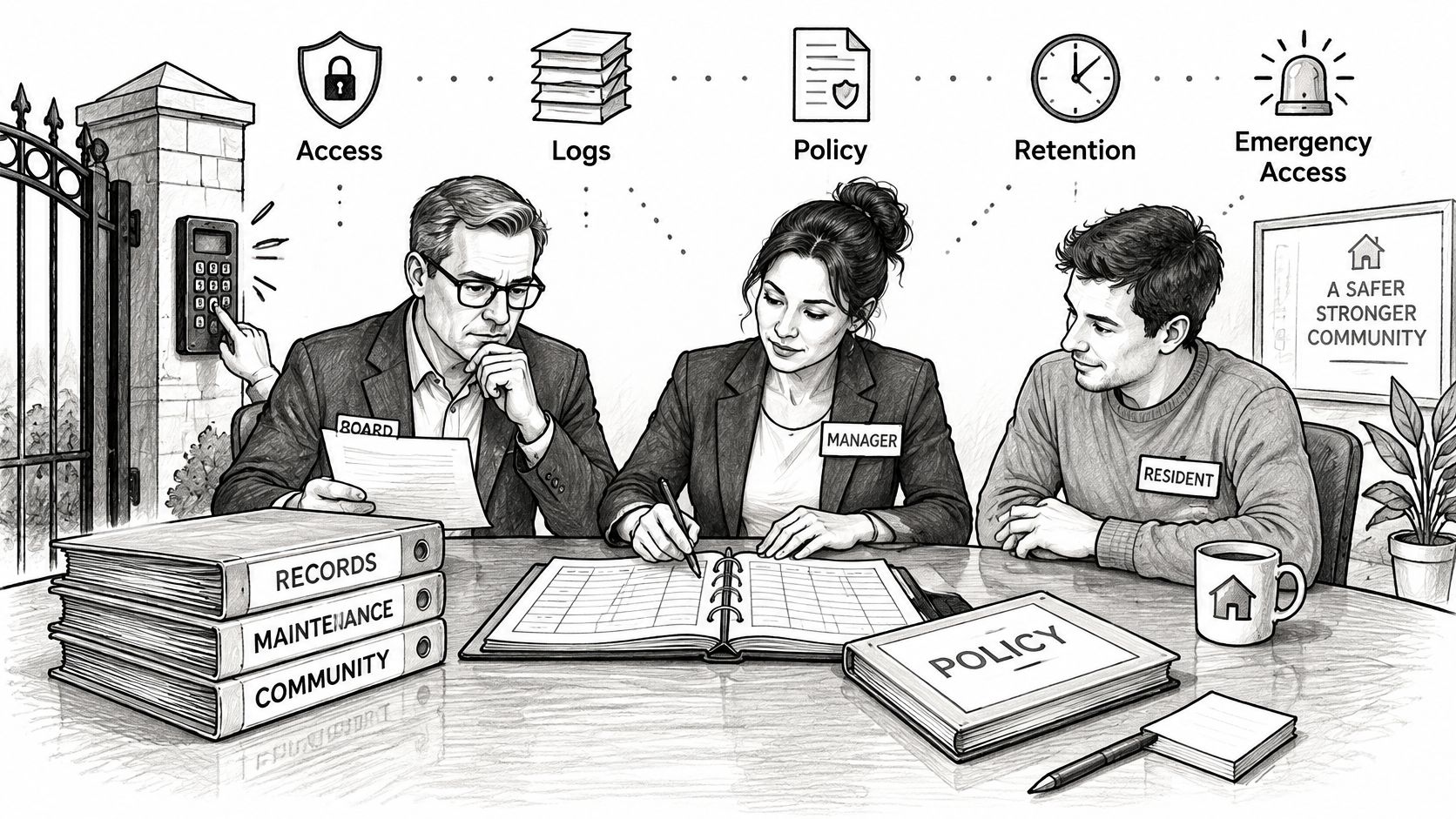
More tracking isn't automatically better management. A log that nobody reviews, or that too many people can browse, creates a privacy problem without improving accountability. Auditability needs role-based access, a written retention schedule, emergency procedures, and a policy the board has approved in a recorded vote.
Records access is already a sore point for owners. South Carolina's 2025 HOA complaint report identified ignored requests to view information or documents as 9.5% of reported concerns, while open-meeting and records-access reforms were the two most common recommended statutory changes, at 27.5% and 18.1%, respectively. The same source material notes that Florida's 2025 HOA statute treats electronic security measures, passwords, and software used to manipulate association data as official records that must generally be retained for at least seven years. Boards outside Florida should replace that example with their own state rule and match the retention schedule to it.
Questions the Policy Must Answer
- Issuing credentials: Who may issue or revoke gate credentials, and who approves exceptions?
- Removal deadlines: How quickly does access end after a move-out, a staff departure, or the end of a contractor's contract, and what happens during a delinquency process under the governing documents?
- Log visibility: Which entry logs can residents, board members, managers, and law enforcement see, and for what purpose?
- Retention and privacy: How long are logs kept, and how does the board avoid publishing identifying visitor data in minutes or owner packets?
Consider a hypothetical example. In a 120-home community, a former tenant's shared code still opens the gate three months after move-out, and nobody can say who used it. Individual credentials with a named owner and a removal deadline would have prevented that gap, because the move-out checklist would have revoked one person's access without changing everyone else's code.
Smartphone-based credentials can support that policy when the board defines privacy boundaries first, which is the point of reviewing smartphone gate access for HOA communities as a governance question rather than a gadget purchase. Property managers can issue and revoke digital keys remotely and set an expiration date on a key, and visitors can be let in remotely, including video verification at the gate.
A board can draft five policy items this week. Name the credential owner, set removal deadlines, define who sees logs, set the retention period, and write the emergency procedure for a gate that won't open or won't close.
Communication and Compliance Without Surprises
Residents judge a board less by its intentions than by whether notices arrive on time and rules are applied the same way twice. That means communication needs a cadence, not a burst of messages after a problem.
Send meeting notices and agendas as the governing documents require. Pair a regular owner update with the financial statements, and give owners one contact point for requests so messages don't scatter across personal inboxes. Publish statements that show operating cash, reserves, delinquencies, payables, and budget-to-actual variances. Owners who see those five items monthly ask better questions at budget time.
Enforcement as a Sequence
- Written notice: Describe the rule, the observed condition, and the cure period set by the declaration.
- Opportunity to be heard: Follow the hearing process the bylaws provide before imposing a fine or other remedy.
- Recorded decision: Put the outcome in the minutes and keep a case file for the matter.
- Written exceptions: If the board grants an exception, record the reason so the next board doesn't treat it as a precedent by accident.
Delinquency collection follows the same discipline. The declaration and state law set the notices and any late-fee or lien steps, so each step should be confirmed with counsel before it's used. Skipping a required notice can undo months of collection work.
Access questions belong in the same owner update when they affect daily life, such as a gate held open for road work or a credential cleanup after an election. Managers reviewing those events can use Nimbio's gate access audit trail as an example of how timestamps help answer a specific dispute without handing owners a full log.
Consistency test: If the board wouldn't send the same letter to every owner in the same situation, it shouldn't send it to one.
Adopt Three Written Systems at the Next Meeting
Boards don't fix management with a retreat. They fix it by adopting three short documents in one recorded vote and assigning an owner to each.
First, adopt the authority matrix, listing each spending category, who approves it, the dollar threshold, and where the approval is recorded. Second, adopt the reserve calendar, listing the current study date, the next update date, and the annual funding review date. Third, adopt the access and vendor register, listing every key holder, contractor, service account, and gate operator model, with an owner and removal date for each entry.
For HOAs and gated neighborhoods, Nimbio replaces the shared gate code with individual digital keys managed from any web browser, billed flat-rate per home. Its Community Manager portal provides instant revocation, home-grouping, 24/7 access logs, and hold-open scheduling, which fits the register approach because each credential has an owner.
Name one owner per document who updates it after every election and contract change. Set the first review date and write it into the minutes. Boards with access questions can start at Nimbio's contact page.
Learning how to manage an HOA gets easier when gate access has named owners, expiration dates, and logs the board can review. Nimbio offers a cellular add-on controller and smartphone app that work with the gate operator a community already has, while existing clickers, fobs, and keypads keep working. Visit the site to see how remote digital keys and visitor verification can fit the written access policy your board adopts next.