A property manager can buy a high-quality sliding glass door electronic lock, install it carefully, and still end up with a door that won't secure properly. The usual culprit isn't the app. It's the door profile, the narrow stile, the mortise pocket, the frame preparation, or a panel that has shifted out of alignment.
Sliding glass doors need a retrofit-first approach. The right solution must combine positive mechanical engagement, reliable door-position feedback, suitable connectivity, and a mounting method that preserves the existing panel instead of creating a new weak point. That matters for homes, HOA communities, multifamily buildings, and commercial spaces where replacing every sliding assembly isn't practical.
Table of Contents
- Why Sliding Glass Door Security Is Its Own Problem
- The Four Types of Sliding Glass Door Electronic Locks
- Core Components and Features That Actually Matter
- Smart-Home Connectivity and Integration Options
- Installation Complexity and Compatibility Checks
- Layered Security Beyond the Lock Itself
- Cost, Battery Life, and Long-Term Ownership
- Buying Checklist and Common Troubleshooting Questions
Why Sliding Glass Door Security Is Its Own Problem
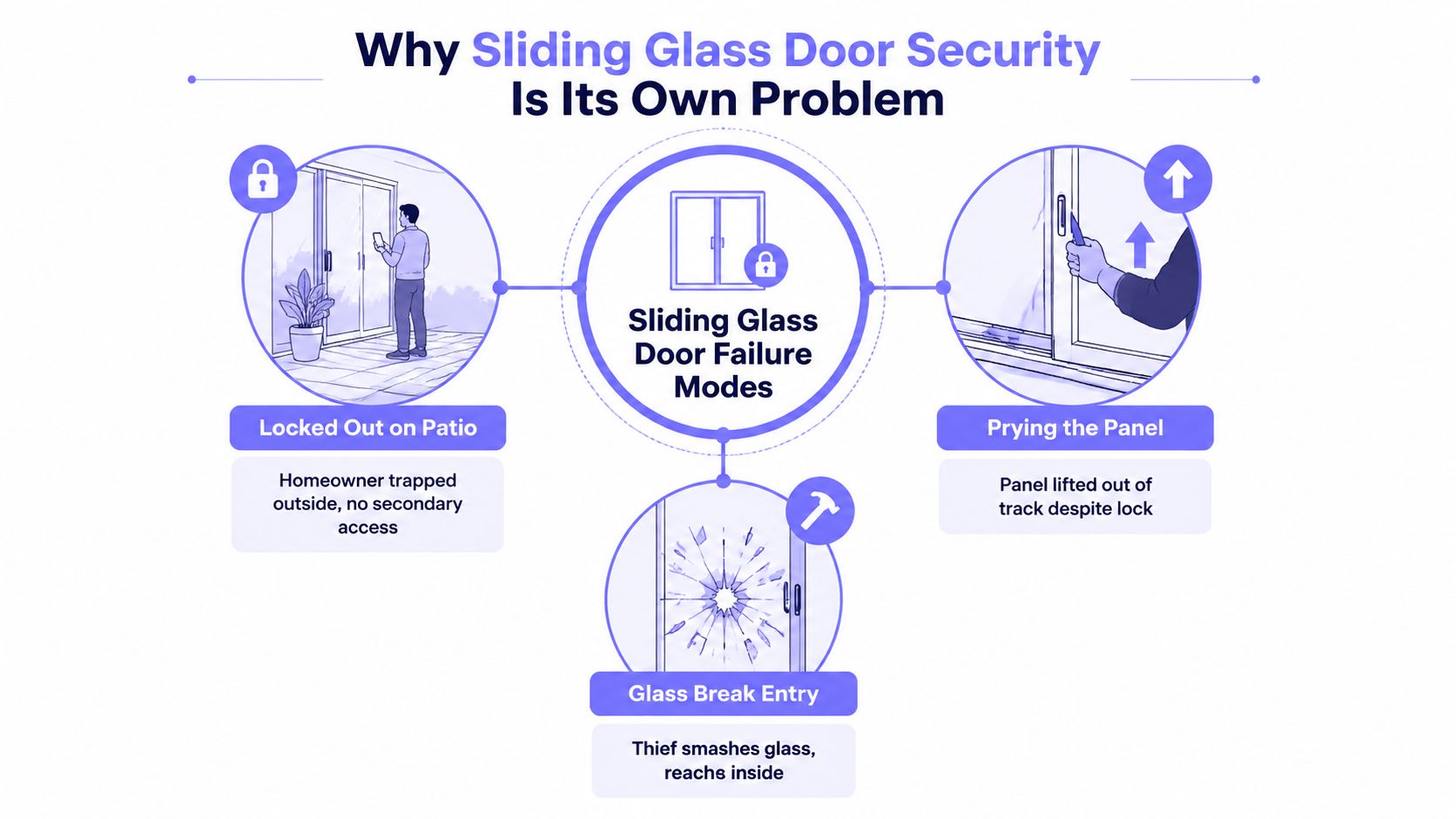
A homeowner steps onto the patio, lets the sliding panel close, and hears the familiar latch click. Minutes later, the door won't open from outside. A dowel or patio bar may hold the panel in place, but the factory latch never fully engaged because the panel drifted on its rollers.
That scenario explains why sliding doors aren't hinged doors turned sideways. The panel moves along a track, can be lifted, and may lose alignment as rollers, frames, and weather seals change. A 1979 U.S. Office of Justice Programs report on sliding glass door units treated these assemblies as their own physical-security category, with performance requirements and forced-entry tests for resistance against unskilled and semiskilled burglars.
Three moving weaknesses
- Roller movement: Lift-and-glide rollers can shift over time, allowing the panel to sit lower or farther from the strike.
- Frame movement: Seasonal humidity and temperature changes can affect alignment, especially in wood, vinyl, and mixed-material assemblies.
- Glass exposure: Tempered glass provides visibility and can be shattered, allowing an intruder to reach toward the interior hardware.
Many factory latches are simple hooks, cams, or foot-operated mechanisms. They can fail when the panel is slightly out of square, and a determined intruder may attack the panel, the track, or the frame rather than the latch itself.
The UK Master Locksmiths Association guidance on sliding doors and windows recommends additional locks positioned so force acts against fixing screws. It also describes multi-point arrangements with at least three horizontal locking points, hook bolts with a minimum 20 mm throw, or vertical shoot bolts with a minimum 14 mm throw. Those specifications illustrate the underlying issue: a sliding door lock has to resist horizontal force, lifting, and track bypass.
Installer's rule: The motor can operate the lock, but the door assembly still carries the security load.
For owners comparing sliding door options for Texas homes, the same principle applies across property types. An electronic lock should reinforce a properly aligned door, not conceal a failing roller system or a weak frame-to-strike connection.
The Four Types of Sliding Glass Door Electronic Locks
The category becomes easier to understand when the buyer asks one question first: What part of the door does the lock replace, clamp onto, or engage? A seatbelt, child seat, and roll cage all protect occupants, but they attach to the vehicle differently. Sliding-door locks work the same way.
A mortise-style unit occupies the existing lock pocket inside the panel stile. A surface-mounted deadbolt sits on the interior face and shoots a pin or bolt into a prepared strike. A multipoint system engages several points along the panel. A wraparound retrofit works with existing hardware and changes less of the door.
| Type | Installation | Best For | Key Tradeoff |
|---|---|---|---|
| Mortise-style lock | Replaces or occupies the factory mortise pocket | Older compatible vinyl sliders and owner-occupied homes | Requires exact pocket and stile compatibility |
| Surface-mounted deadbolt | Attaches to the interior stile and frame | Straightforward retrofit projects | Visible hardware and possible strike preparation |
| Multipoint locking system | Engages the top, bottom, and jamb | Higher-security residential or commercial openings | More frame modification and professional labor |
| Wraparound retrofit | Clamps around or works with existing handle hardware | Renters and owners preserving the existing panel | May provide less mechanical engagement than a purpose-built mortise system |
How to choose the form factor
Mortise-style units make sense when the existing pocket matches the lock body. They can provide clean integration, but a shallow or unusually shaped pocket can make the installation impractical.
Surface-mounted deadbolts are often easier to fit because they don't depend entirely on the original mortise. The tradeoff is that the installer must verify the interior stile, strike location, and available clearance.
Multipoint systems distribute force across more than one location. They're appropriate when the frame and panel can accept the required preparation, but they're rarely a casual do-it-yourself replacement.
Wraparound retrofits suit situations where preserving the factory hardware matters. They can be attractive for renters or property owners who don't want to route a new cavity, though the existing door still needs to be straight, secure, and mechanically sound.
Mainstream smart locks often target standard deadbolts, not true sliding glass doors. A compatibility-focused sliding-door guide highlights why stile width, door thickness, and mortise-pocket size matter more than a long feature list.
Core Components and Features That Actually Matter
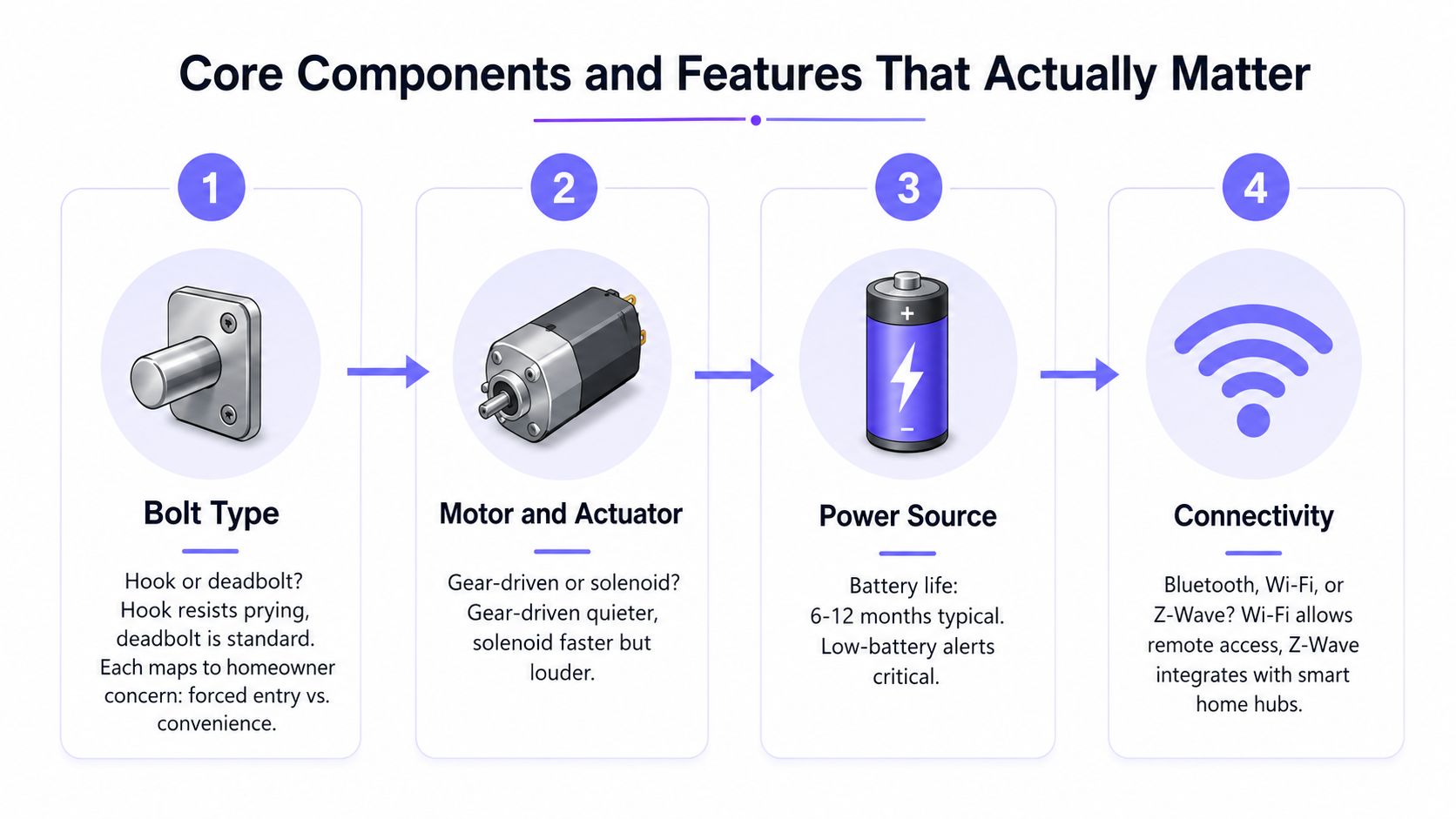
A sliding glass door electronic lock is a chain of mechanical and electronic decisions. If one link is weak, the app may report a secure status while the panel, strike, or sensor is misaligned.
The bolt comes first. A hook bolt can resist a lifting or prying motion more effectively than a straight pin because it captures the receiving point. A dead pin remains useful, especially in a properly prepared frame, but it depends heavily on alignment and the strength of the strike area.
The decision chain
Bolt and actuator: A gear-driven actuator usually offers controlled movement, while a solenoid may operate quickly but can produce a sharper mechanical sound. Neither option compensates for a loose strike or a panel that has dropped.
Sensors: Door-position contacts confirm whether the panel is closed. Tilt or lift sensing can identify movement that a simple contact misses, while tamper contacts can report an attempt to remove or manipulate the lock body.
Power: Battery operation is common because running wire to a patio panel is inconvenient. A useful unit should provide low-battery warnings and retain a mechanical override or other recovery method.
Connectivity: Bluetooth, Wi-Fi, hub-based radio, and cellular links solve different access problems. The correct choice depends on whether the user needs nearby operation, property-wide administration, or access that remains available when the local network drops.
A misaligned panel can fool a door-position sensor. The magnet may appear close enough to register “closed,” while the bolt cannot fully enter the strike. Cold conditions can also affect battery output, so installers should test the lock under realistic weather and not only in a warm showroom.
A loud onboard siren doesn't replace a strong bolt, but it can draw attention when someone tampers with the lock. For broader access-control planning, property teams can review access control practices from Nutmeg Technologies and map credentials, audit events, emergency access, and administrative responsibilities before deployment.
For electrically controlled openings elsewhere on a property, Nimbio door strike compatibility can help teams assess whether an existing strike application can accept a compatible controller.
Smart-Home Connectivity and Integration Options
Connectivity determines whether the lock is a nearby convenience or part of a managed access system. A resident may only need a phone at the patio, while a property manager may need remote credentials, event history, and visitor administration across multiple buildings.
Bluetooth keeps setup simple and limits the lock's exposure to the wider network. Its short range can work well for a single-family door, but it becomes inconvenient when a manager needs to check or administer several units.
Wi-Fi provides direct network access, yet patio installations can produce unpredictable results. Aluminum frames, metal lock bodies, walls, and the mounting position can weaken the signal. A lock that pairs on a workbench may fail after installation because the final location creates a dead spot.
Protocols in practical terms
| Protocol | Typical Range | Hub Required | Best For | Retrofit Caveat |
|---|---|---|---|---|
| Bluetooth | Short, nearby operation | No | Residents using a phone at the door | Remote administration usually needs a bridge |
| Wi-Fi | Property network coverage | No, unless required by the product | Direct app access and connected homes | Signal quality can change after mounting |
| Z-Wave | Hub-based mesh coverage | Yes | Managed smart-home or property systems | Requires compatible hub and network planning |
| Zigbee | Hub-based mesh coverage | Yes | Low-power connected environments | Device compatibility varies by ecosystem |
| Cellular | Carrier network coverage | No local hub | Vacant properties and remote management | Requires supported service and data connectivity |
Z-Wave and Zigbee can reduce battery demand by routing through a hub, while cellular equipment avoids dependence on the property's Wi-Fi network. Cellular access-control hardware is especially relevant where the local network is unreliable, unavailable, or controlled by a resident who may change the password.
Before selecting a radio, installers should test the exact mounting location with the intended router, hub, or cellular service. The access path is only as dependable as the weakest connection between the credential, controller, actuator, and door.
Property managers assessing remote operation can use this remote access guide to compare how connected entry systems handle off-site administration and credential control.
Installation Complexity and Compatibility Checks
Most failed purchases begin before installation. The buyer chooses a lock based on keypad functions or app reviews, then discovers that the lock body cannot fit the active stile or that the strike has nowhere solid to mount.
A proper pre-purchase inspection should record the following:
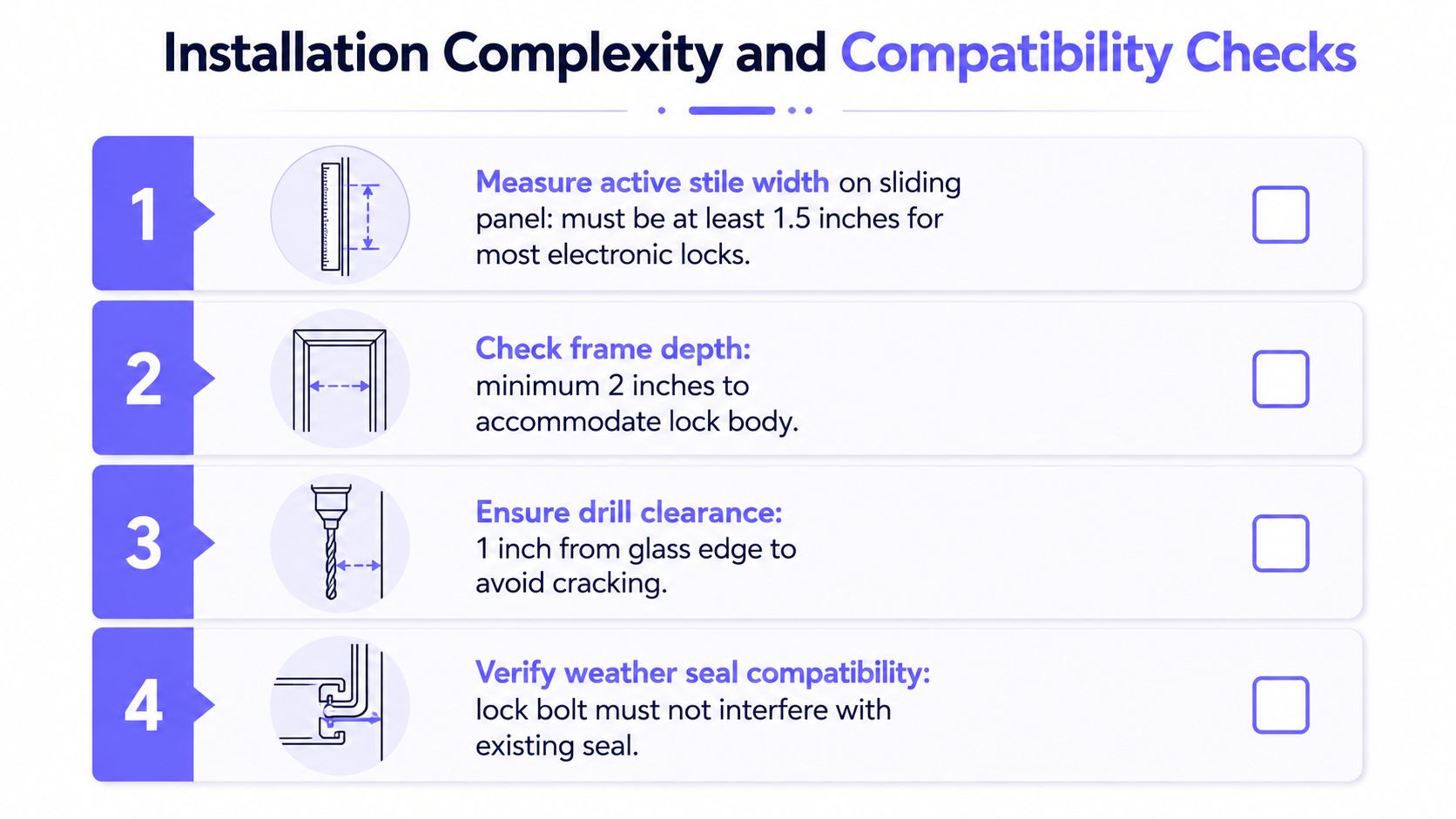
- Active stile width: Measure the vertical edge of the moving panel where the lock body will sit. The provided installation visual identifies 1.5 inches as a minimum for many electronic-lock installations, so a narrow stile may eliminate mortise-style choices.
- Door thickness: Confirm the panel thickness before ordering a clamp or retrofit body. The lock needs enough material for secure mounting without interfering with the glass, seal, or handle.
- Mortise pocket: Look inside the existing jamb and panel preparation. A shallow rectangular pocket may accept a compatible electronic mechanism, while an unusual cavity can require routing or a different form factor.
- Frame preparation: Check whether the receiving frame has a flat, strong surface for the strike. A spacer plate may be needed when the frame steps inward or the weather seal occupies the intended location.
Why the measurements matter
A commercial sliding-door electronic lock may use a narrow retrofit body and a hook-bolt mortise, with environmental ratings such as IP65 or IP66 on some products. Those design choices reflect real constraints, including frame depth, panel thickness, and outdoor exposure, rather than software preferences. One installer guide specifies a 9/16-inch diameter hole for a frame bushing, demonstrating that some systems depend on precise drilling and frame preparation, as shown in the electronic lock installation guide.
Installers should also inspect the rollers, track, glass edge clearance, drainage paths, and emergency egress requirements. A lock body that touches the weather seal can prevent full engagement, while a strike mounted on weak material can become a new pry point.
Residential forced-entry requirements also emphasize that the locking device must remain intact and engaged during testing. The Los Angeles Municipal Code requirements for residential sliding glass doors reinforce a practical point: the frame-to-strike interface matters as much as the electronic lock.
Layered Security Beyond the Lock Itself
An electronic lock authenticates entry. It doesn't stop a person from attacking the glass, lifting the panel, removing exposed screws, or exploiting a weak frame.
Public patio-door guidance from the Canada Mortgage and Housing Corporation emphasizes layered protection around the entire assembly. A strong hook-bolt or narrow-stile lock should work alongside physical blocking, alarms, lighting, and sensible frame protection.
Four practical layers
- Block the track: A properly fitted security bar, patio bar, or security pin can prevent the panel from moving even if the primary lock is bypassed.
- Harden the fasteners: One-way or stainless-steel security screws can reduce the risk of quick removal from exposed handle and track locations.
- Detect glass attack: A glass-break or vibration sensor can alert the property system when the pane is struck or shattered.
- Improve the surroundings: Motion lighting and a visible camera can reduce concealment and provide useful event evidence.
Security film can help hold broken glass together, but it doesn't turn a standard tempered pane into an impenetrable barrier. The film, frame, lock, and alarm should be evaluated as a combined system, especially on patios that face alleys, parking areas, or shared walkways.
Layered protection works because each control addresses a different failure path. A lock controls authenticated movement, a bar controls panel travel, a sensor detects attack, and lighting reduces concealment.
For communities with gates, doors, and shared entry points, administrators also need a way to coordinate credentials and events. Tools for managing gate and door security can support that broader operational layer, while the sliding-door hardware handles the physical opening.
Cost, Battery Life, and Long-Term Ownership
The purchase price is only one part of ownership. A property manager should account for batteries, connectivity hardware, software plans, installation, service calls, and the cost of replacing a lock that doesn't fit the existing door.
Because the available data doesn't establish universal retail pricing, the following table is a budgeting framework, not a market price list. Actual totals depend on the selected product, labor, site conditions, and service agreement.
| Tier | Hardware | Batteries over 3 years | Hub or plan | Warranty |
|---|---|---|---|---|
| Basic retrofit | Verify product pricing and mechanical compatibility | Confirm the manufacturer's replacement schedule | May operate locally without a recurring plan | Review the stated term before purchase |
| Connected residential | Verify lock, bridge, and installation costs | Include scheduled battery replacements and low-battery alerts | May require a bridge or cloud service | Check coverage for electronics and mechanical parts |
| Managed or commercial | Include professional preparation, integration, and service | Budget for routine replacements across every opening | Include administration, connectivity, and monitoring terms | Prefer clearly documented commercial support |
What deserves budget priority
A bridge or hub can be more important than a premium keypad if remote administration is required. Likewise, a longer warranty has limited value if the manufacturer won't support the door profile or mounting method.
Battery-backed mechanical access remains important during depleted batteries, network outages, radio failures, and emergency situations. Property teams should document who receives low-battery alerts, who carries the recovery credential, and how staff verify the lock after a service visit.
Market context supports the broader shift toward connected access. Grand View Research estimates that the global smart lock market was USD 2,770.1 million in 2024 and projects USD 8,136.9 million by 2030. Fortune Business Insights projects the broader smart door lock market from USD 3.50 billion in 2025 to USD 17.75 billion by 2034, with a projected 19.70% CAGR from 2026 to 2034. These figures describe the overall category, not sliding-door hardware specifically, but they help explain why access logs, smartphone credentials, and remote administration are becoming expected features.
Buying Checklist and Common Troubleshooting Questions
A buyer should confirm the door before comparing apps, biometrics, or keypad layouts. The following checklist catches the compatibility problems that cause the most avoidable returns:
- Measure the active stile: Record the usable mounting width, not the overall panel width.
- Confirm panel thickness: Check the manufacturer's fit range against the actual glass-and-frame assembly.
- Identify frame material: Aluminum, vinyl, wood, and composite frames may require different strikes or spacer plates.
- Inspect the mortise pocket: Photograph its shape and measure its depth.
- Check panel movement: Test the rollers, track, latch alignment, and weather seal before adding electronics.
- Plan recovery access: Confirm the mechanical override, battery access, and emergency procedure.
Three field failures and practical fixes
The bolt stops throwing. The panel may have dropped out of square. Adjust or replace the rollers, then realign the strike. Replacing the lock won't correct a door that no longer sits in its original position.
Bluetooth won't pair from the patio. Test the phone at the final mounting location. A repeater, bridge, Wi-Fi model, hub-based system, or cellular controller may be more appropriate than forcing a short-range protocol to cover a difficult space.
The lock beeps but rejects every code. Check the batteries, contacts, and tray for corrosion. If the lock still responds but won't authenticate, follow the manufacturer's reset and credential-recovery process rather than repeatedly entering codes.
For HOA boards and property managers, the best selection is the one that fits the existing door, supports the required access workflow, and remains serviceable after installation.
Nimbio provides a cellular access-control retrofit for electronic gates and compatible door-entry applications, allowing property managers to issue, revoke, and schedule smartphone credentials without relying on local Wi-Fi. Visit Nimbio to evaluate whether its remote visitor management and cellular connectivity fit the wider access plan around a sliding-door or smart-community deployment.