A Tuesday morning at a gated community can expose every weakness in an access system. A property manager may be handling residents locked out, returning a borrowed clicker, chasing a vendor over a keypad that stopped accepting codes, and answering an owner who needs a temporary pass for a visiting relative. At the same time, an HOA president may be asking why the audit log can't produce last Tuesday's entries.
That isn't primarily a lock problem. It's a layered access-control problem, created when fobs, PINs, callboxes, gate operators, and security gate locks have been installed and replaced at different times. The practical decision is whether to keep the existing hardware and add a modern access layer, or replace the gate system altogether.
The right answer depends on the actual failure. Shared PINs, dead fob batteries, corroded strike plates, and callbox intercoms nobody answers all require different remedies. The following framework helps property managers, HOA boards, installers, and residents choose the lock technology, match it to the use case, decide between retrofit and replacement, and maintain the result.
Table of Contents
- Why Security Gate Locks Feel Harder Than They Should
- The Main Types of Security Gate Locks Explained
- Comparing Lock Types on Security, Cost, and Convenience
- Choosing Locks for Residential, Commercial, and Multifamily Use
- Retrofit, Installation, and Compliance Considerations
- How Cellular Retrofit Controllers Change the Equation
- Maintenance, Audit Trails, and Long-Term Reliability
- Making the Right Call for Your Property
Why Security Gate Locks Feel Harder Than They Should
Most gate owners aren't choosing between clean, comparable packages. They're managing equipment from different installation eras, often with a mechanical lock on the gate, an electronic operator beside it, a keypad at the entrance, and a callbox connected to a phone system that has changed hands several times.
That combination creates familiar failure modes:
- Shared PINs: One code gets distributed to residents, vendors, guests, and former occupants, with no reliable way to identify who used it.
- Dead fob batteries: A resident may have a valid credential but still be unable to open the gate when the remote's battery fails.
- Corroded strike plates: Outdoor moisture and gate movement can prevent the latch from lining up with the release mechanism.
- Unanswered callboxes: A visitor can reach the directory but still wait indefinitely if nobody responds.
A mechanical replacement may solve a worn latch while leaving credential management untouched. A new keypad may add code entry but preserve the same shared-access problem. A full gate replacement may deliver modern equipment but waste a functioning operator and frame.
Practical rule: Diagnose the failed layer before approving a new gate system.
The access-control market provides useful context because gate operators, locks, and access systems are often grouped together. One market report values global access control at USD 10.62 billion in 2025 and projects USD 15.80 billion by 2030, an implied 8.3% CAGR, while another estimates the U.S. market at USD 3.94 billion in 2026 and projects USD 4.81 billion by 2031. The same source reports that hardware held 53.22% of the U.S. market in 2025, while mobile credentials are projected to grow at 6.25% CAGR through 2031. These figures indicate that security gate locks increasingly operate inside a broader access-control ecosystem, not as isolated pieces of hardware. Access-control market context
The technology has moved in that direction for a long time. Access control history traces the field from callboxes installed in Berlin in 1881, to PIN keypads in the 1960s, touchscreen kiosks in the 2000s, and smartphone-based entry systems today. That progression explains why many communities can preserve a physical gate while modernizing authorization, audit trails, and remote operation. History of access control
The Main Types of Security Gate Locks Explained
The simplest way to understand security gate locks is to move from hardware that controls the gate directly to systems that control authorization around it.
Mechanical locks
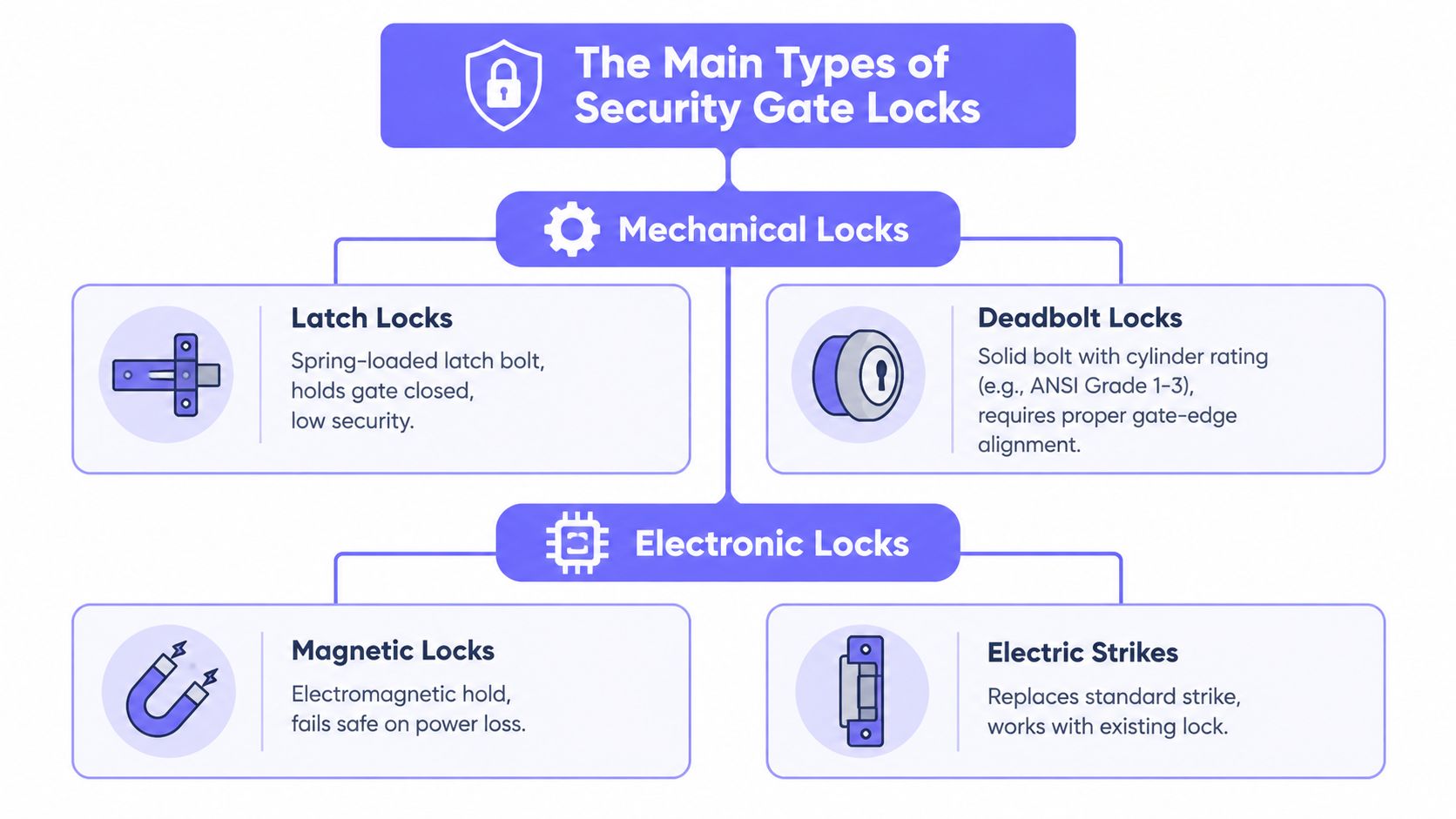
A mechanical latch lock uses a spring-loaded latch bolt to hold the gate closed. It's inexpensive, easy to understand, and suitable where the user population is small and access changes are rare. Its weakness is credential control. A key can be copied, lost, or retained by someone who should no longer enter.
A mechanical deadbolt provides a more substantial physical barrier. The cylinder rating matters, but so does installation. Gate-edge alignment is critical because a sagging or shifting gate can place side pressure on the bolt, making the key difficult to turn or preventing full engagement.
Electromechanical and magnetic locks
An electromechanical lock uses a solenoid to release a latch or deadbolt after receiving a signal from a keypad, card reader, app, or access controller. It can preserve a familiar locking position while adding electronic authorization.
A magnetic lock, commonly called a maglock, holds the gate with a continuous-duty electromagnet. It can provide strong holding force, but it must be designed around power loss and emergency release. The gate lock upgrade overview is useful when evaluating whether an existing gate can accept this approach.
Electric strikes and credential systems
An electric strike replaces or works with a conventional strike plate. The lock body remains mechanically engaged until the strike releases, which often makes it a practical choice for compatible swinging gates and doors.
Keypads accept PINs. Proximity cards and RFID fobs use a reader. Mobile credentials use a smartphone as the authorization device. Each method can open the same gate operator, but each creates a different burden for issuing, revoking, replacing, and auditing credentials.
Cellular and IoT controllers
A cellular or IoT controller acts as an authorization and relay layer over existing equipment. It doesn't necessarily replace the mechanical lock, electric strike, maglock, or gate operator. Instead, it sends the open command through the existing control circuit, which makes cellular retrofit relevant when the gate hardware still works.
Comparing Lock Types on Security, Cost, and Convenience
The best lock isn't the one with the highest holding force. It's the one that provides an appropriate physical barrier while keeping credentials, power behavior, and maintenance manageable.
| Lock Type | Forced-Entry Resistance | Credential Management | Power-Failure Behavior | Typical Installed Cost | Best Fit |
|---|---|---|---|---|---|
| Mechanical latch | Basic to moderate | Keys must be managed manually | Operates without power | Lower | Small properties with stable users |
| Mechanical deadbolt | Moderate to high, depending on grade and installation | Keys must be managed manually | Operates without power | Lower to moderate | Low-volume gates needing physical security |
| Electromechanical lock | Moderate to high | Supports controlled electronic credentials | Depends on lock and release design | Moderate | Retrofit projects with compatible wiring |
| Magnetic lock | High holding force when correctly installed | Works with readers and controllers | Must be designed for fail-safe release | Moderate to high | Commercial or controlled-access locations |
| Electric strike | Moderate | Supports keypad, card, fob, or mobile control | Depends on strike and egress design | Moderate | Compatible swinging gates and doors |
| Keypad system | Depends on the underlying lock | PINs are easy to share and difficult to audit | Depends on power and mechanical override | Moderate | Small user groups with simple access needs |
| Cellular or IoT controller | Depends on connected lock and operator | Per-user credentials, remote revocation, and logs | Depends on existing gate equipment and backup design | Moderate | Remote gates and changing user populations |
Installed cost varies with trenching, power supplies, gate alignment, conduit, operator condition, and local labor. Property managers comparing a broader security project may also find Brisbane wired security system costs useful for understanding how installation complexity affects the budget, even though a gate lock retrofit is a narrower project.
Mechanical locks are the obvious choice when the user list is small and the gate doesn't need an audit trail. They become a poor fit when residents, contractors, and visitors change frequently.
Maglocks are attractive where holding force and controlled release matter, but they're unforgiving of weak power design, poor mounting, and unclear emergency-release procedures. Electric strikes often offer a more retrofit-friendly balance, provided the gate frame and latch geometry support them.
Keypads provide fast entry, but shared codes create accountability gaps. Cellular controllers add the most operational convenience when administrators need remote credentialing and visitor access, although they can't compensate for a failing operator, unsafe gate movement, or a badly aligned lock.
Choosing Locks for Residential, Commercial, and Multifamily Use
Property type changes the decision because the user population, entry volume, and response expectations change with it.
| Property Type | Recommended Lock | Access Method | Key Trade-off |
|---|---|---|---|
| Single-family residence | Magnetic or electromechanical lock | Keypad, remote, or mobile credential | Convenience must be balanced against shared access and tailgating |
| Commercial facility | Heavy-duty magnetic or electromechanical lock | Keypad, card, fob, or cellular controller | Strong control requires sound power, egress, and audit design |
| Multifamily or HOA community | Existing compatible lock with cellular access layer | Per-resident mobile credentials, visitor credentials, or supplementary keypad | Throughput and credential administration matter more than brute force alone |
Single-family gates
A private driveway gate usually has a stable user group. A keypad can be convenient for residents and service providers, while an electromechanical lock or maglock can add controlled release. The owner still needs a plan for contractors, former occupants, deliveries, and guests.
A single shared PIN is easy to administer but difficult to revoke selectively. Mobile credentials or individual codes create better accountability, especially when access events need review after a dispute.
Commercial properties
Warehouses, dealerships, and service yards often need stronger physical hardware, clear user permissions, and a record of activity. Heavy-duty magnetic locks with 1,200 to 1,500 pounds of holding force may suit some commercial applications, but the holding-force specification isn't a substitute for compliant mounting, operator safety, or emergency release.
Facility managers may prefer electronic keypads with audit trails, card or fob readers, and a cellular controller. Remote administration matters when a manager needs to revoke a former employee's access or issue a temporary credential without driving to the gate.
Multifamily and HOA communities
A community gate must process residents, guests, vendors, deliveries, and emergency personnel without turning every access issue into an after-hours phone call. Keypad-only systems and shared PINs create bottlenecks because one credential spreads across a large and changing population.
Per-resident app credentials scale more cleanly because administrators can associate access with a specific person, revoke it when occupancy changes, and provide visitor permissions without handing out permanent codes. The final decision should consider cost per user, credential management overhead, entry throughput, and call volume, not only the lock's physical construction.
Retrofit, Installation, and Compliance Considerations
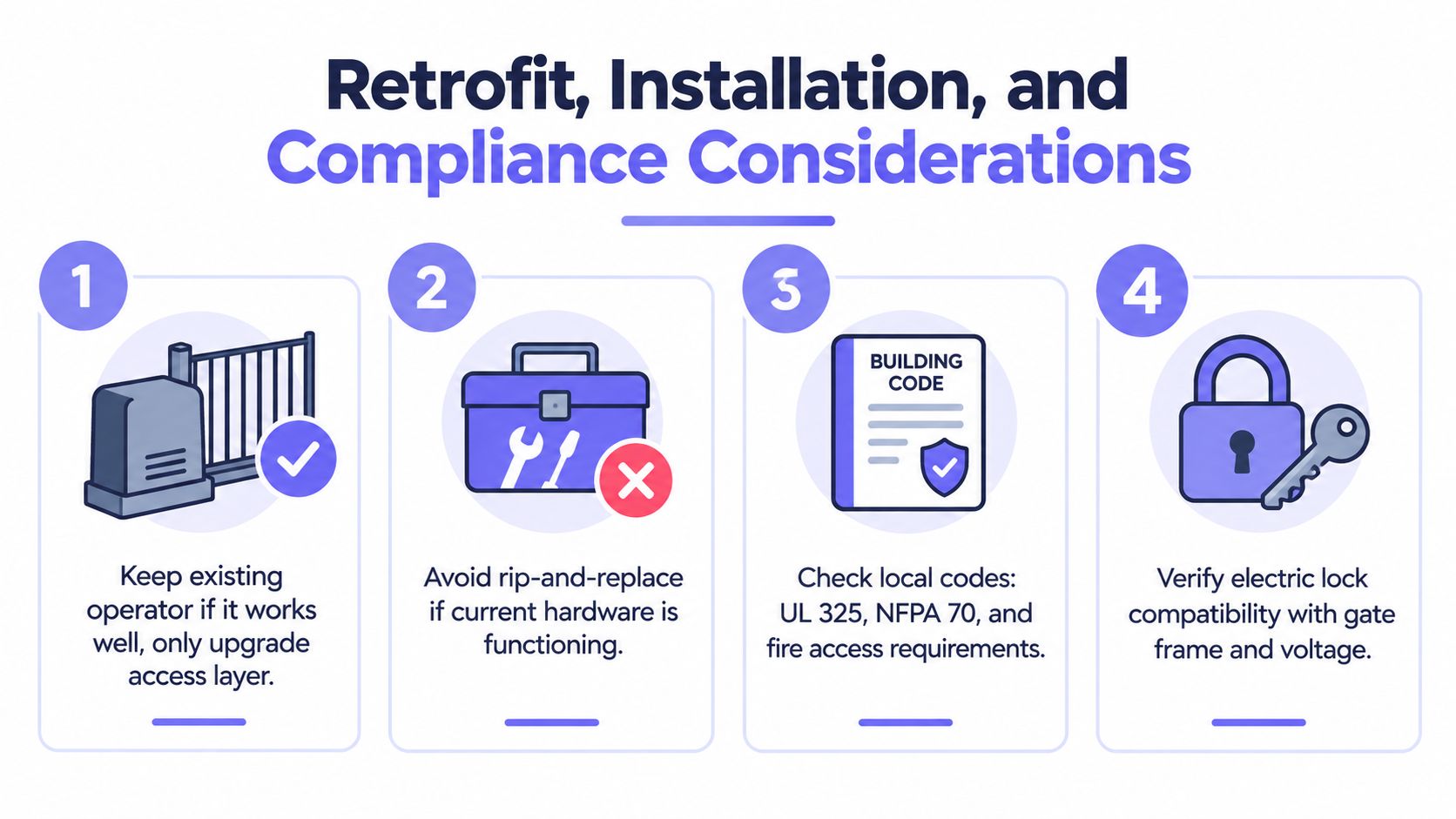
The keep-and-retrofit decision starts with the gate operator, not the sales brochure. If the operator runs reliably and the gate moves safely, upgrading only the keypad, intercom board, reader, or access controller can preserve useful equipment while correcting the access layer.
A full replacement deserves consideration when the operator itself is unreliable, the gate has unsafe movement, the existing power system can't support the lock, or the installation doesn't meet current safety requirements. Replacing a working operator because the access method is outdated often spends money on the wrong component.
Code and standards anchors
Automated vehicular gates in the United States fall under ASTM F2200 for gate design and installation and UL 325 for gate operators. These standards address the gate and operator as a moving system, so a lock specification can't be separated from entrapment protection and safe movement. Gate access-control standards context
Electromagnetic security gate locks are evaluated under performance-based requirements covering cyclical durability, dynamic impact resistance, operational reliability, and static strength. ANSI/BHMA A156.23 is a key North American standard, while UL notes that related access-control systems and locking devices may require listing to UL 294 or UL 1034, depending on the application. ANSI/BHMA A156.23 information
Fail-safe behavior is essential for egress. Electromagnetic locks must release on power loss and generally require a listed release method, such as a sensor or hardware switch, that permits immediate free egress. A gate-adjacent opening also needs an obvious emergency release or fire-department override where local requirements call for it. UL access-control and gate-operator guidance
Installers should also inspect gate sag, hinge wear, latch alignment, cable paths, weather exposure, power supply capacity, backup power, and compatibility between the lock and operator. Guidance for higher-security UK installations also references BS 3621, BS EN 12320 grades 5 or 6, LPS 1175, CPNI approval, and Secured by Design. Security fence and gate material considerations
Most electrified gate retrofits aren't suitable as DIY work. Proper retrofitting legacy gate operators requires low-voltage wiring, relay configuration, safety testing, and verification that the gate still opens, stops, releases, and remains safe under expected failure conditions.
How Cellular Retrofit Controllers Change the Equation
A cellular retrofit controller changes the project from “replace the gate” to “add a controlled access layer.” A device such as Nimbio can wire in parallel with existing equipment and send an open command through the gate operator's control circuit. The approach can work with magnetic locks, electromechanical locks, and traditional electric strikes when the electrical and control interfaces are compatible.
That distinction matters for communities with functioning operators but outdated access methods. The operator continues to handle the gate's movement, while the controller manages mobile authorization and remote commands.
A typical modernization replaces shared PIN dependence with individual app credentials. Administrators can issue or revoke access remotely, create temporary permissions, and review entry activity without collecting physical remotes or manually changing a code for every user.
Modern visitor management can extend beyond opening the gate. Platforms for unmanned gates can manage visitor registration, credentialing, verification, and entry logging, replacing the callbox or paper visitor register with a more complete workflow. Visitor-management workflow context
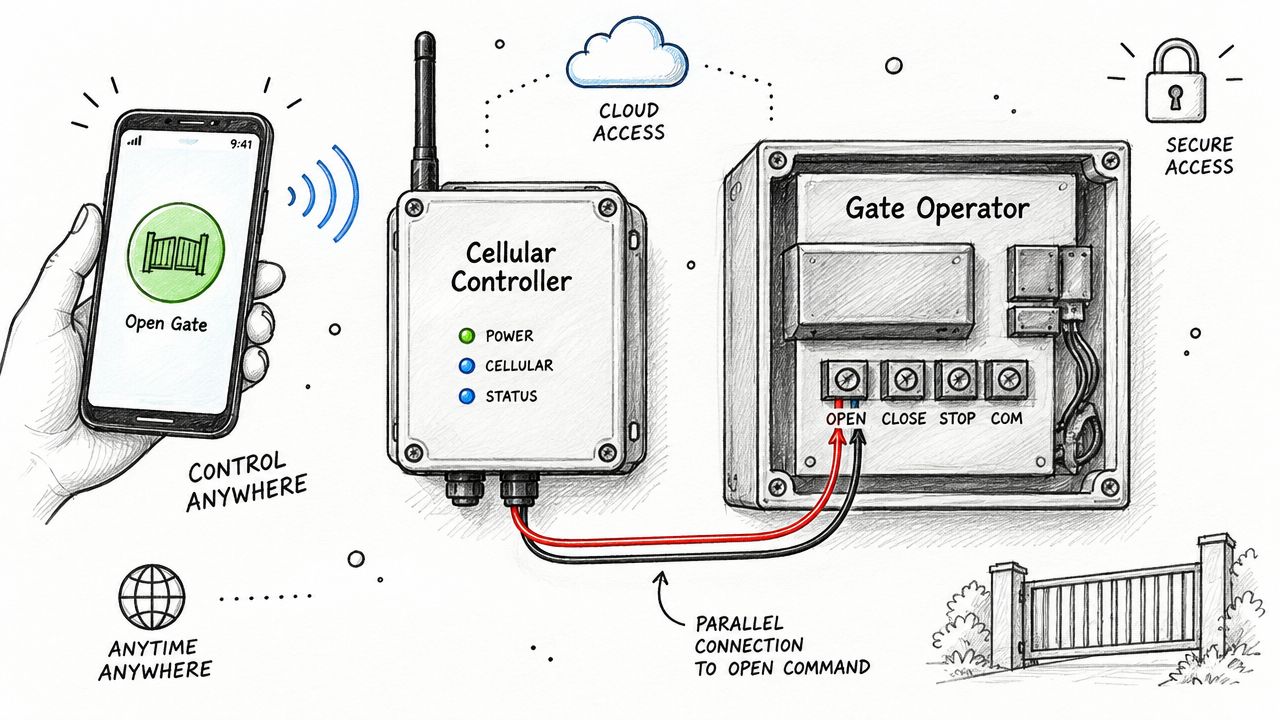
Cellular connectivity also avoids dependence on property Wi-Fi. A cellular retrofit controller can open and monitor gates over an LTE network without relying on Wi-Fi, Bluetooth, or a landline, and it can operate in parallel with existing equipment. Cellular gate retrofit capabilities
The practical concern is network availability. Multi-carrier SIMs and offline credential caching can reduce dependence on a single carrier, while existing wired credentials may remain available as an additional access path. Hold-open schedules can support delivery windows, business hours, or community events without relying on manual overrides.
The technology isn't a cure for unsafe hinges, failed sensors, bad power supplies, or a gate that won't close. It is the middle ground between tolerating shared credentials and replacing every working component. Property managers comparing options should review cellular gate access systems against the existing operator, lock interface, coverage, visitor workflow, and emergency procedures.
Maintenance, Audit Trails, and Long-Term Reliability
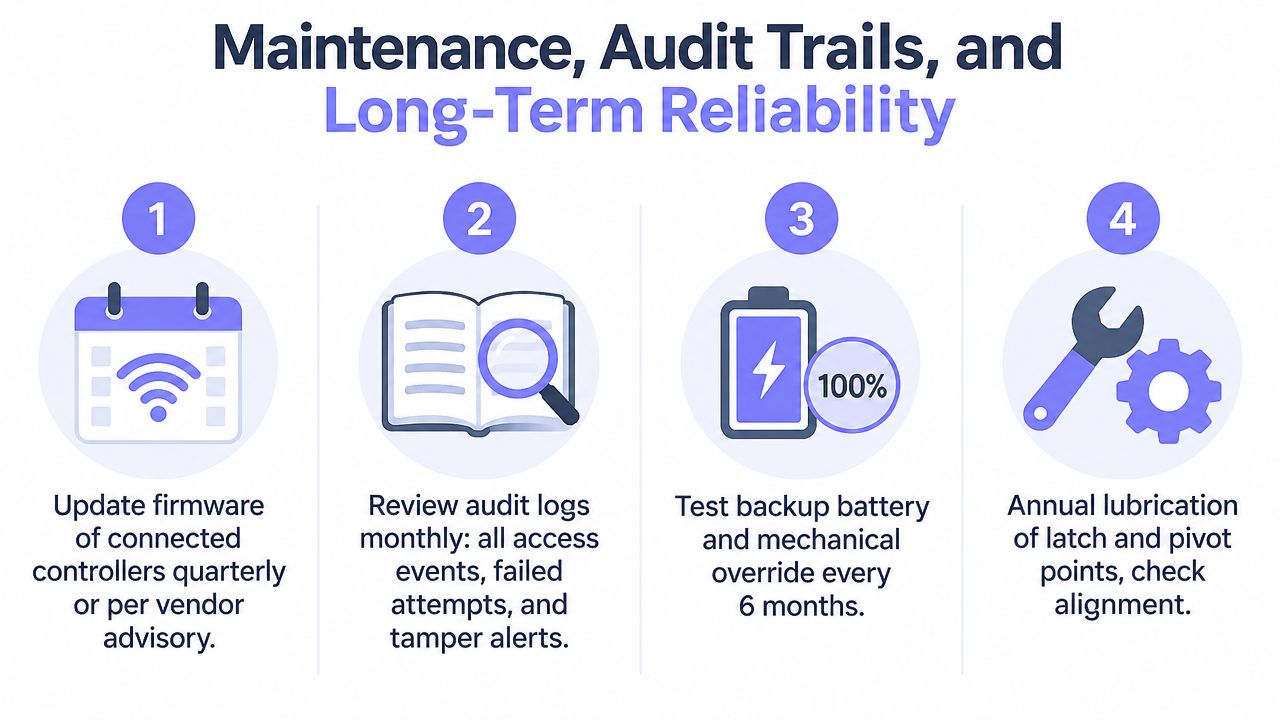
Reliable security gate locks depend on a maintenance routine that covers both electronics and metalwork. Connected controllers need firmware updates according to vendor advisories, and managers should review audit logs regularly for successful entries, failed attempts, and tamper alerts.
A workable schedule separates operational review from physical service:
- Connected systems: Apply firmware updates according to the manufacturer's maintenance guidance and confirm that credentials still behave as intended afterward.
- Audit activity: Commercial managers may review logs daily, while residential communities can use a less frequent routine suited to their risk and staffing.
- Mechanical condition: Lubricate latch bolts and pivot points, tighten sag brackets, and inspect the gate-edge alignment.
- Power resilience: Test backup batteries and emergency releases, then document the result for the property file.
- Access schedules: Use hold-open periods for predictable delivery windows or business hours, and remove schedules that no longer reflect operations.
Wireless keypad batteries deserve attention before they leak or leave residents locked out. Mechanical locks can remain serviceable for a long time, while electronic components and labor arrangements require separate budget planning. Warranty coverage may apply to electronics without covering an installer's service visit, so a property should budget for planned annual inspection rather than waiting for an emergency call.
Reliability comes from small, scheduled checks, not from one heroic installation.
Making the Right Call for Your Property
The decision can be reduced to one diagnostic question: which component is failing?
If the gate is structurally sound, the operator works properly, and complaints focus on lost remotes, shared PINs, temporary guests, or missing audit records, keeping the existing hardware and adding a cellular access layer is usually the sensible path. It addresses the authorization problem without discarding a functioning operator.
If the operator fails, the gate moves unsafely, safety sensors are unreliable, the frame can't support the chosen lock, or the installation doesn't meet applicable UL 325 requirements, replacement may be justified. A property that needs integrated video intercoms, license-plate cameras, and coordinated safety equipment from the outset may also benefit from a broader redesign.
The quick gut-check is straightforward:
- Lock or credential bottleneck: Retrofit the access layer.
- Gate, operator, power, or safety bottleneck: Investigate replacement.
- Unclear failure: Pay for a system assessment before approving hardware.
The right answer depends on the failing component, not on which sales representative arrives first.
Nimbio provides a cellular retrofit layer for compatible electronic gates, locks, callboxes, and building-entry systems, allowing administrators to issue and revoke smartphone credentials, manage visitors, and review access activity without relying on property Wi-Fi. Property managers, HOA boards, and installers can evaluate the existing gate and plan the next upgrade by visiting Nimbio.